Classrooms and community: my moderation standards for Google+, Facebook and blog comments

Over the past few months, I’ve seen a lot of spam and pornography links on Google Plus, on Facebook and on the blogs I maintain. Fortunately, blogs, Google and Facebook both give us the ability to moderate comments and, if we wish, to block other people who do not respect the opinions or character of others.

Last night, I’m seeing a lack of clarity about my approach to online community, so here’s how I think about it, with a nod to the example set by Arizona State University journalism professor Dan Gillmor.

I can and do block spammers and people posting links to pornography.

I will leave comments on on my blogs, precisely because I value conversations, despite the issues that persist online. I have been moderating discussion in online forums and blogs for many years, including those of my publishers. My full thoughts on the value of blog comments — and the social norms that I expect people comments to live within — are on this blog. To date, there are 196 comments on the post.

Vilely insulting me won’t help your case. Insulting others will ruin it. I was a teacher in my twenties. I would not tolerate disrespectful behavior in my classroom, either to me or to other students. If you can’t be civil and continue to insult others, much less the person hosting the forum, you were asked to leave and see the principal.

If the behavior persists, you will lose the privilege of participating in “class.” Eventually, you get expelled. On Google+ or blogs, that takes the form of being defriended, banned or blocked from my public updates. I prefer not to block users but I will do it. I respect your right to speak freely on your own blog, Twitter, Facebook or Google+ account, whether that involves cursing or ignorance.

I strongly believe in the First Amendment. Governments should not censor citizens. That said, I do not, however, feel obligated to host such speech on my own blog, particularly if it is directed towards other commenters. I believe that building and maintaining healthy communities, online of offline, requires that the people hosting them enforce standards for participation that encourage civil dialogue.

I hope that makes sense to friends, readers and colleagues. If not, you are welcome to let me know in the comments.

3 Comments

Filed under blogging, education, social media, technology

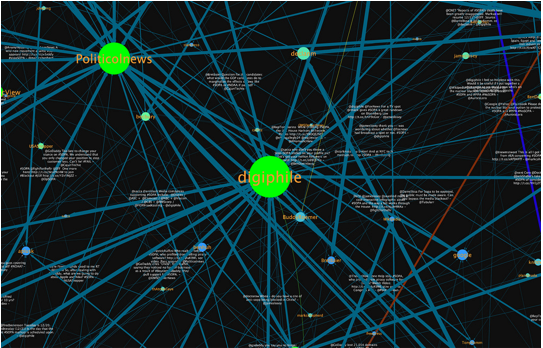
Visualizing conversations on Twitter about #SOPA

Kickstarter data dude Fred Berenson visualized conversations around SOPA on Twitter: View visualization

@digiphile snapshot

His data crunching strongly implies that I’ve been a “supernode” on this story. I’m not surprised, given how closely I’ve been following how the Web is changing Washington — or vice versa.

Leave a comment

Filed under art, article, journalism, microsharing, research, social bookmarking, social media, technology, Twitter

Senator Reid postpones vote on PROTECT IP Act, Romney and Gingrich come out against SOPA

This morning, Senator Harry Reid, the Senate Majority Leader, said in a statement today that he will postpone next week’s vote on the PROTECT IP Act (PIPA). Update: Rep. Lamar Smith followed with a statement that he would also halt consideration of SOPA. This is a historic victory for the Internet community. Collectively, millions of people rose up and told Washington that these bills shall not pass.

An unprecedented day of online protests over the Stop Online Piracy Act (SOPA) in the U.S. House of Representatives and the PIPA in the U.S. Senate and the resulting coverage on cable and broadcast news networks had an effect.

“Senator Reid made the right decision in postponing next week’s vote on PIPA,” said Center for Democracy and Technology president Leslie Harris. “It’s time for a hard reset on this issue. We need a thoughtful and substantive process that includes all Internet stakeholders. We need to take a hard look at the facts and find solutions that honor the Internet’s openness and its unique capacity for innovation and free expression. We are thankful for the efforts of Senator Ron Wyden who from the beginning stood against this bill; his early opposition and leadership gave voice to the important concerns of the Internet community.”

Wikipedia, Google, BoingBoing, Reddit, O’Reilly Media and thousands of other blogs asked their communities to take a stand and contact Washington.

“The amazing thing is that the power of these networks delivered,” wrote David Binetti in TechCrunch. “By the end of the day, 25 Senators — including at least 5 former co-sponsors of the bill — had announced their opposition to SOPA. Think about that for just a second: A well-organized, well-funded, well-connected, well-experienced lobbying effort on Capitol Hill was outflanked by an ad-hoc group of rank amateurs, most of whom were operating independent of one another and on their spare time. Regardless where you stand on the issue — and effective copyright protection is an important issue — this is very good news for the future of civic engagement.”

I concur with that last point. Last night, we finally saw one of the most important questions about the future of the Internet and society asked in a presidential debate: all four GOP candidates for the presidential nomination came out against SOPA at the CNN debate.

As shown by ProPublica’s excellent SOPA Tracker, SOPA and PIPA now have 122 opponents in the House and Senate, four times as many as on Monday.

These bills are not “dead,” no matter what headlines you read today, although I can now say with some confidence that they will not pass in their current form. There are ongoing negotiations to redraft them, cutting DNS filtering provisions or search engine blocks in an effort to make them acceptable to technology companies like Google.

While the Internet mattered this week, it’s important to recognize that but for the efforts of Senator Ron Wyden, Rep. Darrell Issa, Rep. Jason Chaffetz, Rep. Jared Polis and Rep. Zoe Logren, I believe SOPA and PIPA would likely have passed. Senator Wyden put a critical hold on the PROTECT IP Act after it sailed out of the Senate Judiciary Committee. Those representatives proposed dozens of amendments to SOPA in a marathon, days-long markup session that effectively filibustered the bill, delayed it until the House came back into session in January. That delay enabled hundreds of organizations and individuals, including newspaper editors, human rights advocates, academics, engineers and public interest groups, to rally to save the Internet as we know it.

“Supporters of the Internet deserve credit for pressing advocates of SOPA and PIPA to back away from an effort to ram through controversial legislation,” Issa said in an emailed statement. “Over the last two months, the intense popular effort to stop SOPA and PIPA has defeated an effort that once looked unstoppable but lacked a fundamental understanding of how Internet technologies work.

“Postponing the Senate vote on PIPA removes the imminent threat to the Internet, but it’s not over yet. Copyright infringement remains a serious problem and any solution must be targeted, effective, and consistent with how the Internet works. After inviting all stakeholders to help improve American intellectual property protections, I have introduced the bipartisan OPEN Act with Senator Rob Wyden which can be read and commented on at KeepTheWebOPEN.com. It is clear that Congress needs to have more discussion and education about the workings of the Internet before it moves forward on sweeping legislation to address intellectual property theft on the Internet. I look forward to working with my colleagues and stakeholders to achieve a needed consensus about the way forward.”

In the meantime, everyone who participated in this week’s unprecedented day of online action should know that what they did this week mattered. If you’d asked me about the prospects for the passage of these bills back in December — and many people did, after I wrote a feature at Radar in November that highlighted the threat these anti-piracy bills presented to the Internet, security and freedom of expression online — I estimated that it was quite likely. So did Chris Dodd, the head of the MPAA, who told the New York Times that these passage of these bills was “considered by many to be a ‘slam dunk.'”

We’re now in unexplored territory. I’ve been writing about how the Internet affects government and government affects the Internet for years now. This week was clearly a tipping point in that space. The voices of the people, expressed in calls, letters, tweets, petitions and protests, were heard in Washington. There are incredibly difficult challenges that face us as a country and as a global community, from jobs to healthcare to the environment to civil liberties to smoldering wars around the world. What happened this week, however, will reinvigorate the notion that participating in the civic process matters. Here’s to working on stuff that matters, together.

1 Comment

Filed under cyberlaw, government 2.0, social media, technology

On the value of blog comments

paper blogs

"Paper Blogs" by bookwyrmish

Over at GigaOm, Matthew Ingram weighs in on whether blogs should allow comments or not, spurred by a debate between venture capitalist Fred Wilson and Tech Crunch blogger-turned-venture capitalist M.G. Siegler:

MG Siegler, who doesn’t have comments on his blog and has written several posts defending his decision, saying they are 99-percent bile and a waste of his time. On the other side of the debate is fellow VC Fred Wilson, who says Siegler is missing a lot by not allowing comments.

I think Wilson is right — while comments can be a royal pain at times, they are a crucial part of what makes a blog more than just a bully pulpit.

For my part, I respect MG Siegler‘s choice to have a place on the Internet where only he can share his thoughts, whether we call it a blog or not, just as I do that of Seth Godin or John Gruber. If someone wants to comment on a given post, he or she can do so and respond via email, social networks, YouTube or their own blog(s). Or all of the above. There is no shortage of options on the Web of 2012 to share and opinion of something online and link to it. Just the opposite, really. If I want to publicly comment on one of Siegler’s posts, I can do so right here on my blog. Or Facebook. Or Google+. Or  @reply to @parislemon on Twitter, albeit in fewer characters.

From where I sit tonight, whether you choose to have comments or not speaks to whether you want to create an online community, which requires a human’s touch to manage and moderate, or to simply publish your thoughts publicly online, without making the necessary commitment of time and patience.

As is often the case, I agree with Mathew Ingram: blog comments are worth the effort.

He cites two important examples of high functioning people who maintain blogs with excellent comment sections, Anil Dash and Fred Wilson.

Dash and Wilson both spend time reading and responding to comments. For those who have been online for a few years, you know that’s not the case with many other blog authors. In a frank post last year, Dash observed that if your website is full of bad behavior, it’s your fault. He clearly thinks it’s worth it:

“When you engage with a community online in a constructive way, it can be one of the most meaningful experiences of your life. It doesn’t have to be polite, or neat and tidy, or full of everyone agreeing with each other. It just has to not be hateful and destructive.”

It’s worth noting that both men have also put into place architectures for participation that enable them to create better norms for discourse alongside social norms created by community. Dash uses Facebook comments, Wilson Disqus.

Some of the worst comments online still show up on YouTube or unmoderated newspaper comment sections. That’s one reason newspapers have been rethinking anonymous commenters. (Another, of course, is that knowing more about your readers’ demographics matters for online advertising and lead generation.)

It’s on that count that Ingram has extra credibility with me, since he used to be the social media editor at the Globe and Mail in Canada. While Canadians generally have a reputation for being polite, online that can change. Despite years of exposure to the best and worst of humanity on his screen, however, Mathew still supports having them:

“…I still defend comments as a crucial element of what blogging is, and more than that I defend anonymity as well. A blog without comments is a soap-box, plain and simple. Not having comments says you are only interested in passing on your wisdom, without testing it against any external source (at least not where others can watch you do so) or leaving open the opportunity to actually learn something from those who don’t have their own blogs, or aren’t on Twitter or Google+. That may make for a nicer experience for you the blogger, and it may make your blog load faster, but it is still a loss — for you, and for your readers.”

Moderating and responding to comments is a full-time job at high traffic blogs. If you’re a one man outfit, small business or don’t have a full time community manager, that’s going to take time away from research, writing and interviews — and that’s a legitimate problem for a writer, much less an entire news outfit. MG made this point today, commenting on the decision by Macstories to remove all comments:

It’s one thing for a single person site (like this one) to make a call to remove comments. It’s another for a larger team blog to do so. In fact, I can’t think of any without comments.

Right or wrong, the mentality is that to build a next generation media publication on the web, you need comments. That’s why we never got rid of them on TechCrunch (believe me, plenty of us wanted to — Facebook comments were a compromise).

Even more interesting is the psychology behind “needing” comments on big sites. Let’s be honest: most of these sites defend comments because if they don’t, it will seem like they’re taking a shit on their readers. It’s along the lines of “the reader is always right” — even when only half a percent are commenting and the vast majority of those are trolls.

For me, keeping up with email, Google+ and Facebook, @replies on Twitter, txts and IMs frankly can feel a bit exhausting. One of my New Year’s Resolutions for 2012, in fact, is remove communications cruft from my digital life wherever possible, cutting way down on bacn and spam. (Note Bene: I’m not giving up bacon in meatspace.)

That said, I think keeping up that level of engagement is worth it. It’s important to me. I hear from readers that it’s important to them. I plan to continue to publish posts this year that have comments enabled because I believe, as Mathew Ingram does, that they’re worth it, both for me and for other readers. If I ever think that they aren’t, I’ll either turn them off or advocate that we do so — but I’m not expecting a change of heart any time soon.

I’m looking forward to an upgrade at the O’Reilly Radar that should make it much easier for our community to ring in. Given that O’Reilly Media has legions of smart readers, I expect to learn a great deal from them, although I suspect I’ll take my lumps as well if I make mistakes or errors of reasoning. For me, that remains a worthwhile trade.

203 Comments

Filed under blogging, journalism, social media

On Twitter suspensions, spam, censorship and SOPA

Suspended OwlEarlier this afternoon, David Seaman claimed that Twitter suspended his account for tweeting too much about “Occupy Wall Street … and talking too much about the controversial detainment without trial provisions contained in the FY 2012 National Defense Authorization Act (NDAA).”

His account is now back online. Twitter’s official response to him, according to Seaman, was that his account was ‘caught up in one of spam groups by mistake.

Seaman continued to suggest otherwise and implied that Twitter is banning accounts because of their content.

Speaking only for myself, I believe this was completely unrelated to NDAA or OWS and was instead tied to his behavior using a new account. I think what happened today was an auto-suspension of a new account exhibiting behavior associated, not intentional censorship by Twitter. Jillian C. York, the director for international freedom of expression at the Electronic Frontier Foundation, agreed:

I’m writing without an official statement from Twitter but I’d bet that’s what happened. (If I receive such a statement, I’ll post it here.)

UPDATE: Here are the emails Seaman posted to his post, containing Twitter’s responses. They validates my understanding of Twitter’s anti-spam protocols.

At approximately 7:37pm ET, my Twitter account was restored, and I received the following message from Twitter support: “Hello, Twitter has automated systems that find and remove multiple automated spam accounts in bulk. Unfortunately, it looks like your account got caught up in one of these spam groups by mistake. I’ve restored your account; sorry for the inconvenience. Please note that it may take an hour or so for your follower and following numbers to return to normal.” At 8:29pm ET, a second email from Twitter support was received: “Hello, As a clarification, your account was suspended twice; the initial suspension was due to a number of unsolicited duplicate or near-duplicate messages being sent using the @reply and/or mention feature. These features are intended to make communication between people on Twitter easier. Twitter monitors the use of these features to make sure they are used as intended and not for abuse. Using either feature to post messages to a bunch of users in an unsolicited or egregious manner is considered an abuse of its use, which results in an automated account suspension. However, the second suspension after you navigated the self-unsuspension page was due to a known error we are working to fix; our apologies for the re-suspension. Please let me know if you have any questions.”

As far as I know, Twitter accounts aren’t automatically suspended based upon a journalist writing about a controversial issue. You can read the Twitter FAQ on suspensions for their official position. Suspensions are only supposed to happen when a user breaks the Twitter Rules, not because of what they describe or report on. Again, York:

Suspending accounts on Twitter is precedented behavior. What’s less so is a self-identified journalist making a sweeping claim of censorship like this without confirmation, corroboration or analysis of Twitter’s past practices. My account was suspended 2 years ago when @Twitter swept it up on people tweeting on the #g2s hashtag. It was restored the day after wards, along with other people tweeting from the IP address.

I doubt Seaman’s contention that this suspension was related to content. I think it was a mistaken outcome based upon interactions. New accounts are more likely to be flagged automatically as @spam. What happened wasn’t about any one tweet: it’s came through nine tweets in a row of nearly duplicate content to non-followers from a new account. Specifically, “How #Occupy and the #TeaParty could end their struggle tonight: http://read.bi/vL02ZI #NDAA #SOPA #OWS”

Bottom line: Seaman made a sensational claim that probably shouldn’t have been made without more legwork and a statement from Twitter. He used Business Insider’s platform to bring attention to a mistake. It may have brought Business Insider a lot of traffic today but I think, on balance, that Seaman damaged his credibility today.

That’s unfortunate, given that the episode could have been leveraged to make an important point about how governments might work with private social media platforms to remove content that they do not wish to see published.

On that count, learn more about the Stop Online Piracy Act at Radar.

Update: Conor Adams Stevens picked up the Business Insider post and wrote a largely uncritical op-ed at International Business Times that repeated the claim that “NDAA, SOPA, Occupy Wall Street and Anonymous may be off-limits on Twitter.” (If that were true, I wouldn’t have been able to tweet for quite a few months now.)

Update: Nick Judd picked up the story at techPresident, adding some context to the latest episode of Twitter denying another censorship accusation. Judd observes that Deamon’s post “appears to be flat out wrong”:

Seaman still seems to think that some occult hand is at work against opponents of NDAA, questioning the veracity of Twitter’s response to him. This makes no sense, given that NDAA has generated at least 117,000 tweets in the last seven days. None of those have been swept under the digital rug.

There’s also a conspiracy theory floating around about why Twitter has not listed NDAA as a trending topic. Mat Honan bursts that bubble in a post from last week for Gizmodo, which is actually focused on a hashtag memorializing the late Christopher Hitchens. Its title is succinct: “Shutup, Twitter Isn’t Censoring Your Dumb Trends.”

Image Credit: Steve Garfield

13 Comments

Filed under blogging, journalism, social media, technology, Twitter

Stop Online Piracy Act up for markup in the U.S. House of Representatives

Today in Washington, I’m following a hearing in the United States House of Representatives where the Manager’s Amendment of the Stop Online Piracy Act (SOPA) is being marked up. For those unfamiliar, “markup” refers to the process by which a U.S. congressional committee or state legislative session debates, amends, and rewrites proposed legislation.

If the bill is going to be changed before it heads to the House floor, this is the time. There are many further amendments to SOPA proposed by Rep. Zoe Lofgren, Rep. Darrell Issa, Rep. Jared Polis and Rep. Jason Chaffetz, as Michael Masnick has listed at Techdirt.

There are two options to watch the hearing online: the U.S. House stream and Rep. Issa’s “Keep the Web Open” site. Here’s my backgrounder on SOPA, if you haven’t been following this bill, “Congress considers anti-piracy bills that could cripple Internet industries.”

During the hearing, Representative Lofgren asked that the bill be read into the Congressional record and raised issues with how the legislation has been moved forward.

There’s a new op-ed today by DNS engineers on SOPA versus network architecture. The New York Times also ran an article  on the lay of the land with a couple of questionable lines, calling one side of the debate the “Internet world.

The author of the New York Times article, Edward Wyatt, didn’t mention that newspaper journalists have now come out against SOPA as well. The Washington Post linked to Dan Gillmor’s Google+ page, where Dan observes that “finally, journalists see the threat from SOPA and ProtectIP: the American Society of News Editors…has asked Congress to stop this runaway train.”  I talked with the Knight Digital Media Center about how SOPA could chill innovation at news startups.

Sergey Brin also weighed in on SOPA last night on his Google+ account.

“In just two decades, the world wide web has transformed and democratized access to information all around the world. I am proud of the role Google has played alongside many others such as Yahoo, Wikipedia, and Twitter. Whether you are a student in an internet cafe in the developing world or a head of state of a wealthy nation, the knowledge of the world is at your fingertips.

Of course, offering these services has come with its challenges. Multiple countries have sought to suppress the flow of information to serve their own political goals. At various times notable Google websites have been blocked in China, Iran, Libya (prior to their revolution), Tunisia (also prior to revolution), and others. For our own websites and for the internet as a whole we have worked tirelessly to combat internet censorship around the world alongside governments and NGO promoting free speech.

Thus, imagine my astonishment when the newest threat to free speech has come from none other but the United States. Two bills currently making their way through congress — SOPA and PIPA — give the US government and copyright holders extraordinary powers including the ability to hijack DNS and censor search results (and this is even without so much as a proper court trial). While I support their goal of reducing copyright infringement (which I don’t believe these acts would accomplish), I am shocked that our lawmakers would contemplate such measures that would put us on a par with the most oppressive nations in the world. This is why I signed on to the following open letter with many other founders – http://dq99alanzv66m.cloudfront.net/sopa/img/12-14-letter.pdf See also: http://americancensorship.org/ and http://engineadvocacy.org/

More to come as the markup goes forward. With more than 50 amendments proposed, this could continue on into Friday.

Leave a comment

Filed under Uncategorized

What open source can teach open journalism

Faced with continuing disruptions to the way that information is collected, shared and published, foundations, academics and media companies are all looking for better answers about the future of news. One rich source of ideas that some would tap lie in the history and culture open source software.

This evening at the National Press Club in Washington, D.C., two

Melanie Sill, journalism executive in residence at USC’s Annenberg School for Communications and Journalism, talked about her new paper about “open journalism. Following Sill, George Washington University professor Nicki Usher talked about she envisages that relationship of open source software and culture to this idea of open journalism. Notably, the principles that both aspired to for open journalism in a networked society have much in common with those expressed in the open government movement.

According to Sill, “open journalism” is:

Transparent
Who are we? what do we do? How can you check our work?

Responsive
That means that sites include options to comments or requests to follow: do you reply? What value do you show you place in the time or opinion of the reader?

Accountable
If readers try to find who’s in charge, how to report an error, or how to give a tip to a media outlet, how easy is it to do?

Participatory
Amongst journalists, sources, contributors. in open journalism, participation is part of what they do, not an add-on. Participatory journalism is part of the working day. It’s not relegated to a ‘user-generated content’ area bolted on to another part of the site.

Networked
Open journalism links out. It establishes journalists as active participants in a universe of information sharing.

Sill says that media organizations need to break old way of one-way patterns. Social media offers new opportunities and changes expectations of journalists. People need simple ways — better reader interfaces – to contribute to the work of journalists, quoting Jay Rosen, a process that she said will improve the quality of the work.

Sill asserted that increasing understanding of what it takes to create quality journalism can build public support for it. She also sees promise in ‘digital first’ newsrooms, examples of which she cited in her reports.

We have to go beyond simply implementing new production routines, suggested Sill, building ideas of relationship and connection into the process of newsgathering, thereby becoming less insular and more outwardly focused.

How open source relates to open journalism

Usher gives shoutouts to HacksHackers, Newsfoo, Knight, Google, Mozilla and other organizations experimenting with open source software, including several of the winners of the Knight News Challenge and the growing ‘newsroom stack.

News is suddenly an interesting ‘problem space’ to hackers, says Usher. One of the things that open source begins with is “scratching an itch.” There are misconceptions — that open source has has to be noncommercial or without leadership. Open source is not just about code or hackers, says Usher. It’s about ideas and culture. Usher organizes her metaphor around 4 elements:

Transparency – bug tracking is a lot like fact checking, in this sense. Usher suggests thinking of hackers not as criminals but thinking differently about them as people as obsessed with sharing information. In the larger sense, sharing info for great good. Usher thinks it would be helpful for people to see stories as reported, as a way of transparency leads to loyalty.

Tinkering – Usher suggests privileging play & experimentation, process vs product, embracing playfulness, remixing, experimenting, doing good. Journalism could do with a little more tinkering and less “complete reinvention.”

Iteration – there’s a spirit of continual release in open source and technology, says Usher. Think of journalism as iteration, she says. She’s heard the tropes heard again and again: idea that journalism needs to be a lot more like Silicon Valley. The reason we hear that is that in Silicon Valley, companies are allowed to fail. That’s part of the culture there: it’s OK in journalism too, says Usher. Newsrooms have been for a long time afraid of failure. Instead of “reinventing the newsroom,” take small pieces at a time and reorient workflow.

Participation – for open source projects to succeed, they need to get as many people involved as possible. Usher suggests thinking of journalism in the ethic of participation. Instead of opening up journalism as just a service, she says we need to make people part of the process. Open source brings people together in a way that distributes their intelligence, so that they can construct collaborative frameworks.

When you’re participating, have to feel like what you’re participating counts. Open source platforms fail without participation, Usher says. The same is true of open journalism.

6 Comments

Filed under article, journalism, technology

Make Washington more awesome through microphilanthropy

My friend Jennifer 8. Lee was on NPR’s Marketplace tonight, talking about microphilanthropy at Awesome Foundation. You can listen to her segment on “giving awesomely” over at Marketplace.org,

Full disclosure: I’m a trustee here in DC. We’ve given a lot of great grants over the past year. Just this past month, $1000 went to support CodeNow, a new “startup nonprofit” that focused on closing the digital divide by teaching disadvantaged kids to code. The White House is impressed withCode Now’s work in this area, too.

You can see other awesome ideas in DC that inspired us at the Awesome Foundation blog.

If you have more ideas that would make the Washington area more awesome and think you can make it happen, please apply. We’re all ears.

1 Comment

Filed under art, friends, microsharing, personal

My Poynter Institute presentation on open data journalism

This week, I’m down in Florida at the Poynter Institute as a “visiting faculty member,” talking about social media and politics. My first presentation, embedded below, was on the promise of open data journalism.

Leave a comment

Filed under journalism, technology

On online trust, reputation, satire and misquotation on Twitter and beyond

The issue of online trust deeply resonates with me. People can and do lose jobs or opportunities because of social media. I do not find intentional misquotes of someone, particularly any journalist or government official, funny. It’s happened a couple of times to me recently, so I thought I’d offer some personal reflections on why I asked those who did so not to change my updates or to substitute words I never used.

Andy Carvin talks with Jeff Jarvis

Andy Carvin talks with Jeff Jarvis at the 2011 SXSWi Twitter Retreat

1) The size of someone’s following is irrelevant. One tweet to 100 can easily be picked up globally. Context that one person has is also irrelevant to the choice, because the update can be quickly shorn of its origin.

2) I’ve heard that I shouldn’t ask others not to intentionally misquote me because it will “hurt public engagement” or diminish the interest of others in amplifying my signal. I accept that it could affect “engagement” with those I challenge. I prefer to correct the record, especially while history’s rough draft is still being written, to protect my reputation against a misinterpretation of something I never said than that abstraction.

3) With respect to tone, I don’t believe that asking someone politely, directly, to please retract or correct a update is unduly “harsh.” Similarly, I don’t think that objecting to someone else changing my words without indicating that alteration is insulting. In either case, I can also choose to share my request more broadly with an entire audience or use stronger language, though neither is my first or second recourse.

4) Whenever I have asked others to respect the integrity of my writing, whether it’s in 140 characters or 140 paragraphs, I stand by that choice. I’ve been making it for many years and will continue to do so. I’ve reviewed those decisions against the advice of journalism professors and open government advocates and am now in a relatively good position to make a judgment myself, often in a short period of time. It’s quite straightforward to natively RT someone without changing any text, or to share words on Facebook, Tumblr or Twitter.

5) I don’t see my presences here, on Facebook or Twitter as simply “personal accounts,” as I use them all professionally. I don’t see them as 100% professional, either, since my words any of them do not represent the official views of my employer unless they are shared on corporate accounts. My own accounts also travel with me between positions. Certainly, updates sent to family and friends via circles or closed groups are at least expected to be treated differently, though there’s no guarantor of it, aside from trust in the recipients. Over time, some number of people have chosen to regard me as a trusted source in those contexts. That’s a series of relationships that I’ve built carefully on several platforms over many years, with a great deal of time and attention built to accuracy and focus upon what matters.

6) With respect to scope, If anyone thinks his or her own “personal account” couldn’t inadvertently do damage to that reputation with a joke that went viral, I believe that they are very much mistaken. Here’s a Twitter-specific reference: The decision to place different weight on tweets @attributed to me is based on my history, reputation and trust, along with years of accumulated algorithmic authority. When someone tweets “RT @user: quote,” it indicates to everyone who reads it that the named @user wrote the tweet. To date, I haven’t seen those kinds of issues on Google Plus. Regardless, if someone keeps doing that after being asked politely to stop, the next step is to expose them and then, failing changed behavior, block them.

7) Satire is absolutely approved on social networks, including satiric impersonation. (Ask Rahm Emanuel!). If someone sends out a satirical tweet, update or ‘plus’ that “quotes” me, another writer or a public figure with a goofy picture, it wouldn’t be out of tune with what the Borowitz Report or @MayorEmanuel do. That’s fair game, like SNL skits. Updates that imply actual words (like RT @user”fake quote”) are not, at least in my book.

Are fake updates “allowed?” Governments, corporations, and all kinds of other agents put them up. I think we’ll see more of it. Someone can lie or obfuscate of they want — I think it’s increasingly difficult to do so, though it will continue to happen, particularly in conflict zones. The role of editors and journalists on these networks — and open government advocates or technologist — is to sift the truth from the fiction.

8 ) With respect to whether social media is used differently by journalists, whether different rules apply or whether there are “formal rules” applied to it, I’ve seen enough policies emerge to know that the same standards that apply to those employed by media organizations that distribute journalism on television, public radio or print magazines.

I’ve seen a lot of thought given to the issue of trust and its relationship to media using social networks, particularly by big journalism institutions and those that work for them. This isn’t about rhetoric: it’s about created trusted relationships online over time, where authority and truth aren’t simply stamped by a masthead by given by networks of friends, followers, colleagues and networks. The idea that you don’t need a reputation to succeed, at least as a writer of non-fiction, strikes me as patently false. Trust and reputation is why your pitch is accepted, why you are hired or retained, followed or unfollowed, feted or fired.

When journalists really get things wrong, they can lose trust, reputation and, in some cases, their jobs. And yes, that can include satire gone wrong. My point tonight was to recognize that the professional and the personal have crossed over on these networks.

What I say or what is incorrectly said on my behalf can and does have significant offline effects. In other words, it’s more than a personal problem, and it’s one that you can expect me to defend against now and in the future.

Leave a comment

Filed under blogging, journalism, social bookmarking, social media, technology, Twitter