Category Archives: Twitter

Collecting stories

On his personal blog, New York Times technology journalist Nick Bilton mused about “collecting air” in his travels around the globe. He closes his post with this thought, drawn from a recent conversation on a flight:

The man looked at me and asked, “Do you collect anything?”

At first I didn’t know how to respond, I hadn’t thought about it in some time. And then I instinctively told him that I actually collect stories —about people, or events, or places, or companies, or moments in time. That I collect these stories and keep them as words and photos.

I looked out of the plane window for a while as we zipped above the clouds at 35,000 feet, and then I looked back at the man and said, “I guess you could say I collect air.”

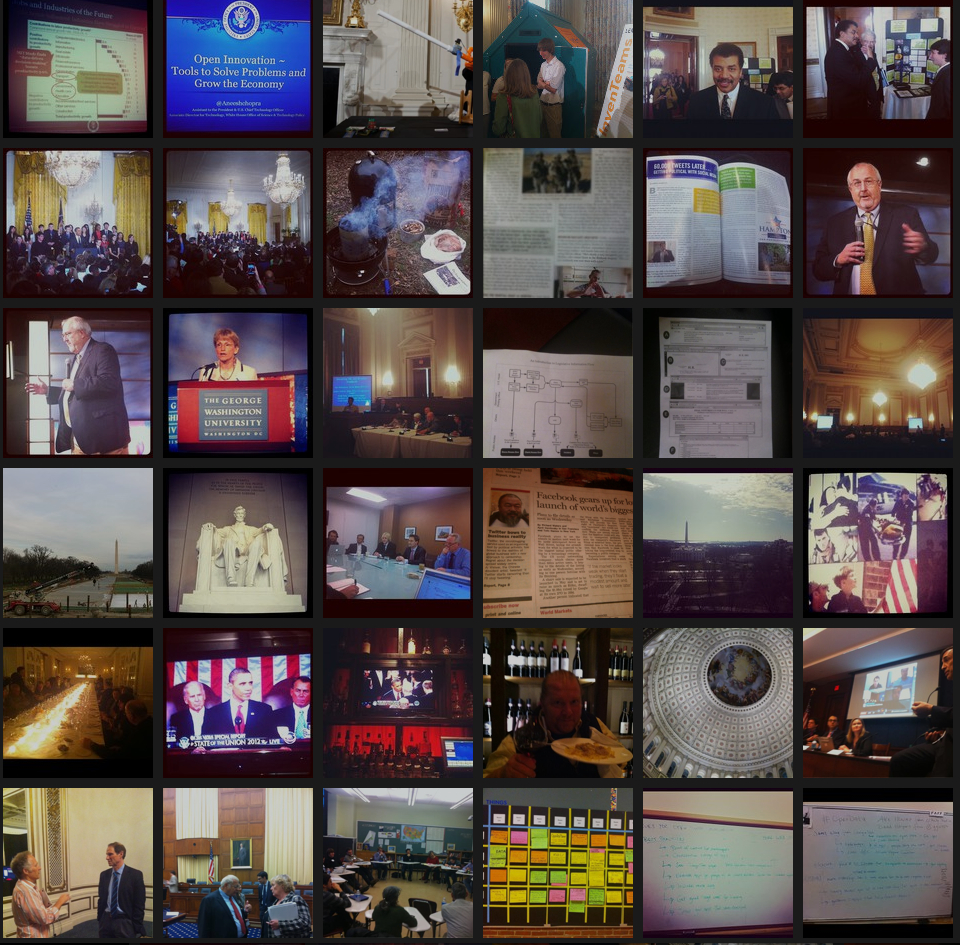
I felt the same instinct over the holidays, when asked to describe what I do or what a day in my life is like now. The photostream I’ve shared to Twitter or Tumblr over the past two weeks offers vignettes of a mobile life:

public Instagram photostream shared to Twitter

My Instagram photostream on Twitter

Those windows on my worlds, reflected as they are in a growing multitude of glowing screens, are a collection that I value much in the same way that a philatelist or numismatist in a previous generation might adore her stamps or her coins. I hope that some of the stories they represent are at least as enduring.

2 Comments

Filed under art, blogging, journalism, microsharing, personal, photography, social media, technology, Twitter

New Sky News social media policy would cripple journalists working on the real-time Web of 2012

Another month, another firestorm over a poorly thought out social media policy from a massive media company. This time, it’s Sky News that’s made a misstep.

I think Reuters social media editor Anthony De Rosa is spot on in his assessment of assessment of the failings of the new social media policy advanced by Sky News: it’s longing for a return to the Victorian Internet

Cory Bergman nailed why it’s OK for journalists to be human on Twitter and Mathew Ingram, as usual, offered his usual common sense analysis of what makes sense, in context. (

Where I think Anthony knocks it out of the park, however, is with respect to the professional rationale for retweeting other accounts: “The idea here at Reuters when it comes to social media is to be the beacon for all news, which makes us the go-to source, no matter what the source may be, after being put through our own filters of verification.”

Just so.

If you’re on a beat, you want to be THE source for news on it. Generally, that means you’ll get beaten on being first to a story. No worries: RT them, then blog it, and link in articles. Over time, people (and algorithms) will value you for that work.

Any entity that distributes content online — whether they’re in the media, government, academia, nonprofit or other organizations, needs to be thinking about search engine optimization (SEO) and social media optimization (SMO) in 2012. Any policies that force journalists into internal silos will eviscerate that capability.

A RT is social media currency. Instructing journalists not to give them out where deserved is like sending them into a conflict or disaster zone with no funds for a fixer, fuel or food. It’s not just bad form. It’s bad business.

1 Comment

Filed under blogging, journalism, microsharing, social media, Twitter

Begun the Drone Wars, have they [VIDEO]

“Luke, you must use the Forge…”

The video above shows a series of experiments performed with a team of “nano quadrotors” at the GRASP Lab in the University of Pennsylvania. These wee vehicles were developed by KMel Robotics.

1 Comment

Filed under scifi, social media, technology, Twitter, video

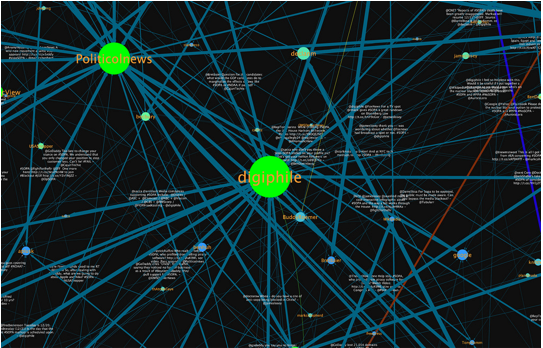
Visualizing conversations on Twitter about #SOPA

Kickstarter data dude Fred Berenson visualized conversations around SOPA on Twitter: View visualization

@digiphile snapshot

His data crunching strongly implies that I’ve been a “supernode” on this story. I’m not surprised, given how closely I’ve been following how the Web is changing Washington — or vice versa.

Leave a comment

Filed under art, article, journalism, microsharing, research, social bookmarking, social media, technology, Twitter

On Twitter suspensions, spam, censorship and SOPA

Suspended OwlEarlier this afternoon, David Seaman claimed that Twitter suspended his account for tweeting too much about “Occupy Wall Street … and talking too much about the controversial detainment without trial provisions contained in the FY 2012 National Defense Authorization Act (NDAA).”

His account is now back online. Twitter’s official response to him, according to Seaman, was that his account was ‘caught up in one of spam groups by mistake.

Seaman continued to suggest otherwise and implied that Twitter is banning accounts because of their content.

Speaking only for myself, I believe this was completely unrelated to NDAA or OWS and was instead tied to his behavior using a new account. I think what happened today was an auto-suspension of a new account exhibiting behavior associated, not intentional censorship by Twitter. Jillian C. York, the director for international freedom of expression at the Electronic Frontier Foundation, agreed:

I’m writing without an official statement from Twitter but I’d bet that’s what happened. (If I receive such a statement, I’ll post it here.)

UPDATE: Here are the emails Seaman posted to his post, containing Twitter’s responses. They validates my understanding of Twitter’s anti-spam protocols.

At approximately 7:37pm ET, my Twitter account was restored, and I received the following message from Twitter support: “Hello, Twitter has automated systems that find and remove multiple automated spam accounts in bulk. Unfortunately, it looks like your account got caught up in one of these spam groups by mistake. I’ve restored your account; sorry for the inconvenience. Please note that it may take an hour or so for your follower and following numbers to return to normal.” At 8:29pm ET, a second email from Twitter support was received: “Hello, As a clarification, your account was suspended twice; the initial suspension was due to a number of unsolicited duplicate or near-duplicate messages being sent using the @reply and/or mention feature. These features are intended to make communication between people on Twitter easier. Twitter monitors the use of these features to make sure they are used as intended and not for abuse. Using either feature to post messages to a bunch of users in an unsolicited or egregious manner is considered an abuse of its use, which results in an automated account suspension. However, the second suspension after you navigated the self-unsuspension page was due to a known error we are working to fix; our apologies for the re-suspension. Please let me know if you have any questions.”

As far as I know, Twitter accounts aren’t automatically suspended based upon a journalist writing about a controversial issue. You can read the Twitter FAQ on suspensions for their official position. Suspensions are only supposed to happen when a user breaks the Twitter Rules, not because of what they describe or report on. Again, York:

Suspending accounts on Twitter is precedented behavior. What’s less so is a self-identified journalist making a sweeping claim of censorship like this without confirmation, corroboration or analysis of Twitter’s past practices. My account was suspended 2 years ago when @Twitter swept it up on people tweeting on the #g2s hashtag. It was restored the day after wards, along with other people tweeting from the IP address.

I doubt Seaman’s contention that this suspension was related to content. I think it was a mistaken outcome based upon interactions. New accounts are more likely to be flagged automatically as @spam. What happened wasn’t about any one tweet: it’s came through nine tweets in a row of nearly duplicate content to non-followers from a new account. Specifically, “How #Occupy and the #TeaParty could end their struggle tonight: http://read.bi/vL02ZI #NDAA #SOPA #OWS”

Bottom line: Seaman made a sensational claim that probably shouldn’t have been made without more legwork and a statement from Twitter. He used Business Insider’s platform to bring attention to a mistake. It may have brought Business Insider a lot of traffic today but I think, on balance, that Seaman damaged his credibility today.

That’s unfortunate, given that the episode could have been leveraged to make an important point about how governments might work with private social media platforms to remove content that they do not wish to see published.

On that count, learn more about the Stop Online Piracy Act at Radar.

Update: Conor Adams Stevens picked up the Business Insider post and wrote a largely uncritical op-ed at International Business Times that repeated the claim that “NDAA, SOPA, Occupy Wall Street and Anonymous may be off-limits on Twitter.” (If that were true, I wouldn’t have been able to tweet for quite a few months now.)

Update: Nick Judd picked up the story at techPresident, adding some context to the latest episode of Twitter denying another censorship accusation. Judd observes that Deamon’s post “appears to be flat out wrong”:

Seaman still seems to think that some occult hand is at work against opponents of NDAA, questioning the veracity of Twitter’s response to him. This makes no sense, given that NDAA has generated at least 117,000 tweets in the last seven days. None of those have been swept under the digital rug.

There’s also a conspiracy theory floating around about why Twitter has not listed NDAA as a trending topic. Mat Honan bursts that bubble in a post from last week for Gizmodo, which is actually focused on a hashtag memorializing the late Christopher Hitchens. Its title is succinct: “Shutup, Twitter Isn’t Censoring Your Dumb Trends.”

Image Credit: Steve Garfield

13 Comments

Filed under blogging, journalism, social media, technology, Twitter

On online trust, reputation, satire and misquotation on Twitter and beyond

The issue of online trust deeply resonates with me. People can and do lose jobs or opportunities because of social media. I do not find intentional misquotes of someone, particularly any journalist or government official, funny. It’s happened a couple of times to me recently, so I thought I’d offer some personal reflections on why I asked those who did so not to change my updates or to substitute words I never used.
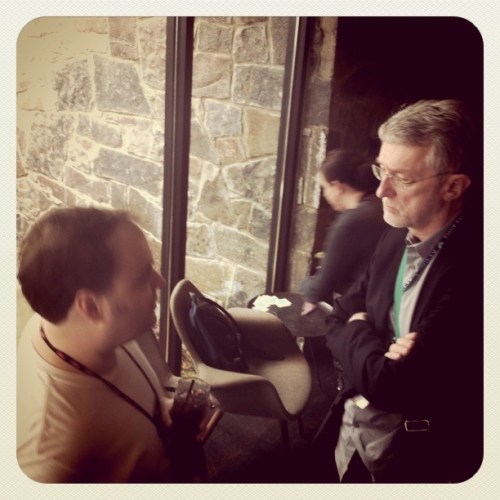
Andy Carvin talks with Jeff Jarvis

Andy Carvin talks with Jeff Jarvis at the 2011 SXSWi Twitter Retreat

1) The size of someone’s following is irrelevant. One tweet to 100 can easily be picked up globally. Context that one person has is also irrelevant to the choice, because the update can be quickly shorn of its origin.

2) I’ve heard that I shouldn’t ask others not to intentionally misquote me because it will “hurt public engagement” or diminish the interest of others in amplifying my signal. I accept that it could affect “engagement” with those I challenge. I prefer to correct the record, especially while history’s rough draft is still being written, to protect my reputation against a misinterpretation of something I never said than that abstraction.

3) With respect to tone, I don’t believe that asking someone politely, directly, to please retract or correct a update is unduly “harsh.” Similarly, I don’t think that objecting to someone else changing my words without indicating that alteration is insulting. In either case, I can also choose to share my request more broadly with an entire audience or use stronger language, though neither is my first or second recourse.

4) Whenever I have asked others to respect the integrity of my writing, whether it’s in 140 characters or 140 paragraphs, I stand by that choice. I’ve been making it for many years and will continue to do so. I’ve reviewed those decisions against the advice of journalism professors and open government advocates and am now in a relatively good position to make a judgment myself, often in a short period of time. It’s quite straightforward to natively RT someone without changing any text, or to share words on Facebook, Tumblr or Twitter.

5) I don’t see my presences here, on Facebook or Twitter as simply “personal accounts,” as I use them all professionally. I don’t see them as 100% professional, either, since my words any of them do not represent the official views of my employer unless they are shared on corporate accounts. My own accounts also travel with me between positions. Certainly, updates sent to family and friends via circles or closed groups are at least expected to be treated differently, though there’s no guarantor of it, aside from trust in the recipients. Over time, some number of people have chosen to regard me as a trusted source in those contexts. That’s a series of relationships that I’ve built carefully on several platforms over many years, with a great deal of time and attention built to accuracy and focus upon what matters.

6) With respect to scope, If anyone thinks his or her own “personal account” couldn’t inadvertently do damage to that reputation with a joke that went viral, I believe that they are very much mistaken. Here’s a Twitter-specific reference: The decision to place different weight on tweets @attributed to me is based on my history, reputation and trust, along with years of accumulated algorithmic authority. When someone tweets “RT @user: quote,” it indicates to everyone who reads it that the named @user wrote the tweet. To date, I haven’t seen those kinds of issues on Google Plus. Regardless, if someone keeps doing that after being asked politely to stop, the next step is to expose them and then, failing changed behavior, block them.

7) Satire is absolutely approved on social networks, including satiric impersonation. (Ask Rahm Emanuel!). If someone sends out a satirical tweet, update or ‘plus’ that “quotes” me, another writer or a public figure with a goofy picture, it wouldn’t be out of tune with what the Borowitz Report or @MayorEmanuel do. That’s fair game, like SNL skits. Updates that imply actual words (like RT @user”fake quote”) are not, at least in my book.

Are fake updates “allowed?” Governments, corporations, and all kinds of other agents put them up. I think we’ll see more of it. Someone can lie or obfuscate of they want — I think it’s increasingly difficult to do so, though it will continue to happen, particularly in conflict zones. The role of editors and journalists on these networks — and open government advocates or technologist — is to sift the truth from the fiction.

8 ) With respect to whether social media is used differently by journalists, whether different rules apply or whether there are “formal rules” applied to it, I’ve seen enough policies emerge to know that the same standards that apply to those employed by media organizations that distribute journalism on television, public radio or print magazines.

I’ve seen a lot of thought given to the issue of trust and its relationship to media using social networks, particularly by big journalism institutions and those that work for them. This isn’t about rhetoric: it’s about created trusted relationships online over time, where authority and truth aren’t simply stamped by a masthead by given by networks of friends, followers, colleagues and networks. The idea that you don’t need a reputation to succeed, at least as a writer of non-fiction, strikes me as patently false. Trust and reputation is why your pitch is accepted, why you are hired or retained, followed or unfollowed, feted or fired.

When journalists really get things wrong, they can lose trust, reputation and, in some cases, their jobs. And yes, that can include satire gone wrong. My point tonight was to recognize that the professional and the personal have crossed over on these networks.

What I say or what is incorrectly said on my behalf can and does have significant offline effects. In other words, it’s more than a personal problem, and it’s one that you can expect me to defend against now and in the future.

Leave a comment

Filed under blogging, journalism, social bookmarking, social media, technology, Twitter

New digital journalism tools and platforms to connect, present and inspire

“It doesn’t have to be like this,” said Alexis Madrigal. “You don’t have to write bad stuff to get people to come to a website”
Tonight at the August meeting of the Online News Association in D.C., +Madrigal shared several of the tools that he’s been experimenting with to connect with his audience and rethink the way he shares information in his work as senior editor at the Atlantic Monthly.

You can find his digital journalism at www.theatlantic.com/alexis-madrigal and on Twitter at @alexismadrigal.

I’ve been reading his book on green energy, “Powering the Dream,” over the past few months. It’s excellent. Alexis also co-founded longshot magazine and wrote for Wired for years.

Given that context, when he talks about the digital tools that he’s using for work and the new applications or platforms that he’s experimenting with online these days, I paid attention. Here’s the breakdown of some of the tools he shared tonight.

First, Google Forms. Alexis described them as “frictionless, easy to set up, and then pull into spreadsheet. He referenced Amanda Michel‘s work using them in her crowdsourcing work at ProPublica.

Second, SoundCloud. That was a new one to me. Time to experiment.

Third, Twitter. This one was not new to me. Alexis said Twitter worked very well for Longshot. He did, however, say “the retweet is dying.” There’s an issue of splitting the incentive model, between “native” vs “manual” RTs, and tracking. Alexis said that he’s noticed all around that retweeting is way down, which has made Twitter less effective.

So, off to explore new places.

One such platform is Tumblr. The problem, said Madrigal, is that Tumblr has its own ecosystem. (I agree with this.) There’s no natural move over from another social media platform, he said, and that sad fact is that you have to put in the same damn work, and then see what moves. On that count, they’ve brought in curator to the Atlantic video channel who’s deeply immersed in the culture but it’s still challenging.

Another new destination is Google Plus. Alexis likes Plus conceptually, given how it allows back and forth, but doesn’t know exactly what he’s going to do with it yet. Alexis said he has largely left Facebook and streamlined his social media use. His Google Plus use went way up during the first couple of days and then leveled out. Now he needs to decide what to do with it. (I know the feeling). Alexis is experimenting with “The Atlantic Tech Plus,” which he described as a behind the scenes look at what his team is working on. He’s not sure what’s next. The digest has driven little traffic to date, but Alexis feels like he “has to be here and know how it works.”

Alexis moved from tools for publishing or sharing to presentation tools. He’s interested in timed slideshows and made the analogy that they’re like “full bleed” in a magazine. He used to think they’re just a way to get pageviews but now he thinking that they’re “a way to get content horizontally. ”

Two points here: beautiful tools are awesome and people are limiting themselves in the way they think about them. In that context, Alexis wants to exploit the behavior readers exhibit in compulsive clicking through a slideshow for good. This sort of thing is “gamification,” though Alexis notes that they just ran a story “called gamification is BS.”

Given this list of of tools, I asked him about Facebook for journalism. Alexis said that he chose to keep who he is as a person vs his work separate there. He hasn’t started a Page but knows people like science writer Steve Silberman who have had “wonderful generative conversations there.”

Finally, Alexis shared two sites that are doing work that can push us to think differently about what an editorial product can be online.

DomusIT (http://domusweb.it) is an Italian art magazine website worth looking at because of its vibrant, colorful and dynamic design:

Zeega (http://zeega.org) is a next generation content management system. Zeega pushes website design to a “crazy extreme,” with HTML5 in fully full bleed experience, including video, animations. Alexis suggested that Zeega can enable a different kind of publication online, something “more magazine-y” and interesting. Less cookie cutter. He expects that this or something like it will open up a new way of telling stories.

We’ll see! I know I have some new places and platforms to explore, along with Twitter, Google, Plus and Tumblr. The lesson that Alexis drew from turntable.fm is that “feeling like the Internet is alive is awesome.” I’ll drop by tomorrow.

2 Comments

Filed under journalism, social media, technology, Twitter

Smarter social networking at SMCDC

Tonight, I’ll be moderating a discussion at Porter Novelli DC about what “smarter social networking” means.

Fortunately, posing questions to this particular set of panelists will be much more easier than trying to herd LOLcats.

Some time shortly after 7 PM EST, I’ll start asking Frank Gruber (@FrankGruber), CEO & co-founder of TechCocktail, Shana Glickfield (@dcconcierge), partner at Beekeeper Group, and Shonali Burke (@shonali), principal at Shonali Burke Consulting, what “smarter social networking” means in 2011. We’ll be talking about forming relationships and acting professionally in the context of the Internet. I might even ask about what good “netiquette” means.

I expect to see Federal News Radio Chris anchor Chris Dorobek (@cdorobek) to be there in person to heckle me online, along with the rest of one of the more connected group of people in the District of Columbia. The DC Social Media Club, after all, comes heavily loaded with BlackBerrys, iPhones, iPads and Android devices. Some will even have two of those devices – one official, one not, and will be wired into Facebook, Twitter, email and txt messaging.

This is clearly a group of people that has thought a lot about how to practice “smarter social networking.” As prepared for the discussion last night, I was reminded that the actions that humans take online increasingly are aligned what they do offline.

That’s because the idea of a separate “cyberspace” is on life support. That’s was one conclusion that Clay Shirky brought to a discussion of the recent report by the Pew Internet and Life Project on the social side of the Internet at the State of the Net Conference.

In wired communities, people are increasingly integrating their online lives with their offline actions. As that trend grows with more of humanity coming online, the role of the Internet as a platform for collective action increases. The world has seen some of that power at work in Tunisia and Egypt this winter.

Those connections are not always strongly made, due to the anonymity sections of the Web of 2011 provide. You only have to look at the quality of civil discourse between commentary on YouTube or newspaper comment threads without moderation to see how anonymity can enable the id of humanity to wash over a page. Teachers, freedom fighters, activists, law enforcement, aid workers, insurgents, journalists or criminals can and will use the Internet for different ends. When any tool is put to ugly or evil use, naturally it provokes outrage, concern, regulation or outright bans.

As Stowe Boyd wrote this weekend in his essay on cognition and the Web, however, “throwing away the web because you don’t like what you see is like breaking a mirror because you don’t like your own reflection. It is us we are staring at in that mirror, on the web: and it is us looking out, too.”It is us we are staring at in that mirror, on the web: and it is us looking out, too.”

In this age of radical transparency, it’s becoming harder and harder to hide to hide demonstrated bad character over time. That’s even more true of people who choose to live their lives more publicly on Facebook, Twitter, Foursquare and where ever else there digital nomadism leads them next.

This isn’t an entirely happy development, as the number of citations of social networking in divorce filings suggest. By the end of the next decade, more people may well be paying money to assure their privacy than to gain more publicity.

In that context, “smarter social networking” in an age of digital transparency may well rely more on good character, better business ethics and placing value in building trusted relationships than faster wireless broadband, the newest smartphone or millions of followers or fans.

3 Comments

Filed under article, blogging, friends, personal, social media, technology, Twitter, Uncategorized

Your Twitter journalism is so phat that _____

Today, spurred by a (rather absurd) debate about whether Twitter is journalism, Brian Solis asked whether tweets are recognized as acts of journalism, and as such, regarded as bona fide journalism. That’s a much better question. As of yet, unfortunately, no media law expert has sprung to answer it in the comments for his post.

Del Harvey Somebody else did answer the question on Twitter, albeit substituting snark for substance: @delbius, also known as Del Harvey, the head of Twitter’s Trust & @Safety team.
Her reply, below, set off one of the funniest exchanges I’ve ever had in more than 3 years of tweeting.

Del: Not gonna lie, read that Tweet and what sprang to mind was “Your mom’s an act of journalism.”

Alex: Your journalism is an act of Mom! Or to put it another way, your journalism is so fat, it had to create a @yearly account.

Del: My journalism is phat, thank you.

Alex: Ok, I’ll play. Your journalism is so phat, it can only be published in 140 characters or more.

Del: Your journalism is so phat that it uses the full title of weblog.

Alex: Your micro journalism is so phat that you have to make the Twitter display widgets auto-width.

Del: Your journalism is so phat your lede takes up a paragraph.

Alex: Your journalism is so phat that the IEEE had to create a new standard data format for your letters.

Del: Your journalism is so phat that your angle is obtuse.

Alex: Your journalism is so phat that you have to use deck.ly to share what your officemate ate for lunch.

Del: Your journalism is so phat your informant was Mrs. Fields.

Alex: Your zombie journalism is so phat that your editor has to use liposuction to find where you buried the lede.

Del: Your journalism is so phat you’re below the *second* fold.

Alex: Your journalism is so phat that your readers are directed by their physicians to go on Lipitor after reading it.

Del: Your journalism is so phat your b-roll had butter on it. (wince @ self)

Alex: Your journalism is so phat that newly elected Congressmen are considering a vote to defund it.

Del: Your journalism is so phat your jump cut is a jiggle cut.

Alex: Your journalism is so phat that you had to get 5000 TB SATA drives to be the scratch disks for your video editing.

Del: Your journalism is so phat your POV pieces are for two people at once.

Alex: Your journalism is so phat that your hyperlinks are coated in myelin.

Alex: Your journalism is so phat that @cjoh had to start running marathons to stay on his information diet.

If you have more reasons your journalism is phat, please add them in the comments.

11 Comments

Filed under blogging, journalism, social media, technology, Twitter

Esperanza Spalding wins Grammy for Best New Artist, @WhiteHouse celebrates the moment

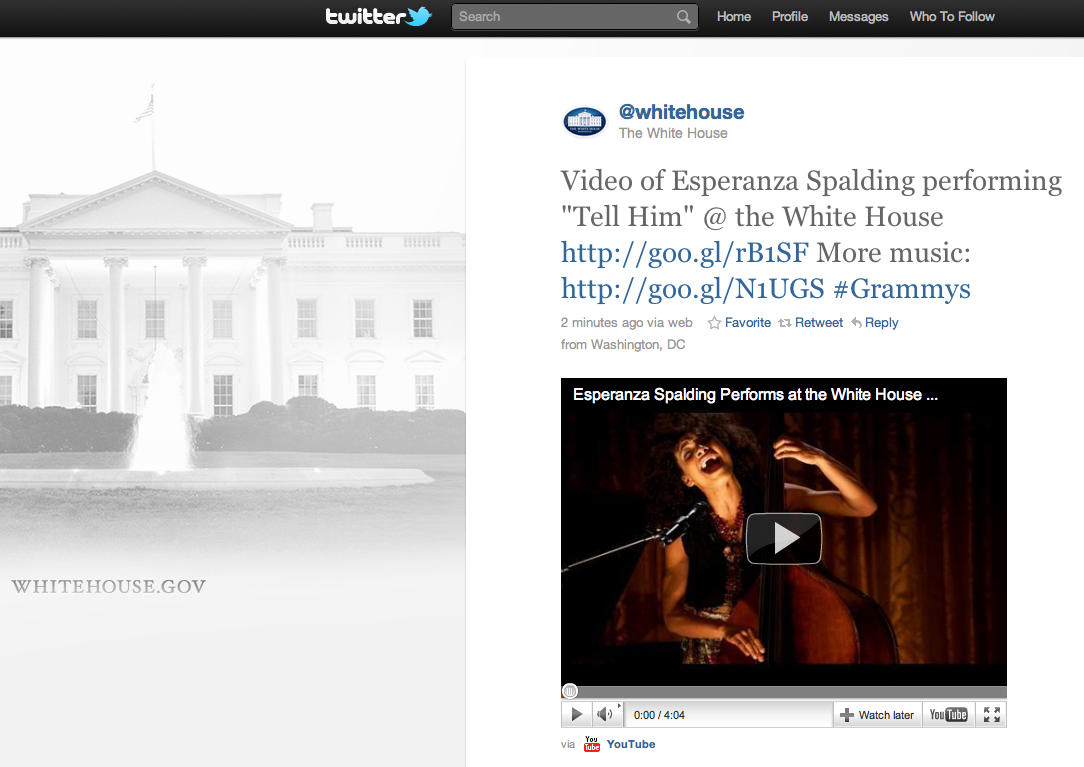
Esperanza Spalding won a Grammy for Best New Artist tonight. She’s an extraordinary talent. Moments after her win, White House new media director Macon Phillips congratulated her on Twitter and linked to a video of her performance at the White House Poetry Jam on YouTube:

Shortly after that, the White House account shared the same video, along with a link to all of the performances on the White House YouTube channel.

It’s good to know there are some music fans down the road at 1600 Pennsylvania Avenue. Congratulations to Spalding for the well-deserved recognition.

2 Comments

Filed under art, music, social media, Twitter, video