Category Archives: social media

New digital journalism tools and platforms to connect, present and inspire

“It doesn’t have to be like this,” said Alexis Madrigal. “You don’t have to write bad stuff to get people to come to a website”
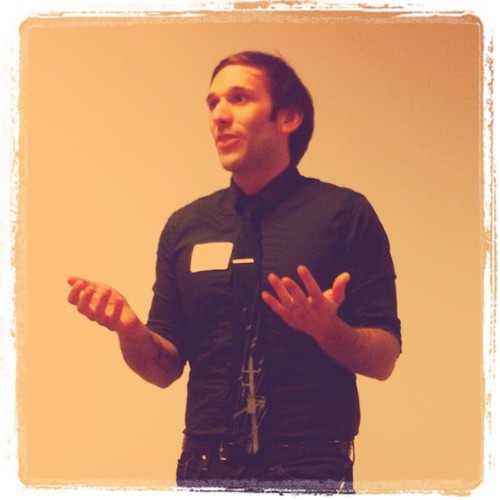
Tonight at the August meeting of the Online News Association in D.C., +Madrigal shared several of the tools that he’s been experimenting with to connect with his audience and rethink the way he shares information in his work as senior editor at the Atlantic Monthly.

You can find his digital journalism at www.theatlantic.com/alexis-madrigal and on Twitter at @alexismadrigal.

I’ve been reading his book on green energy, “Powering the Dream,” over the past few months. It’s excellent. Alexis also co-founded longshot magazine and wrote for Wired for years.

Given that context, when he talks about the digital tools that he’s using for work and the new applications or platforms that he’s experimenting with online these days, I paid attention. Here’s the breakdown of some of the tools he shared tonight.

First, Google Forms. Alexis described them as “frictionless, easy to set up, and then pull into spreadsheet. He referenced Amanda Michel‘s work using them in her crowdsourcing work at ProPublica.

Second, SoundCloud. That was a new one to me. Time to experiment.

Third, Twitter. This one was not new to me. Alexis said Twitter worked very well for Longshot. He did, however, say “the retweet is dying.” There’s an issue of splitting the incentive model, between “native” vs “manual” RTs, and tracking. Alexis said that he’s noticed all around that retweeting is way down, which has made Twitter less effective.

So, off to explore new places.

One such platform is Tumblr. The problem, said Madrigal, is that Tumblr has its own ecosystem. (I agree with this.) There’s no natural move over from another social media platform, he said, and that sad fact is that you have to put in the same damn work, and then see what moves. On that count, they’ve brought in curator to the Atlantic video channel who’s deeply immersed in the culture but it’s still challenging.

Another new destination is Google Plus. Alexis likes Plus conceptually, given how it allows back and forth, but doesn’t know exactly what he’s going to do with it yet. Alexis said he has largely left Facebook and streamlined his social media use. His Google Plus use went way up during the first couple of days and then leveled out. Now he needs to decide what to do with it. (I know the feeling). Alexis is experimenting with “The Atlantic Tech Plus,” which he described as a behind the scenes look at what his team is working on. He’s not sure what’s next. The digest has driven little traffic to date, but Alexis feels like he “has to be here and know how it works.”

Alexis moved from tools for publishing or sharing to presentation tools. He’s interested in timed slideshows and made the analogy that they’re like “full bleed” in a magazine. He used to think they’re just a way to get pageviews but now he thinking that they’re “a way to get content horizontally. ”

Two points here: beautiful tools are awesome and people are limiting themselves in the way they think about them. In that context, Alexis wants to exploit the behavior readers exhibit in compulsive clicking through a slideshow for good. This sort of thing is “gamification,” though Alexis notes that they just ran a story “called gamification is BS.”

Given this list of of tools, I asked him about Facebook for journalism. Alexis said that he chose to keep who he is as a person vs his work separate there. He hasn’t started a Page but knows people like science writer Steve Silberman who have had “wonderful generative conversations there.”

Finally, Alexis shared two sites that are doing work that can push us to think differently about what an editorial product can be online.

DomusIT (http://domusweb.it) is an Italian art magazine website worth looking at because of its vibrant, colorful and dynamic design:

Zeega (http://zeega.org) is a next generation content management system. Zeega pushes website design to a “crazy extreme,” with HTML5 in fully full bleed experience, including video, animations. Alexis suggested that Zeega can enable a different kind of publication online, something “more magazine-y” and interesting. Less cookie cutter. He expects that this or something like it will open up a new way of telling stories.

We’ll see! I know I have some new places and platforms to explore, along with Twitter, Google, Plus and Tumblr. The lesson that Alexis drew from turntable.fm is that “feeling like the Internet is alive is awesome.” I’ll drop by tomorrow.
2 Comments

Filed under journalism, social media, technology, Twitter

Yahoo Research: 50% of tweets consumed are generated by 20,000 elite users

New research from research on Twitter found that 50% of tweets consumed are generated by 20K elite users. Based upon the more than 37,000 tweets I’ve posted over four years of tweeting, it’s a virtual lock that I’m one of them. Of particular interest was the “significant homophily” that the researchers found within categories. I’ve tried hard to escape that effect after reading Ethan Zuckerman’s post on homophily, serendipity and xenophilia nearly three years ago.

FULL PAPER: Twitter flow

Abstract:

We study several longstanding questions in media communications research, in the context of the microblogging service Twitter, regarding the production, flow, and consumption of information. To do so, we exploit a recently introduced feature of Twitter—known as Twitter lists—to distinguish between elite users, by which we mean specifically celebrities, bloggers, and representatives of media outlets and other formal organizations, and ordinary users. Based on this classification, we find a striking concentration of attention on Twitter—roughly 50% of tweets consumed are generated by just 20K elite users—where the media produces the most information, but celebrities are the most followed. We also find significant homophily within categories: celebrities listen to celebrities, while bloggers listen to bloggers etc; however, bloggers in general rebroadcast more information than the other categories. Next we re-examine the classical “two-step flow” theory of communications, finding considerable support for it on Twitter, but also some interesting differences. Third, we find that URLs broadcast by different categories of users or containing different types of content exhibit systematically different lifespans. And finally, we examine the attention paid by the different user categories to different news topics.

Leave a comment

Filed under blogging, research, social bookmarking, social media, technology

Awesome Foundation DC Launch Party warmly welcomed in District

Over the past year, the Awesome Foundation has been growing globally, providing micro-grants for creative genius in multiple continents. Last night, hundreds of people bought “Tickets to Awesome” and joined the DC chapter of the Awesome Foundation at a launch party in One Lounge in Dupont Circle.

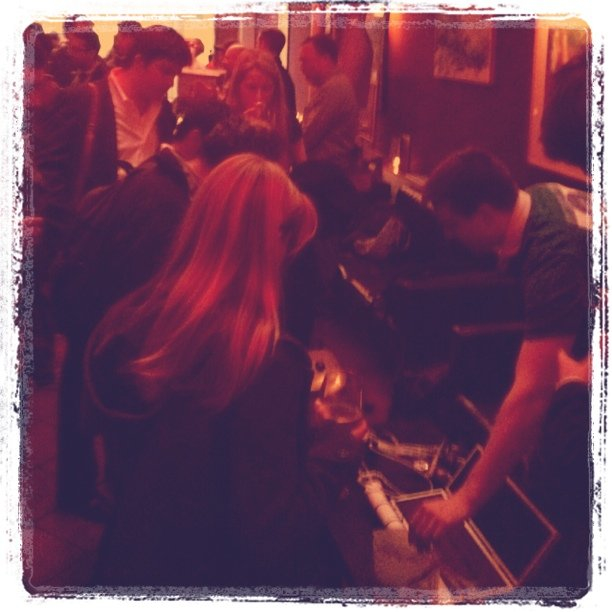
Party goers mixed and mingled with the DC chapter’s microtrustees, including this correspondent, and checked out exhibits and demonstrations from the first four recipients of awesome grants. DC FabLab, Ward 8, Petworth and Counterpoint were in attendance for awards ceremony. Bonnie Shaw (@Bon_Zai), DC’s “Dean of Awesome,” gave a brief speech at the launch party ceremony:

Curious folks also checked out exhibits from My Dream of Jeanne, ExAparatus and ScrapAction, donating to the projects they liked the most using the awesome tokens that came with their tickets. Counterpoint even performed upstairs in front of a packed lounge.

You can follow the Awesome Foundation DC on Twitter for updates on new grants, performances, installations and other awesome events at @AFdnDC.

2 Comments

Filed under art, article, education, friends, journalism, music, photography, social media, technology, video

Smarter social networking at SMCDC

Tonight, I’ll be moderating a discussion at Porter Novelli DC about what “smarter social networking” means.

Fortunately, posing questions to this particular set of panelists will be much more easier than trying to herd LOLcats.

Some time shortly after 7 PM EST, I’ll start asking Frank Gruber (@FrankGruber), CEO & co-founder of TechCocktail, Shana Glickfield (@dcconcierge), partner at Beekeeper Group, and Shonali Burke (@shonali), principal at Shonali Burke Consulting, what “smarter social networking” means in 2011. We’ll be talking about forming relationships and acting professionally in the context of the Internet. I might even ask about what good “netiquette” means.

I expect to see Federal News Radio Chris anchor Chris Dorobek (@cdorobek) to be there in person to heckle me online, along with the rest of one of the more connected group of people in the District of Columbia. The DC Social Media Club, after all, comes heavily loaded with BlackBerrys, iPhones, iPads and Android devices. Some will even have two of those devices – one official, one not, and will be wired into Facebook, Twitter, email and txt messaging.

This is clearly a group of people that has thought a lot about how to practice “smarter social networking.” As prepared for the discussion last night, I was reminded that the actions that humans take online increasingly are aligned what they do offline.

That’s because the idea of a separate “cyberspace” is on life support. That’s was one conclusion that Clay Shirky brought to a discussion of the recent report by the Pew Internet and Life Project on the social side of the Internet at the State of the Net Conference.

In wired communities, people are increasingly integrating their online lives with their offline actions. As that trend grows with more of humanity coming online, the role of the Internet as a platform for collective action increases. The world has seen some of that power at work in Tunisia and Egypt this winter.

Those connections are not always strongly made, due to the anonymity sections of the Web of 2011 provide. You only have to look at the quality of civil discourse between commentary on YouTube or newspaper comment threads without moderation to see how anonymity can enable the id of humanity to wash over a page. Teachers, freedom fighters, activists, law enforcement, aid workers, insurgents, journalists or criminals can and will use the Internet for different ends. When any tool is put to ugly or evil use, naturally it provokes outrage, concern, regulation or outright bans.

As Stowe Boyd wrote this weekend in his essay on cognition and the Web, however, “throwing away the web because you don’t like what you see is like breaking a mirror because you don’t like your own reflection. It is us we are staring at in that mirror, on the web: and it is us looking out, too.”It is us we are staring at in that mirror, on the web: and it is us looking out, too.”

In this age of radical transparency, it’s becoming harder and harder to hide to hide demonstrated bad character over time. That’s even more true of people who choose to live their lives more publicly on Facebook, Twitter, Foursquare and where ever else there digital nomadism leads them next.

This isn’t an entirely happy development, as the number of citations of social networking in divorce filings suggest. By the end of the next decade, more people may well be paying money to assure their privacy than to gain more publicity.

In that context, “smarter social networking” in an age of digital transparency may well rely more on good character, better business ethics and placing value in building trusted relationships than faster wireless broadband, the newest smartphone or millions of followers or fans.

3 Comments

Filed under article, blogging, friends, personal, social media, technology, Twitter, Uncategorized

Your Twitter journalism is so phat that _____

Today, spurred by a (rather absurd) debate about whether Twitter is journalism, Brian Solis asked whether tweets are recognized as acts of journalism, and as such, regarded as bona fide journalism. That’s a much better question. As of yet, unfortunately, no media law expert has sprung to answer it in the comments for his post.

Del Harvey Somebody else did answer the question on Twitter, albeit substituting snark for substance: @delbius, also known as Del Harvey, the head of Twitter’s Trust & @Safety team.
Her reply, below, set off one of the funniest exchanges I’ve ever had in more than 3 years of tweeting.

Del: Not gonna lie, read that Tweet and what sprang to mind was “Your mom’s an act of journalism.”

Alex: Your journalism is an act of Mom! Or to put it another way, your journalism is so fat, it had to create a @yearly account.

Del: My journalism is phat, thank you.

Alex: Ok, I’ll play. Your journalism is so phat, it can only be published in 140 characters or more.

Del: Your journalism is so phat that it uses the full title of weblog.

Alex: Your micro journalism is so phat that you have to make the Twitter display widgets auto-width.

Del: Your journalism is so phat your lede takes up a paragraph.

Alex: Your journalism is so phat that the IEEE had to create a new standard data format for your letters.

Del: Your journalism is so phat that your angle is obtuse.

Alex: Your journalism is so phat that you have to use deck.ly to share what your officemate ate for lunch.

Del: Your journalism is so phat your informant was Mrs. Fields.

Alex: Your zombie journalism is so phat that your editor has to use liposuction to find where you buried the lede.

Del: Your journalism is so phat you’re below the *second* fold.

Alex: Your journalism is so phat that your readers are directed by their physicians to go on Lipitor after reading it.

Del: Your journalism is so phat your b-roll had butter on it. (wince @ self)

Alex: Your journalism is so phat that newly elected Congressmen are considering a vote to defund it.

Del: Your journalism is so phat your jump cut is a jiggle cut.

Alex: Your journalism is so phat that you had to get 5000 TB SATA drives to be the scratch disks for your video editing.

Del: Your journalism is so phat your POV pieces are for two people at once.

Alex: Your journalism is so phat that your hyperlinks are coated in myelin.

Alex: Your journalism is so phat that @cjoh had to start running marathons to stay on his information diet.

If you have more reasons your journalism is phat, please add them in the comments.

11 Comments

Filed under blogging, journalism, social media, technology, Twitter

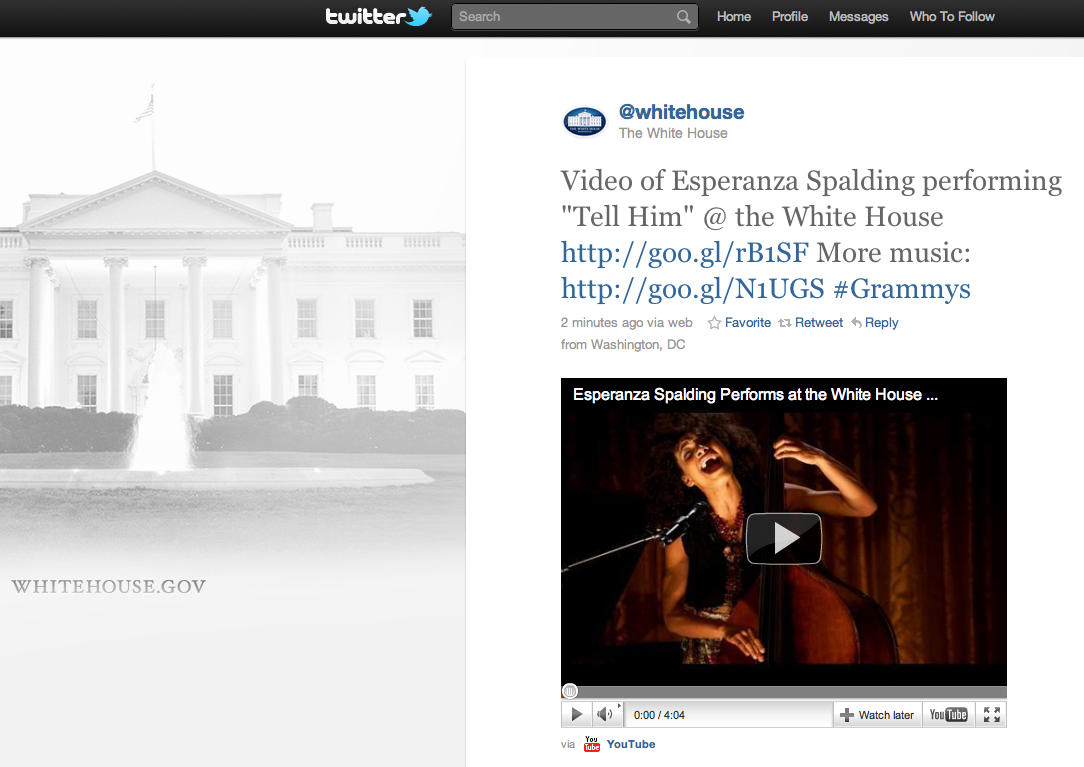
Esperanza Spalding wins Grammy for Best New Artist, @WhiteHouse celebrates the moment

Esperanza Spalding won a Grammy for Best New Artist tonight. She’s an extraordinary talent. Moments after her win, White House new media director Macon Phillips congratulated her on Twitter and linked to a video of her performance at the White House Poetry Jam on YouTube:

Shortly after that, the White House account shared the same video, along with a link to all of the performances on the White House YouTube channel.

It’s good to know there are some music fans down the road at 1600 Pennsylvania Avenue. Congratulations to Spalding for the well-deserved recognition.

2 Comments

Filed under art, music, social media, Twitter, video

Blogging isn’t dead, influence contests should be, and hyperlinks rock.

My belated wishes for the media in the New Year:

Please stop making generalized statements that “bloggers” are ____.

Blogs, whether they’re written by members of the media, business people or “average” citizens matter in 2011. A blog is a platform. All kinds of people use them. Some are more popular than others. Some are written by subject matter experts. Given the adoption of blogging software at the Financial Times, Wall Street Journal, Bloomberg and New York Times, the term “blogger” is is more a term of derision that an accurate classification.

The distinction of “blog” versus mainstream publication online has increasingly blurred to become nearly unrecognizable. Go back and read Nick Denton’s post on why Gawker is moving beyond the blog and consider his plan for new media in 2011.

Please stop writing headlines that “[X] is dead” or about “wars” between companies.

Exception: foreign correspondents and war journalists, both of whom exist in decreasing numbers these days. If you’re not covering an actual war, stop using the metaphor. Seriously.

For instance, blogs aren’t dead, though some of the activity and conversation that existed there in 2006 has moved in Facebook or Twitter in 2011. If you go with such a headline, steel yourself for a critical response.

Please link to the outlet and the journalist that broke a story, whether it’s “old media” or a blog.

Hyperlinks are the dendrites of the Internet. Hyperlinks are like a retweet on Twitter: they’re both social currency. Linking up the source for news story or fact with a link is like footnoting a research paper, except that it both helps the reader learn more and provides credit and authority to the site linked. Neither mainstream media nor blogs should be lifting stories without linking in 2011. So stop.

Please stop disparaging the influence of “bloggers.” Or talking about their pajamas.

It really doesn’t matter what I’m wearing when I file, though these days it’s a suit more often than shorts or pajamas.

The argument that one irate customer taking the Internet won’t matter is passe in 2011, as many publicly traded companies have found during online backlashes. A powerful short video and a post can and will go viral online, particularly if it’s a customer service or product issue that resonates widely.

That’s even more true so for blogs and writers at the top of an industry vertical, although Consumer Reports still has plenty of clout. When experts share their views online, they gain algorithmic authority online, which over time leads to influence over a given community. If Louis Gray or Robert Scoble or Mike Arrington cover a startup, it can put them on the map.

There’s no need to ask media critics like Brian Stelter, Felix Salmon, Ken Doctor, David Carr, David Folkenflik or Jay Rosen if they read blogs: they do. So do more “mainstream media influencers” like Katie Couric or the Sunday talk show hosts, along do the top editors of every publication I’ve talked to last year. The Pulitzer Prize now includes online organizations.

Please stop hosting influence contests. Lift up new voices.

Sure, an influence project might have sounded like a good idea in 2010. Many people disagreed. Strongly. Despite the backlash, new social media contests are still coming online for people to game. Predictably, strong critiques emerged, including those that focus on a different kind of digital divide. There is an emerging industry of analytics services that crunch big data and social recommendations to determine online influence or grade social media accounts, although they all have a long journey yet to evolve.

Instead of encouraging a community to engage in a popularity contest, considering using the power of an established media platform to empower new voices, highlighting what’s unique about an area and connect neighbors who might not know one another.

15 Comments

Filed under blogging, journalism, social media, technology, Twitter

Looking Back: The Best Interviews of 2010 [VIDEO]

2010 was full of amazing stories and experiences, both personal and professional. I’m grateful for the many opportunities I had speak to brilliant, fascinating people about technology, government, media and civil society. I’ve learned a tremendous amount from my interviews this year, many of which were captured on video. Some were filmed with my iPhone 4, others with a Canon 110si, others by O’Reilly Media’s professional video team after I joined the company as its new Gov 2.0 Washington Correspondent.

Regardless of the quality of light, image or sound, each interview taught me something new, and I’m proud they’re all available on the Web to the public. The list below isn’t exhaustive, either. There are easily a dozen other excellent interviews on my channel on YouTube, O’Reilly Media’s YouTube channel, uStream and Livestream. Thank you to each and every person who took time to talk to me this past year.

20. Professor Fred Cate on electronic privacy protections and email

19. Google Open Advocate Chris Messina on Internet freedom

18. Foursquare Creator Dennis Crowley on the NASA Tweetup and #IVoted

17. Co-Chairman of the Future of Privacy Forum Jules Polonetsky

16. NASA CTO Chris Kemp on cloud computing and open source

15. Portland Mayor Sam Adams on open data

14. Former Xerox Chief Scientist and PARC Director John Seely Brown on education

13. NPR’s Andy Carvin on CrisisWiki

12. ISE Founder Claire Lockhart on government accountability

11. Cisco CTO Padmasree Warrior on the evolution of smarter cities

10. Ushahidi Co-Founder Ory Okolloh on crowdsourcing

9. Senator Kate Lundy on Gov 2.0 in Australia

8. Intellipedia: Moving from a culture of “need to know” to “need to share” using wikis

7. ESRI Co-Founder Jack Dangermond on mapping

6. Sunlight Foundation Co-Founder Ellen Miller on Open Government

5. HHS CTO Todd Park on Open Health Data

4. FCC Tech Cast with Expert Lab’s Gina Trapani

3. Apple Co-founder Steve Wozniak on the Open Internet

2. United States CTO Aneesh Chopra on Open Government

1. Tim Berners-Lee on Open Linked Data

Leave a comment

Filed under cyberlaw, education, government 2.0, journalism, social media, technology, video

28 Tweets about #Newsfoo: Data Journalism, Wikileaks and the Long Form

Last weekend, I was proud to join a fascinating group of people in the first News Foo out in Phoenix, Arizona. I’m still thinking through what it all meant to me. Covering events in Washington has kept me extremely busy from the moment I returned.

Almost by definition, you can’t go to everything at an unconference. And by definition, an unconference is what you make of it, meaning that if you to a session to happen, you need to propose it. If you don’t like the one you’re in, vote with your feet. The open structure means that everyone will have a different experience, a reality that was reflected in the tweets, blogposts and feedback that have emerged in the days since the first News Foo concluded in Phoenix.

Newsfoo is a variant of Tim O’Reilly’s famed Foo camps, which have a wiki unconference format. People create the sessions as they go, and they camp out together. The social + intellectual experience is a bonding opportunity. There is also, for example, a Sci Foo camp which is consponsored by O’Reilly, Nature mag and Google. Now there is a push to do a Newsfoo, which would bring technologists and journalists together in a high-level discussion, that looks forward rather than back. It would tackle cool problems, both content side and business side.

To expand on that concept, posted before the event, News Foo was a collaboration between O’Reilly Media, Google and the Knight Foundation. Each hour or so, four or five sessions frequently competed for attention, along with freewheeling conversations in hallways, tables and in the open spaces of Arizona State University’s beautiful journalism center. As with every unconference, the attendees created the program and decided which sessions to attend, aggregating or disaggregating themselves.

If you’re interested in other reactions to News Foo, several excellent posts have made their way online since Sunday. I’ll be posting more thoughts on Newsfoo soon, along with book recommendations from the science fiction session.

For those who were not present, a post by Steve Buttry is particularly worth reading, along with the lively dialogue in the comments: “News Foo Camp: Not fully open, but certainly secret.” Buttry reached out to Sarah Winge, who provided a lengthy, informative comment about what Foos are about and how “Friend D.A.” works. If you’re not familiar with either, go check out Steve’s excellent post.

As he notes there, heavy tweeting was discouraged by the organizers, a request supported by the thinking that being “fully present,” freed of the necessary attention that documenting an event accurately requires of a writer, will result in a richer in-person experience for all involved.

Over the course of the weekend, I certainly tweeted much less than I would at the average conference or unconference. But then foo isn’t either.

I did take a few moments to share resources or stories I heard about at newsfoo with my distributed audience online. Following are 28 tweets, slightly edited (I took out the #Newsfoo hashtag and replies in a few) that did just that, rather like I’d microblogged it. If you’re confused about the “twitterese” below, consult my explainer on the top 50 Twitter acronyms and abbreviations and my thinking on how #hashtags on Twitter are like channels on cable TV. For many more tweets from other attendees, check out “Newsfoo at a Distance,” a Storify curation.

1. #Newsfoo is an unconference in Phoenix, AZ this weekend. Technologists & journalists talking about “what’s next.”

2. Foo Camp is about “making new synapses in the global brain,” says @TimOReilly. And being present. Here.  http://twitpic.com/3cnxcl

3. ASU Cronkite School of Journalism. Beautiful. http://instagr.am/p/dLie/

4. Loving session on context with @mthomps @adamdangelo & @tristanharris. Some context: http://futureofcontext.com #meta

On the long form

5. In #longform discussion. Love this topic: http://longform.org | http://longreads.com | @NiemanLab: http://j.mp/9X9Php

6. More on #longform at @Guardian: http://j.mp/d5lhF5 @longreads @TheAwl @somethingtoread @longformorg @thelonggoodread

7. “Final Salute” http://j.mp/px3Vk Pulitzer Prize-winning story by @jimsheeler. @TheRocky closed last October.

8. Readability changed how I read #longform journalism online: http://readability.com @Pogue: http://nyti.ms/3Yu9KD

9. Learned about @audiopress from @wroush. Roll your own podcast playlists. @Xconomy: http://bit.ly/cuBm1G #longform

Data Journalism

10. Good ooVoo test with @kmcurry. Virtual session with @jeanneholm& @davidherzog on data journalism at 1:45 MST http://bit.ly/etWw7R

11. Data tools at http://opendataday.org being used at #rhok & #odhd hackathons: http://oreil.ly/g4ibiF #opengov #gov20

12. There’s someone from http://scraperwiki.com at #newsfoo.

Wikileaks

13. Moved to #Wikileaks session. Wonderfully deep. Useful take on #cablegate at @TheEconomist: http://econ.st/hyD7kM

14. “Former #WikiLeaks activists to launch new whistleblowing site”-Der Spiegel http://bit.ly/f4iP6Q #cablegate

15. Talking about #COICA: http://act.ly/S3804 http://eff.org/coica #ACTA & DNS issues. Important: http://nyti.ms/evvl6u

Trust and the media

16. Thinking about trust in institutions & the media. See: http://reportanerror.org & @ChangeTracker: http://j.mp/dEzAQw

17. RT @acarvin Same at NPR RT @drcarp Journalist participation in comments leads to reduced moderation and improved tone http://bit.ly/ex9FUx

Newsfoo Ignite

18. Inspired again by @acarvin at Ignite. http://crisiscommons.org http://twitpic.com/3d15em http://twitpic.com/3d15q2

19. You can watch @acarvin do an Ignite on the same topic/preso here now: http://oreil.ly/9ZIEMs

20. Great Ignite on Twitter metrics by @zseward. Bad: http://twitpic.com/3d1qtz Better: http://twitpic.com/3d1qzz

21. Interesting Ignite from the CEO of @peoplebrowsr. Another tool to try: http://research.ly http://twitpic.com/3d1w93

22. “Curiousity is the cartography that allows you to see more finely grained maps of the world”-@tristanharris

Sunday sessions

23. Good morning! Talking how media biz models might work in with FTC #DNTrack. Context: http://oreil.ly/igZJso

24. Reminded of how ugly black hat SEO spammers & fraudsters act online after disasters. http://usat.ly/88pYMk

25. Absolutely geeking out in this #scifi news session. @GreatDismal & Douglas Adams would dig. Geektastic: http://looxcie.com

26. Wonderful moment: “Let me plug a book: “The Victorian Internet'”-@sbma44 “I wrote it”-@tomstandage http://j.mp/QX4tS

27. Yes. @NiemanLab: http://bit.ly/9xFLft RT @tomstandage: Anyone else at #newsfoo interested in the Gutenberg Parenthesis?

28. Bit hard to leave the warm sun of Phoenix & brilliance of the #newsfoo community for DC. Good to debrief with @jsb @rbole @Hari & @pergam.

4 Comments

Filed under blogging, friends, government 2.0, journalism, microsharing, photography, scifi, social media, technology, Twitter, video

8% of American Adults Online Use Twitter [PEW REPORT]

New research from the Pew Research Center’s Internet & American Life Project sheds new light on the use of Twitter In its “Twitter Update,” the Pew Internet report shares key demographics, behaviors and insights on the rapidly growing social network that has continued to be one of Silicon Valley’s hottest startups. Pew researchers found that 8% of online adults said they use Twitter, with some 2% tweeting on a typical day. Pew’s research currently estimates that 74% of American adults are Internet users.

More stats:

  • Users skew younger: Internet users aged 18-29 are significantly more likely to use Twitter than older adults.
  • Minorities are there in strength. Minority Internet users are more than twice as likely to use Twitter than white Internet users.
  • People who live in cities are more likely to tweet. Urban residents are roughly twice as likely to use Twitter as rural dwellers. (That said, the majority of people live in cities.)

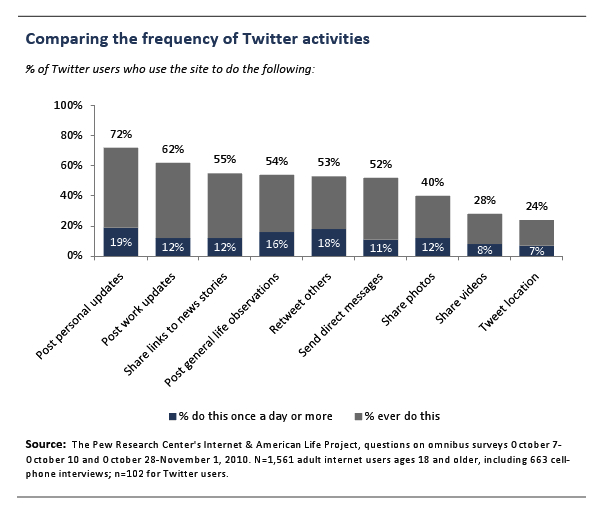
What are people sharing? Hint: It’s not what they’re eating. Personal updates lead the list, followed by work updates, sharing links to news, posting “general life observations,” retweeting other people and direct messaging.

All in all, it’s a fascinating picture of Twitter. You’ll learn a lot more at Pew Internet’s “Twitter Update,” including the sample size and methodology behind the report — so go read it.

And then about it. :)

Leave a comment

Filed under microsharing, social media, Twitter