Category Archives: social media

5 Social Media Week DC 2012 Panels: Conversations, Politics, Technology, Public Diplomacy and eDemocracy

Social Media Week DC  is going to be a busy conference for me this year. If you haven’t heard about it yet, the week-long festival starts 12 days from now. The week will feature speakers, panels, workshops, events, and parties all across the District celebrating tech and social media in the Nation’s Capital, including a special edition of the DC Tech Meetup. I’m going to be moderating four panels and participating on a fifth. I’m excited about all five and I hope that readers, friends, colleagues and the DC community comes to one or more of them.

If the panels that I’m involved in aren’t your cup of tea, you might find something more to your taste in the full SMW DC schedule.

Social Media Week DC 2012

Following is the breakdown of the five panels that I’ll be participating in this year:

  • Creating & Managing High Quality Online Conversations
    Location: Science Club
    Date: Monday, February 13 at 6:30 PM – 8:00 PM |  Add to Google Calendar | Add to iCal
    Description: Discussions in online comment sections and social media can be tricky to manage. Some sites are bogged down full of low quality comments, spam, and more. How do we create high quality online discussions? How do we filter out the noise – the spam, the solicitation, harassment, and hateful speech that often becomes part of any online discussion? We will discuss examples of those that have done it well, and some that haven’t. We will also speak to individuals who have dealt with harassment and negativity online and learn how they fought back and still used social media tools for constructive discussion and engagement.
  • Politics and technology: the media’s role in the changing landscape: ASK QUESTIONS
    Location: Powell Tate
    Date: Tuesday, February 14 at 10:00 AM | Add to Google Calendar | Add to iCal
    Description
    : Digital platforms have changed the media landscape forever, but how has it changed the way the media covers politics? We’ll ask a panel of reporters from Gannett, National Journal, ABC News and Politico as they discuss 2012 election coverage.
  • Social Politics: How Technology Has Helped Campaigns: ASK QUESTIONS
    Location: Powell Tate
    Date: Tuesday, February 14 at 2:00 PM | Add to Google Calendar | Add to iCal
    Description: The social media landscape has changed drastically since 2008. We’ll hear directly from panelists from Google, Twitter and Facebook as they delve into the tools and innovations that candidates and campaigns have utilized as the 2012 campaign heats up.
  • Public Diplomacy in the Age of Social Media
    Location: New America Foundation
    Date: Thursday, February 16 at 9:30 AM – 11:00 AM | Add to Google Calendar| Add to iCal
    Description
    : How does social media change how statecraft is practiced in the 21st century? Who’s participating and why? What have been some lessons learned from the pioneers who have logged on to listen and engage? Three representatives from the U.S. Department of State will share case studies and professional experiences gleaned directly from the virtual trenches.
  • Social Media, Government and 21st Century eDemocracy
    Location: The U.S. National Archives
    Date: Friday, February 17 at 1:00 PM – 2:00 PM | Add to Calendar | Add to iCal
    Description: While Sean Parker may predict that social media will determine the outcome of the 2012 election, governance is another story entirely. Meaningful use of social media by Congress remains challenged by a number of factors, not least an online identity ecosystem that has not provided Congress with ideal means to identify constituents online. The reality remains that when it comes to which channels influence Congress, in-person visits and individual emails or phone calls are far more influential with congressional staffers.“People think it’s always an argument in Washington,” said Matt Lira, Director of Digital for the House Majority Leader. “Social media can change that. We’re seeing a decentralization of audiences that is built around their interests rather than the interests of editors. Imagine when you start streaming every hearing and making information more digestible. All of a sudden, you get these niche audiences. They’re not enough to sustain a network, but you’ll get enough of an audience to sustain the topic. I believe we will have a more engaged citizenry as a result.”

    This conversation with Lira (and other special guests, as scheduling allows) will explore more than how social media is changing politics in Washington. We’ll look at its potential to can help elected officials and other public servants make better policy decisions.

If you’re not in DC, check to see if there is a Social Media Week event near you: in 2012, the conference now include New York, San Francisco, Miami, Toronto, London, Paris, Rome, Hong Kong, Tokyo, Singapore, and Sao Paulo.

2 Comments

Filed under article, government 2.0, journalism, social media, technology

Less TV, more Internet: First White House Google Plus Hangout features real questions from citizens

Today, more than a quarter of a million people* watched the first Presidential Google Hangout with President +Barack Obama from +The White House.  The archived video, below, comes courtesy of  Reuters social media editor Anthony De Rosa, whose shared his review of President Obama’s first Hangout at Reuters.com. For the best reporting I’ve seen on the participants and questions, read Sarah Lai Stirland on President Obama’s Hangout.

My immediate takeaway? The forum featured real questions on significant issues, with genuine citizen-president interactions, with back and forth conversation. That was precisely the promise of the platform that I considered ahead of time, when I asked whether a Google+ Hangout could bring the president closer to the citizens he serves.

Earlier in the afternoon, I joined Google’s Daniel Sieberg on our own Google+ Hangout to talk about the potential impact that online video, hangouts, and live broadcasts between citizens and their elected officials could have on the political landscape.

The moderator, Google’s Steve Grove, gave the participants (2 men, 2 women and one classroom of young people) the opportunity to follow up on their questions to the president. There will be much more analysis of the questions asked and the president’s answers tonight, as there should be.

Here’s a quick recap, distilled from my notes: The forum began with a video question to the president about promoting a living wage for students working their way through college. The second question came from the Hangout, on why the White House doesn’t expand expanded H1B visas for foreign workers at the expense of skilled labor with the U.S. President Obama told the wife of a semiconductor engineer (who asked the latter question and, critically, got to follow up in the Hangout) if she sent him her husband’s resume, he’d be happy to find what’s happening.

One could dismiss it as pandering — or celebrate it as a citizen cutting through the morass of bureaucracy to tell the nation’s chief executive that the system wasn’t working as he said it should. Such followups in the Hangout are what made this different than the past YouTube and White House interviewed. Politico talked to Jennifer Wedel, of Forth Worth, Texas, who asked the question during the presidential Hangout:

“I’ll have to take you up on that,” Wedel said of the president’s offer to help her husband, Darin, who lost his job at Texas Instruments three years ago.

Later, Wedel told POLITICO that she and the president had a “pretty crazy interaction” that she hadn’t expected when she asked about the federal government granting H-1B visas to skilled foreign workers while U.S. citizens such as her husband are out of work.

“I don’t think he was trying to be condescending or anything,” said Wedel, who never completed college and was a stay-at-home mom before her husband was laid off, but now has a full-time job at State Farm to help make ends meet. “I just think I stumped him a little and he wanted me to hush about it.”

“I think he knows pretty well that the H-1B is an issue because — it’s kind of like the Occupy movement — big corporations are putting up the money to get the visas” and choosing lower-paid foreign workers over domestic ones, Wedel said. “I don’t think what he was telling me was true, and I think he knew it, and that’s why he offered to take my husband’s resume,” she said, adding that her husband has kept it updated.

Another question from YouTube featured a video taken from an #Occupy protester in Portland. A question taken from within the White House Hangout asked about the president’s plans to help small business and to restructure government, which the Washington Post covered this month.

Another question posed within the Hangout about a lack of dialogue with children about the financial crisis offered the president a human moment, where he said that he tries to explain what’s happened with economy to his daughters over the dinner table.

There were incontrovertibly tough questions asked tonight, including one from a homeless veteran who asked why the U.S. is sending money to Pakistan and places that are known to give money to terrorism. In answer, the president said that the U.S. only spends 1% of its budget on foreign aid, and that it pays off in a lot of ways as part of the country’s national security strategy. What we don’t want is countries to collapse, have to send in our guys at huge potential risk and cost to taxpayers, he said.

The President was asked a video question from YouTube that cited a New York Times story on the use of drones in Iraq, which the president called “overwritten. The drones have not caused an unusual number of civilian casualties, he said, stating that it was a targeted focused effort aimed at Al Queda, not for other purposes.

I was personally glad to see that Grove asked a question on the Stop Online Piracy Act (SOPA) and PROTECT IP Act (PIPA), noting that both were hot within the YouTube community. Needless to say, that part of the transcript will be carefully analyzed by the people whose collective online action changed Washington.

We need to use tools we have, he said, noting recent takedown action by the Justice Department. At the same time, when SOPA came up on the hill, said the President, “we expressed some concerns about the way the legislation had been written.”  Now, he said, the content and server sides need to come together for strong IP protections that preserve basic architecture of the Internet.

While the top-rated question was asked, concerning the extradition of a British national, there were no questions posted about legalizing marijuana, which once again rose to the top of CitizenTube (perhaps Grove and his colleagues at YouTube felt it had been asked enough?) nor any question was asked about the National Defense Reauthorization Act, which many other users on YouTube wanted to see addressed.

UPDATE: When I followed up with Grove on Google+ about the process behind the questions, he made the following comment:

We chose the questions from among the top-voted questions on YouTube… it’s always a fun challenge to ensure you get a broad range of issues and perspectives into these discussions from amongst the top-voted questions, but I hope people feel that we did a good job of listening to community votes. We asked several of the top-voted questions, including the #1 voted question on YouTube. Some people asked why we didn’t ask about marijuana legalization… as an FYI, we asked the President about it last year (see here: Drug Policy – President Obama’s YouTube Interview 2011).

As far as the hangout participants, we also selected them based off of the questions they had submitted to YouTube — again looking for a range of Americans… that part had to happen a little earlier during the submission process, so we could prepare for the Hangout today.

President Barack Obama participates in an interview with YouTube and Google+ to discuss his State of the Union Address, in the Roosevelt Room of the White House, Jan. 30, 2012. The interview was held through a Google+ Hangout, making it the first completely virtual interview from the White House. (Official White House Photo by Pete Souza)

President Barack Obama participates in an interview with YouTube and Google+ to discuss his State of the Union Address, in the Roosevelt Room of the White House, Jan. 30, 2012. The interview was held through a Google+ Hangout, making it the first completely virtual interview from the White House. (Official White House Photo by Pete Souza)

Overall, I can honestly say that we saw something new in the intersection of government, technology and society. From where I sat, plugged in within the Sunlight Foundation, it felt like a good thing, not just for the White House or the president’s campaign or Google (although all certainly benefitted) but for the promise of the Internet to more directly connect public officials to those that they serve, with all of their real problems, concerns, doubts and fears.

At the end of the event, there was a moment of unexpected human connection, when one of the women on the hangout invited her three children to come meet the president.

They stared and smiled, left a bit wide eyed by the President of the United States smiling out of the computer screen and bidding them to obey their mother and do their homework. We could do with more wonder in the world, where such unexpected encounters occur online.

Viewership estimate via Google’s Steve Grove, who said at the end of the netcast that a quarter of a million people were watching on YouTube. Given the White House’s own livestream, the number could be higher.

13 Comments

Filed under application, government 2.0, social media, technology, video

Classrooms and community: my moderation standards for Google+, Facebook and blog comments

Over the past few months, I’ve seen a lot of spam and pornography links on Google Plus, on Facebook and on the blogs I maintain. Fortunately, blogs, Google and Facebook both give us the ability to moderate comments and, if we wish, to block other people who do not respect the opinions or character of others.
Last night, I’m seeing a lack of clarity about my approach to online community, so here’s how I think about it, with a nod to the example set by Arizona State University journalism professor Dan Gillmor.

I can and do block spammers and people posting links to pornography.

I will leave comments on on my blogs, precisely because I value conversations, despite the issues that persist online. I have been moderating discussion in online forums and blogs for many years, including those of my publishers. My full thoughts on the value of blog comments — and the social norms that I expect people comments to live within — are on this blog. To date, there are 196 comments on the post.

Vilely insulting me won’t help your case. Insulting others will ruin it. I was a teacher in my twenties. I would not tolerate disrespectful behavior in my classroom, either to me or to other students. If you can’t be civil and continue to insult others, much less the person hosting the forum, you were asked to leave and see the principal.

If the behavior persists, you will lose the privilege of participating in “class.” Eventually, you get expelled. On Google+ or blogs, that takes the form of being defriended, banned or blocked from my public updates. I prefer not to block users but I will do it. I respect your right to speak freely on your own blog, Twitter, Facebook or Google+ account, whether that involves cursing or ignorance.

I strongly believe in the First Amendment. Governments should not censor citizens. That said, I do not, however, feel obligated to host such speech on my own blog, particularly if it is directed towards other commenters. I believe that building and maintaining healthy communities, online of offline, requires that the people hosting them enforce standards for participation that encourage civil dialogue.

I hope that makes sense to friends, readers and colleagues. If not, you are welcome to let me know in the comments.

3 Comments

Filed under blogging, education, social media, technology

Visualizing conversations on Twitter about #SOPA

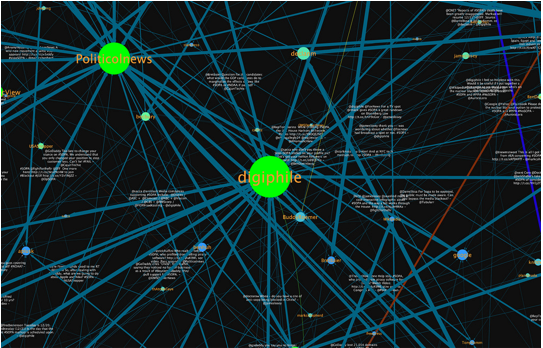
Kickstarter data dude Fred Berenson visualized conversations around SOPA on Twitter: View visualization

@digiphile snapshot

His data crunching strongly implies that I’ve been a “supernode” on this story. I’m not surprised, given how closely I’ve been following how the Web is changing Washington — or vice versa.

Leave a comment

Filed under art, article, journalism, microsharing, research, social bookmarking, social media, technology, Twitter

Senator Reid postpones vote on PROTECT IP Act, Romney and Gingrich come out against SOPA

This morning, Senator Harry Reid, the Senate Majority Leader, said in a statement today that he will postpone next week’s vote on the PROTECT IP Act (PIPA). Update: Rep. Lamar Smith followed with a statement that he would also halt consideration of SOPA. This is a historic victory for the Internet community. Collectively, millions of people rose up and told Washington that these bills shall not pass.

An unprecedented day of online protests over the Stop Online Piracy Act (SOPA) in the U.S. House of Representatives and the PIPA in the U.S. Senate and the resulting coverage on cable and broadcast news networks had an effect.

“Senator Reid made the right decision in postponing next week’s vote on PIPA,” said Center for Democracy and Technology president Leslie Harris. “It’s time for a hard reset on this issue. We need a thoughtful and substantive process that includes all Internet stakeholders. We need to take a hard look at the facts and find solutions that honor the Internet’s openness and its unique capacity for innovation and free expression. We are thankful for the efforts of Senator Ron Wyden who from the beginning stood against this bill; his early opposition and leadership gave voice to the important concerns of the Internet community.”

Wikipedia, Google, BoingBoing, Reddit, O’Reilly Media and thousands of other blogs asked their communities to take a stand and contact Washington.

“The amazing thing is that the power of these networks delivered,” wrote David Binetti in TechCrunch. “By the end of the day, 25 Senators — including at least 5 former co-sponsors of the bill — had announced their opposition to SOPA. Think about that for just a second: A well-organized, well-funded, well-connected, well-experienced lobbying effort on Capitol Hill was outflanked by an ad-hoc group of rank amateurs, most of whom were operating independent of one another and on their spare time. Regardless where you stand on the issue — and effective copyright protection is an important issue — this is very good news for the future of civic engagement.”

I concur with that last point. Last night, we finally saw one of the most important questions about the future of the Internet and society asked in a presidential debate: all four GOP candidates for the presidential nomination came out against SOPA at the CNN debate.

As shown by ProPublica’s excellent SOPA Tracker, SOPA and PIPA now have 122 opponents in the House and Senate, four times as many as on Monday.

These bills are not “dead,” no matter what headlines you read today, although I can now say with some confidence that they will not pass in their current form. There are ongoing negotiations to redraft them, cutting DNS filtering provisions or search engine blocks in an effort to make them acceptable to technology companies like Google.

While the Internet mattered this week, it’s important to recognize that but for the efforts of Senator Ron Wyden, Rep. Darrell Issa, Rep. Jason Chaffetz, Rep. Jared Polis and Rep. Zoe Logren, I believe SOPA and PIPA would likely have passed. Senator Wyden put a critical hold on the PROTECT IP Act after it sailed out of the Senate Judiciary Committee. Those representatives proposed dozens of amendments to SOPA in a marathon, days-long markup session that effectively filibustered the bill, delayed it until the House came back into session in January. That delay enabled hundreds of organizations and individuals, including newspaper editors, human rights advocates, academics, engineers and public interest groups, to rally to save the Internet as we know it.

“Supporters of the Internet deserve credit for pressing advocates of SOPA and PIPA to back away from an effort to ram through controversial legislation,” Issa said in an emailed statement. “Over the last two months, the intense popular effort to stop SOPA and PIPA has defeated an effort that once looked unstoppable but lacked a fundamental understanding of how Internet technologies work.

“Postponing the Senate vote on PIPA removes the imminent threat to the Internet, but it’s not over yet. Copyright infringement remains a serious problem and any solution must be targeted, effective, and consistent with how the Internet works. After inviting all stakeholders to help improve American intellectual property protections, I have introduced the bipartisan OPEN Act with Senator Rob Wyden which can be read and commented on at KeepTheWebOPEN.com. It is clear that Congress needs to have more discussion and education about the workings of the Internet before it moves forward on sweeping legislation to address intellectual property theft on the Internet. I look forward to working with my colleagues and stakeholders to achieve a needed consensus about the way forward.”

In the meantime, everyone who participated in this week’s unprecedented day of online action should know that what they did this week mattered. If you’d asked me about the prospects for the passage of these bills back in December — and many people did, after I wrote a feature at Radar in November that highlighted the threat these anti-piracy bills presented to the Internet, security and freedom of expression online — I estimated that it was quite likely. So did Chris Dodd, the head of the MPAA, who told the New York Times that these passage of these bills was “considered by many to be a ‘slam dunk.'”

We’re now in unexplored territory. I’ve been writing about how the Internet affects government and government affects the Internet for years now. This week was clearly a tipping point in that space. The voices of the people, expressed in calls, letters, tweets, petitions and protests, were heard in Washington. There are incredibly difficult challenges that face us as a country and as a global community, from jobs to healthcare to the environment to civil liberties to smoldering wars around the world. What happened this week, however, will reinvigorate the notion that participating in the civic process matters. Here’s to working on stuff that matters, together.

1 Comment

Filed under cyberlaw, government 2.0, social media, technology

On the value of blog comments

paper blogs

"Paper Blogs" by bookwyrmish

Over at GigaOm, Matthew Ingram weighs in on whether blogs should allow comments or not, spurred by a debate between venture capitalist Fred Wilson and Tech Crunch blogger-turned-venture capitalist M.G. Siegler:

MG Siegler, who doesn’t have comments on his blog and has written several posts defending his decision, saying they are 99-percent bile and a waste of his time. On the other side of the debate is fellow VC Fred Wilson, who says Siegler is missing a lot by not allowing comments.

I think Wilson is right — while comments can be a royal pain at times, they are a crucial part of what makes a blog more than just a bully pulpit.

For my part, I respect MG Siegler‘s choice to have a place on the Internet where only he can share his thoughts, whether we call it a blog or not, just as I do that of Seth Godin or John Gruber. If someone wants to comment on a given post, he or she can do so and respond via email, social networks, YouTube or their own blog(s). Or all of the above. There is no shortage of options on the Web of 2012 to share and opinion of something online and link to it. Just the opposite, really. If I want to publicly comment on one of Siegler’s posts, I can do so right here on my blog. Or Facebook. Or Google+. Or  @reply to @parislemon on Twitter, albeit in fewer characters.

From where I sit tonight, whether you choose to have comments or not speaks to whether you want to create an online community, which requires a human’s touch to manage and moderate, or to simply publish your thoughts publicly online, without making the necessary commitment of time and patience.

As is often the case, I agree with Mathew Ingram: blog comments are worth the effort.

He cites two important examples of high functioning people who maintain blogs with excellent comment sections, Anil Dash and Fred Wilson.

Dash and Wilson both spend time reading and responding to comments. For those who have been online for a few years, you know that’s not the case with many other blog authors. In a frank post last year, Dash observed that if your website is full of bad behavior, it’s your fault. He clearly thinks it’s worth it:

“When you engage with a community online in a constructive way, it can be one of the most meaningful experiences of your life. It doesn’t have to be polite, or neat and tidy, or full of everyone agreeing with each other. It just has to not be hateful and destructive.”

It’s worth noting that both men have also put into place architectures for participation that enable them to create better norms for discourse alongside social norms created by community. Dash uses Facebook comments, Wilson Disqus.

Some of the worst comments online still show up on YouTube or unmoderated newspaper comment sections. That’s one reason newspapers have been rethinking anonymous commenters. (Another, of course, is that knowing more about your readers’ demographics matters for online advertising and lead generation.)

It’s on that count that Ingram has extra credibility with me, since he used to be the social media editor at the Globe and Mail in Canada. While Canadians generally have a reputation for being polite, online that can change. Despite years of exposure to the best and worst of humanity on his screen, however, Mathew still supports having them:

“…I still defend comments as a crucial element of what blogging is, and more than that I defend anonymity as well. A blog without comments is a soap-box, plain and simple. Not having comments says you are only interested in passing on your wisdom, without testing it against any external source (at least not where others can watch you do so) or leaving open the opportunity to actually learn something from those who don’t have their own blogs, or aren’t on Twitter or Google+. That may make for a nicer experience for you the blogger, and it may make your blog load faster, but it is still a loss — for you, and for your readers.”

Moderating and responding to comments is a full-time job at high traffic blogs. If you’re a one man outfit, small business or don’t have a full time community manager, that’s going to take time away from research, writing and interviews — and that’s a legitimate problem for a writer, much less an entire news outfit. MG made this point today, commenting on the decision by Macstories to remove all comments:

It’s one thing for a single person site (like this one) to make a call to remove comments. It’s another for a larger team blog to do so. In fact, I can’t think of any without comments.

Right or wrong, the mentality is that to build a next generation media publication on the web, you need comments. That’s why we never got rid of them on TechCrunch (believe me, plenty of us wanted to — Facebook comments were a compromise).

Even more interesting is the psychology behind “needing” comments on big sites. Let’s be honest: most of these sites defend comments because if they don’t, it will seem like they’re taking a shit on their readers. It’s along the lines of “the reader is always right” — even when only half a percent are commenting and the vast majority of those are trolls.

For me, keeping up with email, Google+ and Facebook, @replies on Twitter, txts and IMs frankly can feel a bit exhausting. One of my New Year’s Resolutions for 2012, in fact, is remove communications cruft from my digital life wherever possible, cutting way down on bacn and spam. (Note Bene: I’m not giving up bacon in meatspace.)

That said, I think keeping up that level of engagement is worth it. It’s important to me. I hear from readers that it’s important to them. I plan to continue to publish posts this year that have comments enabled because I believe, as Mathew Ingram does, that they’re worth it, both for me and for other readers. If I ever think that they aren’t, I’ll either turn them off or advocate that we do so — but I’m not expecting a change of heart any time soon.

I’m looking forward to an upgrade at the O’Reilly Radar that should make it much easier for our community to ring in. Given that O’Reilly Media has legions of smart readers, I expect to learn a great deal from them, although I suspect I’ll take my lumps as well if I make mistakes or errors of reasoning. For me, that remains a worthwhile trade.

203 Comments

Filed under blogging, journalism, social media

On Twitter suspensions, spam, censorship and SOPA

Suspended OwlEarlier this afternoon, David Seaman claimed that Twitter suspended his account for tweeting too much about “Occupy Wall Street … and talking too much about the controversial detainment without trial provisions contained in the FY 2012 National Defense Authorization Act (NDAA).”

His account is now back online. Twitter’s official response to him, according to Seaman, was that his account was ‘caught up in one of spam groups by mistake.

Seaman continued to suggest otherwise and implied that Twitter is banning accounts because of their content.

Speaking only for myself, I believe this was completely unrelated to NDAA or OWS and was instead tied to his behavior using a new account. I think what happened today was an auto-suspension of a new account exhibiting behavior associated, not intentional censorship by Twitter. Jillian C. York, the director for international freedom of expression at the Electronic Frontier Foundation, agreed:

I’m writing without an official statement from Twitter but I’d bet that’s what happened. (If I receive such a statement, I’ll post it here.)

UPDATE: Here are the emails Seaman posted to his post, containing Twitter’s responses. They validates my understanding of Twitter’s anti-spam protocols.

At approximately 7:37pm ET, my Twitter account was restored, and I received the following message from Twitter support: “Hello, Twitter has automated systems that find and remove multiple automated spam accounts in bulk. Unfortunately, it looks like your account got caught up in one of these spam groups by mistake. I’ve restored your account; sorry for the inconvenience. Please note that it may take an hour or so for your follower and following numbers to return to normal.” At 8:29pm ET, a second email from Twitter support was received: “Hello, As a clarification, your account was suspended twice; the initial suspension was due to a number of unsolicited duplicate or near-duplicate messages being sent using the @reply and/or mention feature. These features are intended to make communication between people on Twitter easier. Twitter monitors the use of these features to make sure they are used as intended and not for abuse. Using either feature to post messages to a bunch of users in an unsolicited or egregious manner is considered an abuse of its use, which results in an automated account suspension. However, the second suspension after you navigated the self-unsuspension page was due to a known error we are working to fix; our apologies for the re-suspension. Please let me know if you have any questions.”

As far as I know, Twitter accounts aren’t automatically suspended based upon a journalist writing about a controversial issue. You can read the Twitter FAQ on suspensions for their official position. Suspensions are only supposed to happen when a user breaks the Twitter Rules, not because of what they describe or report on. Again, York:

Suspending accounts on Twitter is precedented behavior. What’s less so is a self-identified journalist making a sweeping claim of censorship like this without confirmation, corroboration or analysis of Twitter’s past practices. My account was suspended 2 years ago when @Twitter swept it up on people tweeting on the #g2s hashtag. It was restored the day after wards, along with other people tweeting from the IP address.

I doubt Seaman’s contention that this suspension was related to content. I think it was a mistaken outcome based upon interactions. New accounts are more likely to be flagged automatically as @spam. What happened wasn’t about any one tweet: it’s came through nine tweets in a row of nearly duplicate content to non-followers from a new account. Specifically, “How #Occupy and the #TeaParty could end their struggle tonight: http://read.bi/vL02ZI #NDAA #SOPA #OWS”

Bottom line: Seaman made a sensational claim that probably shouldn’t have been made without more legwork and a statement from Twitter. He used Business Insider’s platform to bring attention to a mistake. It may have brought Business Insider a lot of traffic today but I think, on balance, that Seaman damaged his credibility today.

That’s unfortunate, given that the episode could have been leveraged to make an important point about how governments might work with private social media platforms to remove content that they do not wish to see published.

On that count, learn more about the Stop Online Piracy Act at Radar.

Update: Conor Adams Stevens picked up the Business Insider post and wrote a largely uncritical op-ed at International Business Times that repeated the claim that “NDAA, SOPA, Occupy Wall Street and Anonymous may be off-limits on Twitter.” (If that were true, I wouldn’t have been able to tweet for quite a few months now.)

Update: Nick Judd picked up the story at techPresident, adding some context to the latest episode of Twitter denying another censorship accusation. Judd observes that Deamon’s post “appears to be flat out wrong”:

Seaman still seems to think that some occult hand is at work against opponents of NDAA, questioning the veracity of Twitter’s response to him. This makes no sense, given that NDAA has generated at least 117,000 tweets in the last seven days. None of those have been swept under the digital rug.

There’s also a conspiracy theory floating around about why Twitter has not listed NDAA as a trending topic. Mat Honan bursts that bubble in a post from last week for Gizmodo, which is actually focused on a hashtag memorializing the late Christopher Hitchens. Its title is succinct: “Shutup, Twitter Isn’t Censoring Your Dumb Trends.”

Image Credit: Steve Garfield

13 Comments

Filed under blogging, journalism, social media, technology, Twitter

On online trust, reputation, satire and misquotation on Twitter and beyond

The issue of online trust deeply resonates with me. People can and do lose jobs or opportunities because of social media. I do not find intentional misquotes of someone, particularly any journalist or government official, funny. It’s happened a couple of times to me recently, so I thought I’d offer some personal reflections on why I asked those who did so not to change my updates or to substitute words I never used.

Andy Carvin talks with Jeff Jarvis

Andy Carvin talks with Jeff Jarvis at the 2011 SXSWi Twitter Retreat

1) The size of someone’s following is irrelevant. One tweet to 100 can easily be picked up globally. Context that one person has is also irrelevant to the choice, because the update can be quickly shorn of its origin.

2) I’ve heard that I shouldn’t ask others not to intentionally misquote me because it will “hurt public engagement” or diminish the interest of others in amplifying my signal. I accept that it could affect “engagement” with those I challenge. I prefer to correct the record, especially while history’s rough draft is still being written, to protect my reputation against a misinterpretation of something I never said than that abstraction.

3) With respect to tone, I don’t believe that asking someone politely, directly, to please retract or correct a update is unduly “harsh.” Similarly, I don’t think that objecting to someone else changing my words without indicating that alteration is insulting. In either case, I can also choose to share my request more broadly with an entire audience or use stronger language, though neither is my first or second recourse.

4) Whenever I have asked others to respect the integrity of my writing, whether it’s in 140 characters or 140 paragraphs, I stand by that choice. I’ve been making it for many years and will continue to do so. I’ve reviewed those decisions against the advice of journalism professors and open government advocates and am now in a relatively good position to make a judgment myself, often in a short period of time. It’s quite straightforward to natively RT someone without changing any text, or to share words on Facebook, Tumblr or Twitter.

5) I don’t see my presences here, on Facebook or Twitter as simply “personal accounts,” as I use them all professionally. I don’t see them as 100% professional, either, since my words any of them do not represent the official views of my employer unless they are shared on corporate accounts. My own accounts also travel with me between positions. Certainly, updates sent to family and friends via circles or closed groups are at least expected to be treated differently, though there’s no guarantor of it, aside from trust in the recipients. Over time, some number of people have chosen to regard me as a trusted source in those contexts. That’s a series of relationships that I’ve built carefully on several platforms over many years, with a great deal of time and attention built to accuracy and focus upon what matters.

6) With respect to scope, If anyone thinks his or her own “personal account” couldn’t inadvertently do damage to that reputation with a joke that went viral, I believe that they are very much mistaken. Here’s a Twitter-specific reference: The decision to place different weight on tweets @attributed to me is based on my history, reputation and trust, along with years of accumulated algorithmic authority. When someone tweets “RT @user: quote,” it indicates to everyone who reads it that the named @user wrote the tweet. To date, I haven’t seen those kinds of issues on Google Plus. Regardless, if someone keeps doing that after being asked politely to stop, the next step is to expose them and then, failing changed behavior, block them.

7) Satire is absolutely approved on social networks, including satiric impersonation. (Ask Rahm Emanuel!). If someone sends out a satirical tweet, update or ‘plus’ that “quotes” me, another writer or a public figure with a goofy picture, it wouldn’t be out of tune with what the Borowitz Report or @MayorEmanuel do. That’s fair game, like SNL skits. Updates that imply actual words (like RT @user”fake quote”) are not, at least in my book.

Are fake updates “allowed?” Governments, corporations, and all kinds of other agents put them up. I think we’ll see more of it. Someone can lie or obfuscate of they want — I think it’s increasingly difficult to do so, though it will continue to happen, particularly in conflict zones. The role of editors and journalists on these networks — and open government advocates or technologist — is to sift the truth from the fiction.

8 ) With respect to whether social media is used differently by journalists, whether different rules apply or whether there are “formal rules” applied to it, I’ve seen enough policies emerge to know that the same standards that apply to those employed by media organizations that distribute journalism on television, public radio or print magazines.

I’ve seen a lot of thought given to the issue of trust and its relationship to media using social networks, particularly by big journalism institutions and those that work for them. This isn’t about rhetoric: it’s about created trusted relationships online over time, where authority and truth aren’t simply stamped by a masthead by given by networks of friends, followers, colleagues and networks. The idea that you don’t need a reputation to succeed, at least as a writer of non-fiction, strikes me as patently false. Trust and reputation is why your pitch is accepted, why you are hired or retained, followed or unfollowed, feted or fired.

When journalists really get things wrong, they can lose trust, reputation and, in some cases, their jobs. And yes, that can include satire gone wrong. My point tonight was to recognize that the professional and the personal have crossed over on these networks.

What I say or what is incorrectly said on my behalf can and does have significant offline effects. In other words, it’s more than a personal problem, and it’s one that you can expect me to defend against now and in the future.

Leave a comment

Filed under blogging, journalism, social bookmarking, social media, technology, Twitter

The Web is what we make of it

I saw a Google Chrome commercial twice tonight that struck a chord with me. The extended version, embedded below, has been online since May.

On the one hand, it’s a slick ad for a search engine giant’s Web browser that features a glowing treatment of a megacelebrity and her happy fans.

On the other, it’s a view into a changed world that still feels very much of the moment, months after its debut. It reminded me that the Internet has fundamentally changed how we can directly connect with the people who inspire us and on another.

There’s something both deeply joyful and poignant seeing Lady Gaga’s fans dance and sing along with her to that particular song.

On a night where I also saw so much pain, anger, fear, cruelty and misunderstanding flow over the same global electronic network of networks, it felt good to be reminded of how much more connected we can be. If we choose, we can reach out and connect to hundreds of other millions of humans, who are both different and fundamentally the same, looking at a growing mobile Web of billions of screens, small, medium and large.

We can see, share and celebrate the best of human nature in real-time or mourn, censor and condemn that which is worst in us. We go online and find ourselves, for good or ill, and leave a Web that is what we make of it.

Every time we log on, we have an opportunity to change how we think or connect with someone else around this pale blue dot.

Thank you for sharing that journey and teaching me something new, every day.

4 Comments

Filed under art, friends, music, personal, social media, technology, video

Can we still quit Facebook?

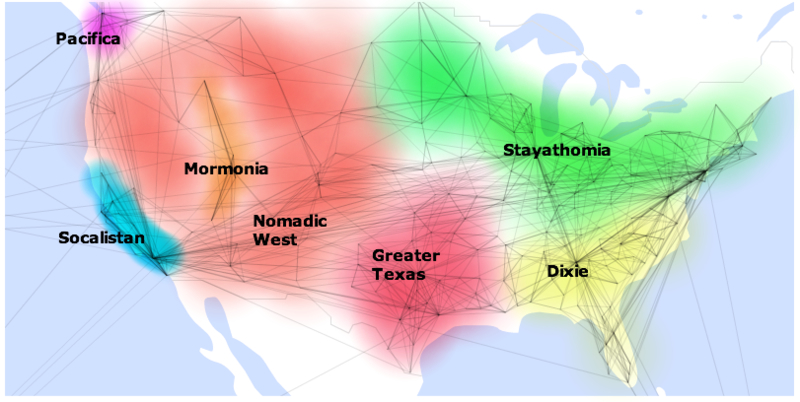
"How to split up the US" by Pete Warden

I’ve been thinking a lot about an essay I wrote last year on the failure of Quit Facebook Day. It was one of the most popular articles I’ve ever published on my personal blog. I think the piece holds up well, given the passage of time, and given recent changes at Facebook, it may become relevant again.

Over at Mashable, Christina Warren writes that “You won’t quit Facebook” in a new op-ed. (Side note: Mashable is a media partner for Facebook’s social news reader. I was surprised that neither Warren nor her editor disclosed that in her op-ed and will leave it to Micah Sifry to ask whether Facebook’s media partners can cover it objectively.)

I’m not so sure of Warren’s larger point. Comments there suggest a few Mashable readers have left, which is minimum an interesting data point, given the rather social audience we know visits the site. BrianBoyer left tonight and livetweeted his exit, linking to a post on “why logging out isn’t enough for partial explanation.

As a news application developer – a so-called “hacker journalist” – Boyer has a different relationship with technology than many members of the media and public. He makes the platforms and works at a newspaper company that sells ads against them. He’s commented on journalists using Facebook before and now has acted on his convictions.

Whether many others follow, I think, will depend upon whether there are substantive harms to users that result from the changes that are subsequently publicized by print and broadcast media, changing the perceived risk around usage. When whether anyone in the social journalism group would quit Facebook (closed group), the overwhelming answer was: no. That’s not surprising from that particular cadre of the media, of course. There’s a vibrant discussion around this post over at my first draft on Google Plus where others feel differently. (The convergence of Google and online privacy deserves its own post, which I have written elsewhere.)

I’m not predicting that will happen but I can foresee several different scenarios where unexpected sharing of reading or socializing behavior could have consequences to work, employment, education or relationships. @Mat Buchanon of Gizmodo explored the new Facebook integration more eloquently than I and at some length here:

There are significant benefits to be gained from social sharing, as my publisher Tim O’Reilly has outlined at Radar and in his talks. I have enjoyed many of them, given my frequent user of social media, and expect to continue to do so, with care.

That said, I do not want to have all of my actions online shared, nor would I wish those of marginalized segments of society to be made public if it endangered their safety.

I’ve talked with senior executives at Facebook several times, including its CTO and chief security officer and chief privacy officer. My sense remains that they all want to do the right thing by the people on their network, providing them with better tools to share information, keep them safe and give them better privacy controls… although the persistent cookies that remain upon logout pose an issue on the latter counts.

All that said, I can’t help but wonder if these changes will tilt the balance for more users. We’ll learn more over the coming months.

Caveat Lector

If you use Facebook, you need to read this New York Times article on new changes and think carefully about how much of your activity online you want to share here publicly.

From reading to listening to watching to buying, anything connected to Facebook will be tracked, logged and added to the growing body of information about your life online.

As with so many other aspects of our lives, we all owe it to ourselves to be educated about our digital choices.

Digital privacy is about much more than Facebook

To be clear: while Facebook is the biggest social network on the planet, with some 800 million users that spend more time on it than any other site, the issue of digital privacy is much larger, as anyone who has read the Wall Street Journal’s “What do They Know?” series or followed the issues knows well.

I covered all of last year’s FTC privacy hearings and was reminded of just how broad and deep the issue of digital privacy runs. New online privacy frameworks are lagging far behind industries that are crunching unprecedented amounts of data to try to target and personalize everything we buy, read, eat or watch. Location-based services have new bearing on online privacy. Last year, online privacy debates heated up in Washington. Expect more of the same.

2 Comments

Filed under blogging, journalism, social media, technology