Filed under Uncategorized


Filed under Uncategorized
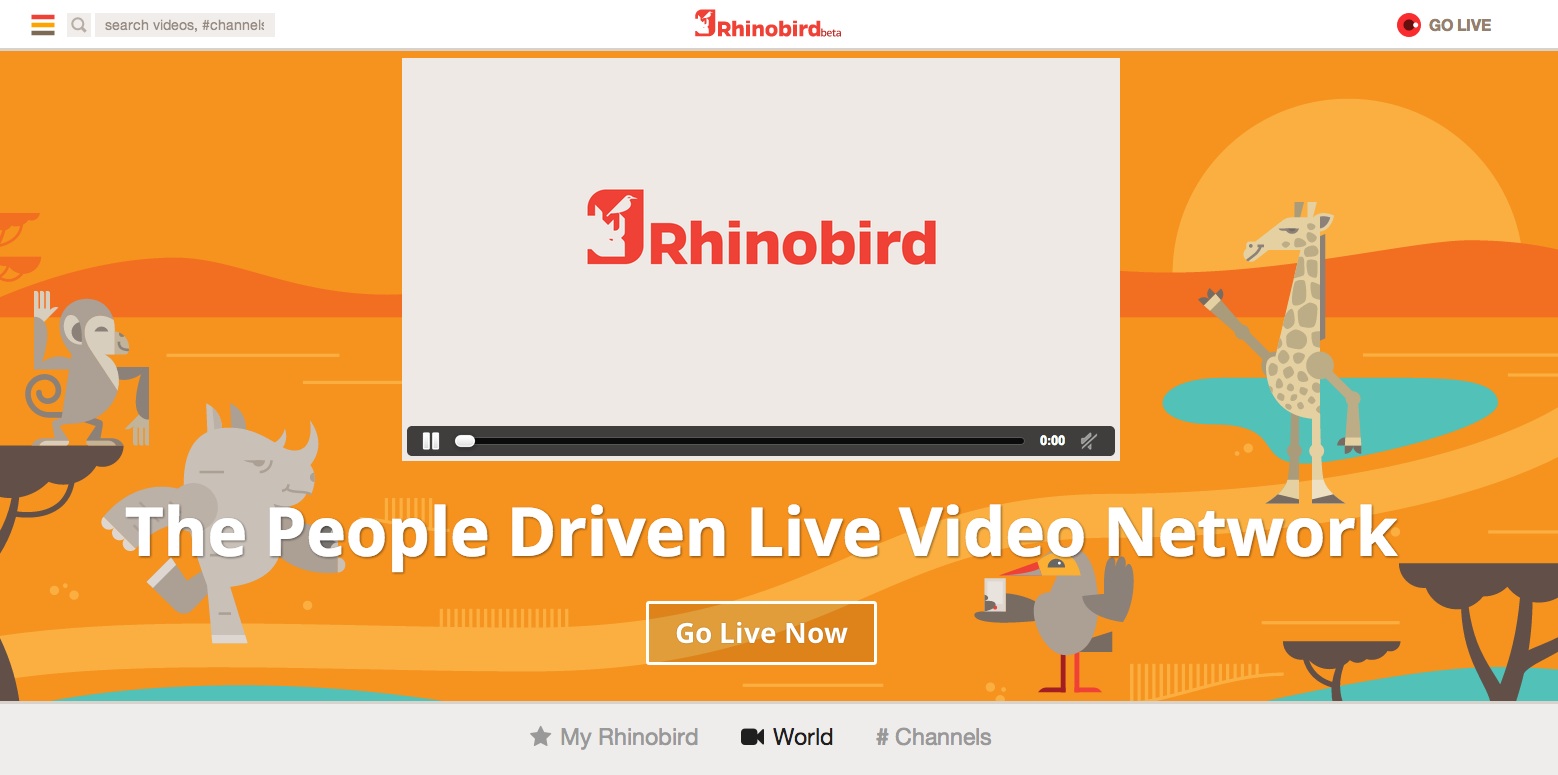
Media hype around the livestreaming “Meerkat election” helped Twitter, which put up its own Periscope for social livestreaming last month. Today, RhinoBird.tv officially launches its beta during that the spectacle of the running of the 119th Boston Marathon in the greater Boston area, offering an opportunity for thousands of Android users along the race route to download the app and crowdsource livestreaming the event.
The original funding for RhinoBird came from the Knight Foundation in 2012, where a proposal to “aggregate live mobile video streams of breaking news events into an easily searchable world map, connecting users directly to global events as they unfold” won the 2012 Knight News Challenge.
A couple of weeks ago, I talked with Felipe Heusser, the CEO of RhinoBird and a fellow at the Berkman Center for Internet & Society, about the app and livestreaming in general.
Our video interview is embedded below.
As Heusser notes, along with Android, RhinoBird also works within the Web browser using the open WebRTC project. It is, as they say here in Massachusetts, wicked fast.
Whether its approach to organizing livestreams around channels in a #hashtag convention familiar from Twitter is adopted en masse by hundreds of millions of Android users over the coming months will be fun to watch, along with those watching runners today.
If the app catches on, you’ll be able to watch the #BostonMarathon on RhinoBird.tv. Good luck with your respective races.
Filed under Android, app, application, open source, open standard, video
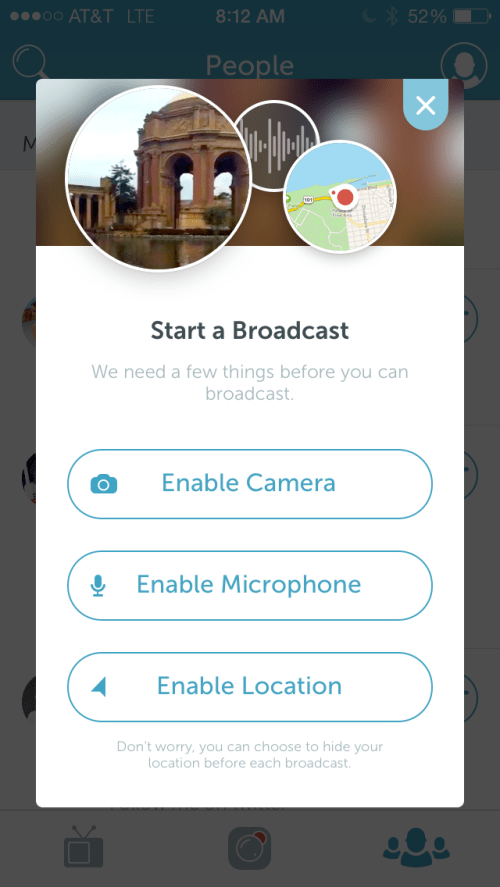
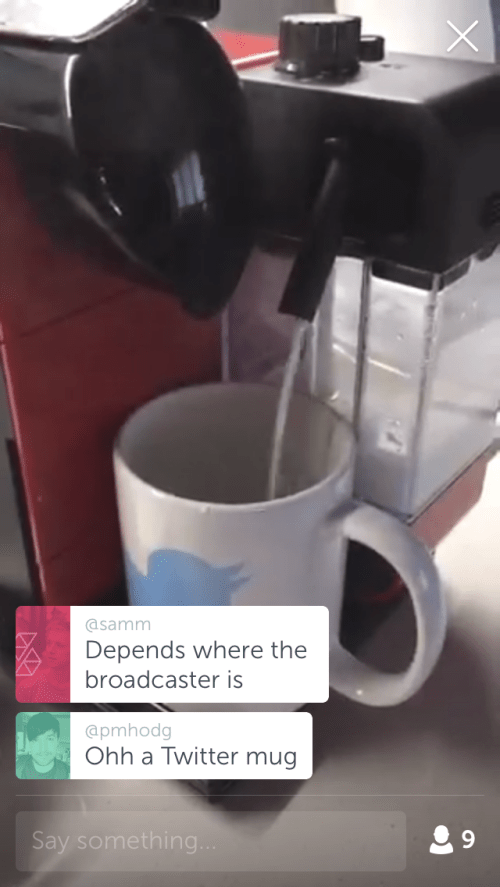
Today, Twitter’s livestreaming app is live in the Apple App Store.
Cue “Periscope Election” hype! More seriously, it’s a slick app: easy to sign up, browse, network and, most importantly, livestream.
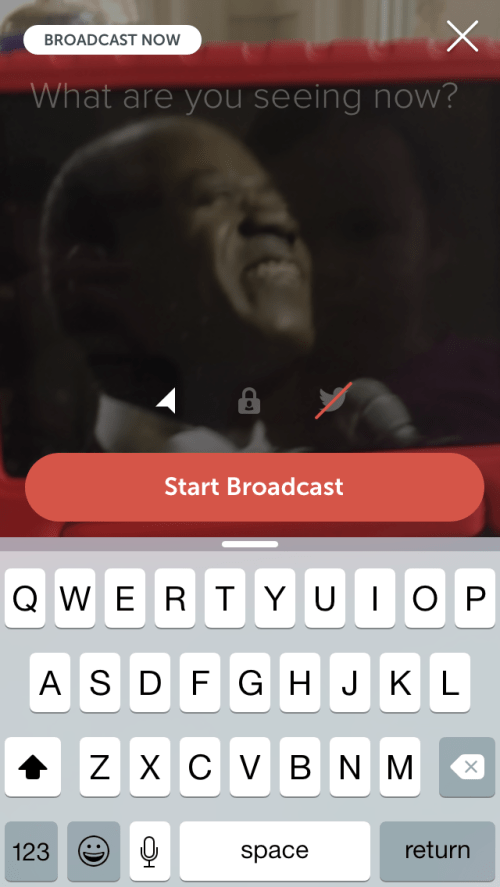
Twitter once asked us “What are you doing?” Now, Periscope asks us “What are you seeing?”
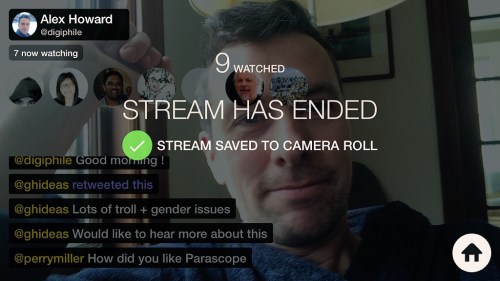
When I logged on, I saw windows into our shared worlds from all over the globe.
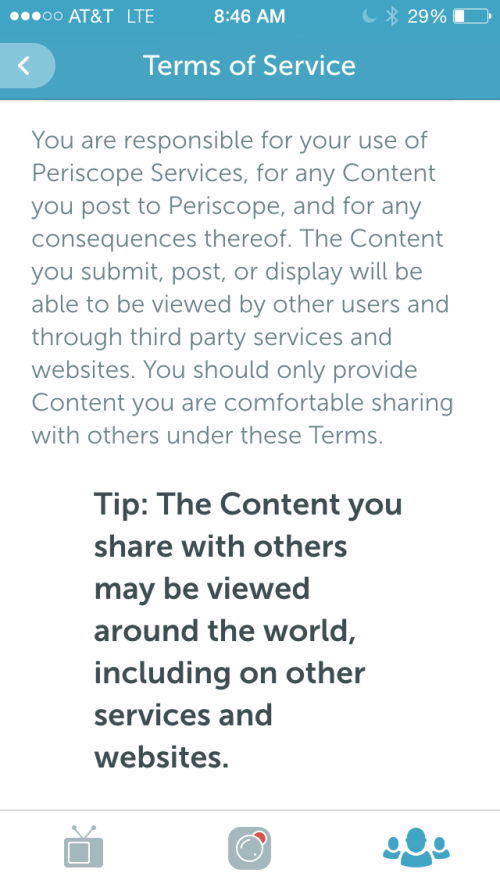
The Periscope privacy policy & Terms of Service more or less mirror Twitter’s, with a bold reminder that livestreams & archived videos are public. There’s at least one exception: no livestreaming pornography.
Fast wireless broadband service, social networks, and powerful smartphones with great cameras create a new context for livestreaming services, which has led tech companies, entrepreneurs and huge corporations to bet big on them.
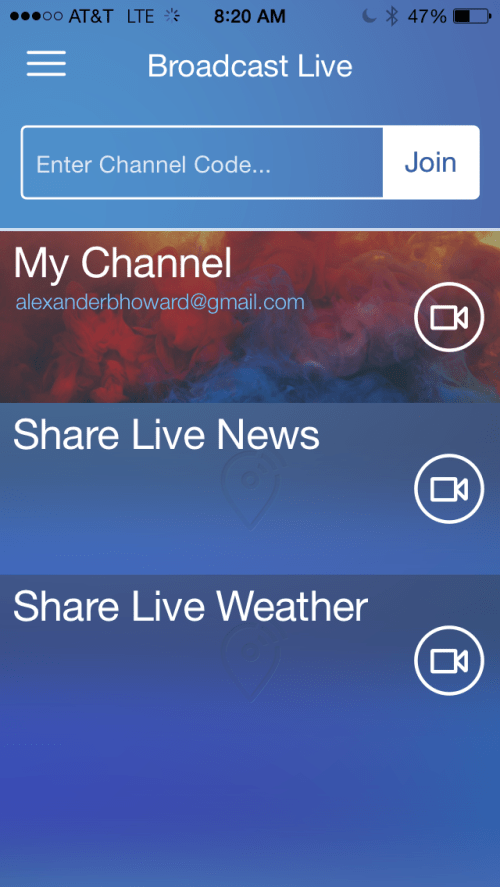
I downloaded Stringwire as well this week, but it’s not on par with Periscope’s features, UX or integration. I wonder if NBC Universal will create clear incentives for its use.
As I found some time ago, Google Hangouts can also be streamed live to YouTube. There are an awful lot of a Android devices in the world; I’d keep an eye on how that evolves, along with Facebook’s video features.
I also wonder about who will use these apps and where. Established celebrities can find their audiences. This morning, I saw people tuned in to see Mario Batali cook this morning. As with Vine and YouTube, unheralded talent may find success as well.
Most of life is, however, mundane by definition. I look forward to seeing how Periscope and other apps help us choose and share moments that resonate with the rest of humanity.
Filed under Uncategorized

Today, Ambassador Safira Deborah tweeted that she would stop using Twitter herself because doing so was distracting from the twin goals of “peace and stability” that the United States of America had in Libya. It was unclear whether it was her communication choices that led to the decision, the reception she encountered on the platform or some combination of the two factors. Twiplomacy created a timeline of her tweets, if you want to see them natively on Twitter.
The ambassador tweeted out a 8-part statement today, working within Twitter’s character limitations. She offered context for her initial decision to use the real-time social media platform, stating that it the “only way to reach out” for public diplomacy, in the context of Libya’s security situation and that her goal was to “encourage a transparent dialogue with all Libyans.”
The ambassador clarified that, while she would go silent, the United States delegation to Libya would continue to use Twitter on the embassy’s official account,@USAEmbassyLibya.
Filed under Uncategorized

The New York Times “First Draft” and Politico Playbook picked up the “Meerkat Election” idea today, so get ready for the hype cycle to wash through the commentariat. Former Florida governor Jeb Bush “meerkatted” yesterday — which is to say, used an app integrated with Twitter on his smartphone to livestream an event online. If that doesn’t sound revolutionary in 2015, congratulations: you’ve been paying attention to mobile technology over the last decade.
When you read posts that predict Meerkat’s prominence in 2016, keep a couple things in mind.
First, Twitter did change how political reporters covered the campaigns in 2012, so everyone is looking for the “next thing,” particularly in the New York and DC media world. Politicians and media using a shiny new app that “conquered all at SXSW” makes for easy copy and gets clicks. The integration of Meerkat into Twitter means that social network will drive more attention and adoption, although the app’s access to the company’s social graph bears watching. By the time 2016 rolls around, Twitter’s native live streaming function may be the new new killer campaign app. Steel yourself for the “Periscope Election,” friends.
Second, when you hear hype about technology like this breathless account in Politico from political reporters and operatives, be extra skeptical. Remember, 2008 was the “MySpace Election” and 2004 was to be the “Friendster Election. Heck, 1860 was the “Telegraph Election!” (Ok, the last one isn’t quite true, but you get the idea. )
Third, at present Meerkat videos are not archived on the site or embeddable . While that could certainly change in the months before the election, particularly if the startup gets funding, it is a consideration for journalists. That doesn’t mean, however, there isn’t another option: Ben Rubin, the developer of the app, told me that you can save Meerkat streams to your phone and upload the archived session to video sharing platorms like YouTube, an ability I subsequently confirmed.
Finally, livestreaming is not new to American politics. Presidential candidates like Senator Chris Dodd were using uStream in 2008. Ask President Dodd if it changed the election. A couple comments on Medium add some context, including one by Matt Browner Hamlin, who worked on the Dodd campaign.
Livestreaming was available in the last two presidential campaign cycles, but it didn’t fundamentally change our politics. It didn’t even shift the primary in 2008, as Browner Hamlin noted on Medium:
To state the obvious, the Dodd campaign’s innovative use of live streaming technology and public engagement via streaming video did not move the needle an inch in the Democratic presidential primary. Maybe it’s because we were eight years ahead of our time. But more likely it’s because the forces of political sentiment in America are too big to be influenced by one technology platform or one medium of engagement.
A covert video did affect Governor Mitt Romney’s campaign, but the reality of small video cameras had been part of the fabric of our lives for years before.
I wrote this post entirely on my iPhone, so it’s fair to acknowledge that media has evolved in recent years. (I’ve also been guilty of hype about new platforms myself.)
It’s also fair to acknowledge that Meerkat does something that defines innovation: it makes it easier to livestream on your phone.
“I think that because we remove friction to watch or go live (everyone can consume or contribute on the go with one click) it makes it easy for people to gain a larger audience while keeping the intimacy with the audience,” commented Ben Rubin, via email.
Faster connections, powerful smartphones and much high social media adoption do change the context from past election cycles, but will they change the outcomes or the dynamic?
We’ll see. The White House press secretary is doing a Meerkat interview today: maybe someone will ask him whether the size of the lens, camera and screens used to view it are a revolution or an evolution.
Filed under Uncategorized
Before I dove into the sometimes controversial waters of technology and development, I talked to a lot of people about parenting and screen time, including some experts. I wrote about what I learned in a column about the parenting challenges that ubiquitous screens pose in the 21st century.
Following is a quick list of insights to scan & share, with a big lift from danah boyd at the end.
1) Screens are ubiquitous in modern life. How we integrate them into our own lives will influence our children.
2) Engagement with our children as we consume media, whether on TV, tablets, or print, is critical to their learning.
3) “Parents can’t go wrong if they engage in “dialogic learning.” As you read or watch screens, talk about the stories.
4) There’s an important difference between children passively consuming media on a screen andusing it to be social. Watching a video isn’t the same as Facetiming with grandparents.
5) Parents should consider if screen time consuming media may be replacing human-to-human interaction.
6) Kids generally learn better with materials they can touch, vs what they see on a screen. 3D > 2D.
7) Not all screen time is detrimental. It should be age appropriate, time-limited, & involve parents.
8) Children learning through play are negatively impacted by screens playing in the background.
9) Watching TV or videos 2 hours before bedtime can have negative impacts on children’s sleep.
10) Common sense: use of mobile devices by parents, ignoring children, can lead to them acting out.
11) Too much interactivity in ebooks and games can actually distract from story lines and learning.
12) From danah boyd: “Parents: check your own screen engagement when you’re with your kid. We set the norms.
13) “When you’ve got younger kids, talk through every interaction you have with a screen” — danah boyd
14) “When your kids are older, talk them through how they want to allocate their time in general” — danah boyd
15) “It’s not about ‘screen vs. non-screen’ because homework is now screen. It’s about thinking about what time should look like.” — danah boyd
16) “What makes screen time ‘educational’ is…how the tech or media is integrated into life more generally”- — danah boyd
17) “Forgive yourself for using tech as a babysitter sometimes.”— danah boyd. Have empathy for other parents, too, especially on plane rides or long bus rides.
Fellow parents, your comments and thoughts on screen time, kids and learning are welcome.
Filed under article, education, journalism, research

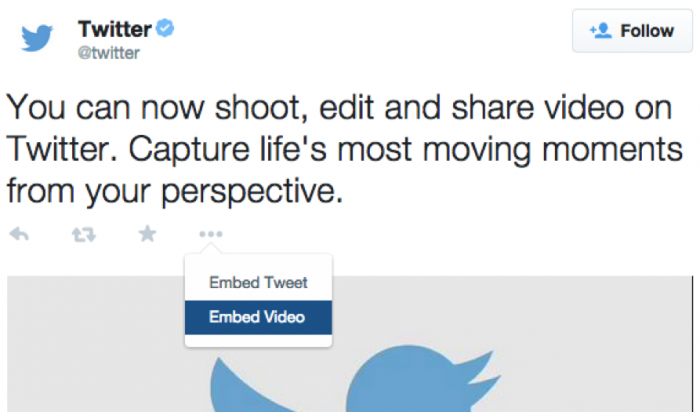
If the medium is the message, what are we to take of a service famous for short text messages evolving into a medium that can be embedded in other messages? Twitter has take a (web)page from YouTube in making videos created on its platform metastatic, spreadable and shareable.
We can now upload videos to @twitter & embed them: http://t.co/bUkVvBolaX Quite an evolution since 2007 pic.twitter.com/dRAUUpjkXN
— Alex Howard (@digiphile) March 2, 2015
While the ongoing shift to more pictures and video isn’t going to make Twitter into the next Instagram — it’s its own thing — the social platform has certainly come a long way since its text-based origin in 2006!
When I joined Twitter in 2007, I thought it was interesting, combining presence technology with mobile publishing and microblogging. A year later, I saw much more potential in the service than the sarcastic dismissal it tended to receive in the media and business worlds. It wasn’t until a disputed election in Iran in 2009, when online discussion and sharing of documentary evidence leaking out of that country led CNN to change its coverage, that the world started waking up to what Twitter would eventually become. While my embrace of Twitter has led some commentators to consign me to a triumphalist, intolerant cult of scolds, I continue to hold that there’s considerable value to be found here, premature eulogies notwithstanding.
Filed under Uncategorized
In a series of 17 tweets today, Jack Dorsey endorsed the multi-part “tweetstorm” as a “clever” way around the famous 140 character constraint of Twitter, the social media platform he co-founded in 2006.
“The folks using Twitter daily created the @username, the #hashtag, and the retweet, all within the constraint of 140 characters,” he tweeted. “The @, #, and RT have become cultural movements and have influenced every social and communications service since. Even offline. The “tweetstorm” and #/tweet syntax is a (clever) way around the 140 character constraint. Once again created by people using the service!”
What the co-founder of Twitter had to say in the latter half of his tweetstorm is worth noting as well, particularly in the context of the public social media company’s earning’s report next week. He defended Twitter CEO Dick Costolo from criticism, which in recent months has included a Wall Street Journal feature and influential investors on Wall Street.
Dorsey also highlighted recent product improvements at Twitter, including group messaging and video,
@Jack’s endorsement of the tweetstorm is likely to carry some weight with both users and Twitter itself, although he hasn’t been in a position to directly implement product design for some time. Previously, new features like the #hashtag and RT have been built into the Twitter platform after users adopted them. For that to happen again with the tweetstorm, Twitter would have to alter its publishing interface across operating systems to accommodate series or perhaps acquire an app like tweetstorm.io that enables easier creation.
One of Twitter’s most voluble users, venture capitalist Marc Andreessen (@pmarca), may be the must public adopter of the tweetstorm format, making news with series on Bitcoin and many other topics. Vox.com co-founder Ezra Klein is also a fan of the format, sending tweetstorms about whatever he’s covering with some frequency. Other users are as well, like digital media manager Justin Whitaker:
https://twitter.com/justinmwhitaker/status/560871823764914176
If Twitter does formally adopt the format as its own, don’t expect universal excitement.
https://twitter.com/JackLoftus/status/560873531563839488
Some observers and users of the platform don’t care much for the tweetstorm convention, even going so far as to say that “the tweetstorm trend must be stopped,” as Charlie Worzel did last year:
The fundamental criticism of the tweetstorm™ goes beyond the simple “get a blog” mentality. At its root, the tweetstorm™ feels like an abuse of power/influence or, at the very least, a slightly inconsiderate, oblivious way to engage with people who’ve chosen to follow you (granted, users can obviously choose to opt-out at any time with an unfollow). In earnestly embarking on a tweetstorm™, the tweetstormer™ is tacitly admitting that he or she has many important things to say and an infinite listener attention span in which to say them.
For my part, I can’t say I care much for the convention. While it is more accessible to all than using screenshots of text to get around the character constraint, a form that writer Mat Honan has dubbed the “screenshot, I tend to think that if you have enough to say that many tweets are required, you and the people you want to read whatever you are choosing to communicate will be better off if the series is collected into a blog post and edited.
I took a (decidedly unscientific, highly biased) poll of my followers on Twitter about the practice and confirmed that ‘tweetstorms’ are not beloved by all, but some people do like them.
https://twitter.com/_alastair/status/560920556682244096
https://twitter.com/6loss/status/560922865923817472
https://twitter.com/6loss/status/560923100897107969
https://twitter.com/cyclerunner/status/560924294252089345
https://twitter.com/jcufaude/status/560935496751132673
All that said, now that Jack Dorsey has endorsed tweetstorming, I suspect we’ll see more of them, not less. What I can co-sign, however, is the value Dorsey ascribes to Twitter’s role as a platform for expression and connection around the world.
While the platform and product is still imperfect, not equally representative of all of humanity or absolved from addressing ongoing issues with censorship and abuse, I’ve found that it to be a valuable place to invest time and attention for the past 7 years. I hope that feeling endures.
Filed under Uncategorized
“If the press won’t represent itself — and the people — by showing some interest in the free flow of government information, who will?” – Margaret Sullivan, public editor, New York Times
If an editor says that she is “very interested in the subject, and in following the legislation,” even if she and her staff are “particularly busy,” I would expect to see her tweet about it and retweet people who do have time to cover it. That wasn’t the case, even when the New York Times editorial pages blog wrote about it and other editors tweeted.
I can’t help but judge this to be a weak reply by the DC bureau chief. It’s particularly disheartening when the bill in question never got a vote in the House yesterday, sending Freedom of Information Act reform to expire in the 113th Congress.
Over the years, I’ve found that being politely persistent with editors over email and Twitter has led to more attention & coverage of boring but important topics. I tried a couple of new approaches to try to get attention on this count, including making “memes” and tweeting about what media companies were covering instead.
I spent the time not just because of the obvious need for FOIA reform but because I care about the New York Times and these other publications. I hoped they would put attention where it has *impact*. I can’t imagine that I made myself popular by doing so, but I’ve faced uncomfortable public questions about why I haven’t covered subjects, or how I did it. I’ve made errors of omission.
In my view, I failed; the vast majority of editors, producers and editorial boards simply didn’t cover FOIA reform, with notable exceptions at The Tennessean, Star Tribune, Review Journal, Cincinnati Enquirer, Bennington Banner, and, at the 11th hour, Newsweek.
The Washington Post did, on Wednesday, but completely blew the headline, putting no pressure on House leadership. I knew cable & broadcast news were unlikely to bother covering FOIA reform. I expected The New York Times would, when I flagged it on Sunday and contacted the public editor.
My bet was that House leadership would judge that they could hold back FOIA reform for a vote because major media would focus elsewhere. If so, they were right, and the public interest lost.
“In a political climate as divided as this, I had hoped that we could come together in favor of something as fundamental to our democracy as the public’s right to know,” said Senator Patrick Leahy (D-VT), That government transparency and openness would not just be the standard applied to the Obama Administration but what is applied to every future administration. The FOIA Improvement Act would have done just that.”
Postscript: On Friday afternoon, Columbia Journalism Review published a FOIA reform dies while the press looked the other way that quoted David Cuillier of the Society for Professional Journalists, Sullivan and me.
By day’s end, publications that hadn’t covered the bill while it was live covered its death. A “Push to Reform the Freedom of Information Act Collapses in House,” reported Frontline PBS. The U.S. “House Scuttle Bipartisan FOIA Reforms, reported MSNBC. FoxNews published an Associated Press report that Congress Fails to Revise Freedom of Information Act. None of the outlets had informed readers and watchers about the bill over the previous week, or what forces or people prevented its passage.
“If we’re going to be beacons of democracy, we need to walk the talk,” Cullier told CJR.
Post-Postscript: Writing for the Sunlight Foundation, Matt Rumsey managed to publish a somewhat, well, sunny post about the death of FOIA reform.
Sunlight has been strongly supportive of the FOIA Improvement Act because it addresses real world problems faced by requesters every day, specifically targeting overly broad exemptions and limiting unnecessary fees. Just like Sen. Patrick Leahy, D-Vt., one of its strongest champions, we aredisappointed that it did not become law.
And yet, we are hopeful for the future.
Most laws never make it out of committee even after repeated attempts spread over multiple years. The FOIA Improvement Act came tantalizingly close to becoming law its first time around.
Rest assured that the FOIA Improvement Act will be reintroduced in the 114th Congress and that the Sunlight Foundation and its allies will be fighting harder than ever for its passage. We want to say a hearty thank you to Leahy, Sen. John Cornyn, R-Texas, and everyone else that worked so hard during the 113th Congress to make these needed reforms possible. We’ll see you next year!
The Washington Post, to its credit, did a post-mortem on how this popular government transparency bill died in Congress. The reason the FOIA reform stalled in the House may not simply have been lobbying by the financial industry, however, as had been previously reported.
According to House aides, some lawmakers balked at the legislation because several agencies, including the Justice Department, warned that those making information requests would use the “forseeable harm” requirement as the basis for frequent lawsuits.
This detail led Trevor Timm, executive director of the Freedom of the Press Foundation, to argue that it was the Justice Department that secretly tried to stop FOIA reform, despite the text of the legislation being almost word-for-word the poilcy that the agency itself embraced in 2009.
Writing for the National Security Archive, Nate Jones looked for lessons from the death of the unanimously supported FOIA bill and decried “Janus-faced support for open government.” Here was his key takeaway:
Many people –in Congress, in the agencies, in the White House, in the media– proclaim they believe in open government, but don’t really. To me, that’s the only plausible reason a FOIA bill could garner unanimous approval (thrice in the Senate over the past seven years!) and still die; that’s the only plausible reason agencies whisper that instructions about FOIA currently on the books will ruin the federal government as we know it; that’s the reason for White House silence on the benefits the FOIA Ombuds office not being forced to run its reports though the Department of Justice so they can be “rosified;” that’s the reason the New York Times wins Pulitzers for its FOIA-based reporting, but doesn’t assign a Congressional beat reporter to cover the bill’s death.
How do we overcome these FOIA Januses? First, we must avoid being stalled out. We should force Speaker Boehner to act on his pledge that he “look[s] forward to working to resolve this issue [FOIA reform] early in the new Congress.” FOIA champions Senators Leahy, Cornyn, and Grassley remain in the Senate Judiciary Committee; these senators have an impressive history of defending and working to reform FOIA, no matter which party is in the majorly. Replacing Representative Issa on the House Oversight Committee is Jason Chaffetz (R-Ut); Democratic FOIA champion Elijah Cummings remains. Encouragingly, Chaffetz has said he “wants to address the Freedom of Information Act and the difficulties many have in getting the executive branch to comply with FOIA requests.” Both houses should immediately reintroduce the FOIA bill. More than 440 members who voted for FOIA reform remain in Congress.
On Saturday, December 20, the New York Times editorial board called for the 114th Congress to revisit the freedom to see government records.
Filed under Uncategorized
Last night, Buzzfeed editor-in-chief Ben Smith published an explosive story, reporting on a dinner in New York City where Uber executive Emil Michael floated the idea of hiring opposition researchers to dig up dirt on journalists who had been critical of the startup. Michael, who has since repeatedly apologized, asserted that neither “me nor my company would ever engage in such activities.” Uber spokesperson Nairi Hourdajian tweeted that “We have not, do not and will not investigate journalists. Those remarks have no basis in the reality of our approach.”
If so, Uber would differ from H-P, Wal-Mart, Deutche Telekom, Fox News and other tech companies that have investigated and monitored journalists reporting on them. Regardless of the truth of whether this famously aggressive company has or will gather such “dirt files,” one item in Smith’s report deserves special notice, as Jay Yarrow picked up this morning: Smith reported that Uber demonstrated how it could spy on journalists:
In fact, the general manager of Uber NYC accessed the profile of a BuzzFeed News reporter, Johana Bhuiyan, to make points in the course of a discussion of Uber policies. At no point in the email exchanges did she give him permission to do so.
Uber told Smith that “Any such activity would be clear violations of our privacy and data access policies. Access to and use of data is permitted only for legitimate business purposes. These policies apply to all employees. We regularly monitor and audit that access.”
According to Ellen Cushing, a senior editor at San Francisco Magazine, that policy doesn’t look watertight.
https://twitter.com/elcush/status/534529021929717760
Cushing explained more in a followup post about the warning she received::
It’s worth noting here that as far as I know, the company hasn’t looked into my logs. After talking to Uber staffers, it’s quite clear that the company stokes paranoia in its employees about talking to the press, so there’s a solid possibility that my sources’ fears were just the result of overzealous (and unfounded) precaution. But when I contacted a former employee last night about the news, this person told me that “it’s not very hard to access the travel log information they’re talking about. I have no idea who is ‘auditing’ this log or access information. At least when I was there, any employee could access rider rating information, as I was able to do it. How much deeper you could go with regular access, I’m not sure, as I didn’t try.” A second former employee told me something similar, saying “I never heard anything about execs digging into reporters’ travel logs, though it would be easy for them to do so.”
If you’re not thinking through the potential issues of Uber knowing who its riders are, when, and where, and what they are likely to have been doing, it’s worth stepping back a bit. Such associations can be powerful, as Uber has itself noted itself, from a “Ride of Glory“, defined as “anyone who took a ride between 10pm and 4am on a Friday or Saturday night, and then took a second ride from within 1/10th of a mile of the previous nights’ drop-off point 4-6 hours later (enough for a quick night’s sleep” to associations with alcohol and prostitution.
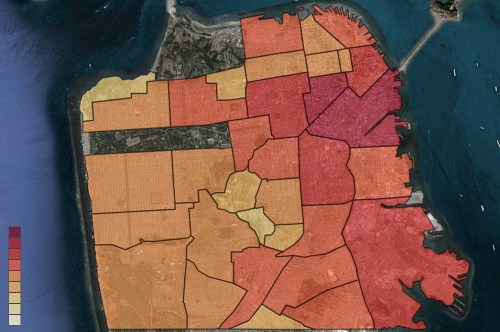
Uber blog: “How Prostitution and Alcohol Make Uber Better.” – “Areas of San Francisco with the most prostitution, alcohol, theft, and burglary also have the most Uber rides. ”
With great data comes great power, and therefore responsibility. That means culture and ethics matter. The reason Michael was angry at Sarah Lacy is appears to be because of her excoriating post about Uber’s culture.
Now, imagine if powerful members of Congress decide that they don’t like Uber’s labor practices, or surge pricing, or its approach to flaunting regulatory strictures, or the way it lobbies city governments not to be subject to reporting on compliance with accessibility laws. What then? Will the same executives who have showed a limited “God View” at launch parties choose not to use more powerful internal analytics to track who is going where and when?
https://twitter.com/JMBooyah/status/534703327964299265
I know this is all hypothetical, but multiple reports of executives accessing user profiles mean we need keep our eyes open and ears clear, particularly given the relationships we can see forming between powerful politicians and tech companies, and the stories we already know meta data can tell about our lives.
https://twitter.com/emilmichael/status/462851533584220160
The co-founder and CEO of Uber, Travis Kalanick, is a driven entrepreneur relentlessly focused on building a great product that seamlessly connects demand to capacity in a brilliant mobile app, leaving payment and logistics in the background. When I sat across from him at the launch party for Uber in DC, I found him to be funny and quick-witted, with a natural salesman’s charisma. Today, I think Uber users, including me, need to hear from him next, however, isn’t about future profit projections, plans for future expansion or more partnerships: it’s that we can trust him and his company with our locations and our safety. We want to know that they won’t ever use the data generated by our movements or pickups against us or the people who represent us. We want to know that they aren’t “morally bankrupt.” The stakes are too high to blindly trust without verifying.
UPDATE: Kalanick tweeted out the following statement after I published this post: “Emil’s comments at the recent dinner party were terrible and do not represent the company. His remarks showed a lack of leadership, a lack of humanity, and a departure from our values and ideals. His duties here at Uber do not involve communications strategy or plans and are not representative in any way of the company approach. Instead, we should lead by inspiring our riders, our drivers and the public at large. We should tell the stories of progress and appeal to people’s hearts and minds. We must be open and vulnerable enough to show people the positive principles that are the core of Uber’s culture. We must tell the stories of progress Uber has brought to cities and show the our constituents that we are principled and mean well. The burden is on us to show that, and until Emil’s comments we felt we were making positive steps along those lines. But I will personally commit to our riders, partners and the public that we are up to the challenge. We are up to the challenge to show that Uber is and will continue to be a positive member of the community. And furthermore, I will do everything in my power towards the goal of earning that trust. I believe that folks who make mistakes can learn from them – myself included – and that also goes for Emil. And last, I want to apologize to @sarahcuda.”
I’ll update this if he replies to my question. An edited version of this post was published on Wired.com.
UPDATE: On Tuesday night, un response to further concerns and criticism about its data use, Uber updated its privacy policy in a post to the company blog. I’m posting the statement in full below:
We wanted to take a moment to make very clear our policy on data privacy, which is fundamental to our commitment to both riders and drivers. Uber has a strict policy prohibiting all employees at every level from accessing a rider or driver’s data. The only exception to this policy is for a limited set of legitimate business purposes. Our policy has been communicated to all employees and contractors.
Examples of legitimate business purposes for select members of the team include:
Supporting riders and drivers in order to solve problems brought to their attention by the Uber community.
Facilitating payment transactions for drivers.
Monitoring driver and rider accounts for fraudulent activity, including terminating fake accounts and following up on stolen credit card reports.
Reviewing specific rider or driver accounts in order to troubleshoot bugs.
The policy is also clear that access to rider and driver accounts is being closely monitored and audited by data security specialists on an ongoing basis, and any violations of the policy will result in disciplinary action, including the possibility of termination and legal action.
Uber’s business depends on the trust of the riders and drivers that use our technology and platform. The trip history of our riders is confidential information, and Uber protects this data from internal and external unauthorized access. As the company continues to grow, we will continue to be transparent about our policy and ensure that it is properly understood by our employees.
[Graphic Credit: TechCrunch, Uber]
Filed under article, security, technology