














Video from the vigil:
Filed under Uncategorized
Some days, a joyous video can bring a tear to your eye. (That happens even more easily to when you’re planning your own wedding.) This “flash wedding” in Prudential Center last December in Boston did just that, riffing on the idea of a “flash mob.”
Unlike many flash mobs, however, this one had a point. Mazel tov, folks.
[Hat tip: Steve Garfield]
My belated wishes for the media in the New Year:
Please stop making generalized statements that “bloggers” are ____.
Blogs, whether they’re written by members of the media, business people or “average” citizens matter in 2011. A blog is a platform. All kinds of people use them. Some are more popular than others. Some are written by subject matter experts. Given the adoption of blogging software at the Financial Times, Wall Street Journal, Bloomberg and New York Times, the term “blogger” is is more a term of derision that an accurate classification.
The distinction of “blog” versus mainstream publication online has increasingly blurred to become nearly unrecognizable. Go back and read Nick Denton’s post on why Gawker is moving beyond the blog and consider his plan for new media in 2011.
Please stop writing headlines that “[X] is dead” or about “wars” between companies.
Exception: foreign correspondents and war journalists, both of whom exist in decreasing numbers these days. If you’re not covering an actual war, stop using the metaphor. Seriously.
For instance, blogs aren’t dead, though some of the activity and conversation that existed there in 2006 has moved in Facebook or Twitter in 2011. If you go with such a headline, steel yourself for a critical response.
Please link to the outlet and the journalist that broke a story, whether it’s “old media” or a blog.
Hyperlinks are the dendrites of the Internet. Hyperlinks are like a retweet on Twitter: they’re both social currency. Linking up the source for news story or fact with a link is like footnoting a research paper, except that it both helps the reader learn more and provides credit and authority to the site linked. Neither mainstream media nor blogs should be lifting stories without linking in 2011. So stop.
Please stop disparaging the influence of “bloggers.” Or talking about their pajamas.
It really doesn’t matter what I’m wearing when I file, though these days it’s a suit more often than shorts or pajamas.
The argument that one irate customer taking the Internet won’t matter is passe in 2011, as many publicly traded companies have found during online backlashes. A powerful short video and a post can and will go viral online, particularly if it’s a customer service or product issue that resonates widely.
That’s even more true so for blogs and writers at the top of an industry vertical, although Consumer Reports still has plenty of clout. When experts share their views online, they gain algorithmic authority online, which over time leads to influence over a given community. If Louis Gray or Robert Scoble or Mike Arrington cover a startup, it can put them on the map.
There’s no need to ask media critics like Brian Stelter, Felix Salmon, Ken Doctor, David Carr, David Folkenflik or Jay Rosen if they read blogs: they do. So do more “mainstream media influencers” like Katie Couric or the Sunday talk show hosts, along do the top editors of every publication I’ve talked to last year. The Pulitzer Prize now includes online organizations.
Please stop hosting influence contests. Lift up new voices.
Sure, an influence project might have sounded like a good idea in 2010. Many people disagreed. Strongly. Despite the backlash, new social media contests are still coming online for people to game. Predictably, strong critiques emerged, including those that focus on a different kind of digital divide. There is an emerging industry of analytics services that crunch big data and social recommendations to determine online influence or grade social media accounts, although they all have a long journey yet to evolve.
Instead of encouraging a community to engage in a popularity contest, considering using the power of an established media platform to empower new voices, highlighting what’s unique about an area and connect neighbors who might not know one another.
Filed under blogging, journalism, social media, technology, Twitter
2010 was full of amazing stories and experiences, both personal and professional. I’m grateful for the many opportunities I had speak to brilliant, fascinating people about technology, government, media and civil society. I’ve learned a tremendous amount from my interviews this year, many of which were captured on video. Some were filmed with my iPhone 4, others with a Canon 110si, others by O’Reilly Media’s professional video team after I joined the company as its new Gov 2.0 Washington Correspondent.
Regardless of the quality of light, image or sound, each interview taught me something new, and I’m proud they’re all available on the Web to the public. The list below isn’t exhaustive, either. There are easily a dozen other excellent interviews on my channel on YouTube, O’Reilly Media’s YouTube channel, uStream and Livestream. Thank you to each and every person who took time to talk to me this past year.
Filed under cyberlaw, education, government 2.0, journalism, social media, technology, video
 Yesterday, a leaked screenshot from an internal Yahoo! product meeting created widespread throughout much of the Web: delicious, the social bookmarking giant, appeared in the “sunset” category. There are petitions to save it, offers to buy it, a movement to to open source it and even a suggestion that it should be moved into the Library of Congress.
Marshall Kirkpatrick wrote a beautiful euology on ReadWriteWeb, RIP delicious: you were so beautiful to me.
A day later, delicious has responded. Spoiler: they’re not shutting down. The statement on what’s next for delicious from the blog is posted in full below.
Many of you have read the news stories about Delicious that began appearing yesterday. We’re genuinely sorry to have these stories appear with so little context for our loyal users. While we can’t answer each of your questions individually, we wanted to address what we can at this stage and we promise to keep you posted as future plans get finalized.
Is Delicious being shut down? And should I be worried about my data?
– No, we are not shutting down Delicious. While we have determined that there is not a strategic fit at Yahoo!, we believe there is a ideal home for Delicious outside of the company where it can be resourced to the level where it can be competitive.
What is Yahoo! going to do with Delicious?
– We’re actively thinking about the future of Delicious and we believe there is a home outside the company that would make more sense for the service and our users. We’re in the process of exploring a variety of options and talking to companies right now. And we’ll share our plans with you as soon as we can.
What if I want to get my bookmarks out of Delicious right away?
– As noted above, there’s no reason to panic. We are maintaining Delicious and encourage you to keep using it. That said, we have export options if you so choose. Additionally, many services provide the ability to import Delicious links and tags.
We can only imagine how upsetting the news coverage over the past 24 hours has been to many of you. Speaking for our team, we were very disappointed by the way that this appeared in the press. We’ll let you know more as things develop.
-cyeh · Chris
I’m looking forward to learning what happens next for delicious; there appear to be a number of options that might be palatable to long-time users, particularly the developer community. While my usage took a nose dive over the past two years, I’d like to be able to keep using my 2353 bookmarks there and the service in general.
I’m particularly curious about whether delicious could up in the Library of Congress. If billions of tweets are worth storing, why not this vast collection of collectively curated hyperlinks?
Filed under social bookmarking, technology
From Playing for Change.
“A dream you dream alone is only a dream. A dream you dream together is a reality.” – John Lennon
This month marked the 30th anniversary of John Lennon’s death.
[Hat Tip @MosesHawk]
Filed under video
Last weekend, I was proud to join a fascinating group of people in the first News Foo out in Phoenix, Arizona. I’m still thinking through what it all meant to me. Covering events in Washington has kept me extremely busy from the moment I returned.
Almost by definition, you can’t go to everything at an unconference. And by definition, an unconference is what you make of it, meaning that if you to a session to happen, you need to propose it. If you don’t like the one you’re in, vote with your feet. The open structure means that everyone will have a different experience, a reality that was reflected in the tweets, blogposts and feedback that have emerged in the days since the first News Foo concluded in Phoenix.
Newsfoo is a variant of Tim O’Reilly’s famed Foo camps, which have a wiki unconference format. People create the sessions as they go, and they camp out together. The social + intellectual experience is a bonding opportunity. There is also, for example, a Sci Foo camp which is consponsored by O’Reilly, Nature mag and Google. Now there is a push to do a Newsfoo, which would bring technologists and journalists together in a high-level discussion, that looks forward rather than back. It would tackle cool problems, both content side and business side.
To expand on that concept, posted before the event, News Foo was a collaboration between O’Reilly Media, Google and the Knight Foundation. Each hour or so, four or five sessions frequently competed for attention, along with freewheeling conversations in hallways, tables and in the open spaces of Arizona State University’s beautiful journalism center. As with every unconference, the attendees created the program and decided which sessions to attend, aggregating or disaggregating themselves.
If you’re interested in other reactions to News Foo, several excellent posts have made their way online since Sunday. I’ll be posting more thoughts on Newsfoo soon, along with book recommendations from the science fiction session.
For those who were not present, a post by Steve Buttry is particularly worth reading, along with the lively dialogue in the comments: “News Foo Camp: Not fully open, but certainly secret.” Buttry reached out to Sarah Winge, who provided a lengthy, informative comment about what Foos are about and how “Friend D.A.” works. If you’re not familiar with either, go check out Steve’s excellent post.
As he notes there, heavy tweeting was discouraged by the organizers, a request supported by the thinking that being “fully present,” freed of the necessary attention that documenting an event accurately requires of a writer, will result in a richer in-person experience for all involved.
Over the course of the weekend, I certainly tweeted much less than I would at the average conference or unconference. But then foo isn’t either.
I did take a few moments to share resources or stories I heard about at newsfoo with my distributed audience online. Following are 28 tweets, slightly edited (I took out the #Newsfoo hashtag and replies in a few) that did just that, rather like I’d microblogged it. If you’re confused about the “twitterese” below, consult my explainer on the top 50 Twitter acronyms and abbreviations and my thinking on how #hashtags on Twitter are like channels on cable TV. For many more tweets from other attendees, check out “Newsfoo at a Distance,” a Storify curation.
1. #Newsfoo is an unconference in Phoenix, AZ this weekend. Technologists & journalists talking about “what’s next.”
2. Foo Camp is about “making new synapses in the global brain,” says @TimOReilly. And being present. Here. http://twitpic.com/3cnxcl
3. ASU Cronkite School of Journalism. Beautiful. http://instagr.am/p/dLie/

4. Loving session on context with @mthomps @adamdangelo & @tristanharris. Some context: http://futureofcontext.com #meta
On the long form
5. In #longform discussion. Love this topic: http://longform.org | http://longreads.com | @NiemanLab: http://j.mp/9X9Php
6. More on #longform at @Guardian: http://j.mp/d5lhF5 @longreads @TheAwl @somethingtoread @longformorg @thelonggoodread
7. “Final Salute” http://j.mp/px3Vk Pulitzer Prize-winning story by @jimsheeler. @TheRocky closed last October.
8. Readability changed how I read #longform journalism online: http://readability.com @Pogue: http://nyti.ms/3Yu9KD
9. Learned about @audiopress from @wroush. Roll your own podcast playlists. @Xconomy: http://bit.ly/cuBm1G #longform
Data Journalism
10. Good ooVoo test with @kmcurry. Virtual session with @jeanneholm& @davidherzog on data journalism at 1:45 MST http://bit.ly/etWw7R
11. Data tools at http://opendataday.org being used at #rhok & #odhd hackathons: http://oreil.ly/g4ibiF #opengov #gov20
12. There’s someone from http://scraperwiki.com at #newsfoo.
Wikileaks
13. Moved to #Wikileaks session. Wonderfully deep. Useful take on #cablegate at @TheEconomist: http://econ.st/hyD7kM
14. “Former #WikiLeaks activists to launch new whistleblowing site”-Der Spiegel http://bit.ly/f4iP6Q #cablegate
15. Talking about #COICA: http://act.ly/S3804 http://eff.org/coica #ACTA & DNS issues. Important: http://nyti.ms/evvl6u
Trust and the media
16. Thinking about trust in institutions & the media. See: http://reportanerror.org & @ChangeTracker: http://j.mp/dEzAQw
17. RT @acarvin Same at NPR RT @drcarp Journalist participation in comments leads to reduced moderation and improved tone http://bit.ly/ex9FUx
Newsfoo Ignite
18. Inspired again by @acarvin at Ignite. http://crisiscommons.org http://twitpic.com/3d15em http://twitpic.com/3d15q2
19. You can watch @acarvin do an Ignite on the same topic/preso here now: http://oreil.ly/9ZIEMs
20. Great Ignite on Twitter metrics by @zseward. Bad: http://twitpic.com/3d1qtz Better: http://twitpic.com/3d1qzz
21. Interesting Ignite from the CEO of @peoplebrowsr. Another tool to try: http://research.ly http://twitpic.com/3d1w93
22. “Curiousity is the cartography that allows you to see more finely grained maps of the world”-@tristanharris
Sunday sessions
23. Good morning! Talking how media biz models might work in with FTC #DNTrack. Context: http://oreil.ly/igZJso
24. Reminded of how ugly black hat SEO spammers & fraudsters act online after disasters. http://usat.ly/88pYMk
25. Absolutely geeking out in this #scifi news session. @GreatDismal & Douglas Adams would dig. Geektastic: http://looxcie.com
26. Wonderful moment: “Let me plug a book: “The Victorian Internet'”-@sbma44 “I wrote it”-@tomstandage http://j.mp/QX4tS
27. Yes. @NiemanLab: http://bit.ly/9xFLft RT @tomstandage: Anyone else at #newsfoo interested in the Gutenberg Parenthesis?
28. Bit hard to leave the warm sun of Phoenix & brilliance of the #newsfoo community for DC. Good to debrief with @jsb @rbole @Hari & @pergam.
Filed under blogging, friends, government 2.0, journalism, microsharing, photography, scifi, social media, technology, Twitter, video
New research from the Pew Research Center’s Internet & American Life Project sheds new light on the use of Twitter In its “Twitter Update,” the Pew Internet report shares key demographics, behaviors and insights on the rapidly growing social network that has continued to be one of Silicon Valley’s hottest startups. Pew researchers found that 8% of online adults said they use Twitter, with some 2% tweeting on a typical day. Pew’s research currently estimates that 74% of American adults are Internet users.
More stats:
What are people sharing? Hint: It’s not what they’re eating. Personal updates lead the list, followed by work updates, sharing links to news, posting “general life observations,” retweeting other people and direct messaging.
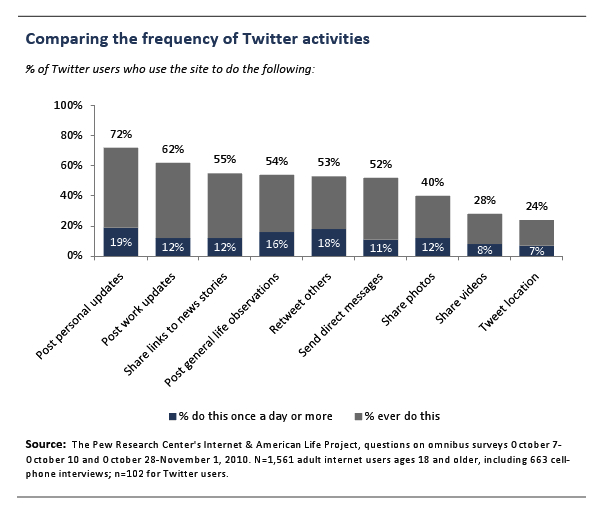
All in all, it’s a fascinating picture of Twitter. You’ll learn a lot more at Pew Internet’s “Twitter Update,” including the sample size and methodology behind the report — so go read it.
And then tweet about it. :)
Filed under microsharing, social media, Twitter
 I’ve been traveling a lot this year as part of my role as the Gov 2.0 correspondent at O’Reilly Media, along with attending a succession of panels, forums, conferences and symposiums here in Washington. It’s been a privilege and a pleasure to explore more of the country and tell the stories of fascinating people and trends. The next ten days are going to be especially interesting, although I’m happy to report that I won’t be venturing far beyond the District of Columbia’s boundaries during that time.
Tomorrow, the first International Open Government Data Conference begins here in Washington. I’ll be on a panel on Tuesday discussing the value proposition of open government data.
On Thursday, a Politico tech policy forum will focus on what’s next in technology in Washington, featuring Kim Hart and federal CTO Aneesh Chopra.
This weekend, PBS and NPR will host the second annual Public Media Camp. In 2009, the public media unconference was about “We, the media.” We’ll see what theme predominates the discussion in 2010.
On Monday, November 22, I’ll be on a panel at the Center for Science, Technology, and Security Policy at the American Association for the Advancement of Science for a cybersecurity forum, “Can policy keep up with the pace of technical change?”
Since the cybersecurity forum does not appear to have an online event listing, the details are below:
“Cybersecurity presents a unique challenge to government policymakers.
Innovation, falling information technology resource costs, and the corresponding
development of malware and other cybersecurity threats have occurred
at speeds that far exceed the rate at which government is accustomed to
establishment and implementation of policy.
What has the federal government learned from its experience in chasing
this rapidly moving target? Have government practices evolved to meet the
speed and diversity of the problem? Are there alternative policy approaches
to traditional governmental procedures that might better counter the range of
threats to this nation’s cybersecurity?
Please join us from 3:00 to 4:30 on Monday November 22, 2010 to hear former
federal cybersecurity advisor Richard Clarke and a panel of cybersecurity and
internet policy experts address policy formulation and implementation in the face
of unprecedented challenges.
Speakers:
Richard Clarke. Former special advisor on cybersecurity to President George
W. Bush. Author of Cyber War: The Next Threat to National Security.
Dr. Eugene Spafford. Professor of Computer Science at Purdue University.
Dr. Spafford has served as a senior advisor and consultant on issues of security
and intelligence to the Department of Justice, the Department of Energy, and
two Presidents of the United States.
Larry Clinton. President and CEO of the Internet Security Alliance, a multi-
sector industry group, created by the former Chairman of the U.S. House
Permanent Select Committee on Intelligence.
And me.
I have a feeling I’ll have a lot to talk about over the Thanksgiving dinner table next Thursday, along with reporting it out at Radar, Govfresh and the Huffington Post.
If you want to follow my speaking or reporting, I share my schedule on Plancast and post regularly to Twitter (@digiphile) and Facebook.
Filed under technology
 E-PluribusUnum.org


 digiphile