Category Archives: blogging

Can we still quit Facebook?

"How to split up the US" by Pete Warden

I’ve been thinking a lot about an essay I wrote last year on the failure of Quit Facebook Day. It was one of the most popular articles I’ve ever published on my personal blog. I think the piece holds up well, given the passage of time, and given recent changes at Facebook, it may become relevant again.

Over at Mashable, Christina Warren writes that “You won’t quit Facebook” in a new op-ed. (Side note: Mashable is a media partner for Facebook’s social news reader. I was surprised that neither Warren nor her editor disclosed that in her op-ed and will leave it to Micah Sifry to ask whether Facebook’s media partners can cover it objectively.)

I’m not so sure of Warren’s larger point. Comments there suggest a few Mashable readers have left, which is minimum an interesting data point, given the rather social audience we know visits the site. BrianBoyer left tonight and livetweeted his exit, linking to a post on “why logging out isn’t enough for partial explanation.

As a news application developer – a so-called “hacker journalist” – Boyer has a different relationship with technology than many members of the media and public. He makes the platforms and works at a newspaper company that sells ads against them. He’s commented on journalists using Facebook before and now has acted on his convictions.

Whether many others follow, I think, will depend upon whether there are substantive harms to users that result from the changes that are subsequently publicized by print and broadcast media, changing the perceived risk around usage. When whether anyone in the social journalism group would quit Facebook (closed group), the overwhelming answer was: no. That’s not surprising from that particular cadre of the media, of course. There’s a vibrant discussion around this post over at my first draft on Google Plus where others feel differently. (The convergence of Google and online privacy deserves its own post, which I have written elsewhere.)

I’m not predicting that will happen but I can foresee several different scenarios where unexpected sharing of reading or socializing behavior could have consequences to work, employment, education or relationships. @Mat Buchanon of Gizmodo explored the new Facebook integration more eloquently than I and at some length here:

There are significant benefits to be gained from social sharing, as my publisher Tim O’Reilly has outlined at Radar and in his talks. I have enjoyed many of them, given my frequent user of social media, and expect to continue to do so, with care.

That said, I do not want to have all of my actions online shared, nor would I wish those of marginalized segments of society to be made public if it endangered their safety.

I’ve talked with senior executives at Facebook several times, including its CTO and chief security officer and chief privacy officer. My sense remains that they all want to do the right thing by the people on their network, providing them with better tools to share information, keep them safe and give them better privacy controls… although the persistent cookies that remain upon logout pose an issue on the latter counts.

All that said, I can’t help but wonder if these changes will tilt the balance for more users. We’ll learn more over the coming months.

Caveat Lector

If you use Facebook, you need to read this New York Times article on new changes and think carefully about how much of your activity online you want to share here publicly.

From reading to listening to watching to buying, anything connected to Facebook will be tracked, logged and added to the growing body of information about your life online.

As with so many other aspects of our lives, we all owe it to ourselves to be educated about our digital choices.

Digital privacy is about much more than Facebook

To be clear: while Facebook is the biggest social network on the planet, with some 800 million users that spend more time on it than any other site, the issue of digital privacy is much larger, as anyone who has read the Wall Street Journal’s “What do They Know?” series or followed the issues knows well.

I covered all of last year’s FTC privacy hearings and was reminded of just how broad and deep the issue of digital privacy runs. New online privacy frameworks are lagging far behind industries that are crunching unprecedented amounts of data to try to target and personalize everything we buy, read, eat or watch. Location-based services have new bearing on online privacy. Last year, online privacy debates heated up in Washington. Expect more of the same.

2 Comments

Filed under blogging, journalism, social media, technology

Yahoo Research: 50% of tweets consumed are generated by 20,000 elite users

New research from research on Twitter found that 50% of tweets consumed are generated by 20K elite users. Based upon the more than 37,000 tweets I’ve posted over four years of tweeting, it’s a virtual lock that I’m one of them. Of particular interest was the “significant homophily” that the researchers found within categories. I’ve tried hard to escape that effect after reading Ethan Zuckerman’s post on homophily, serendipity and xenophilia nearly three years ago.

FULL PAPER: Twitter flow

Abstract:

We study several longstanding questions in media communications research, in the context of the microblogging service Twitter, regarding the production, flow, and consumption of information. To do so, we exploit a recently introduced feature of Twitter—known as Twitter lists—to distinguish between elite users, by which we mean specifically celebrities, bloggers, and representatives of media outlets and other formal organizations, and ordinary users. Based on this classification, we find a striking concentration of attention on Twitter—roughly 50% of tweets consumed are generated by just 20K elite users—where the media produces the most information, but celebrities are the most followed. We also find significant homophily within categories: celebrities listen to celebrities, while bloggers listen to bloggers etc; however, bloggers in general rebroadcast more information than the other categories. Next we re-examine the classical “two-step flow” theory of communications, finding considerable support for it on Twitter, but also some interesting differences. Third, we find that URLs broadcast by different categories of users or containing different types of content exhibit systematically different lifespans. And finally, we examine the attention paid by the different user categories to different news topics.

Leave a comment

Filed under blogging, research, social bookmarking, social media, technology

Smarter social networking at SMCDC

Tonight, I’ll be moderating a discussion at Porter Novelli DC about what “smarter social networking” means.

Fortunately, posing questions to this particular set of panelists will be much more easier than trying to herd LOLcats.

Some time shortly after 7 PM EST, I’ll start asking Frank Gruber (@FrankGruber), CEO & co-founder of TechCocktail, Shana Glickfield (@dcconcierge), partner at Beekeeper Group, and Shonali Burke (@shonali), principal at Shonali Burke Consulting, what “smarter social networking” means in 2011. We’ll be talking about forming relationships and acting professionally in the context of the Internet. I might even ask about what good “netiquette” means.

I expect to see Federal News Radio Chris anchor Chris Dorobek (@cdorobek) to be there in person to heckle me online, along with the rest of one of the more connected group of people in the District of Columbia. The DC Social Media Club, after all, comes heavily loaded with BlackBerrys, iPhones, iPads and Android devices. Some will even have two of those devices – one official, one not, and will be wired into Facebook, Twitter, email and txt messaging.

This is clearly a group of people that has thought a lot about how to practice “smarter social networking.” As prepared for the discussion last night, I was reminded that the actions that humans take online increasingly are aligned what they do offline.

That’s because the idea of a separate “cyberspace” is on life support. That’s was one conclusion that Clay Shirky brought to a discussion of the recent report by the Pew Internet and Life Project on the social side of the Internet at the State of the Net Conference.

In wired communities, people are increasingly integrating their online lives with their offline actions. As that trend grows with more of humanity coming online, the role of the Internet as a platform for collective action increases. The world has seen some of that power at work in Tunisia and Egypt this winter.

Those connections are not always strongly made, due to the anonymity sections of the Web of 2011 provide. You only have to look at the quality of civil discourse between commentary on YouTube or newspaper comment threads without moderation to see how anonymity can enable the id of humanity to wash over a page. Teachers, freedom fighters, activists, law enforcement, aid workers, insurgents, journalists or criminals can and will use the Internet for different ends. When any tool is put to ugly or evil use, naturally it provokes outrage, concern, regulation or outright bans.

As Stowe Boyd wrote this weekend in his essay on cognition and the Web, however, “throwing away the web because you don’t like what you see is like breaking a mirror because you don’t like your own reflection. It is us we are staring at in that mirror, on the web: and it is us looking out, too.”It is us we are staring at in that mirror, on the web: and it is us looking out, too.”

In this age of radical transparency, it’s becoming harder and harder to hide to hide demonstrated bad character over time. That’s even more true of people who choose to live their lives more publicly on Facebook, Twitter, Foursquare and where ever else there digital nomadism leads them next.

This isn’t an entirely happy development, as the number of citations of social networking in divorce filings suggest. By the end of the next decade, more people may well be paying money to assure their privacy than to gain more publicity.

In that context, “smarter social networking” in an age of digital transparency may well rely more on good character, better business ethics and placing value in building trusted relationships than faster wireless broadband, the newest smartphone or millions of followers or fans.

3 Comments

Filed under article, blogging, friends, personal, social media, technology, Twitter, Uncategorized

Your Twitter journalism is so phat that _____

Today, spurred by a (rather absurd) debate about whether Twitter is journalism, Brian Solis asked whether tweets are recognized as acts of journalism, and as such, regarded as bona fide journalism. That’s a much better question. As of yet, unfortunately, no media law expert has sprung to answer it in the comments for his post.

Del Harvey Somebody else did answer the question on Twitter, albeit substituting snark for substance: @delbius, also known as Del Harvey, the head of Twitter’s Trust & @Safety team.

Her reply, below, set off one of the funniest exchanges I’ve ever had in more than 3 years of tweeting.

Del: Not gonna lie, read that Tweet and what sprang to mind was “Your mom’s an act of journalism.”

Alex: Your journalism is an act of Mom! Or to put it another way, your journalism is so fat, it had to create a @yearly account.

Del: My journalism is phat, thank you.

Alex: Ok, I’ll play. Your journalism is so phat, it can only be published in 140 characters or more.

Del: Your journalism is so phat that it uses the full title of weblog.

Alex: Your micro journalism is so phat that you have to make the Twitter display widgets auto-width.

Del: Your journalism is so phat your lede takes up a paragraph.

Alex: Your journalism is so phat that the IEEE had to create a new standard data format for your letters.

Del: Your journalism is so phat that your angle is obtuse.

Alex: Your journalism is so phat that you have to use deck.ly to share what your officemate ate for lunch.

Del: Your journalism is so phat your informant was Mrs. Fields.

Alex: Your zombie journalism is so phat that your editor has to use liposuction to find where you buried the lede.

Del: Your journalism is so phat you’re below the *second* fold.

Alex: Your journalism is so phat that your readers are directed by their physicians to go on Lipitor after reading it.

Del: Your journalism is so phat your b-roll had butter on it. (wince @ self)

Alex: Your journalism is so phat that newly elected Congressmen are considering a vote to defund it.

Del: Your journalism is so phat your jump cut is a jiggle cut.

Alex: Your journalism is so phat that you had to get 5000 TB SATA drives to be the scratch disks for your video editing.

Del: Your journalism is so phat your POV pieces are for two people at once.

Alex: Your journalism is so phat that your hyperlinks are coated in myelin.

Alex: Your journalism is so phat that @cjoh had to start running marathons to stay on his information diet.

If you have more reasons your journalism is phat, please add them in the comments.

11 Comments

Filed under blogging, journalism, social media, technology, Twitter

Blogging isn’t dead, influence contests should be, and hyperlinks rock.

My belated wishes for the media in the New Year:

Please stop making generalized statements that “bloggers” are ____.

Blogs, whether they’re written by members of the media, business people or “average” citizens matter in 2011. A blog is a platform. All kinds of people use them. Some are more popular than others. Some are written by subject matter experts. Given the adoption of blogging software at the Financial Times, Wall Street Journal, Bloomberg and New York Times, the term “blogger” is is more a term of derision that an accurate classification.

The distinction of “blog” versus mainstream publication online has increasingly blurred to become nearly unrecognizable. Go back and read Nick Denton’s post on why Gawker is moving beyond the blog and consider his plan for new media in 2011.

Please stop writing headlines that “[X] is dead” or about “wars” between companies.

Exception: foreign correspondents and war journalists, both of whom exist in decreasing numbers these days. If you’re not covering an actual war, stop using the metaphor. Seriously.

For instance, blogs aren’t dead, though some of the activity and conversation that existed there in 2006 has moved in Facebook or Twitter in 2011. If you go with such a headline, steel yourself for a critical response.

Please link to the outlet and the journalist that broke a story, whether it’s “old media” or a blog.

Hyperlinks are the dendrites of the Internet. Hyperlinks are like a retweet on Twitter: they’re both social currency. Linking up the source for news story or fact with a link is like footnoting a research paper, except that it both helps the reader learn more and provides credit and authority to the site linked. Neither mainstream media nor blogs should be lifting stories without linking in 2011. So stop.

Please stop disparaging the influence of “bloggers.” Or talking about their pajamas.

It really doesn’t matter what I’m wearing when I file, though these days it’s a suit more often than shorts or pajamas.

The argument that one irate customer taking the Internet won’t matter is passe in 2011, as many publicly traded companies have found during online backlashes. A powerful short video and a post can and will go viral online, particularly if it’s a customer service or product issue that resonates widely.

That’s even more true so for blogs and writers at the top of an industry vertical, although Consumer Reports still has plenty of clout. When experts share their views online, they gain algorithmic authority online, which over time leads to influence over a given community. If Louis Gray or Robert Scoble or Mike Arrington cover a startup, it can put them on the map.

There’s no need to ask media critics like Brian Stelter, Felix Salmon, Ken Doctor, David Carr, David Folkenflik or Jay Rosen if they read blogs: they do. So do more “mainstream media influencers” like Katie Couric or the Sunday talk show hosts, along do the top editors of every publication I’ve talked to last year. The Pulitzer Prize now includes online organizations.

Please stop hosting influence contests. Lift up new voices.

Sure, an influence project might have sounded like a good idea in 2010. Many people disagreed. Strongly. Despite the backlash, new social media contests are still coming online for people to game. Predictably, strong critiques emerged, including those that focus on a different kind of digital divide. There is an emerging industry of analytics services that crunch big data and social recommendations to determine online influence or grade social media accounts, although they all have a long journey yet to evolve.

Instead of encouraging a community to engage in a popularity contest, considering using the power of an established media platform to empower new voices, highlighting what’s unique about an area and connect neighbors who might not know one another.

15 Comments

Filed under blogging, journalism, social media, technology, Twitter

28 Tweets about #Newsfoo: Data Journalism, Wikileaks and the Long Form

Last weekend, I was proud to join a fascinating group of people in the first News Foo out in Phoenix, Arizona. I’m still thinking through what it all meant to me. Covering events in Washington has kept me extremely busy from the moment I returned.

Almost by definition, you can’t go to everything at an unconference. And by definition, an unconference is what you make of it, meaning that if you to a session to happen, you need to propose it. If you don’t like the one you’re in, vote with your feet. The open structure means that everyone will have a different experience, a reality that was reflected in the tweets, blogposts and feedback that have emerged in the days since the first News Foo concluded in Phoenix.

Newsfoo is a variant of Tim O’Reilly’s famed Foo camps, which have a wiki unconference format. People create the sessions as they go, and they camp out together. The social + intellectual experience is a bonding opportunity. There is also, for example, a Sci Foo camp which is consponsored by O’Reilly, Nature mag and Google. Now there is a push to do a Newsfoo, which would bring technologists and journalists together in a high-level discussion, that looks forward rather than back. It would tackle cool problems, both content side and business side.

To expand on that concept, posted before the event, News Foo was a collaboration between O’Reilly Media, Google and the Knight Foundation. Each hour or so, four or five sessions frequently competed for attention, along with freewheeling conversations in hallways, tables and in the open spaces of Arizona State University’s beautiful journalism center. As with every unconference, the attendees created the program and decided which sessions to attend, aggregating or disaggregating themselves.

If you’re interested in other reactions to News Foo, several excellent posts have made their way online since Sunday. I’ll be posting more thoughts on Newsfoo soon, along with book recommendations from the science fiction session.

For those who were not present, a post by Steve Buttry is particularly worth reading, along with the lively dialogue in the comments: “News Foo Camp: Not fully open, but certainly secret.” Buttry reached out to Sarah Winge, who provided a lengthy, informative comment about what Foos are about and how “Friend D.A.” works. If you’re not familiar with either, go check out Steve’s excellent post.

As he notes there, heavy tweeting was discouraged by the organizers, a request supported by the thinking that being “fully present,” freed of the necessary attention that documenting an event accurately requires of a writer, will result in a richer in-person experience for all involved.

Over the course of the weekend, I certainly tweeted much less than I would at the average conference or unconference. But then foo isn’t either.

I did take a few moments to share resources or stories I heard about at newsfoo with my distributed audience online. Following are 28 tweets, slightly edited (I took out the #Newsfoo hashtag and replies in a few) that did just that, rather like I’d microblogged it. If you’re confused about the “twitterese” below, consult my explainer on the top 50 Twitter acronyms and abbreviations and my thinking on how #hashtags on Twitter are like channels on cable TV. For many more tweets from other attendees, check out “Newsfoo at a Distance,” a Storify curation.

1. #Newsfoo is an unconference in Phoenix, AZ this weekend. Technologists & journalists talking about “what’s next.”

2. Foo Camp is about “making new synapses in the global brain,” says @TimOReilly. And being present. Here.  http://twitpic.com/3cnxcl

3. ASU Cronkite School of Journalism. Beautiful. http://instagr.am/p/dLie/

4. Loving session on context with @mthomps @adamdangelo & @tristanharris. Some context: http://futureofcontext.com #meta

On the long form

5. In #longform discussion. Love this topic: http://longform.org | http://longreads.com | @NiemanLab: http://j.mp/9X9Php

6. More on #longform at @Guardian: http://j.mp/d5lhF5 @longreads @TheAwl @somethingtoread @longformorg @thelonggoodread

7. “Final Salute” http://j.mp/px3Vk Pulitzer Prize-winning story by @jimsheeler. @TheRocky closed last October.

8. Readability changed how I read #longform journalism online: http://readability.com @Pogue: http://nyti.ms/3Yu9KD

9. Learned about @audiopress from @wroush. Roll your own podcast playlists. @Xconomy: http://bit.ly/cuBm1G #longform

Data Journalism

10. Good ooVoo test with @kmcurry. Virtual session with @jeanneholm& @davidherzog on data journalism at 1:45 MST http://bit.ly/etWw7R

11. Data tools at http://opendataday.org being used at #rhok & #odhd hackathons: http://oreil.ly/g4ibiF #opengov #gov20

12. There’s someone from http://scraperwiki.com at #newsfoo.

Wikileaks

13. Moved to #Wikileaks session. Wonderfully deep. Useful take on #cablegate at @TheEconomist: http://econ.st/hyD7kM

14. “Former #WikiLeaks activists to launch new whistleblowing site”-Der Spiegel http://bit.ly/f4iP6Q #cablegate

15. Talking about #COICA: http://act.ly/S3804 http://eff.org/coica #ACTA & DNS issues. Important: http://nyti.ms/evvl6u

Trust and the media

16. Thinking about trust in institutions & the media. See: http://reportanerror.org & @ChangeTracker: http://j.mp/dEzAQw

17. RT @acarvin Same at NPR RT @drcarp Journalist participation in comments leads to reduced moderation and improved tone http://bit.ly/ex9FUx

Newsfoo Ignite

18. Inspired again by @acarvin at Ignite. http://crisiscommons.org http://twitpic.com/3d15em http://twitpic.com/3d15q2

19. You can watch @acarvin do an Ignite on the same topic/preso here now: http://oreil.ly/9ZIEMs

20. Great Ignite on Twitter metrics by @zseward. Bad: http://twitpic.com/3d1qtz Better: http://twitpic.com/3d1qzz

21. Interesting Ignite from the CEO of @peoplebrowsr. Another tool to try: http://research.ly http://twitpic.com/3d1w93

22. “Curiousity is the cartography that allows you to see more finely grained maps of the world”-@tristanharris

Sunday sessions

23. Good morning! Talking how media biz models might work in with FTC #DNTrack. Context: http://oreil.ly/igZJso

24. Reminded of how ugly black hat SEO spammers & fraudsters act online after disasters. http://usat.ly/88pYMk

25. Absolutely geeking out in this #scifi news session. @GreatDismal & Douglas Adams would dig. Geektastic: http://looxcie.com

26. Wonderful moment: “Let me plug a book: “The Victorian Internet'”-@sbma44 “I wrote it”-@tomstandage http://j.mp/QX4tS

27. Yes. @NiemanLab: http://bit.ly/9xFLft RT @tomstandage: Anyone else at #newsfoo interested in the Gutenberg Parenthesis?

28. Bit hard to leave the warm sun of Phoenix & brilliance of the #newsfoo community for DC. Good to debrief with @jsb @rbole @Hari & @pergam.

4 Comments

Filed under blogging, friends, government 2.0, journalism, microsharing, photography, scifi, social media, technology, Twitter, video

Why don’t more tweets get @replies or retweets?

As Jennifer Van Grove wrote at Mashable yesterday, “research shows that 71% of all tweets produce no reaction — in replies or retweets — which suggests an overwhelming majority of our tweets fall on deaf ears.”

Sysomos, maker of social media analysis tools, looked at 1.2 billion tweets over a two-month period to analyze what happens after we publish our tweets to Twitter. Its research shows that 71% of all tweets produce no reaction — in the form of replies or retweets — which suggests that an overwhelming majority of our tweets fall on deaf ears.

Sysomos findings also highlight that retweets are especially hard to come by — only 6% of all tweets produce a retweet (the other 23% solicit replies).

I’ll admit, this doesn’t shock me, based upon my experience over the years.

Many of my tweets are retweeted but then I have above-average reach at @digiphile and engaged followers.

I know I’m an outlier in many respects there, and that the community that I follow and interact with likely is as well.

This research backs that anecdotal observation up: people are consuming information rather than actively interacting with it. But my own experience doesn’t gibe with that greater truth, and that’s why I chimed in, even though I know it may expose me to more of my friend Jack Loftus‘ withering snark. (If you don’t read him at Gizmodo you’re missing out.)

Why Don’t People @Reply more?

So what’s going on? I have a couple of theories. The first is that @replies are much like comments. Most people don’t make either. Even though social networking has shifted many, many more people into a content production role through making status updates to Twitter, Facebook, Foursquare (and now perhaps LinkedIn), the 90-9-1 rule or 1% rule still appears to matter most of the social Web. Participation inequality is not a new phenomenon.

That scope of that online history suggests that the behaviors of yesteryear aren’t completely subsumed by the explosion of a more social Web. Twitter and Facebook do appear to have diminished long form blogging activity or comments on posts, as netizens have moved their meta commentary to external social networks. And even there, recent Forrester research suggest that social networking users are creating less content.

In other words, it’s not that Facebook or Twitter sucks, it’s that human behavior is at issue.

It’s not that Twitter or its employees or developers per se are at fault, though you can see where, for example, Quora or Vark are expressly designed to create question and answer threads.

It’s that, for better or worse, the culture of the people using Twitter is expressed in how they use it, including the choice to reply, RT or otherwise engage.

If the service is going to grow into an “information utility” and become a meaningful venue with respect to citizen engagement with government, the evolution of #NewTwitter may need to add better mechanisms to encourage that interaction.

So is Twitter useful?

As Tom Webster pointed out at his blog [Hat tip to @Ed]:

As a researcher, if I were writing this headline, I would have written it thusly: “Nearly 3 in 10 Tweets Provoke A Reaction.”

I follow about 3,000 people on Twitter. If we assume that this lot posts five tweets per week (a conservative figure), that’s 15,000 tweets I could see in a given week, were I to never peel my eyes away from Tweetdeck. The Sysomos data suggests that of those 15,000 tweets, 4,350 were replied to or at least retweeted. See, I think that’s actually a big number.

In other words, 29% of tweets do get a response. That’s better than the direct mail or email marketing, as far as I know. I don’t expect a response from every tweet, though I’ve been guilty of that expectation in past years. That’s why I often ask the same question more than once now, or tweet stories again, or why I’ll syndicate a given post, video or picture into multiple networks.

I continue to find Twitter a useful tool for my profession. While inbound Web traffic from Twitter is negligible when compared to Google, Facebook, StumpleUpon or even Fark, I’ve found it useful for sourcing, sentiment analysis, Q&A, a directory, a direct line to officials and executives, and of course for distributing my writing. Twitter may not be essential in the same sense that a cellphone, camera, notebook and an Internet connection are in my work but I’ve found it to be a valuable complement to those tools. I’ve definitely sourced stories, gathered advice or recommendations through crowdsourcing questions there, with far less effort than more traditional means.

15 Comments

Filed under blogging, government 2.0, microsharing, research, social bookmarking, social media, technology, Twitter

Dressing for success in Washington: Suits, shirtsleeves and shorts

Much was made of President Obama’s choice on day one of his Presidency to doff his jacket in the Oval Office. When the White House unbuttoned its formal dress code, it was a symbolic move that reflected a larger shift to more casual business attire in culture. While some may feel the President’s showed a lack of respect for the office, for many Americans, doffing the jacket in office and rolling up shirt sleeves to get to work simply reflected their own experience.

For many people after all, it’s about whether you can get the job done, not what you’re wearing when you do it. That issue came into sharp relief yesterday, when some speakers at the 140 Conference held during Digital Capital Week in the District of Columbia came under criticism for not wearing pants.

I wish I could wear shorts more often around Washington. It’s now officially moved into “absurdly hot season” and wearing a suit is miserable. That said, there’s often no way around it. This week, for instance, I wore a suit to the Center for American Progress for the Law.gov workshop, since I knew I’d be meeting John Podesta and other lawyers who put stock in that kind of professionalism. I’ve pulled my suit on to go to the ballet at the Kennedy Center, to go to Congressional testimony or to attend a landmark event on community health data at the National Academy of Sciences.

That said, I wore linen shorts, sandals and a collared shirt to the Gov 2.0 day at Digital Capital Week, since it was damn hot, and that fit my vision of summer business casual in the District. And yesterday, at the 140 Conference, I wore jeans and an untucked dress shirt, since that fit the image of the tech journalist I am these days.

Mike Schaffer, a self-described social media strategist here in DC, focused on elevating the style of online communications professionals in public. Respectfully, I think he missed the point. In every situation above, what I wore mattered but, to my audience, was beside the point.

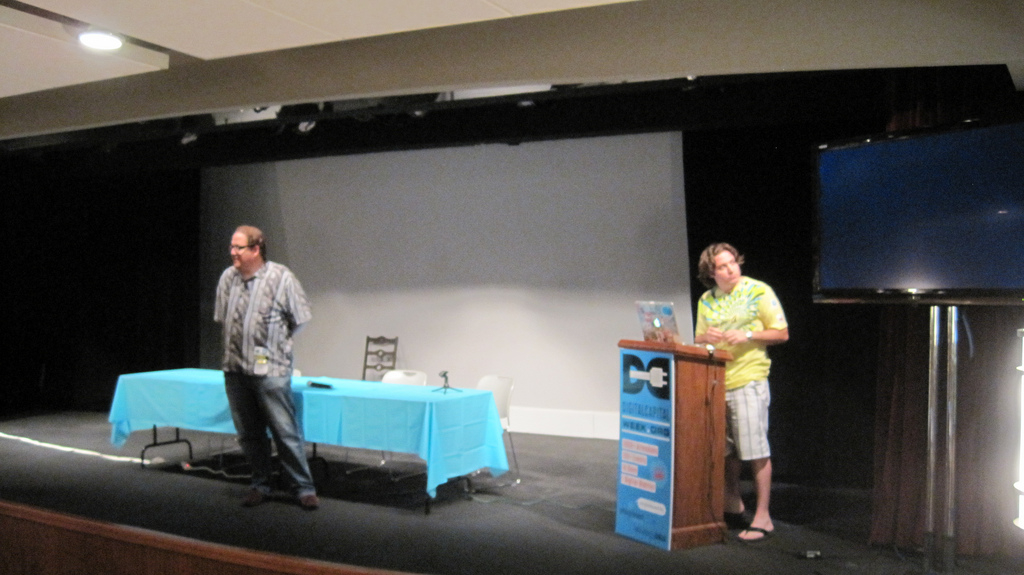
Peter Corbett may have worn shorts and a t-shirt, as seen on the left, but, in his role, it didn’t matter. Since I know him and have respect for the work he’d done for D.C. Week, at iStrategy Labs for Apps for the Army, and other initiatives, I know what he’s done.

I also believe that the informal nature of 140 Conference requires no more of us than that we represent ourselves as ourselves and share what matters, much like, perhaps, we might approach Twitter.

Representative Mike Honda (D-CA) may have come dressed in a suit, as you might expect from a Congressman in D.C., but what he said reflected that sentiment:

“It’s about sharing who you are, rather than trying to sell what you’d like to have people believe about you.”

By focusing on what people wore instead of what they said or have done, I’m not sure Schaffer honored the hard work of the organizers, nor the quality of the experiences that, say, Justin Kownacki shared.

Kownacki, whose cargo shorts drew attention at the D.C. 140 Conference, tweeted afterwards that “I don’t believe in wardrobe labels. I judge words and actions, not packaging. I’m amused by the #140conf attendees who think my wardrobe ‘killed my credibility.’ Who knew packaging dictates truth? Wardrobes provide a shorthand by which we can exclude & ignore. Makes life easier for traditionalists & streamliners, I’m sure.”

I’ve been to dozens of tech conferences, many of which featured people dressed to the nines with little substantive tactical or strategic value.

I can frankly say, as someone who has overdressed on occasion, that sometimes wearing shorts and a hip t-shirt is absolutely the right choice.

Tools and Togs both matter

Schaffer wrote that “a carpenter is known for getting the job done, not which saw he uses.”

That’s both true and untrue. Master builders who can afford to work with Bosch or DeWalt tools do so because of the quality of the tools and the precision product they allow. It’s true that someone with lack of knowledge to use them will fare far worse that a worker without, just as a rube with an expensive composite fly rod might be outfished by a boy with a cheap piece of bamboo and string, if the young man knows where and how to apply his simple rig. What you do with the tools matters more than their quality, but don’t overlook the fact that those tools do matter.

If someone contracts with a professional videographer to create a broadcast-quality ad and she showed up with a disposable camera and a vintage iBook, what would the new client think?

Consider the building example again. Carpenters are known for building things out of wood. Getting the job done is dependent upon the general contractor who employs him or her, or the reputation of the master builder that is hired. I have some familiarity with carpentry, after working as an apprentice for 18 months in Massachusetts. In that role, I wore shorts when it was hot, Carhardt pants when it wasn’t and many layers of fleece and polypro when it was frigid. We dressed as needed to get the job done. If someone showed up on the job site improperly dressed, or without boots, a belt, gloves and a full set of tools, he couldn’t get the job done without a loan of same.

Working in digital media is no different, in the sense that what we wear what we need to to accomplish a goal, in the context of the social mores of the space we move in.

Virtually, that might mean creating a well-designed website that is standards compliant. Or developing a mobile app for a conference or service. In the social media world, it means adding an avatar, bio, link and other elements that fill out a profile before sally forth. Dressing to impress can mean many things, but in the end, it’s what you can do and have done that will matter most to your clients, customers and audience. Did I get the story right? Will the house stay sound for decades? Is this a sustainable business? Does the app work?

Given the monumental challenges that lie ahead for government officials in Washington and around the nation, I suspect many citizens would rather they focus on getting real results, narrowing budgets, passing effective legislation and developing effective regulations that address issues in the financial, technical and environmental space, rather than any wardrobe choice.

As for me, I hope I can wear shorts more often around Washington.

10 Comments

Filed under article, blogging, friends, journalism, social media, technology, Twitter

Using social media for better journalism: @Sreenet at #ONADC

“I used to say “justify every pixel,” said Sree Sreenivasan. “Now I say earn every reader.”

Sreenivasan, a dean of student affairs and professor at the Columbia Journalism School, went beyond “what Jeff Jarvis calls the blog boy dance,” offering up more than an hour of cogent advice, perspective and tips on social media to a packed classroom populated by members of the DC Online News Association at Georgetown’s campus in Virginia.

Where once he used to go around newsrooms to talk about email, then Google and blogs, now he’s moved to new tools of digital journalism grounded in a reciprocal relationship between the audience and the reporter. After all, Sreenivasan had to tailor his talk to the audience, a collection of writers, editors and producers already steeped in the tools of digital journalism, moving quickly beyond listing Twitter, Facebook and LinkedIn to the tools and services that that enable journalists to use those social media platforms improve their reporting, editing and careers.

“The best people find the things that work for them and skip the rest,” said Sreenivasan. Services need to be useful, relevant and extend the journalist’s work. Quoting a student, now at the Wall Street Journal, Sreenivasan observed that you “can have greatest content in world but will die on the vine if we don’t have a way for our readers to find it.” He classified the utility of social media for journalists into four broad categories:

  • tracking trends on a given beat
  • connecting with the audience, where ever it is online
  • putting that audience to work, aka crowdsourcing
  • building and curating the journalists personal brand

“Tools should fit into workflow and life flow,” he said. “All journalists should be early testers and late adopters.” In that context, he shared three other social media tools he’s tried but does not use: Google Wave, Google Buzz and Foursquare. Sreenivaan also offered Second Life as as an example, quipped that “I have twins; I have no time for first life!”

The new Listener-in-Chief

One group that undoubtedly needs to keep up with new tools and platforms is the burgeoning class of social media editors. Sreenivasan watches the newly-minted “listeners-in-chief” closely, maintaining a list of social media editors on Twitter and analyzing how they’re using the social Web to advance the editorial mission of their mastheads.

He showed the ONA audience a tool new to many in the room, TagHive.com, that showed which tags were trending for a group. What’s trending for social media editors? This morning, it was “news, love, work, today, great, people, awesome and thanks.” A good-natured group, at least as evidenced by language.

Sreenivasan also answered a question I posed that is of great personal interest: Is it ethical to friend sources on social networking platforms?

The simple answer is yes, in his opinion, but with many a caveat and tweaks to privacy settings. Sreenivasan described the experiences of people in NGOs, activists and other sources whose work has been impaired by associations on social media. To protect yourself and sources, he recommended that Facebook users untag themselves, practicing “security by obscurity,” and use lists. As an example of what can go wrong, he pointed to WhatTheFacebook.com.

Where should journalists turn next for information? Follow @sreenet on Twitter and browse through the resources in his social media guide, which he referenced in the four videos I’ve embedded in this post. He’s a constant source of relevant news, great writing and good tips.

1 Comment

Filed under blogging, education, journalism, social bookmarking, social media, technology, Twitter, video

Why including women matters for the future of technology and society

The Women of ENIAC

The "Women of ENIAC." For their history, read "Programming the ENIAC."

Some issues trigger a deeper response than others within communities. In the technology world, the education, opportunities and inclusion of women holds unusual resonance.

In the U.S., as Nick Kristof wrote, “schoolgirls are leaving boys behind in the dust.” After graduation, the narrative evolves further. As Claire Cain Miller wrote in the New York Times on Friday, “women now outnumber men at elite colleges, law schools, medical schools and in the overall work force. Yet a stark imbalance of the sexes persists in the high-tech world, where change typically happens at breakneck speed.”

Why the disparity in the world of Silicon Valley startups, venture capital and high technology? Why are so few women in Silicon Valley?

At least some of the issue runs deep, far back into the educational system. As Miller writes:

That attitude is prevalent among young women. Girls begin to turn away from math and science in elementary school, because of discouragement from parents, underresourced teachers and their own lack of interest and exposure, according to a recent report by theAnita Borg Institute for Women and Technology and the Computer Science Teachers Association.

Just 1 percent of girls taking the SAT in 2009 said they wanted to major in computer or information sciences, compared with 5 percent of boys, according to the College Board.

Only 18 percent of college students graduating with computer science degrees in 2008 were women, down from 37 percent in 1985, according to the National Center for Women and Information Technology.

So what can be done? How could including women in FOO Camp or making a list of women in tech or unconferences matter?

As computer scientist Hillary Mason tweeted tonight, “We don’t need affirmative action. We need meaningful culture change and support.”

Based upon the research a colleague gathered tonight, some actions could make an important difference in three ways:

(1) It’s good for men. Inclusion of women and minorities reduce stereotypes, and promotes second-order reflection on latent stereotypes, by providing real, first-hand experience. (Mahzarin R. Banaji and Curtis D. Hardin, Automatic Stereotyping, 7(3) Psychol. Sci. 136-41 (May 1996).)

This leads to better, more accurate evaluation of people’s work – because when people unconsciously use stereotypes, they mis-evaluate work. For example women’s presence in high-level orchestras basically doubled once auditions started to be done gender-blind, focusing only on the music.
(Claudia Goldin and Cecilia Rouse, Orchestrating Impartiality: The Impact of “Blind” Auditions on Female Musicians, 90(4) American Econ. Rev. 715-41 (2000).)

(2) It’s good for women. The absence of women (or very low numbers of women) signals to women that they aren’t welcome or don’t belong, which can in turn cause them to leave the field or choose not to enter it in the first place. (William T. Bielby, Minimizing Workplace Gender and Racial Bias, 29(1) Contemporary Soc. 120-29 (2000))

Research also suggests that when women are invited to the table, they have more energy free to do good work, instead of using half their energy just breaking down the door. Reducing cognitive load on subjects who have to work to overcome stereotypes is not a minor factor.

(3) It’s good for business & technology. Whatever the vertical, the entire industry benefits when the best work is being created and presented. As Miller writes:

Analysts say it makes a difference when women are in the garages where tech start-ups are founded or the boardrooms where they are funded. Studies have found that teams with both women and men are more profitable and innovative. Mixed-gender teams have produced information technology patents that are cited 26 percent to 42 percent more often than the norm, according to the National Center for Women and Information Technology.

In a study analyzing the relationship between the composition of corporate boards and financial performance, Catalyst, a research organization on women and business, found a greater return on investment, equity and sales in I.T. companies that have directors who are women.

The number of senior women doing major research and running labs in traditionally male-dominated fields like physics also offers insight into how efforts to include women can lead to merit-based selection across the broadest set of the best candidates. For instance, consider Lisa Randall, one of the most cited theoretical physicists of the last half-decade. Or Marissa Mayer, a senior Google exec who, as Miller wrote, many women she interviewed cited as “someone who gives them hope.”

Where to learn more

I don’t believe that most people are consciously biased, nor that they intend to be biased. Research into implicit bias suggests, however, that the most pervasive forms of bias are unconscious. Those biases can have tremendous effects on how we evaluate others, mostly to our own detriment – but also to our communities and industries.

Does the issue of women in tech matter to the bottom line? Miller’s reporting suggests that’s so:

Studies have found that teams with both women and men are more profitable and innovative. Mixed-gender teams have produced information technology patents that are cited 26 percent to 42 percent more often than the norm, according to the National Center for Women and Information Technology.

In a study analyzing the relationship between the composition of corporate boards and financial performance, Catalyst, a research organization on women and business, found a greater return on investment, equity and sales in I.T. companies that have directors who are women.

Fortunately, there are a growing number of conferences, groups and networks that celebrate and honor women in technology, including:

O’Reilly Community also features an excellent series of essays on women in tech. For the fascinating story of how women were involved in “hacking” the world’s first programmable computer, pictured at the top of this post), read ENIACprogrammers.org. And the recent Ada Lovelace Day listed dozens of inspirational women who are innovators, inventors and educators.

Finally, Nick Kristof has done the world a mitzvah by writing eloquently about womens’ rights in his most recent book, “Half the Sky.” Learn more at HalfTheSkyMovement.org.

30 Comments

Filed under blogging, research, technology