Category Archives: blogging

Why journalists need to pay attention to Google Author Rank in 2013

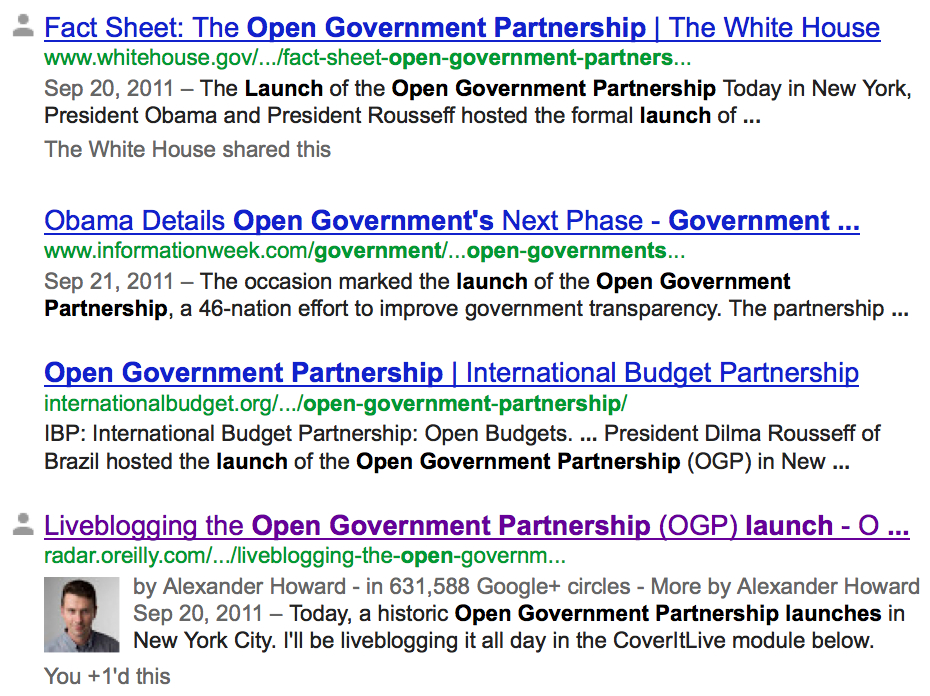
Remember back in 2011, when Google linked the Google Plus profiles of journalists to Google News, and folks like Emily Bell,  Erik Wemple, Amy Gahran, Megan Garber  and I had a cross-platform conversation about it? (OK, probably not.) I thought then that Google integrating Plus with journalism online was probably inevitable. Here we are in 2013, where Google’s “Author Rank” is now putting journalists’ faces into search results and linking to their Google+ profiles.
abh-search-results-ogp

If you focus on online marketing, journalism and SEO — and like it or not, if you publish on the Internet, you need to keep an eye on these areas — this is a noteworthy development. It’s worth taking the time to understand Author Rank, learn how it works, why it matters to SEO, and think about how it might apply to what you do online. To learn more, check out  Google’s Authorship page on Plus.

I’m far from the first to point this out. Denis Pinsky wrote in December 2012 that journalists should care about Author Rank a lot more than Amazon sales rank. Megan Garber, who teased apart some of the issues in a November 2011 post on Google+ at the Nieman Lab, noted Google ran a pilot that in the summer of 2011 that put profiles into search engine results. The article that caught my attention yesterday and prompted this post was by Erin Griffith at Pando Daily, who looked at how Author Rank changes marketing and journalism.

As Griffith suggests, the addition of Author Rank is likely related to the quality of search results. By prioritizing posts written by verified authors who have authority in a given topic in search, Google users will be exposed to better results — and posts created by spammers and link factories will be deprecated. Or so the thinking goes.

According to an SEO agency president cited in a PandoDaily article about the shift, “bylined stories rank higher, and they get more real estate. Most importantly, they return clickthrough rates that are 40 percent greater than normal.”

If accurate, that’s quite a carrot for Google to dangle in front of SEO-obsessed media organizations and freelancers alike, which will lead to influence that may well call for renewed caution about the power the search engine giant holds to organize the world’s information. There are reasonable concerns about how Google has proceeded here. For instance, Google could have given journalists the option to link to a profile on another social network, or to a page on their masthead’s website. Instead, Google Plus is being put forward.

The road ahead

Is linking a Google+ profile to search results a negative for journalists? Given what I’ve seen since 2011, on the whole, I still don’t think so. I’m willing to be proven wrong, as always. As I wrote then (self-plagiarism alert!) Edd Dumbill opened my eyes to the transition ahead of us some time ago in his post about why he thinks Google Plus is the social backbone for the Internet.

I highly recommend reading Edd’s post and thinking through what else might be tied together beyond journalists and their articles. It could be connecting people and places. Or teachers to schools, bartenders to pubs, managers to stores. Or other makers or creators, like musicians to tracks, filmmakers to videos, or photographers to their photos. Connecting coders to their code would be a natural fit for Google. Communities could advance those signals.

Facebook has followed much the same sort of thinking in extending the semantics of its social graph within its network — and has more than 1 billion users at present. Given this shift, I have to wonder whether we’ll eventually see the public Facebook profiles of journalists associated with bylines and stories in Bing search results — and how quickly publishers and journalists will move to associate themselves with Google search engine results.

Media now have a clear choice before them: join Plus to connect profiles with their stories or stay out of the social fray. It will be a different decision than joining Twitter or Facebook was in years past, before it was clear to the general public that social networking would not be a passing fad. There will be more pressure for journalists to join Google Plus now, given the rewards in traffic and profile visibility that will accrue to having your face in Google News and search results.

I chose to tie my profile to my bylines in the summer of 2011, in that pilot, so that people looking for information would see my face in search results and connect to me. New readers are now finding me through many social networks (Twitter, Facebook, LinkedIn, Instagram, Pinterest, Tumblr, Plus and others) and search. Given what I do, it made sense for me.

It will likely not be the right choice for investigative journalists who cover organized crime or government corruption, or for those who operate from conflict zones or under autocratic regimes. For many others, however, being “discoverable” to their communities, beats and colleagues on Plus now looks as professionally relevant as participating on Twitter or Facebook.
8 Comments

Filed under article, blogging, journalism, social media, technology

Revisiting standards for moderation and community on social networks

If the Internet and social media represent the new public square, it’s important to talk about the rules of the road.

Over the past year, I’ve seen a lot of spam and pornography links on Google+, Facebook, Twitter and on comment sections of the blogs I maintain.

Google and Facebook both give us the ability to moderate comments and, if we wish, to block other people who do not respect the opinions or character of others.

Now that a lot more people are circling me on Google+, following me on Twitter and subscribing to me on Facebook, it’s time to revisit a post from earlier this years. If you have found your comment removed, I’d like to explain why and offer some guidelines. Here’s how I think about maintaining community, with a nod to ASU journalism professor Dan Gillmor‘s example:

I can and do block spammers and people posting links to pornography in my comment threads.

I generally leave comments on my blogs, precisely because I value conversations, despite the issues that persist online. I have been moderating discussion in online forums and blogs for many years, including those of my publishers. My full thoughts on the value of blog comments — and the social norms that I expect people comments to live within — are here.

Vilely insulting me won’t help your case. Insulting others will ruin it. I was a teacher in my twenties. I would not tolerate disrespectful behavior in my classroom, either to me or to other students. If you can’t be civil and continue to insult others, much less the person hosting the forum, you were asked to leave and see the principal.

If the behavior persists, you will lose the privilege of participating in the class at all. Eventually, you get expelled. On Google+ or blogs, that takes the form of being defriended, banned or blocked from my public updates. I prefer not to block users but I will do so. I respect your right to speak freely on your own blog, Twitter, Facebook or Google+ account, whether that involves cursing or ignorance.

I strongly believe in the First Amendment, with respect to government not censoring citizens. That said, I do not, however, feel obligated to host such speech on my own blog, particularly if it is directed towards other commenters. I believe that building and maintaining healthy communities, online of offline, requires that the people hosting them enforce standards for participation that encourage civil dialogue.

I hope that makes sense to readers. If not, you are welcome to let me know why in the comments. And if your approach differs, please explain how and why.

Following is a storify from a forum I participated in that featured perspectives from other people entrusted with online community moderation:

[View the story “A story of online community, comments and moderation” on Storify]

2 Comments

Filed under blogging, journalism, microsharing, social bookmarking, social media, technology, Twitter

On acts of journalism, social media, credentialing, shield laws and press freedom

Anyone with a smartphone can now do reporting: share geolocated photos, video or stream what’s happening. I’m here, you’re not, here’s what I see. Does such “citizen reporting” rise to an “act of journalism” and need to protected under the First Amendment? Increasingly, I tend to think that it does — and that’s going to be a key question in the not-so-distant future, if Congress gets around to re-examining shield laws. Shield laws have been an issue for years, in the context of how the digital media ecosystem has democratized the means of publication, particularly of reporting images and video.

Currently, there is no federal shield law to protect sources and methods. Last year’s ruling in Oregon cemented the reality that 20th century shield laws lag today’s social media realities, even if the blogger in question turns out to have gone far beyond where many of the people initially defending her realized. A subsequent clarification showed that the judge who made the ruling believes bloggers can be journalists.

Honestly, some days I find the gatekeeping and credentialism I still see and hear disquieting. Since my degree is in biology and sociology, not “journalism,” should I get kicked out of the profession? Without getting testy, this attitude is exactly what will allow governments to arrest people livestreaming because they aren’t “members of the media.” (I also think it’s why there are still tables for “print only” in Congressional hearing rooms and 20th century rules for hard press passes for broadcast, radio or print journalists in the Senate and restrictions on the use of computers in some House subcommittees.)

Who gets to decide if someone is a journalist? Is someone who works at the Daily Enquirer who posts pictures of a naked celebrity a journalist — but someone who posts pictures of a cop beating a student is not? What about a columnist who writes about the Greatest Athlete EVER versus a blogger who chronicles how well documented city council hearings are and issues with the document format or codec type from the software vendor? The odds are good that it will be U.S. Senators and judges who make that call: it’s important to think carefully about which side you come down upon and why.

This stuff is ALL really blurry. Is Twitter journalism or isn’t it?. What about tweets? Blog posts? Video?
Remember, there are companies who have tried to criminalize linking or embedding. There also folks out there in media land who have say linking is unfair aggregation. Both could be an issue for what some practitioners have called social journalism.

We need to be careful about being quick to exclude or defend turf in a historic moment when the practice of journalism has become more open to all then ever before, particularly when press freedom continues to be under pressure globally and whistleblowers are being prosecuted domestically. The bloggers vs journalists debate has significant potential downstream impact that matters, even as it morphs into “curators vs journalists.”

Honestly, I’m starting to think that the term “curators” should have been left in museums, where it was quite clear what they did. How about “editors vs curators?” Fuzzier, right?

Hey, I love it when people link and share my work, personally. I hate it when they plagiarize, don’t link or attribute it. Curate me, please!

Personally, if someone produces work that is fair, accurate, adds necessary context and based on the available evidence, I’m generally happy to call it journalism, regardless of whether the author is on a masthead somewhere or has the right B.S. on a sheepskin.

This post has been updated with links and commentary.

6 Comments

Filed under blogging, government 2.0, journalism, microsharing, social media, technology, Twitter

In the Capital, influence on social media in DC is more than Twitter followers

It’s hard to believe that it’s been over a year since I implored the DC tech community and media scene at large to stop holding influence contests. Deja vu, all over again.

It was brilliant of In The Capital to hire a smart journalist to cover notable events in the political and tech scene. That coverage put them on the District’s radar during Social Media Week.

It was not brilliant of them to put together this week’s smudged sterling example of linkbait, which stands to damage their credibility with new readers who are not friends of those selected.

Look: I’ve met 80% of the people on this list of the “DC’s Top 10 Social Media Influencers” and follow many of them. I have much respect for their smarts, digital savvy and professionalism.

But if this is the” top 10,” what, exactly, does being an DC “influencer in social media” mean here? Online influence is not just about having a lot of Twitter followers.

For instance, I’m ahead of @LukeRussert by more than 33,000+ and have a higher Klout score, due in part to a large following on Google+ and Facebook. Does that mean that I’m more influential? Maybe on social media and certainly with respect to technology, but certainly not on broadcast news, which still retains enormous influence in our country. It also wasn’t hard to think of another person in DC who’s more influential with respect to social media than either one of us:

What about more “influential in the startup and DC tech scene, which “In the Capital” says it covers? Are all ten of these people more influential than Peter Corbett, Frank Gruber or Jen Consalvo, the co-founders or DC Week and organizers of the huge DC Tech Meetup? I’d don’t think so. And neither does Russert:

In a larger sense, does anyone believe that Russert is more of an “influencer” on social media in Washington than President Obama, between @WhiteHouse and @BarackObama? (I certainly don’t kid myself about my “clout” relative to POTUS.) What about @SpeakerBoehner or House Majority Leader @EricCantor or @SenJohnMcCain? Is the rest of the list is more “influential” than @MarkKnoller or @MarcAmbinder or @MikeAllen? A recent study of Twitter use in Congress, in fact, found that SenatorSanders was the most “influential” member of Congress on social media. (Or at least on Twitter.) one could go deeper on the list of people in media and government but the point is clear enough.

Mark Drapeau, director of innovative engagement in Microsoft’s office of civic engagement — and a member of the list — offered a dissenting perspective:

all these lists are kinda different or the same based on peoples’ biases and what they hope to accomplish and the audience they hope to reach. The Washington Post turns it into a ridiculous game. In the Capital picked… people they think are cool. Politico made the same exact list [of top DC Twitterers] and it’s all – gasp – politicos! The LA Times made the same list [DC twitterers], and they simply ranked people by followers – lazy! I made the same list based on how people interact with their communities – lots of people I know from… my community! All the lists are right, all the lists are wrong, there is nothing to debate, complain about, or mock.

In DC social media, there’s lots of actual social data to crunch to enable some measure influence and connected, not just from PeerIndex or Klout but from Google back links or Twitter/Facebook engagement numbers. Or they could have run their own data on how much engagement or amplification people get on Twitter, Facebook, Tumblr, Google+, etc. That’s just not what happened today.

This feels straightforward, at least from where I sit tonight: If editors make lists, they need to be able to back them up with criteria and methodology. That’s why people read Consumer Reports, for instance, when they buy things. Lists and ratings from credible publications influence the buying and hiring decisions of consumers. That’s why there’s a market for them and why people and brands get excited about being selected.

If “In The Capital” really wanted to measure “influence” and do a Top 10 List, “In the Capital” could have cited Klout or PeerIndex, flawed as those services may yet be. Gadi-Ben Yehuda, social media strategist for IBM’s Center on the Business of Government, made this comment:

The easiest way to have voided any controversy would have been not to use the title “DC’s Top Ten Influencers in Social Media,” which is confusing in any case. Honestly, when I saw who was on the list (the majority was women), I thought “OK, this must be people who do primarily social media activities, i.e. they don’t publish substantive articles on important government events (like Alex), they don’t run tech/innovation companies (like Peter Corbett), they don’t work in the innovation office of cabinet-level agencies (like @AlecJRoss). These are people who’s skill is in the medium that others of us use as a tool to accomplish other things.”

That seemed to answer the question of what the article was about, but only if one focused on the words “in social media.” But what about this words “top” and “influencer” what do those words even mean? Klout defines influence as the ability to spur others to take action. If that’s what an influencer is, then I don’t think there can be a top ten list without Obama, or at least Macon Phillips. Again, Peter Corbett (he got more than 10K people here for DCWeek, after all). Alan Rosenblatt should also likely be on that list.

Based upon Byrne’s comments and some background gathered at last night’s DC Social Media Happy Hour, the list was originally pitched to be about 10 awesome women who consult and teach others in the DC community about how to use social media. Shireen Michell, for instance, is influential with segments of the District’s community who are not in the government or media space.

Then In The Capital appears to have dropped two of them, added Russert and Drapeau, and changed the title and premise, which was not and is not supportable based upon qualititative or quantitative grounds. When asked about the substance behind the list, the author of the post offered this response:

Lisa Byrne, a social strategist at the Pappas Group who was put on the list, offered some insight into what seems to have happened:

“I actually gave a lot of input (originally it was all female so I never spoke of any guys who should be noted),” she commented. “I was not advised it would be titled Influencers. I listed people who were community leaders in the social space – online and specifically offline.”

1 Comment

Filed under blogging, government 2.0, journalism, social media, technology, Twitter

Collecting stories

On his personal blog, New York Times technology journalist Nick Bilton mused about “collecting air” in his travels around the globe. He closes his post with this thought, drawn from a recent conversation on a flight:

The man looked at me and asked, “Do you collect anything?”

At first I didn’t know how to respond, I hadn’t thought about it in some time. And then I instinctively told him that I actually collect stories —about people, or events, or places, or companies, or moments in time. That I collect these stories and keep them as words and photos.

I looked out of the plane window for a while as we zipped above the clouds at 35,000 feet, and then I looked back at the man and said, “I guess you could say I collect air.”

I felt the same instinct over the holidays, when asked to describe what I do or what a day in my life is like now. The photostream I’ve shared to Twitter or Tumblr over the past two weeks offers vignettes of a mobile life:

public Instagram photostream shared to Twitter

My Instagram photostream on Twitter

Those windows on my worlds, reflected as they are in a growing multitude of glowing screens, are a collection that I value much in the same way that a philatelist or numismatist in a previous generation might adore her stamps or her coins. I hope that some of the stories they represent are at least as enduring.

2 Comments

Filed under art, blogging, journalism, microsharing, personal, photography, social media, technology, Twitter

New Sky News social media policy would cripple journalists working on the real-time Web of 2012

Another month, another firestorm over a poorly thought out social media policy from a massive media company. This time, it’s Sky News that’s made a misstep.

I think Reuters social media editor Anthony De Rosa is spot on in his assessment of assessment of the failings of the new social media policy advanced by Sky News: it’s longing for a return to the Victorian Internet

Cory Bergman nailed why it’s OK for journalists to be human on Twitter and Mathew Ingram, as usual, offered his usual common sense analysis of what makes sense, in context. (

Where I think Anthony knocks it out of the park, however, is with respect to the professional rationale for retweeting other accounts: “The idea here at Reuters when it comes to social media is to be the beacon for all news, which makes us the go-to source, no matter what the source may be, after being put through our own filters of verification.”

Just so.

If you’re on a beat, you want to be THE source for news on it. Generally, that means you’ll get beaten on being first to a story. No worries: RT them, then blog it, and link in articles. Over time, people (and algorithms) will value you for that work.

Any entity that distributes content online — whether they’re in the media, government, academia, nonprofit or other organizations, needs to be thinking about search engine optimization (SEO) and social media optimization (SMO) in 2012. Any policies that force journalists into internal silos will eviscerate that capability.

A RT is social media currency. Instructing journalists not to give them out where deserved is like sending them into a conflict or disaster zone with no funds for a fixer, fuel or food. It’s not just bad form. It’s bad business.

1 Comment

Filed under blogging, journalism, microsharing, social media, Twitter

Classrooms and community: my moderation standards for Google+, Facebook and blog comments

Over the past few months, I’ve seen a lot of spam and pornography links on Google Plus, on Facebook and on the blogs I maintain. Fortunately, blogs, Google and Facebook both give us the ability to moderate comments and, if we wish, to block other people who do not respect the opinions or character of others.

Last night, I’m seeing a lack of clarity about my approach to online community, so here’s how I think about it, with a nod to the example set by Arizona State University journalism professor Dan Gillmor.

I can and do block spammers and people posting links to pornography.

I will leave comments on on my blogs, precisely because I value conversations, despite the issues that persist online. I have been moderating discussion in online forums and blogs for many years, including those of my publishers. My full thoughts on the value of blog comments — and the social norms that I expect people comments to live within — are on this blog. To date, there are 196 comments on the post.

Vilely insulting me won’t help your case. Insulting others will ruin it. I was a teacher in my twenties. I would not tolerate disrespectful behavior in my classroom, either to me or to other students. If you can’t be civil and continue to insult others, much less the person hosting the forum, you were asked to leave and see the principal.

If the behavior persists, you will lose the privilege of participating in “class.” Eventually, you get expelled. On Google+ or blogs, that takes the form of being defriended, banned or blocked from my public updates. I prefer not to block users but I will do it. I respect your right to speak freely on your own blog, Twitter, Facebook or Google+ account, whether that involves cursing or ignorance.

I strongly believe in the First Amendment. Governments should not censor citizens. That said, I do not, however, feel obligated to host such speech on my own blog, particularly if it is directed towards other commenters. I believe that building and maintaining healthy communities, online of offline, requires that the people hosting them enforce standards for participation that encourage civil dialogue.

I hope that makes sense to friends, readers and colleagues. If not, you are welcome to let me know in the comments.

3 Comments

Filed under blogging, education, social media, technology

On the value of blog comments

paper blogs

"Paper Blogs" by bookwyrmish

Over at GigaOm, Matthew Ingram weighs in on whether blogs should allow comments or not, spurred by a debate between venture capitalist Fred Wilson and Tech Crunch blogger-turned-venture capitalist M.G. Siegler:

MG Siegler, who doesn’t have comments on his blog and has written several posts defending his decision, saying they are 99-percent bile and a waste of his time. On the other side of the debate is fellow VC Fred Wilson, who says Siegler is missing a lot by not allowing comments.

I think Wilson is right — while comments can be a royal pain at times, they are a crucial part of what makes a blog more than just a bully pulpit.

For my part, I respect MG Siegler‘s choice to have a place on the Internet where only he can share his thoughts, whether we call it a blog or not, just as I do that of Seth Godin or John Gruber. If someone wants to comment on a given post, he or she can do so and respond via email, social networks, YouTube or their own blog(s). Or all of the above. There is no shortage of options on the Web of 2012 to share and opinion of something online and link to it. Just the opposite, really. If I want to publicly comment on one of Siegler’s posts, I can do so right here on my blog. Or Facebook. Or Google+. Or  @reply to @parislemon on Twitter, albeit in fewer characters.

From where I sit tonight, whether you choose to have comments or not speaks to whether you want to create an online community, which requires a human’s touch to manage and moderate, or to simply publish your thoughts publicly online, without making the necessary commitment of time and patience.

As is often the case, I agree with Mathew Ingram: blog comments are worth the effort.

He cites two important examples of high functioning people who maintain blogs with excellent comment sections, Anil Dash and Fred Wilson.

Dash and Wilson both spend time reading and responding to comments. For those who have been online for a few years, you know that’s not the case with many other blog authors. In a frank post last year, Dash observed that if your website is full of bad behavior, it’s your fault. He clearly thinks it’s worth it:

“When you engage with a community online in a constructive way, it can be one of the most meaningful experiences of your life. It doesn’t have to be polite, or neat and tidy, or full of everyone agreeing with each other. It just has to not be hateful and destructive.”

It’s worth noting that both men have also put into place architectures for participation that enable them to create better norms for discourse alongside social norms created by community. Dash uses Facebook comments, Wilson Disqus.

Some of the worst comments online still show up on YouTube or unmoderated newspaper comment sections. That’s one reason newspapers have been rethinking anonymous commenters. (Another, of course, is that knowing more about your readers’ demographics matters for online advertising and lead generation.)

It’s on that count that Ingram has extra credibility with me, since he used to be the social media editor at the Globe and Mail in Canada. While Canadians generally have a reputation for being polite, online that can change. Despite years of exposure to the best and worst of humanity on his screen, however, Mathew still supports having them:

“…I still defend comments as a crucial element of what blogging is, and more than that I defend anonymity as well. A blog without comments is a soap-box, plain and simple. Not having comments says you are only interested in passing on your wisdom, without testing it against any external source (at least not where others can watch you do so) or leaving open the opportunity to actually learn something from those who don’t have their own blogs, or aren’t on Twitter or Google+. That may make for a nicer experience for you the blogger, and it may make your blog load faster, but it is still a loss — for you, and for your readers.”

Moderating and responding to comments is a full-time job at high traffic blogs. If you’re a one man outfit, small business or don’t have a full time community manager, that’s going to take time away from research, writing and interviews — and that’s a legitimate problem for a writer, much less an entire news outfit. MG made this point today, commenting on the decision by Macstories to remove all comments:

It’s one thing for a single person site (like this one) to make a call to remove comments. It’s another for a larger team blog to do so. In fact, I can’t think of any without comments.

Right or wrong, the mentality is that to build a next generation media publication on the web, you need comments. That’s why we never got rid of them on TechCrunch (believe me, plenty of us wanted to — Facebook comments were a compromise).

Even more interesting is the psychology behind “needing” comments on big sites. Let’s be honest: most of these sites defend comments because if they don’t, it will seem like they’re taking a shit on their readers. It’s along the lines of “the reader is always right” — even when only half a percent are commenting and the vast majority of those are trolls.

For me, keeping up with email, Google+ and Facebook, @replies on Twitter, txts and IMs frankly can feel a bit exhausting. One of my New Year’s Resolutions for 2012, in fact, is remove communications cruft from my digital life wherever possible, cutting way down on bacn and spam. (Note Bene: I’m not giving up bacon in meatspace.)

That said, I think keeping up that level of engagement is worth it. It’s important to me. I hear from readers that it’s important to them. I plan to continue to publish posts this year that have comments enabled because I believe, as Mathew Ingram does, that they’re worth it, both for me and for other readers. If I ever think that they aren’t, I’ll either turn them off or advocate that we do so — but I’m not expecting a change of heart any time soon.

I’m looking forward to an upgrade at the O’Reilly Radar that should make it much easier for our community to ring in. Given that O’Reilly Media has legions of smart readers, I expect to learn a great deal from them, although I suspect I’ll take my lumps as well if I make mistakes or errors of reasoning. For me, that remains a worthwhile trade.

203 Comments

Filed under blogging, journalism, social media

On Twitter suspensions, spam, censorship and SOPA

Suspended OwlEarlier this afternoon, David Seaman claimed that Twitter suspended his account for tweeting too much about “Occupy Wall Street … and talking too much about the controversial detainment without trial provisions contained in the FY 2012 National Defense Authorization Act (NDAA).”

His account is now back online. Twitter’s official response to him, according to Seaman, was that his account was ‘caught up in one of spam groups by mistake.

Seaman continued to suggest otherwise and implied that Twitter is banning accounts because of their content.

Speaking only for myself, I believe this was completely unrelated to NDAA or OWS and was instead tied to his behavior using a new account. I think what happened today was an auto-suspension of a new account exhibiting behavior associated, not intentional censorship by Twitter. Jillian C. York, the director for international freedom of expression at the Electronic Frontier Foundation, agreed:

I’m writing without an official statement from Twitter but I’d bet that’s what happened. (If I receive such a statement, I’ll post it here.)

UPDATE: Here are the emails Seaman posted to his post, containing Twitter’s responses. They validates my understanding of Twitter’s anti-spam protocols.

At approximately 7:37pm ET, my Twitter account was restored, and I received the following message from Twitter support: “Hello, Twitter has automated systems that find and remove multiple automated spam accounts in bulk. Unfortunately, it looks like your account got caught up in one of these spam groups by mistake. I’ve restored your account; sorry for the inconvenience. Please note that it may take an hour or so for your follower and following numbers to return to normal.” At 8:29pm ET, a second email from Twitter support was received: “Hello, As a clarification, your account was suspended twice; the initial suspension was due to a number of unsolicited duplicate or near-duplicate messages being sent using the @reply and/or mention feature. These features are intended to make communication between people on Twitter easier. Twitter monitors the use of these features to make sure they are used as intended and not for abuse. Using either feature to post messages to a bunch of users in an unsolicited or egregious manner is considered an abuse of its use, which results in an automated account suspension. However, the second suspension after you navigated the self-unsuspension page was due to a known error we are working to fix; our apologies for the re-suspension. Please let me know if you have any questions.”

As far as I know, Twitter accounts aren’t automatically suspended based upon a journalist writing about a controversial issue. You can read the Twitter FAQ on suspensions for their official position. Suspensions are only supposed to happen when a user breaks the Twitter Rules, not because of what they describe or report on. Again, York:

Suspending accounts on Twitter is precedented behavior. What’s less so is a self-identified journalist making a sweeping claim of censorship like this without confirmation, corroboration or analysis of Twitter’s past practices. My account was suspended 2 years ago when @Twitter swept it up on people tweeting on the #g2s hashtag. It was restored the day after wards, along with other people tweeting from the IP address.

I doubt Seaman’s contention that this suspension was related to content. I think it was a mistaken outcome based upon interactions. New accounts are more likely to be flagged automatically as @spam. What happened wasn’t about any one tweet: it’s came through nine tweets in a row of nearly duplicate content to non-followers from a new account. Specifically, “How #Occupy and the #TeaParty could end their struggle tonight: http://read.bi/vL02ZI #NDAA #SOPA #OWS”

Bottom line: Seaman made a sensational claim that probably shouldn’t have been made without more legwork and a statement from Twitter. He used Business Insider’s platform to bring attention to a mistake. It may have brought Business Insider a lot of traffic today but I think, on balance, that Seaman damaged his credibility today.

That’s unfortunate, given that the episode could have been leveraged to make an important point about how governments might work with private social media platforms to remove content that they do not wish to see published.

On that count, learn more about the Stop Online Piracy Act at Radar.

Update: Conor Adams Stevens picked up the Business Insider post and wrote a largely uncritical op-ed at International Business Times that repeated the claim that “NDAA, SOPA, Occupy Wall Street and Anonymous may be off-limits on Twitter.” (If that were true, I wouldn’t have been able to tweet for quite a few months now.)

Update: Nick Judd picked up the story at techPresident, adding some context to the latest episode of Twitter denying another censorship accusation. Judd observes that Deamon’s post “appears to be flat out wrong”:

Seaman still seems to think that some occult hand is at work against opponents of NDAA, questioning the veracity of Twitter’s response to him. This makes no sense, given that NDAA has generated at least 117,000 tweets in the last seven days. None of those have been swept under the digital rug.

There’s also a conspiracy theory floating around about why Twitter has not listed NDAA as a trending topic. Mat Honan bursts that bubble in a post from last week for Gizmodo, which is actually focused on a hashtag memorializing the late Christopher Hitchens. Its title is succinct: “Shutup, Twitter Isn’t Censoring Your Dumb Trends.”

Image Credit: Steve Garfield

13 Comments

Filed under blogging, journalism, social media, technology, Twitter

On online trust, reputation, satire and misquotation on Twitter and beyond

The issue of online trust deeply resonates with me. People can and do lose jobs or opportunities because of social media. I do not find intentional misquotes of someone, particularly any journalist or government official, funny. It’s happened a couple of times to me recently, so I thought I’d offer some personal reflections on why I asked those who did so not to change my updates or to substitute words I never used.

Andy Carvin talks with Jeff Jarvis

Andy Carvin talks with Jeff Jarvis at the 2011 SXSWi Twitter Retreat

1) The size of someone’s following is irrelevant. One tweet to 100 can easily be picked up globally. Context that one person has is also irrelevant to the choice, because the update can be quickly shorn of its origin.

2) I’ve heard that I shouldn’t ask others not to intentionally misquote me because it will “hurt public engagement” or diminish the interest of others in amplifying my signal. I accept that it could affect “engagement” with those I challenge. I prefer to correct the record, especially while history’s rough draft is still being written, to protect my reputation against a misinterpretation of something I never said than that abstraction.

3) With respect to tone, I don’t believe that asking someone politely, directly, to please retract or correct a update is unduly “harsh.” Similarly, I don’t think that objecting to someone else changing my words without indicating that alteration is insulting. In either case, I can also choose to share my request more broadly with an entire audience or use stronger language, though neither is my first or second recourse.

4) Whenever I have asked others to respect the integrity of my writing, whether it’s in 140 characters or 140 paragraphs, I stand by that choice. I’ve been making it for many years and will continue to do so. I’ve reviewed those decisions against the advice of journalism professors and open government advocates and am now in a relatively good position to make a judgment myself, often in a short period of time. It’s quite straightforward to natively RT someone without changing any text, or to share words on Facebook, Tumblr or Twitter.

5) I don’t see my presences here, on Facebook or Twitter as simply “personal accounts,” as I use them all professionally. I don’t see them as 100% professional, either, since my words any of them do not represent the official views of my employer unless they are shared on corporate accounts. My own accounts also travel with me between positions. Certainly, updates sent to family and friends via circles or closed groups are at least expected to be treated differently, though there’s no guarantor of it, aside from trust in the recipients. Over time, some number of people have chosen to regard me as a trusted source in those contexts. That’s a series of relationships that I’ve built carefully on several platforms over many years, with a great deal of time and attention built to accuracy and focus upon what matters.

6) With respect to scope, If anyone thinks his or her own “personal account” couldn’t inadvertently do damage to that reputation with a joke that went viral, I believe that they are very much mistaken. Here’s a Twitter-specific reference: The decision to place different weight on tweets @attributed to me is based on my history, reputation and trust, along with years of accumulated algorithmic authority. When someone tweets “RT @user: quote,” it indicates to everyone who reads it that the named @user wrote the tweet. To date, I haven’t seen those kinds of issues on Google Plus. Regardless, if someone keeps doing that after being asked politely to stop, the next step is to expose them and then, failing changed behavior, block them.

7) Satire is absolutely approved on social networks, including satiric impersonation. (Ask Rahm Emanuel!). If someone sends out a satirical tweet, update or ‘plus’ that “quotes” me, another writer or a public figure with a goofy picture, it wouldn’t be out of tune with what the Borowitz Report or @MayorEmanuel do. That’s fair game, like SNL skits. Updates that imply actual words (like RT @user”fake quote”) are not, at least in my book.

Are fake updates “allowed?” Governments, corporations, and all kinds of other agents put them up. I think we’ll see more of it. Someone can lie or obfuscate of they want — I think it’s increasingly difficult to do so, though it will continue to happen, particularly in conflict zones. The role of editors and journalists on these networks — and open government advocates or technologist — is to sift the truth from the fiction.

8 ) With respect to whether social media is used differently by journalists, whether different rules apply or whether there are “formal rules” applied to it, I’ve seen enough policies emerge to know that the same standards that apply to those employed by media organizations that distribute journalism on television, public radio or print magazines.

I’ve seen a lot of thought given to the issue of trust and its relationship to media using social networks, particularly by big journalism institutions and those that work for them. This isn’t about rhetoric: it’s about created trusted relationships online over time, where authority and truth aren’t simply stamped by a masthead by given by networks of friends, followers, colleagues and networks. The idea that you don’t need a reputation to succeed, at least as a writer of non-fiction, strikes me as patently false. Trust and reputation is why your pitch is accepted, why you are hired or retained, followed or unfollowed, feted or fired.

When journalists really get things wrong, they can lose trust, reputation and, in some cases, their jobs. And yes, that can include satire gone wrong. My point tonight was to recognize that the professional and the personal have crossed over on these networks.

What I say or what is incorrectly said on my behalf can and does have significant offline effects. In other words, it’s more than a personal problem, and it’s one that you can expect me to defend against now and in the future.

Leave a comment

Filed under blogging, journalism, social bookmarking, social media, technology, Twitter