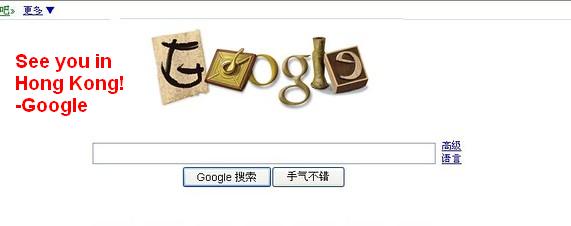
Last night, Google shut down its China search engine, Google.cn. Visitors to Google.cn are now redirected to Google’s Chinese-language service based in Hong Kong, Google.com.hk.
Google has now set up a censorship dashboard for Google services in China that shows which services are blocked.
As Ron Deibert of CitizenLab tweeted, “It’s no ONI report, nor Herdict, but interesting anyway.”
In a statement posted to Google’s official blog, David Drummond explained the new approach to China. Google had previously announced on January 12 that it would no longer stand by a 2006 deal with the Chinese government after it was the target of hacker attacks that it attributed to China.
“CDT applauds Google for following through on its commitment to protect human rights and for its continued effort to enable China’s people with unfiltered access to robust sources of information from all over the world,” said Leslie Harris, President and CEO of the Center for Democracy & Technolog.
“Whether the Chinese people will be able to take advantage of Google search now rests squarely with the Chinese government. If China allows access to unfiltered search, it will be a substantial win for global Internet freedom and for the Chinese people. If China blocks access, it will finally make clear to the Chinese people who is pulling the levers of censorship in the country.”
“It is certainly a historic moment,” said Xiao Qiang, director of the China Internet project at the University of California, Berkeley, quoted in “Google Shuts China Site in Dispute Over Censorship,” in the New York Times. “The Internet was seen as a catalyst for China being more integrated into the world. The fact that Google cannot exist in China, clearly indicates that China’s path as a rising power is going in a direction different from what the world expected and what many Chinese were hoping for.”
As the Ryan Singel reports in his post on Epicenter blog at Wired, “Google Uncensors Chinese Search Engine,” “now a search on June 4, the day of the 1989 Tiananmen massacre, returns 226 million results. Formerly that search, and thousands of other terms like it, had limited results and a notification to users that search results had been hidden due to the rules of China’s Communist government.”
How much has the online world changed in the past quarter of a century? In the years since Synbolics.com was registered, hundreds of millions of websites have followed that first domain name. According to the VeriSign Domain Name Industry Report, at the end of 2009 there were 192 million domain name registrations across all of the Top Level Domain Names (TLDs).
Of those, .com continues to have the highest base. “The world we live in today is the most interdependent in history,” said former President Bill Clinton, speaking within the Reagan building in Washington D.C. last week at the Policy Impact Forum. “The real question is what can we do through the present state of the Internet to improve the path we’re on.”
Clinton was introduced by VeriSign president Mark McLaughlin as the “first Internet President,” a reasonable contention given the explosive growth of the online world during his terms in office. As McLaughlin pointed out, under Mr. Clinton Internet governance passed to ICANN and the first White House website. (For those interested, you can still hear Socks meow.) McLaughlin and others blogged about 25 years of .com on Facebook.
Clinton made his comments on the day that the FCC’s National Broadband Plan was released, putting the question of how connectivity, innovation and speech should be stimulated (or regulated) into clear relief. Clinton suggested that access framework proposed by the FCC might be needed.
“In America, we opted for a degulation approach in the Internet and cellphone business,” he said, “but a lot of our competitorsnow have better cell phone coverage than we do because they had some regulation to guarantee a framework of universal access.”
In the present, “I’m worried about unequal access,” Clinton said. “We devoted 870 million a year to education technology. We developed the E-Rate so that information could be more publicly shared.”
“In general, our entrepreneurial approach is the best one,” said Clinton, but “there are limits to it and sometimes we need a framework to make sure the markets can continue to grow by having more universal access. So I’m hoping the FCC proposals will do that.”
Clinton talked about how the Internet has been indispensable to the work of his foundation. He also focused on the importance of information technology to his administration.
In 1996, then-President Clinton issued Executive Order 13011 on federal information technology, which ordered the heads of all federal agencies to “refocus information technology management to support directly their strategic missions,” create agency CIOs and “cooperate in the use of information technology to improve the productivity of Federal programs.”
When the decision came to support as a medium, said Clinton, “the Internet was either going to be to the private reserve of a few or to the positive good of all. All the decisions that came were a result of seeing in its infancy the staggering potential we see today.” Clinton also gave credit to Al Gore, who “took unmerciful abuse about a claim he never made.”
Clinton chose to highlight a proposal from President Obama and the Secretary of State for a global health initiative that will leverage information technology. “There has to be a limit to ability to wealthy countries helping poor countries by treating discrete health problems,” he said. “Sooner or later, they have to have [functioning] health systems. In the end, you have to give people the ability to support themselves.”
When considering potential answers to that immense challenge, does the Internet have anything to do with solutions? One area where the Internet has proven its utility is enabling distributed fundraising. Clinton himself said that over half of donations made to victims of the Indonesian tsunami were made online.
In 2010, Clinton said that MassiveGood.com, could a micropayment fundraising model where every time a consumer buys a plane ticket, reserves a hotel room or rents a car, they can choose to donate a small amount to AIDS, tuberculosis, malaria or childrens’ healthcare. “None of this would be conceivable without the Internet,” said Clinton.
“We’re going to have instantaneous posting of all donations and expenditures,” he said. “That’s what we did after the tsunami, with stunning effects in reducing corruption and increasing transparency.”
Clinton took some time to talk about both healthcare, the issue of the day, and climate change, perhaps the issue of the decade. “There are four countries which signed the Kyoto protocoal,” said Clinton: Denmark, Sweden, Germany and the UK. Clinton asserted that was because of the way that they consume and produce energy. ” A wealthy country has to have a new source of jobs every 5-8 years, he said. “The only way can be distributed is through the adequate use of IT. In the years ahead, we ought to do whatever we can increase access, compress time, improve connectivity.” ABC News’ Julie Percha reported more on Clinton’s talk at the Tech Forum, focusing on his remarks on healthcare.
Clinton also issued a challenge to those in the audience that work in technology: “What is the role of IT in dealing with the capacity problems of the poor and the rigidity problems of the wealthy?”
What is necessary to ensure open global access? “First of all, you can’t if nations disagree,” he said. “If they decide to control access, they have some ability to do it. Look at the role tech played at bringing to light what happened in the Iranian election.” Clinton suggested too that the audience consider the impact of cell phones in poor countries. “For every 10% increase of cellphone usage in poor countries, they gain .6% to GDP,” said Clinton, citing a recent mobile research report.
In looking back at the importance of the Internet, Clinton said that “the potential for impact has gone far beyond what I expected. On balance, it’s an instrument of freedom, not repression.”
The former President offered some insight into his use of technology during a question and answer with McLaughlin after his keynote. When asked what his three favorite websites were, Clinton chose political ones: Politico, the Huffington Post and FireDogLake. Clinton affirmed the substantive contributions that websites can make, although “don’t have to do what newspapers have to do every day,” as “some only have to have three serious articles a week.” Clinton said that he’s “worried about the ability to maintain any newspaper” in the years ahead.
Clinton also fessed up to his favorite device: an iPhone, “because I can get everything on it.” He said he tried to stay away from the BlackBerry “because I’m still obsessive,” sharing in the process that former President George H. W. Bush was “constantly doing email.”
Kara Swisher from All Things Digital was also on hand at the 25 Years of .Com Tech Impact Forum, where she moderated a panel on the future of Web technology. She recorded a video of the Q&A after the keynote that can be viewed at Boomtown, in “Bill Clinton talks about his Internet legacy.”
Mental Health Break: the wonderfully creative video for “This Too Shall Pass,” from the OK Go album, “Of the Blue Colour of the Sky.”
According to the shownotes on YouTube, the video was directed by James Frost, OK Go and Syyn Labs and produced by Shirley Moyers.
The video was filmed in a two story warehouse, in the Echo Park neighborhood of Los Angeles, CA. The “machine” was designed and built by the band, along with members of Syyn Labs ( http://syynlabs.com/ ) over the course of several months. OK Go thanks State Farm for making this video possible.
I was the 7,869,145th person to discover it. [HT Mark Drapeau] I’m ok with that. The success of this video built further on “Here It Goes Again,” one of the most popular viral videos ever:
This past week, OK Go took one step further along their transition to “Band 2.0” — they left EMI Records to form Paracadute Recordings. (Paracadute is parachute in Italian, for those wondering, along with being really fun to say.) Fittingly, the move was a;so announced on YouTube:
As Kulash indicated in a New York Times op-ed, “WhoseTube” earlier this year, however, there’s more of a backstory here. As Kulash observed, EMI prevented users from embedding the label’s videos on other websites, a move which likely targeted at increasing the label’s streaming royalties from YouTube. Kulash argued that the policy hamstrung the “viralability” of the video:
When EMI disabled the embedding feature, views of our treadmill video dropped 90 percent, from about 10,000 per day to just over 1,000. Our last royalty statement from the label, which covered six months of streams, shows a whopping $27.77 credit to our account.
Clearly the embedding restriction is bad news for our band, but is it worth it for EMI? The terms of YouTube’s deals with record companies aren’t public, but news reports say that the labels receive $.004 to $.008 per stream, so the most EMI could have grossed for the streams in question is a little over $5,400.
With that move, the “most-downloaded band ever” followed Radiohead and NIN into independent distribution and promotion. Given a press release that credits OK Go with 180 million video streams and counting, perhaps Damian Kulash, Tim Nordwind, Dan Konopka and Andy Ross figure they can make it without a label’s backing.
Given the challenges of selling music online, this hybrid model of sponsored viral media, touring and merchandise sales might allow OK Go to make enough to support families. Not every artist is going to be able to pull this off. As Jonathan Coulton showed in 2007, however, for some savvy musicians, the Web offers a new media model. Code Monkey went viral – and fans got involved:
Both Coulton and OK Go have embraced video, blogging, Twitter, Facebook and other online networks to distribute their work, promote their appearances and — crucially — engage their fans. Making money from that investment of time is the secret sauce, of course, but for some, “band 2.0” will pay off. Not every band will be able to make more than $2 million dollars from digital downloads, as Radiohead managed to do through inrainbows.com, but OK Go’s success does show how creativity can be rewarded.
In the meantime, enjoy that Rube Goldbergian video.
“Politicians know they can use social media to talk to people. What they don’t know yet is how to listen.”
That was Anil Dash’s summary of a basicchallenges that lie ahead for many world’s representatives as they explore Twitter, Facebook, YouTube, blogs and other online platforms that allow reciprocal communication. Last year, he wrote that “the most Interesting new tech startup of 2009” was government.
Dash knows a thing or two about tech startups as the first employee of Six Apart LLC, one of the world’s leading blogging companies. He understands online engagement too, after blogging at Dashes.com since 1999. Now, however, he’s set his sights on an even bigger goal: transforming the ways citizens relate to their government through social media using a startup mindset.
Speaking to a group of “digerati” at Baked and Wired, a chic purveyor of cupcakes and Internet in Washington’s tony Georgetown neighborhood, Dash laid out his vision for Expert Labs, “a new independent initiative to help policy makers in our government take advantage of the expertise of their fellow citizens.”
The first project at Expert Labs will be a “ThinkTank App,” an open source web application that aggregates and organizes replies to status updates on Twitter. ThinkTank App was developed by Lifehacker founder Gina Trapani, who has signed on with Expert Labs to develop the platform.
The first client for Expert Labs is one that would make most startup founders swoon, too: the White House will be using the ThinkTank app to get better answers from citizens.
“We want to create a different space for participation that rewards good answers, said Dash. He cited several online websites with communities that allow meaningful exchange of information without the ugliness that pervades many comment boards, including stackoverflow.com, ask.metafilter.com and the site his wife manages, SeriousEats.com.
“We need to establish our priorities as a nation, with citizens as the think tank,” said Dash.” If we can go from six people in closed door room to sixty thousand addressing a problem, that will be a small win.” Dash asserted that the disruptive influence of online collaborative tools will cause “entire federal agencies will be transformed, just as newspapers have been.”
Given the immense economic, social and technological challenges that lie ahead for the United States and the world in this young 21st Century, that’s a vision worth keeping an eye on.
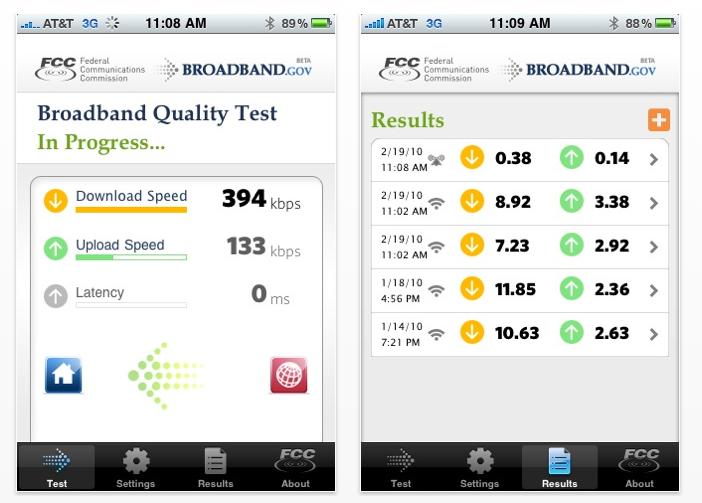
The FCC’s new apps will allow users to test the speed of mobile broadband service and report deadzones where mobile broadband is not available. The FCC iPhone app is a free download from iTunes or the Android marketplace.
“Transparency empowers consumers, promotes innovation and investment, and encourages competition,” said Chairman Julius Genachowski in a press release. “The FCC’s new digital tools will arm users with real-time information about their broadband connection and the agency with useful data about service across the country. By informing consumers about their broadband service quality, these tools help eliminate confusion and make the market work more effectively.”
The Consumer Broadband Test and the Broadband Dead Zone Report are also available as fixed applications at Broadband.gov. According to the FCC, the Ookla, Inc. Speed Test and the Network Diagnostic Tool (NDT) running on the Measurement Lab (M-Lab) platform are used to power the app.
In the future, the FCC says it will making additional broadband testing applications available for consumer use. Consumers can also submit availability information by e-mail to fccinfo@fcc.gov. And, perhaps taking a page from Google’s playbook, this application is in beta. According to the Consumer Broadband Test information page, “this beta version is the FCC’s first attempt at providing Americans with real-time information about their broadband connection quality.”
I ran a quick test on my home cable Internet connection.
My downlink isn’t quite fiber optic speed, but I found it close to existing tools. The test depends upon Java, though many users are likely to have that installed at this point.
I tried out the mobile app as well, which used the GPS in my iPhone to discover my location. According to the FCC mobile broadband testing app, I’m getting 1.42 Mbps download speed from AT&T 3G here in Capitol Hill and .11 Mbps upload.
Beats GPRS, if not a Clearwire 4G connection — or my wifi.
Privacy concerns?
The FCC states that it’s “committed to protecting the personal privacy of consumers utilizing these tools, and will not publicly release any individual personal information gathered.” It’s posted a privacy statement to that effect.
Crowdsourcing citizen reporting
The larger context of the release of the FCC mobile broadband testing app is worth noting. The FCC will release its National Broadband Plan next week.
Part of that plan will certainly incorporate assessing where broadband service is exists, how robust it is and, perhaps, how closely service matches advertised rates.
This kind of data could serve in much the same vein as the FTC’s consumer complaint assistant works at FTComplaintassistant.gov. The FCC has given citizens a tool to report service quality and availability around the country. Equipped with that data, commissioners may be able to make more informed policy decisions as they roll out the broadband plan.
Now it remains to be seen whether citizens use it or not.
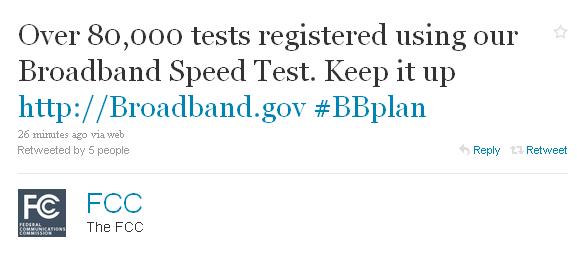
UPDATE: On Saturday night, March 13th, the FCC tweeted that over 80,000 tests had been registered using the Broadband Speed Test. It was unclear how many tests were through Broadband.gov or the apps.
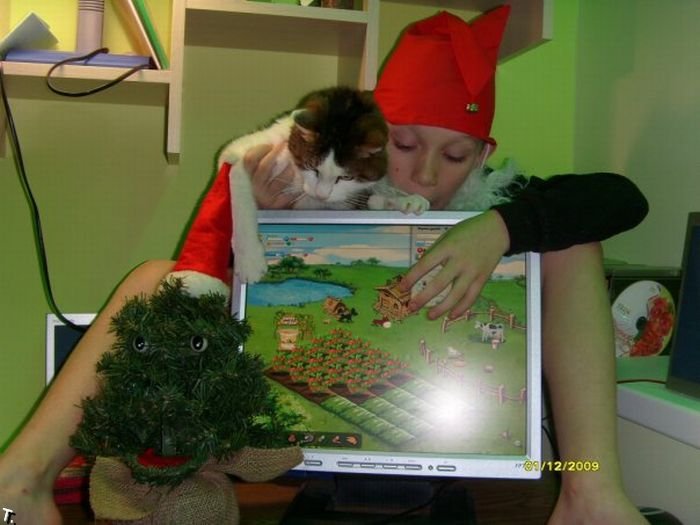
The popularity of Zynga’s “Farmville” for among Facebook’s 400 million users is well known. Given 69 million active monthly players, Farmville is bigger than Twitter.
A less publicized statistic is that users of Russia’s top social network, VKontakte.ru, also have a farming application the top social game.
Earler today, I met Nick Wilsdon, a Russian online marketer, by following the #RusTechDel hashtag on Twitter. (In doing so, I was reminded again that #hashtags on Twitter are like channels on cable TV.) I asked Wilsdon if he knew how many unique visitors vKontackte & others receive monthly.
Wilsdon answered with a quick report on vKontackte and Odnoklassniki.ru. According to the statistics he cites, “Happy Farmer” has more than 6 million users and revenues estimated at $200 million dollars per month.
Whether or not gaming addiction is an issue, China’s burgeoning social gaming market shows how popular – and profitable – this phenomenon has become.
As VentureBeat’s reporting on online faming games suggests, there’s a “new agrarian revolution” in China. It’s tempting to summarize a global interest in social gaming on the farm as a common virtue, as millions tend virtual gardens for a few minutes every day across different cultures. It would be lovely if it spoke to yuor shared interest in growing things.
Unfortunately, there’s a dark side to virtual farming parallel to perils of factory farming in the real world: the profit motive.
Some fear that this new social farming revolution may not contribute to the positive development of society. A central feature of social farm games in China is stealing vegetables. Official state media People’s Daily reports that 70 percent of users on Kaixin001 cite it as their favorite feature, and it has even spawned the popular phrase “How many vegetables have you stolen today?”
This key addictive feature has created news stories of business executives “obsessed” with stealing vegetables and broken relationships over vegetables stolen on the night shift. The game is so addictive — with players setting alarm clocks at all hours of the night to check crops — that it “destroys jobs and relationships.”
“Simplicity and stickiness are behind the global epidemic of farm games. Anyone can learn to grow crops within minutes and reap a reward for getting friends — or the entire office — addicted too,” said BloggerInsight Co-Founder Lucas Englehardt.
There’s a business in serving that intense interest, along with providing others a means to slay monsters in World of Warcraft. There’s no small amount of psychology at work behind the incentive structures of these games, as designer look for ways to induce users to spend money on virtual good or services. And, as Michael Arrington pointed out in “Scamville” in TechCrunch last year, the “social gaming ecosystem” can lead to bad behavior.
For good or ill, however, more of us are planting virtual seeds each day.
It’s no secret that the media industry has been massively disrupted by the Internet and mobile communications technology. Newspapers no longer have monopolies on the market for local advertising. And news breaks in real-time across social networks like Twitter, splashing on the the 24 hour news networks minutes later.
The media market in Washington, D.C. has been similarly affected by technological change, particularly as new, nimble online players have moved into the nation’s capitol. Last night, I visited FedNet’s officers in D.C. for the Online News Association‘s February meetup. The night featured a panel moderated by Keith Carney, President of FedNet and featured Mike Mills (@Mike_Mills), Editorial Director of the Congressional Quarterly/Roll Call Group; Howard Kamen (@hkamen) Partnership Editor for USA Today, and Karl Eisenhower, Editor, New Media Strategy for NationalJournal.com. Fednet will be posting video soon; in the meantime, the livestream I recorded is below:
Vodpod videos no longer available.
The panel primarily focused on the business of online news as practiced by these different organizations. Congressional Quarterly (CQ) and Roll Call have a combination of a subscription model focused on high-value, scarce information gleaned from dedicated reporting on the minutiae of legislation, lobbying and political news. The combination of access, high value eyeballs and profit didn’t escape another provider of high value information: As Mills observed, the Economist Group owns both Roll Call and CQ now. The same media group also runs Congress.org, which Mills says is for “citizens to learn about Congress engage in grassroots activity.” He’s not worried about losing content to search engines, either, given a closed subscription model. “We’re not on the Internet, we’re on the intranet,” said Mills.
USA Today, by contrast, is a national newspaper with a generalist focus. According to Kamen, partnerships with other organization are providing USAToday.com with data for interactive graphics. Those interactive features in turn provide sustained traffic over time to support an advertising revenue model. When asked by Carney if a paywall might show up at USA Today to match the reported metered model at the New York Times, Kamen responded that “I don’t think that’s going to happen any time soon.” USA Today has moved into mobile news, recording over 2.5 million downloads of its free iPhone app. “We made it free to get eyeballs first,” said Kamen.
Even though the paper’s leadership has focused on retaining its position as the most widely circulated paper in the US, Kamen’s comments made it clear that USAToday.com is an important part of its future. “I truly think we do have an ‘online first’ model now,” said Kamen, although there coordinating print and online remains a “work in progress.”
The bridge between writers and coders has been bridged at National Journal, where Eisenhower said every newsroom has dedicated IT resources. The need to connect developers with reporters is felt across town, too: “The real merger that needs to happen is between editorial and IT,” said Mills.
National Journal is also shifting with the times, looking carefully at where and when readers are consuming their content. “Knowing our audience means knowing their work habits,” said -Eisenhower. “Mobile is very important.” Like other glossy weekly magazines, National Journal is experimenting with new advertising models as print circulation wanes.
What will 2010 bring? Innovation and disruption, without question. Certain takeaways from last night, however, should be of use to every media organization, even those without immense national circulations or access to information of interest to readers with attractive demographics for advertisers.
First, go where the readers are. Mills observed that failures in business models were often rooted in not following the audience to where they’re getting information.
Second, go mobile. Create applications, stripped down websites and email alerts that allow the audience to get news on the go.
Third, use data to create evergreen content. Organizations like Gallup or even governments themselves are providing data feeds or sets that can be used for interactive graphics.
Finally, get social. Facebook recently passed Yahoo as the second-most visited site in the world. Many news organizations are finding that social networks are a significant source of traffic, as the audience shares what it’s reading.
All in all, a great night. I enjoyed talking with the always-entertaining Tiffany Shackleford about celebrity culture online and Lee from NPR’s “Tell Me More” about digital distribution and syndication. Even as old models crumble, there’s no shortage of innovation in how we share the news in 2010.
While I’m proud of those posts, one of the themes that emerged from the weekend was the importance of video for communication. I’m not at all on “video as the new text,” especially for countries with low Internet penetration or bandwidth, but there’s no denying that online video has extraordinary power in conveying messages. Just look at video of Iranian protesters on the streets of Tehran, reports from the earthquake in Haiti or the President of the United States on YouTube. Tune in to CitizenTube any minute of the day to witness that power in action.
Following are short videos from Gov2.0 LA organizers and attendees that share their takeways from the event.
Lovisa Williams
@lovisatalk talks about the goals of the Gov2.0 LA Camp.
As the Wall Street Journal reported today, Google’s development team has been working “feverishly” to tweak Buzz privacy settings. Earlier tonight, Google responded to widespreadprivacyconcerns about Buzz, its new social messaging platform.
Google will add a tab specifically for Buzz in Gmail. While Google has not chosen to separate Buzz entirely from Gmail, as many readers thought might be the case after reading a story in SearchEngineLand. Instead, as Danny Sullivan reports there, Google may offer Buzz independently from gmail in the future. This move addresses user experience, creating a clear means to configure the social messaging platform or disable it.
Buzz will no longer automatically connect Google Reader or Picassa. Both of these environments could be limited to closed networks of friends or contacts. When someone wrote “F*** You, Google,” its development team was apparently listening. According to the New York Times story on Buzz privacy settings, Google reached out to the aggrieved user and made changes to address some of her concerns.
Crucially, Google Buzz will move from auto-follow to auto-suggest. Instead of simply connecting a new user to existing gmail contacts, Buzz will now present the user with suggested users from within that social network.
Will it be enough to address the concerns of aggrieved users and convince bystanders to try Buzz? As Neil Gaiman tweeted, “Google DID work late. And DID fix it. I don’t think I’ll ever turn it on now, but good on them.” Or as Jay Rosen put it, “I waited, read the news about Google Buzz, absorbed the accounts and experiences of people I trust, and disabled it before ever opening it.”
Whatever the impact of tonight’s changes, Google has moved quickly to improve the areas of Buzz that have caused such angst online. As Gina Trapani, a self-described “Google fangirl” tweeted, “no doubt Buzz’s privacy issues are seriously problematic, but at least they’re iterating quickly and openly.”
The question that remains is why none of these privacy concerns were clear at the outset. “Google addressed most concerns – good job,” tweeted Evgeny Morozov. “But strange they hadn’t expected the backlash. What were they really thinking?”
Morozov, whose trenchant analysis of the “wrong kind of buzz around Google Buzz,” has been an prominent voice in highlighting the risks of using public social networks for citizens in countries where voicing dissent can carry a death penalty. As he wrote, “I am extremely concerned about hundreds of activists in authoritarian countries who would never want to reveal a list of their interlocutors to the outside world.”
This change may address that concern, though an “evil genie” may already be out of the bottle if intelligence services have already mined activists’ social networks. It’s not just citizens within authoritarian governments that had much to lose, after all. As danah boyd observed, “automated connections (a la Google Buzz) are particularly dangerous for at-risk populations.” Lawyers have other concerns: exposing clients through email addresses could violate confidentiality agreements.
Another tweak will help a bit with some of the above. As Jason Kincaid wrote at TechCrunch, “private e-mail addresses that were exposed in Buzz @replies are now covered up by asterisks.
That said, Google has now followed Facebook in making a major change to user privacy without testing it first or, crucially, allowing its users to opt out. Instead of making joining Buzz an option, Gmail users were added by default. And the only means users had to disable Buzz completely was akin to a nuclear option: deleting a Google profile.
I haven’t found the algorithmic authority or relevancy in Buzz that I’d expected yet. As Zach Seward tweeted, there’s “something to be said for Google Buzz: When @robinsloan hosts a fascinating discussion, you can link to it.” Buzz support for open data standards may prove to be both disruptive and beneficial for the open Web. Now that I’ve taken steps to hide my contact, I plan to continue using Google Reader to share news to my Google Profile and Buzz to participate in discussions.
That said, this brush with privacy may have tainted the launch of Buzz in much the same way that the death of a luger in Vancouver put a pall over the beginning of the Winter Olympics. Google may have more information about online users that any entity on the planet. By exposing those relationships without offering users the opportunity to opt-out of the new service on launch, the Internet giant has put trust in privacy at risk, an existential worry given that data that Google has about so many.
As Stan Lee put it, “with great power, there must also come great responsibility.” The past week’s backlash has reminded millions of the stakes for such trust.
A few minutes ago, Google Buzz went live at http://buzz.google.com. Google posted a video introducing the Buzz, which ties together Google contacts into a distributed social network accessed through a new tab in Gmail.
In a live webcast on YouTube, Bradley Horowitz (@elatable) explained what Google was after with Buzz: a way to add relevance to the information firehose represented by social messaging and activity. The Web application will act as a user interface to for social data.
Based upon the demo, it will be a snappy app for processing, sharing and annotating images, video and conversations. “Organizing the world’s social information has been a large problem, the kind @Google likes to solve,” said Buzz product manager Todd Jackson, explaining at least some of the why behind the application of algorithmic authority to social media. Jackson writes more in his introduction to Google Buzz at Google’s official blog.
Content shared on Buzz can be posted publicly to a Google Profile (like the one for, say, Alexander Howard) or sent privately within a network. At first glance, the user interface and contrls looks like a Friendfeed clone, with the additional of familiar keyboard shortcuts from gmail and Google Reader. And, notably, Google has adopted the “@reply” convention from the Twitter community as a means of initiating a conversation with contact.
To get a user started with a network, Buzz will autofollow people you’ve emailed. In other words, as Jeremiah Owyang predicted last summer, Google made email into a social network.
Buzz is also mobile.
The mobile Web application, which works on both iPhone and Android, includes geotagging and voice recognition, allowing the user to make spoken updates. While Google profiles will aggregate a user’s Buzz activity, “Places” will aggregate location-based reviews. (In other words, look out Yelp.) A “Nearby” button provides location-based context for Buzz users. Google also launched a new mobile verion of Google Maps, adding a a social layer to its maps. The new “conversation bubbles” on Google Maps indicate geotagged Buzz updates and look like a lightweight, useful version of Twittervision.
Coming soon to the enterprise
Google Buzz will be launched as an enterprise product, says Horowitz. Buzz would likely serve as microblogging layer for Google Apps, providing helpful filtering for the noise of the social Web, unlike Wave, which added it. “A lot of the functionality is inspired by Wave,” said Horowitz, a likely nod to a decision to adopt the best features of the often maligned social messaging platform.
Google co-founder Sergey Brin was on hand to share his personal experience with Buzz, offering a preview of how it might be pitched to other business executives or CIOs. “I found a huge amount of productivity from using Google Buzz internally,” said Brin. “I posted [an] OpEd to Buzz. I looked at the broad categories and did a general edit based on that feedback. It was far more efficient.”
Open APIs?
Public feeds are supported as an XML feed and are fully supported by PubSubHub as of today, said another Google exec. By going open API and openly courting developers to join them on Google Code, Google may be after the same fertile ecosystem that surround Twitter.
What does Google Buzz mean?
All of the above gives an idea of what Google’s newest Web application can do and how it might work. Altimeter Group’s Jeremiah Owyang has already posted a quick take on what Google Buzz will mean. Key insights:
At the high level, this is a strong move for Google, they continue to aggregate other people’s social content, and become the intermediatry. This helps them to suck in Twitter, Flickr, and any-other-data type as the APIs open up, giving them more to ‘organize’. This is Google acting on its mission to the world.
For consumers, the risk of privacy will continue to be at top of mind. Although the features allow for sharing only with friends or in public. expect more consumer groups to express concern. Overtime, this will become moot as the next generation of consumers continues to share in public.
For consumers, this could potentially have more adoption than Twitter as Gmail has a large footprint Google told me it’s tens of millions (active monthly unique). Of course, most Gmail users likely aren’t Twitter users, but there could be a large platform to draw from.
For Facebook, this is a direct threat, these features emulate Friendfeed and the recently designed Facebook newsfeed. Expect Google to incorporporate Facebook connect, commoditizing Facebook data as it gets sucked into Google and displayed on Google SERP.
For small busineses and retailers, this will impact their search engine results pages, as a single top ‘buzzer’ could cause their content to be very relevant, if that person was relevant, then their influential content could show at top of SERP pages. Expect Google to continue to offer advertising options now around buzz content –fueling their revenues.
Strong, near real-time analysis from Owyang. One area he didn’t dwell as much on is the utility to both businesses and many users of the social Web who want relevance for work or for specific topics, without the noise that often obscures both on Twitter, Facebook or other social networks. Power users have had to evolve many strategies to filter signal from the noise, including shadow accounts, lists, keyword searches or alerts. Google Buzz has the potential to allow over 150 million gmail users to quickly filter the most useful content from the social Web and then selectively share it with either friends, colleagues or the open Web. That action, often termed “curation” in the digital journalism space, is singularly useful.
If Buzz easily enables that activity for mobile users, it will have the potential to massively disrupt the nascent mobile social networking space that currently includes Yelp, Gowalla, Brightkite, Loopt and Foursquare. If users turn to Buzz for reviews, to find who is nearby or what’s being discussed in the neighborhood, Google will also have made Google Maps much stickier, which could in turn make it a more useful platform for contextual mobile advertising. Given the potential for targeted ads based on location to be more useful, that might in turn be of great utility to both users and the search engine giant, though electronic privacy advocates are likely to look at the move with concern.
Will people use Buzz? That’s the multi-million dollar question. Facebook and Twitter own the social Web, as it stands. If Buzz offers a UI that adds relevance, it has a shot. If users find utility in the way that Buzz helps them filter social media from other platform, it could stack up well against Brizzly, Seesmic or similar “social dashboards.”
I’ll keep an eye out for the function to go live in my inbox in the meantime and read TechMeme for other reactions.
Emerging technology has the power to make democracy stronger or weaker. Understanding where, when, and how is the hard part. Subscribe to Civic Texts to get insights about how technologies are changing our democracy in your inbox.

 Last night, Google shut down its China search engine, Google.cn. Visitors to Google.cn are now redirected to Google’s Chinese-language service based in Hong Kong, Google.com.hk.
 “CDT applauds Google for following through on its commitment to protect human rights and for its continued effort to enable China’s people with unfiltered access to robust sources of information from all over the world,” said Leslie Harris, President and CEO of the Center for Democracy & Technolog.





 digiphile