Business innovation through IT: “Computers create more productivity”

During the roaring 90s, technology evangelists convinced business owners to drop millions on IT equipment to cash in on productivity gains and chase digital goldmines online. A decade later, MIT professor Eric Brynjolfsson has published a new book entitled “Wired for Innovation: How Information Technology is Reshaping the Economy.”  He also recently co-authored “The New, Faster Face of Innovation” in the Wall Street Journal/Sloan Management Review.

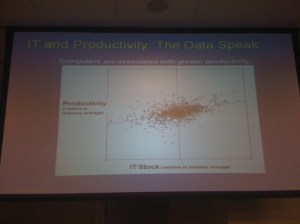
innovation-ITProfessor Brynjolfsson presented the findings from his book at the Information Technology and Innovation Foundation in Washington earlier today. After breaking down the components of a large IT project, the bulk of which consist of implementation and deployment, he examined  Dell Computers as a case study in IT innovation.

Professor Brynjolfsson visited a Dell factory, a bustling manufacturer where most PCs are built to completion in one day. During his visit, he noticed that the back third of the factory empty. He suggested to the Dell executive that was taking him on the tour that perhaps that space wasted.

The reply? “We used to use it but don’t need it any more. We’re producing more in less space.”

Brynjolfsson said that Dell had implemented i2 software and completed a business process redesign to gain these efficiencies. Orders are transmitted customers go right to suppliers, which deliver new parts to the facility every 4 hours in a classic case of “just-in-time manufacturing.” Managers are able to both see problems earlier and fix them, leading to a substantial improvement in efficiency.

The exec called up Brynjolffsson later to let him know Dell was now using that extra space, producing twice as much from the factory as a year earlier. In essence, says Brynjollfson, Dell had “built a second factory” – except that it was made of business processes and software, representing intangible assets. “That’s a microcosm of what’s been going on in the US economy,” he observed.

Photomontage showing what a complete iceberg m...
Image via Wikipedia

In that larger context, “computerization” has a greater effect than computers.

Brynjollfsson used the metaphor of an iceberg to describe the role of organizational assets. In that sense, IT capitol and other technological investment are the visible portion of  much vaster organizational complements below the surface. As he put it, “intangible assets are more important in the information economy”

Brynjollfsson cited an broad analysis by MIT of organizational assets, including 1167 large firms over 10 years and 10,473 observations.

The analysis colllected4 principle types of data:

  1. Revenue/market value.
  2. Computer capital from computer intelligence.
  3. Ordinary capitol, labor, other assets, R&D.
  4. Organizational assets.

Results?

Brynjollfsson cited three key findings, including identification of a distinct set of business practices common to heavy IT users.

  1. The “digital organization.” That concept describes a distinct corporate culture and organizational process are found at most (but not all) heavy users of computers and the Internet
  2. Higher productivity and higher market value. Firms that adopt this digital organization have higher performance
  3. IT and the digital organization are complements. Firms that adopt the digital organization and simultaneously invest more in IT have disproportionately higher performance.

According to Brynjollfsson, there are 7 identifiable practices of digital organizations:

  1. Move from analog to digital business process.
  2. Distribute decision-making rights.
  3. Foster open information access.
  4. Link incentives to performance.
  5. Maintain focus and communicate goals.
  6. Hire the best people.
  7. Invest in human capitol.

If these practices are better – and they’re noticeably better, says Brynjollsson – why aren’t they being adapted? The dispersion between successes and failures has been growing, if anything, in recent years. What’s the story?

A member of the audience suggested a well-known model at MIT, system dynamics, where a feedback loop that of poor practices trapped organizations in negative spirals.  Byrnjollfson observed as well that decisions that can be quantified or structured are becoming more centralized. Older & bigger firms had a harder time, both in terms of company & employee age. “Most of our metrics were focused on business performance: productivity, profitability, market value. When we asked about employees, we found employees were also better off.” According to Byrnjollfson, firms which adopt the tenets of digital organizations have higher pay, from top to bottom and are less likely to have turnover.

The bottom line, in terms of the professor’s findings, is that information technology is a catalyst for a productivity surge but that  organizational change is the bulk of the iceberg, so to speak. Payoffs only come when investments are made in both IT infrastucture and training, education and incentives in a coherent sytem.

He cautioned, however, that the IT investments of some organization were both overstated and overvalued during the dotcom bubbles, where intangibles were used to justify stratospheric valuations.  Many companies invested beyond an optimal point, and in assets that inevitably decreased in both value and utility over time.

These gains are also realizable only in the context of talented, educated knowledge workers. “Technology investments require more skilled workforce,’ he said. “If you make investments in IT education, you help narrow the wage gap.”

He ended by making an analogy to the invention of  microscopy by Anton Van Leeuwenhoek, which in turn led to a revolution in medicine and biology. In Professor  Brynjollfson’s view, the revolution in data flows inside companies and bureaucracy has the potential to lead to substantial improvements in public policy. The paradigm of managing large organizations through the analysis of real-time manufacturing data can be applied to economic policy, healthcare and energy, to name a few areas of far-reaching potential.

Reblog this post [with Zemanta]

Leave a comment

Filed under Uncategorized

National Institute of Food and Agriculture (NIFA) launches in DC

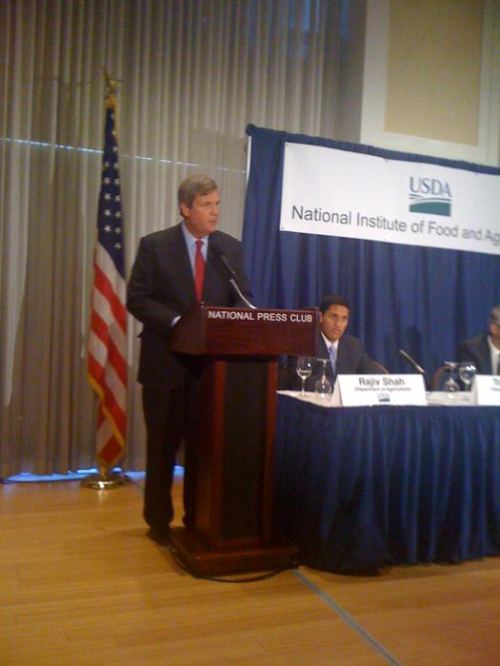
This afternoon, I was privileged to be at hand at the National Press Club today when Secretary of Agriculture Vilsack launched the National Institute of Food & Agriculture (NIFA).

Agriculture Secretary Vilsack speaks at the National Press Club

Agriculture Secretary Vilsack speaks at the National Press Club

The new institute’s website is http://nifa.usda.gov.

And, it being 2009, you can followed NIFA at @USDA_NIFA on Twitter.

According to Secretary Vilsack, ” NIFA will be the Department’s extramural research enterprise. It is no exaggeration to say that NIFA will be a research “start-up” company – we will be rebuilding our competitive grants program from the ground up to generate real results for the American people. To lead NIFA, President Obama has tapped a preeminent plant scientist from the Danforth Plant Science Center in St. Louis – Roger N. Beachy, winner of the Wolf Prize in Agriculture and a member of the National Academy of Sciences.”

As I mentioned on Twitter, @FoodSafety and @USDAFoodSafety are  already up and tweeting.

Among other many agricultural science initiatives, secretary Vilsack emphasized that this new USDA institution will identify agriculture opportunities in U.S. that, within 10 years, will be “net carbon sinks.”

“USDA science will support our efforts to radically improve food safety for all Americans,” said secretary Vilsack. “Each year in the U.S. alone, food-borne pathogens like E. coli kill 5,000 people and sicken 75 million more; the cost to the economy from these infections exceeds $35 billion.”

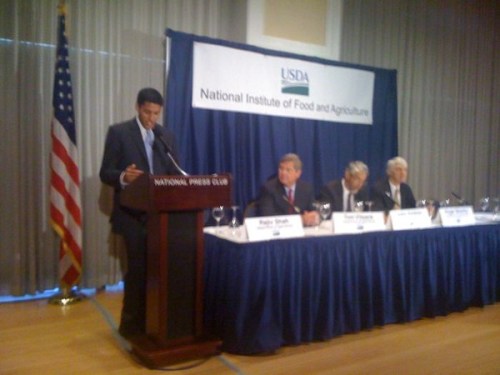
Following the Secetary’s remarks, Rajiv “Raj” Shaw, Under Secretary of Agriculture for Research, Education, and Economics (REE) and Chief Scientist at the United States Department of Agriculture, provided an overview of the different areas agricultural science could positively affect both the energy policy of the United States, food security and, in time, hunger at a global scale.

Raj Shah at the NIFA launch

Raj Shah at the NIFA launch

Following Shah, the @WhiteHouse science advisor, Dr. Holdren, t, leavened the event with casual humor of an agricultural variety, punning his way into a wave of chuckles.

Dr. Holdren was clearly inspired by what he’d seen at the “Astronomy Night” at the White House last night.

More information and video of that event is available at http://blog.ostp.gov, courtesy of @WhiteHouseOSTP.

Video of the event, including the remarks of all three men, is archived and available on demand at VisualWebcaster.com: NIFA launch at National Press Club.

Leave a comment

Filed under Uncategorized

orchid

Media_httpfarm3staticflickrcom245939922184929acd7ee724jpg_gyzgfdwahsqvzhe

Leave a comment

Filed under Uncategorized

Supreme Court preview for the 2009-2010 session from ACS

The Supreme Court of the United States

The Supreme Court of the United States

What cases coming before the Supreme Court will be the “most interesting and have the most impact” on the American people? That’s a matter of considerable interest before the Justices hold their opening conference next Monday.

According to the lawyers assembled for the American Constitution Society for Law and Policy yesterday, the court will consider the constitutionality of life sentences for juveniles, free speech, campaign finance and corporations, revisit  elements of Miranda rights, and hear a case on antitrust on the NFL.

Quite a docket.

The Supreme Court will also, in what Michael Carvin called the “most important separation of powers case in 20 years,” take a hard look at the Public Accounting Oversight Board (PCAOB).  Is the PCAOB, established by the Sarbanes-Oxley Act (SOX),  a “5th branch” of government?

Michael Carvin was just one of an estimable collection of legal minds on the panel, moderated by one Thomas C. Goldstein. Goldstein, along with arguing some 21 cases before the Court, is principally responsible for SCOTUSblog. Goldstein and Carvin were joined by Pamela Harris, executive director of the Supreme Court Institute at the Georgetown Law Center, Doug Kendall, founder and president of the Constitutional Accountability Center, Lisa Kung, director of the Southern Center for Human Rights, Deanne Maynard, partner at Morrison & Foerster and Paul Smith, partner at Jenner & Block.

In the spirit of legally-inspired disclaimers on accuracy of interpretation, I should note before I go any further that, while I have a parent who is a lawyer and am romantically involved with a law professor, I have no formal legal training and came to panel as a journalist and observer.

Campaign Finance

Up to until now, says Doug Kendall, the rule has been to limit corporate participation. The court upheld election communications rule before hand within 30 days. The case before the Court is one that has attracted gallons of media ink, due in no small part to the involvement of a well-known citizen: Secretary of State Hillary Clinton. Consideration of campaign finance is already underway and received additional attention given that it was the first that newly-sworn in Justice Sotomayor has heard.

Doug Kendall brought up the 1990 precedent of “Austin v Michigan” as way of exploring the issue of free speech by a corporation vs speech by an individual. The argument that he put forward goes back to the language of the U.S. Constitution, which refers to persons and people – but not businesses. Kendall argued that the distinction is consistent with first principles. If Austin is overruled, he said, it would unleash corporate campaign expenditures.

Mike Carvin, in a rebuttal that evidenced his considerable experience in courtroom oratory, brought up the example of corporate media outlets like MSNBC or the Washington  Post endorsing a candidate. He questioned whether that would be any different than corporation buying advertising space endorsing a candidate. “Doesn’t think eliminating core political speech rights is consistent,” he said.

Carvin asserted that  26 states don’t regulate speech in this way and don’t operate any differently.  “It would be one thing if we were eviscerating rights for free speech,” said Carvin. “Are we doing this in the name of preserving McCain-Feingold?” He strongly suggested that free speech rights should not “be sacrificed on such slim evidence.”

Kendall observed that the “First Amendment also includes something about the freedom of the press” –  different than, say, Exxon Mobil. “This case raises fundamental questions about what at its core our constitutional protects,” he said, positing the analogy of  “We the people vs We the corporations.”

After that exchange, the substantive issues of whether video depictions of animal cruelty are protected under the First Amendment or national monuments on private land felt positively quotidian, despite the rigorous analysis of the precedents and relevance of the matters.

Miranda,  separation of powers and revisiting federalism

Harris explained that two different cases will be relevant to revisiting Miranda, one of which will address whether a citizen has the right to counsel during questioning. As she pointed out, these cases are “the first real cuts” for Roberts and Alito at the issue.

Another case will visit the question of whether you “deprive employer of honest services” by using business equipment – like, say a computer – on the job for personal or family business. That’s a serious question, given  both the open language and vagueness of the law in question and the way it could impact millions of people who conduct personal business online daily.

Harris also indicated that the case raised questions regarding the separation of powers – classic federalism issues.

Another case, Melendez v Diaz, will focus upon the 6th Amendment, involving the Confrontation Clause. At issue is whether  lab reports represent testimoniasl, which goes to the question of their introduction in trial. Is it enough for a defendant to call the analyst as his own witness? Or does the state need to do so? It “seems like the question is answered,” said Harris.  “What’s different?” The answer is practical: a new Justice. The practical concerns of bringing in analysts each time lab results are presented are significant – doing so would slow process. Given her self-identification as a legal pragmatist, will Sotomayor be more receptive than Souter was?  Harris doesn’t think so.

Separation of powers is also at issue with regards to the Public Accounting Oversight Board (PCAOB), as referenced above. The PCAOB, said Carvin, is “outside of government and presidential control” – that’s a  separation of powers issue.  The defense of agency is “unprecedented in American history,” he said.  The President can appoint or remove chairmen from institutions within the so-called “4th branch,” like the  SEC, FCC or Federal Reserve. In Carvin’s view, PCAOB is a 5th branch,”  with the SEC holding limited ability to influence regulations coming from it.

Criminal matters

According to Lisa Kung, Troy, Alabama has the highest number of capital convictions in the state. The case  of Hollywood v. Allen has raised issues around a  “cut & paste” judicial process at play there, where decisions are showing up with typos from drafts, like “proposed” making it through or misspellings of judges’ names. The question of the case? “What kind of deference does a federal court pay to this kind of judicial…nonsense,” said Kung, focusing less on the minutiae of mistakes and more on the quality of decisions.

Kung also discussed the case of Sullivan vs Ford, where the Supreme Court will decide on the issue of juvenile life without parole. The young man in question was sentenced at 13 years old to life in prison with no chance of parole. “Will it extend Roper?” Kung asked. That care is relevant  to the application of the death penalty under 18. Will Kennedy’s reasoning apply?

Kung brought up a case in which prosecutors were caught acting badly in Iowa by fabricating evidence. The relevant question is how much immunity should the law give to a prosecutor?

Business Docket

A case involved the NFL and antitrust law is coming up, specifically the use of the NFL’s intellectual property by others. The decision and  reasoning behind it could apply to any sort of joint venture down the road.

There’s also a patent case, examining what represents an eligible process. At issue in the Bilsky case is a business method, specifically a theory of hedge fund risk management.

Merck is also on the docket. That’s “part of trend where court taking cases cutting back on plaintiff’s bar,” said Deanne Maynard. “At what point does the plaintiff know enough that it should file?” In this case, the issue is over the troubled pain reliever, Vioxx.

Finally, there’s an issue over property, a case of “classic takings mode,” says Carvin. In Florida, if you own a beach house, the law says that you own the sand down to the high water mark. Like many coastal communities, Florida’s beach homes have been losing land due to erosion. Local governments have tried shoreline replenishment on the beaches in the state, which added 75 feet.  That’s the crux of the issue; the state then asserted that land is public. Home owners disagree.

Carvin, who argued  Bush v. Gore in front of the Florida Supreme Court, pointed out that this case may be memorable, in terms of how that court might change the law.  In essence, he said the court seems to have changed property rights by reinterpretation.

Parting thoughts: SupremeCourt.gov and finding information on cases

I was lucky to hear this preview of the cases coming up. I’m hopeful that the ACS will be releasing video of the session to the public. My observation after some searching online is that, despite SCOTUSblog and other watchers, resources that enable citizens to easily find out what cases are being heard aren’t easy to come by. The court’s website, SupremeCourtus.gov, provides information on recent decisions but the docket page is out of date and relies on the visitor knowing case numbers. Hearing lists are blank. The calendar page is a PDF that doesn’t indicate when individual cases are being heard.

I’m far from the first person to feel some angst over this issue. According to Fast Company, the court’s staffers know the site can use a redesign. The Sunlight Foundation’s Daniel Schuman confirms that in a post on redesigning the Supreme Court: “The Justices appear to agree. They’ve recently asked Congress for money to move control of the site in-house, taking over responsibility from the GPO.”

You can see the Sunlight Foundation’s mockup of what such a redesign might look like, below. The Foundation’s other suggestions, if implemented, would go a long way to making the Court’s cases, decisions and operations more transparent to the American people. I hope they are taken up, along with the long list of cases above.

The Sunlight Foundation's mockup of a new Supreme Court website

The Sunlight Foundation's mockup of a new Supreme Court website

Reblog this post [with Zemanta]

1 Comment

Filed under article, blogging, journalism

Cloud computing and DC, OpenID, privacy, cybersecurity, 3121, CongressCamp, Gov20 and the US CIO

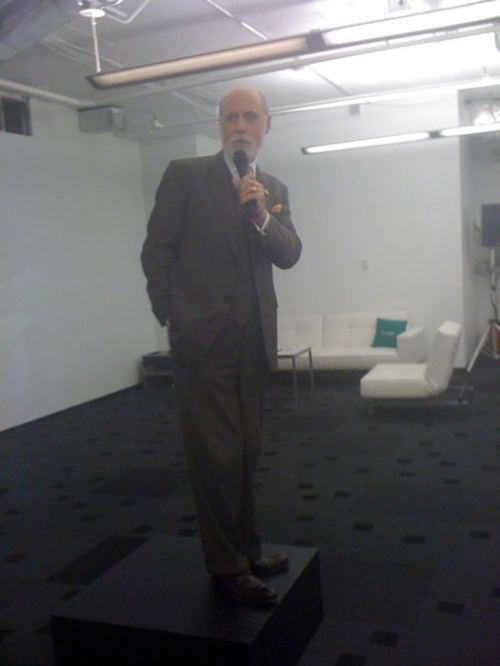
Fall came and with it a torrent of news and events. I’m still sifting through news, ideas and encounters from the Gov 2.0 Summit last week. I’m still smiling after meeting Clay Shirky, Craig Newmark and Vint Cerf. The “father of the Internet,” below was  a kind, gentlemanly presence at Google’s offices after the Gov 2.0 Expo.

Vint Cerf at Google

Vint Cerf at Google

Following up on Gov 2.0, I wrote about how D.C.’s CTO found both compliance cost savings benefits to cloud computing and reported on the OpenID federated identity framework set for .gov authentication pilot.

In a snarky moment, I caught the Twitter fail whale surfacing during a discussion on cloud computing.

fail-whale-cloud-computing-gov20
Ironic animal.

I recorded a half hour of video with Chris Messina and David Recordon discussing OpenID authentication and .gov websites.

I wrote a short piece that sized up U.S. CIO Vivek Kundra on Data.gov, OpenID and government transparency.

I blogged about how U.S. CTO Chopra focused on transparency and outcomes at Gov 2.0.

After I made it through that writing, I summarized new research from the IAPP that showed privacy policy success lies in collaboration with IT and synthesized the expectations of Center for Democracy and Technology analysts regarding federal technology policy here Washington.

And I managed to get a post up about how 3121 brings social networking and security challenges to Capitol Hill that included an interview with the CTO responsible for getting this new professional network for Congressional staffers working properly.

At the beginning of the week, I also wrote three posts on Congress Camp, including:

I visited the FCC for the first time, where I watched the panels on broadband and healthcare.

And on one pleasant fall night, I also visited the National Press Club, where the DC Social Media Club hosted a panel that discussed  how mainstream media is using social media tools.

I think I like living in the District.

I know this is a lot of “I” but hey, this is my blog. Thanks for visiting!

I can’t wait for the weekend! BBQs with friends and family, bike rides, plenty of time outdoors.

Reblog this post [with Zemanta]

Leave a comment

Filed under article, blogging, journalism, technology

MSM using social media tools at the National Press Club

I went to the Washington, D.C. Social Media Club‘s fall kickoff meeting tonight, which featured a terrific panel on Mainstream Media Using Social Media Tools. The moderator,  Jeff Mascott of Adfero, facilitated an excellent discussion with three journalists from traditional print publications:

I livestreamed the event through the digiphile channel at livestream.com. I couldn’t get the video from livestream to embed below correctly, so you’ll need to watch the session on demand at livestream.com. I wish I’d had a better mic and found a seat in the middle for a closer view. That said, the Social Media Club recorded a high quality version of the panel that will be available soon, so you won’t have to rely on my artifacted stream and low sound levels. Nota Bene: forward ahead to 6:30 or so, when the panel actually begins!

My insights for the night?

Challenges for the @Washingtonian include retaining a traditional editorial “voice” online and yet adding some  irreverance and snark on social media platforms. Apparently, the editors want stories to be published in print first and then the  Web second. That may be a  tough balance to strike.

Social media “enables me to compete with NFL and ESPN,” said @Cindyboren of the @WashingtonPost. Twitter levels the playing field for her.

The toughest challenge for  for @RickDunham? Time management, given the need to keep up with updating the Houston Chronicle’ digital outposts and the conversations . Community moderation is unending and necessary.

Rick also made a fascinating point about #journalism ethics and #socialmedia: keeping ideological balance with subscriptions to fan pages for politicians on Facebook is important in the digital age to maintain balance. Reporters need to follow everyone on their beat.

I asked a question about sourcing, as you’ll see if you watch the video. The panel provided good answers. Both @cindyboren and @rickdunham apply classic standards of #journalism to confirm the truth of statements, usually by calling people or  “@’ing the source.” Pick up that phone!

Rick also made a fascinating observation: the Chronicle is  realizing real adverstising revenue by livestreaming confirmation hearings and Congressional town halls to interested readers. Er, viewers.  By carrying such news events on their websites, newspapers have become in effect independent Internet TV stations. Hello, convergence.

As an aside, I learned Helen Thomas is @frontrowhelen on Twitter. @IkePigott made her an account.

Great event. Many new faces, with others now becoming more familiar as I get to know the local DC new media community.

Reblog this post [with Zemanta]

1 Comment

Filed under blogging, journalism, social media, technology, Twitter, video

Social media and compliance, online privacy, Twitter security and the CIO of Massachusetts [new articles]

After to moving to DC the beginning of August, I’ve focused in on my beat:  how laws and regulations affects IT operations.

I described how Anne Marguiles is approaching her role as the CIO of the Commonwealth of Massachusetts, focusing on innovation, privacy and security.

I reported on the amendment of the  Massachusetts data protection law.

I wrote  a digest of some of the debate in the blogosphere, positing that standards aren’t security, when it comes to PCI compliance and Heartland’s data breach.

Prompted by the work of a contributor, I asked what online privacy expectations exist for social media use at work?

Afterwards, I published a series on social media and compliance, focusing first on online privacy regulations, then the ECPA and online privacy and finally drafting a social media and online privacy policy.

Recently, I blogged about how a Twitter security hole highlights need for a social media policy today.

It’s been a great first month in Washington. I look forward to the return of Congress in September.

1 Comment

Filed under Uncategorized

Top 20 Websites For DRM-Free Science Fiction Ebooks

100 dollar laptop: ebook mode
Image via Wikipedia

Serious science fiction fans are always hungry for new authors, perspectives and worlds. Cory Doctorow, no stranger to science fiction fandom nor authorship, recently pointed out a terrific post at DavidBDean.com that listed websites where one can find DRM-free science fiction to slake that cyberliterature thirst.

The following list combines the best of the online resources for DRM-free science fiction suggested by the BoingBoing community with the excellent “13 DRM-free ebook sites” resource by Mark Gladding at Text2Go Blog.

Baen Free Library
You’ll find around a hundred or so free ebooks here. There’s also an Annotated Baen Free eBook Listing, which includes scads of CD-ROMs that shipped as promotional materials, all neatly zipped up for download.

Craphound.com
Cory Doctorow has made gobs of his science fiction novels and novellas available online for download. I enjoyed Little Brother, though fans of classic space opera are likely to be left somewhat mystified.

Double-Dragon-ebooks.com
Nearly 500 DRM-free science fiction ebooks, most of which are new to me, for good or ill. Ratings from the community should help both the visitor and myself to judge what might be worth downloading.

Ebooksjustpublished.com
The clever Charles Gladding, of Tumbywood Software in Australia, set this website up to track ebooks as they’re published. He has a commercial incentive to do so, given that his Text2Go software is made to convert text to speech for use on a portable media player, but as that’s a rather useful service,  I raise my virtual goblet to him and thank him for the useful site. The most recent posting sent me to “Beasts of New York,” a “children’s book for grownups.” Thanks, Charles.

Escapepod.org
There are over 200 episodes of the Escapepod podcast now, many of which feature great short scifi stories. Episode 205 even includes a full cast dramatizing “Rogue Farm” by Charles Stross.

Feedbooks.com
Probably the most attractively designed website of the bunch. Great catalog, plenty of DRM-free science fiction ebooks. I downloaded a PDF of Charles Stross’ “Accelerando” tonight, in fact.

Fictionwise.com
DRM-free doesn’t mean free-free. Fictionwise offers nearly 5,000 ebooks, each with user ratings. An ebook will cost you anywhere from $0.99 for old or obscure scifi to $18 or so for a novel hot off the presses. If you join their “club,” savings are even more pronounced. Tons of classics and new offerings in there.

FreeSFonline.de
Terrific links to scifi work from 2009. Ethics upfront: Doesn’t link to pirated copies.

Futurismic.com
“A website for people interested in the future and the effects of science and technology on the present.” You’ll find new scifi in the fiction section.

Gutenberg.net.au/sfproject
The Australian iteration of Project Gutenberg has an exhaustive list of DRM-free science fiction

iO9.com

Top-notch science fiction blog. Not specifically oriented towards DRM-free scifi but posts often point to such work.

Kalkion.com
“Kalkion is the collaborative effort of passionate science fiction writers who have come together for a noble cause.” News, resources, jobs, blogs, community.

Manybooks.net
Hundreds of science fiction novels, in just about every electronic format you might desire. I downloaded Scalzi’s first novel tonight.

Only-Free-Fiction.com
A bit limited but worth a quick browse.

Podiobooks.com
If you’re going on a long drive or are a fan of audio books during your commute, Podiobooks has dozens of DRM-free science fiction novels available for download.

Project Gutenberg
The grandfather of ebook resources has many science fiction novels for download.

RevolutionSF.com
Plenty of DRM-free science fiction to be read at this “online magazine and community dedicated to celebrating the best in science fiction, fantasy, comics, anime, and gaming.”

SpeculativeFictionreview.com
Publisher and bookseller. Promotes new writers.  Books section includes downloads.

Strangehorizons.com
One new science fiction story a week, going back to 2000. HTML format, in the main, but therefore quite legible on, say, an iPhone or the like.

Tor.com
Tor, publisher of many a scifi classic, has been sending me a friendly email newsletter for many months now that featured newly published books, audiobooks and readings. I’ve also been happily downloading and reading new DRM-free ebooks that they’ve announced. While that particular option has ended, there are still dozens of stories to be read there.

A Note on DRM

You might wonder what the fuss is over DRM-free ebooks. After all, easily downloading a new novel to a Kindle over a wireless broadband connection in 30 seconds or so is an act straight out of science fiction. I’d suggest considering the scenario where an ebook publisher can exercise certain rights over content remotely, as Amazon in fact did earlier this year. Readers interested in the coalition that has raised concerns on those counts may find Defectivebydesign.org of interest.

Reblog this post [with Zemanta]

14 Comments

Filed under Uncategorized

Classic Nintendo game themes, acappella? Massive geek WIN.

It may be an “online classic” (read: from 2006) but as a child of the 80s and a confirmed acappella geek, this live performance of classic Nintendo game themes by the University of Washington’s Redefined was too good not to share.

The Tetris choreography was particularly inspired. And when the bass did the little theme from the dungeon level in Mario Brothers, I instantly thought of Stockwell singing “you are in the dungeon. you are in the dungeon.”

Fun diversion on a busy morning.

Reblog this post [with Zemanta]

Leave a comment

Filed under music, technology, video

John Hughes 80s Montage: Teenage Wasteland

Outstanding montage of John Hughes films set to “Teenage Wasteland” by “The Who.”

Vodpod videos no longer available.

RIP, John Hughes.

[HT Laughing Squid]

Reblog this post [with Zemanta]

Leave a comment

Filed under movies, video