Morning in Maine

I’m working on the front porch this morning, sipping from a hot cup of coffee while the rain beats on the roof above, falling in fat, heavy drops along the drip line in front of me. A hundred yards out, a loon quietly paddles by, immune to the rain cascading down all around it, cocking its head when I move too quickly from the door to the sofa along the house’s outer wall.

The sky and bay are nearly the same color of grey this morning. The demarcation between the two is barely visible along the horizon line, called out by the dark shapes of islands crowned with pine trees and ringed with granite and knotted wrack.

It’s these quiet early morning moments in Maine that I tend to remember most when I’m surrounded by people, planes and tumult over the course of the year, immersed not in the sound of thousands of rain drops hitting leaves and weathered shingles but rather machines and men, their voices raised in anger, happiness, frustration and joy on the course of whatever task or journey that day’s course sets before them.

For now, it’s enough to simply be, disappearing into the words of a past interview, drinking deep of the cool, clean air and thinking of an older world that has long ago disappeared into the annals of a quieter age.

1 Comment

Filed under nature, personal, photography

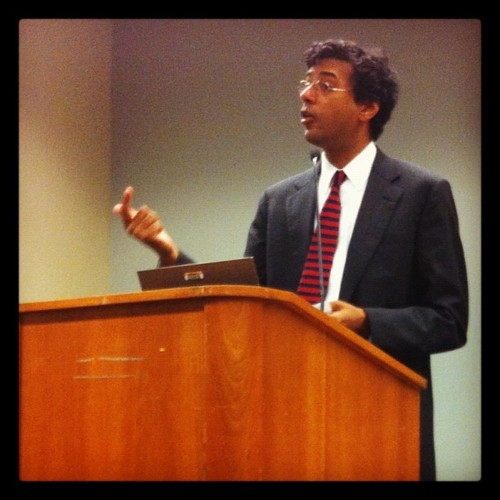
Notes on Dr. Atul Gawande’s talk at the Health Data Palooza [LIVEBLOG]


[Editor’s note: these are live, rough notes from my iPad, and should not in any way represent a 100% accurate transcription. I missed far too much. Caveat lector. My comments are in brackets. You can find Dr. @Atul_Gawande‘s bio & writing at the New Yorker. Update: I’ve posted video of Dr. Gawande below.]

GAWANDE: A fascinating part [of the Health Data Palooza]: the idea that we’re putting together people from government, healthcare systems, people from outside who have knowledge about data and tools. This is quite different from the normal models: regulatory or laissez faire.

We have a healthcare system that’s fundamentally broken. The most common complaints from patients seem to be no one you can count on. If you’re paying, you have no sense that there is anyone who can help it costs be under control.

Where to start to fix that? We have recognized that there is enormous variation in cost, depending on whet you go. There is enormous variation in cost, depending on where you go. The two don’t have anything to do with one another. So there’s hope. [Good news.]

Some of the best places to get care are the least expensive. [In healthcare,] positive deviants are the ones that look the most like systems.

Examples from war and lessons within lethality

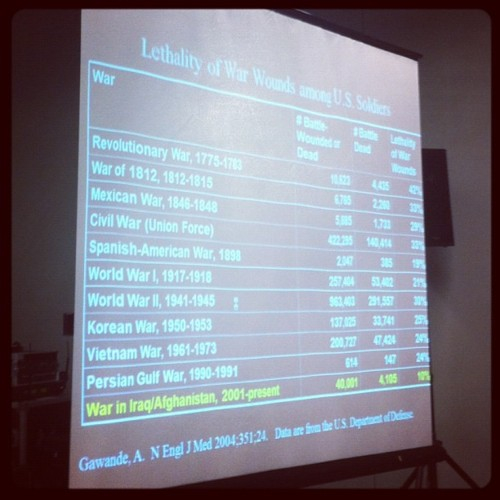
GAWANDE: Start by looking at performance of doctors in war and their teams. In the war in Iraq/Afghanistan, lethality below 10%. That doesn’t reflect intensity of conflict but improvement in care.

How did we do it? It was the not discovery of new tech that transformed survival but ability to use existing tech far better, in a system that works.

1) Kevlar. Got soldiers to wear it, operationally.
2) Speed to operating table. Improved forward mobile operating theaters.

We achieved the best survival rates in history. How? They changed the way they did surgery. Looked at data, realized needed to stop bleeding, stop contamination, under resource restrictive conditions. No X-rays, needed to learn 19th century techniques for finding fractures by feel.

They adopted “damage control surgery”: Do what you could during 2 hours. Ship and add a note: here’s what I’d did, what’s needed. That helped stimulate development of simple EHR. Average time from wounded on the battlefield, to getting care in the field, Baghdad, in Germany, in us, is less than 3 days. Less than 36 hours for some.

Soldiers can find better care for some conditions in Iraq than in a US city, with fewer resources. How? Alignment of finances, incentives. They weren’t “fee for service soldiers.” Everyone is on the same team: focused on saving life, maintaining health.

Within 48 hours of the wounding or death of soldier, posted on the DoD website. [DCAS: Defense Casualty Analysis System] The public accesses that data, but doctors & nurses access it the most.

One more example: soldiers not wearing protective eyewear. They called them ‘Granny goggles.’ The DoD contracted with a designer, made cool ones. Now wearing. Needed data and research to understand. [Stories matter.]

Affordable Care Organizations (ACOs) have done financial alignment. They’re committing to doing more project at a time. They’re committed to better health within an environment.

To get there, folks in war needed data useful to frontline decision makers. [The same is true at home.]

3 Comments

Filed under government 2.0, research, technology

A few thoughts on the use of Twitter by federal officials

“Yes, saw news @acarvin retweeted from Tunisia. On it. Please @reply from @StateDept. – Hillz”

Last month, Federal Computer Week reporter Alice Lipowicz interviewed me about how federal officials and Congressmen in the United States government were using Twitter. She ended up using just one quote in her article on Feds using Twitter, regarding the reality that the division between “personal” and “professional” accounts has become quite blurred in the public eye, regardless of disclaimers made.

Look no further than the Congressional staffers who were connected to tweets about drinking during the workday and subsequently fired. With millions of people on the service and the DC media listening closely, there’s simply a higher likelihood that a bad error will be noticed and spread — and corrections never travel as far as the original error. An offhand comment, even if meant to be funny, can be taken out of context.

If a government executive or editor shared pictures of cute puppies and dogs on an official Twitter feed, they do run the risk that some people may not take their professional leadership as seriously. Then again, citizens and colleagues might connect with them as a fellow ‘dog person,’ like me. I set up a Twitter account for my greyhound some time ago. (He doesn’t tweet much.)

Alice and I talked about much more than risk, though, and since I have notes from the conversation, here are a few other observations I made. (The caption above, for Secretary of State Hillary Clinton, is 100% fiction.)

First, we talked about Senator Chuck Grassley (R-Iowa), who writes cryptic tweets but appears to be doing something some of his colleagues may not: listen. He told the National Law Journal that he pays attention to reactions to his tweets.

“Twitter’s a new way to communicate with constituents,” said Senator Grassley. “The real-time feedback and contact with the grassroots that Twitter offers is a real value.”

Even though some of his more partisan tweets have drawn controversy at times, he is a notable example of a lawmaker in the Senate demonstrating personal use of social media, including typos, text speak and messages that his staff might prefer he hadn’t sent, like his recent comments concerning the President.

In general, if Congress is going to draft legislation that leads to rulemaking about social media, it makes sense that Senators and Representatives should have some basic familiarity with these tools and what’s being said on them or down with them, given the role that they’re now playing in the new public square.

Their staffers certainly realize that by now, tethered by BlackBerrys and iPhone and Android devices to a 24/7 newscycle that has compressed to 24 minutes — or even 24 seconds — from 24 hours. The modern workplace may reward working long hours outside of the office, or at least the appearance of it. Late night and early morning emails are part of Washington working culture. It takes a specific attitude, boundaries and discipline to find a healthy work-life balance in the context of pressure.

That’s certainly true of officials as well, like federal CIO Steven VanRoekel, who is a father to several young children. He is an unapologetically geeky guy who has been learning to use Twitter better, as Alice described, to go “direct” in answered questions from the government IT media.

He and his colleague, US CTO Todd Park, are actually both more advanced in their use of Twitter at this point in their tenures than Vivek Kundra and or Aneesh Chopra, their respective predecessors, neither of whom were tweeting when they began work. (Both men continue to tweet now, after they’ve left government, with Chopra much more active.)

VanRoekel tweeted infrequently as the managing director of the FCC, although he demonstrated that he both knew the basics. Using hashtags for comedic effect in his tweets now strongly suggests he’s learned something about the culture of Twitter since then. Yes, it was a bit of inside baseball, since you’d need to understand the context of Molly’s column to understand his comment, but the tweet was a reply to a specific column.

I thought that he was trying to be funny, with respect to confirming that APIs would be part of the federal government’s digital strategy using a “#specialsauce” hashtag and “#thereIsaidit.” At least for my (admittedly) geeky sense of humor, I think he succeeded.

I still see a perception in some quarters that Twitter is a fad and a waste of time — and currently, given the political context around taxes, the federal budget and spending, conversations about government wasting anything trend pretty negatively. Even with 100% of federal agencies on the service, I find that it still takes a demonstration of how Twitter is useful to accomplishing a mission before an uninitiated person’s eyes open to its value. Searching for topics, events or the name of an employer or agency is often effective.

That’s true for every other social network or tool, too. In 2012, I’m still enjoying exploring and experimenting with what the right approach to each platform, from blogging to Twitter to having family, friends and subscribers on Facebook and Google+ to tumbling or staying LinkedIn to my professional network or sharing video on YouTube. The same is true of federal officials.

We’re all “stumbling” along together.

Leave a comment

Filed under article, social media, technology, Twitter, video

Open Government 2.0: Government of, by, for, and with the People

In the 1990s, the Internet changed communication and commerce forever. A decade later, the Web 2.0 revolution enabled a new disruption in media by democratizing the tools for publishing. Citizens without specialized technical skills can now easily upload pictures, video, and text to a more interactive Web, where they can then use powerful new platforms to share, mix, and comment upon it all. In the years since the first social networks went online, the disruption presented by this dynamic online environment, fed by faster Internet connections and a global explosion of mobile users, has created shifts in the power structure as powerful as those brought about by the introduction of the printing press centuries ago.

With the Internet being hailed as the public arena for our time, governments around the world are waking up to a changed information environment in the 21st century. Social-media platforms present new risks and rewards for government, but the fact is these platforms are hosting public discourse between hundreds of millions of citizens. In the context of these changes, public servants have begun using social media to share information and engage with citizens. Below, four Government 2.0 pioneers share their insights, experiences, and hopes about the new opportunities social media offers for people to participate in their government.

These essays were originally published in the Association for Computing Machinery’s “Interactions” Magazine. They are republished here with permission.

Serving Citizens via Social Media


By Steve Ressler (@govloop), founder of GovLoop.com, former IT program manager and auditor at the U.S. Department of Homeland Security.

In 2012, social media is mainstream. Facebook is preparing a $100 billion IPO. President Obama is hosting a series of [social media] Town Halls. Even my grandmother is on Facebook. So what’s the role of social media in government? A few years ago, social media in government was brand new. It was exciting when a new city launched a Facebook page or a councilperson posted meetings on YouTube, or a state department launched a mobile app.

We’ve moved past the honeymoon phase, and now social media is being asked to deliver core mission value. For state and local governments, there are three foundational ways in which social media helps deliver value:

Reach more people. One of the core foundational roles of state and local government is to provide information for citizens. This is why for years government agencies have sent information via postal mail, printed agency newsletters, held in-person town hall meetings, and built telephone call centers. With more than 750 million users on Facebook, 200 million on Twitter, and the whole world tuning in to YouTube, social media is simply the largest channel that most people use these days to get information.

Get feedback. Another core role of government is to get feedback from citizens. Classic town halls simply do not work as well in today’s modern society, where everyone is busy and few people have the time to drive downtown at 5 p.m. on a Wednesday for a meeting. Social media is an interactive, two-way medium that acts as a great vehicle for real-time feedback.

Lower costs and increase revenue. In today’s tough budgetary times, cities and states simply cannot ignore opportunities to lower costs and increase revenue. Mobile applications like SeeClickFix let citizens photograph and report potholes and other city problems, instead of the city having to send out a truck to investigate every call-in complaint. Instead of spending tens of thousands of dollars on printing and mailing property-tax statements or city guides, city governments can save lots of money by sending the same information via email and social media. And that’s just the beginning.

I’ll be the first to admit that social media is not perfect. It is not a magic cure. Just because you add new social media channels does not mean you can remove other channels, like phone lines. Further, implementing social media well is a skill, and it takes time to see its impact. It matters, however, because the world has already changed. If government wants to remain relevant to citizens, it must evolve to meet the demands of the 21st century. The modern citizen is using social media, and is the reason why Facebook has [845] million users, and that iPhones and iPads have made Apple the second most valuable company in the world. Government must meet citizens where they are now or risk losing the opportunity to be more relevant to their lives.

Selective Use of Social Media in Government Projects

By Jeffrey Levy (@levy413), Director of Web Communications at the U.S. Environmental Protection Agency.

The use of social media runs the gamut, from agencies that are still considering it, to those who are using it mostly as a broadcast mechanism, to those like EPA that offer a mix of broadcast and community participation, to those who rely on social media for full-blown collaboration. Social media gives us good tools to enhance transparency, participation, and collaboration. But the trick is figuring out the most effective projects in which to use these tools.

Five years ago, there wasn’t even a single U.S. government blog. Today there is at least one U.S. agency using every type of social media I can think of. EPA itself is engaged in most channels, at least in broadcast mode and often in two-way discussion and the solicitation of community-created content (photos, videos, comments, etc.).

Social media works very well in conjunction with email and websites. At EPA, we use all channels to promote other channels, both by cross-linking and by embedding content from social media into Web pages. Some things we’re starting to think about are how to use two-dimensional barcodes (QR codes) well, and developing mobile applications in general. One nice thing is that many social media sites already have mobile versions, so it is simple and useful to link to them from our mobile site.

We are active where the people are on the most popular social media platforms, so we have the chance to talk to, and respond to, people who may never come to our main website. We also have a much broader ability to share our information. In many cases, we hear ideas from people who otherwise would not contact us. For example, during the recent nuclear crisis in Fukushima, Japan, we were able to answer questions through Facebook to help alleviate concerns and provide solid information to new groups of people.

Our mission is best served when we work collaboratively with the public to protect their health and the environment. Photo and video projects engage people. For example, the “It’s My Environment video project involved hundreds of people making short video clips, in which they took ownership of protecting our environment. By using social media channels to promote “Pick 5 for the Environment,” we challenge people to take other kinds of actions.

Social media can also help us catch environmental criminals simply by helping us advertise our fugitives list. The health warnings we issue can reach hundreds of thousands of people through Facebook, Twitter, and email. The recipients are people who asked to be kept in the loop, so they are a much more interested audience than the general public. Another key aspect of our mission is our use of online discussion forums, where we invite anyone to share their thoughts and opinions on policy issues.

My social media mantra is mission, tools, metrics, teach. It depends on the channel, but generally, we need better stats. For example, we have 42,000 followers on Twitter. But what’s the number of people who actually see a particular tweet? Facebook provides impressions, which is a more useful statistic. YouTube provides some good metrics too.

We also need inexpensive tools to help us monitor multiple channels. Each social media company is doing its own thing, and most are not focused on helping us cross channels. But multichannel management will become increasingly important as we grow more active in more channels.

Changing the Conversation Through Social Media

By Nick Schaper (@nickschaper), Executive Director of Digital Strategic Communications at U.S. Chamber of Commerce, former Director of Digital Media for U.S. Speaker of the House of Representatives, Representative John Boehner.

Much has been made of American politicians’ sometimes transformative, sometimes awkward, and occasionally career-ending entrances into social media. Suffice it to say that many are on board and they’re not likely to exit social media. Your member of Congress wants you to like him or her, both at the ballot box and on Facebook. While the number of elected representatives integrating social media into their communications efforts has soared, this is still very much a new frontier in governance. Americans are getting a very rare opportunity to shape the direction of their government.

In the heady frontier days of the government’s adoption of social media (five to seven years ago), members of Congress moved from the stodgy “traditional media” strategy of drafting and sending out a press release to the cutting-edge “new media” strategy of drafting and sending out a press release and then posting a link to it via Twitter and Facebook. It was hardly splitting the atom, but it was moving in the right direction.

As the government social media ecosystem continues to evolve, we’re seeing more aggressively innovative efforts aimed at increasing participation, transparency, and accountability. Officials and their staff are identifying the unique abilities of popular platforms, such as Facebook and Twitter, and they’re adjusting their communications accordingly. In the past year alone, we’ve seen Republicans in the U.S. House of Representatives enlist Americans’ digital support in voting on which government programs to cut, resulting in their directly shaping the governing agenda of what would become the House’s new majority. Further down Pennsylvania Avenue, the Obama Administration’s digital team has led the nation’s first Twitter and Facebook town halls, among numerous other experiments in participatory and open government.

These efforts have helped to create a vast new virtual town square. Unfortunately, that square is still a noisy, unruly place. Like much of the Web, .gov is plagued by signal-to-noise issues, many of which are exacerbated by the unique rules and traditions of each branch. Members of Congress, for example, would prefer to communicate primarily (if not exclusively) with constituents who live in their districts. Users don’t generally list their home address in their Twitter bio, so should members be @replying to tweets when they can’t trace the origin?

Identity and bandwidth challenges will not be solved anytime soon, and certainly not in this space, but suffice it to say that your representatives are eagerly looking for new ways to communicate and legislate. Congressional staffs scour online communities for mentions of their bosses. Bloggers and other digital influentials have been given unprecedented access to politicians. When the president recently took questions live via Twitter, he found himself on the hot seat in his own White House when he faced questions on the lack of jobs and a flagging economy. All of this is testament to the fact that the tweets and status updates of citizens are echoing in the marble halls of our nation’s government.

The marriage of social media and government has made it through the honeymoon stage. To what degree that results in a more perfect union is still yet to be seen. The potential for transformative change is there, and I’m confident it will be realized by this and many generations of social media patriots to come.

Reaching and Revealing New Heights Through Social Media


By Stephanie L. Schierholz (@schierholz), former Social Media Manager, National Aeronautics and Space Administration.

To understand how NASA uses social media to accomplish its mission, you must first understand the agency’s vision. Simply put, the space agency’s goal is to “reach for new heights and reveal the unknown so what we do and learn will benefit all humankind.” What NASA accomplishes and learns cannot benefit all humankind if people do not know about what we’re discovering. This is why the 1958 act that established the National Aeronautics and Space Administration also called for the agency to “provide for the widest practicable and appropriate dissemination of information concerning its activities and the results thereof.”

Making NASA accessible to the American people—and, really, to citizens around the world—has been ingrained in the agency’s operations since the early days. If you are old enough, you know this is true because you saw astronaut Neil Armstrong set foot on the moon via television signals from a NASA broadcast. Today you can watch NASA TV streaming online via your computer or mobile device.

The mandate to share what the agency is doing as widely as possible (and a restriction against advertising) keeps us on the lookout for new ways we can spread the word and be more accessible. Social media tools have enabled NASA to engage the public efficiently and effectively. Social media sites provide us an easy way to keep the public updated with news delivered straight into their personal newsfeed or homepage, which they probably visit more often than traditional news sites or the NASA website.

The agency has come quite a distance since the pioneers at NASA’s Jet Propulsion Laboratory started a Twitter account for the Phoenix Mars Lander program (@MarsPhoenix) in May 2008. NASA’s primary Twitter account (@NASA) has more than 1 million followers. We have more than 200 social media accounts agency-wide, including more than 20 astronauts on Twitter. You can find them all at www.nasa.gov/connect. Because of its interest in identifying new ways to connect, NASA was the first government agency to form partnerships with Gowalla, Facebook, and SlideShare. Why? Because each allows the agency to share our content with audiences who might never visit the main NASA website.

The real value of NASA’s use of social media tools can be seen in the level of engagement they attract and the communities that form around them. It is called social media because our fans and followers have a reasonable expectation their questions will be answered and their comments heard. By responding and interacting with them, NASA has the opportunity to educate, inform, and inspire. Fans and followers who are passionate about what we do have platforms to express this passion and share it with others.

NASA “tweetups” take it to the next level, bringing the online engagement to in-person gatherings where participants have an opportunity to talk to NASA leaders, scientists, engineers, and astronauts and the chance to see how and where we work. Participants have arrived at NASA tweetups as casual fans or followers and walked away as enthusiastic advocates of the work we are doing. A strong sense of community develops at these events, exemplifying how social media can bring together people who have common interests.

What’s next for NASA and social media? We’ll continue to keep our eyes open for platforms we can use to engage and share the word out about what we’re doing. Meanwhile, the agency is working on improving our internal support for social media, focusing on processes, guidelines, and coordination. You can expect to see improvements to our Facebook page, a mobile check-in spot for our “Search for the Moon Rocks” partnership with Gowalla, a Foursquare mayor of the International Space Station, more of our presentations, videos, and documents on SlideShare, and more out-of-this-world content in the places you go to be social online.

***
The insights and experiences shared above represent only a small sample of the variety of ways in which social media is transforming governments. While the examples are U.S.-centric, they do represent trends that are evolving in other countries. What we’ve left for a future discussion is how citizens around the world are using social media to disrupt traditional ways of governing. For instance, social media is credited with helping to accelerate social change in Tunisia, Egypt, and other parts of the Middle East. It’s also been used in collaborative partnerships between government and citizens to respond to man-made crises or natural disasters.

The examples above, however, should provide a useful overview of some of the ways in which today’s participatory platforms are playing increasingly important roles in the evolution of government of, by, for, and now with the people.


Leave a comment

Filed under Uncategorized

In the Capital, influence on social media in DC is more than Twitter followers

It’s hard to believe that it’s been over a year since I implored the DC tech community and media scene at large to stop holding influence contests. Deja vu, all over again.

It was brilliant of In The Capital to hire a smart journalist to cover notable events in the political and tech scene. That coverage put them on the District’s radar during Social Media Week.

It was not brilliant of them to put together this week’s smudged sterling example of linkbait, which stands to damage their credibility with new readers who are not friends of those selected.

Look: I’ve met 80% of the people on this list of the “DC’s Top 10 Social Media Influencers” and follow many of them. I have much respect for their smarts, digital savvy and professionalism.

But if this is the” top 10,” what, exactly, does being an DC “influencer in social media” mean here? Online influence is not just about having a lot of Twitter followers.

For instance, I’m ahead of @LukeRussert by more than 33,000+ and have a higher Klout score, due in part to a large following on Google+ and Facebook. Does that mean that I’m more influential? Maybe on social media and certainly with respect to technology, but certainly not on broadcast news, which still retains enormous influence in our country. It also wasn’t hard to think of another person in DC who’s more influential with respect to social media than either one of us:

What about more “influential in the startup and DC tech scene, which “In the Capital” says it covers? Are all ten of these people more influential than Peter Corbett, Frank Gruber or Jen Consalvo, the co-founders or DC Week and organizers of the huge DC Tech Meetup? I’d don’t think so. And neither does Russert:

In a larger sense, does anyone believe that Russert is more of an “influencer” on social media in Washington than President Obama, between @WhiteHouse and @BarackObama? (I certainly don’t kid myself about my “clout” relative to POTUS.) What about @SpeakerBoehner or House Majority Leader @EricCantor or @SenJohnMcCain? Is the rest of the list is more “influential” than @MarkKnoller or @MarcAmbinder or @MikeAllen? A recent study of Twitter use in Congress, in fact, found that SenatorSanders was the most “influential” member of Congress on social media. (Or at least on Twitter.) one could go deeper on the list of people in media and government but the point is clear enough.

Mark Drapeau, director of innovative engagement in Microsoft’s office of civic engagement — and a member of the list — offered a dissenting perspective:

all these lists are kinda different or the same based on peoples’ biases and what they hope to accomplish and the audience they hope to reach. The Washington Post turns it into a ridiculous game. In the Capital picked… people they think are cool. Politico made the same exact list [of top DC Twitterers] and it’s all – gasp – politicos! The LA Times made the same list [DC twitterers], and they simply ranked people by followers – lazy! I made the same list based on how people interact with their communities – lots of people I know from… my community! All the lists are right, all the lists are wrong, there is nothing to debate, complain about, or mock.

In DC social media, there’s lots of actual social data to crunch to enable some measure influence and connected, not just from PeerIndex or Klout but from Google back links or Twitter/Facebook engagement numbers. Or they could have run their own data on how much engagement or amplification people get on Twitter, Facebook, Tumblr, Google+, etc. That’s just not what happened today.

This feels straightforward, at least from where I sit tonight: If editors make lists, they need to be able to back them up with criteria and methodology. That’s why people read Consumer Reports, for instance, when they buy things. Lists and ratings from credible publications influence the buying and hiring decisions of consumers. That’s why there’s a market for them and why people and brands get excited about being selected.

If “In The Capital” really wanted to measure “influence” and do a Top 10 List, “In the Capital” could have cited Klout or PeerIndex, flawed as those services may yet be. Gadi-Ben Yehuda, social media strategist for IBM’s Center on the Business of Government, made this comment:

The easiest way to have voided any controversy would have been not to use the title “DC’s Top Ten Influencers in Social Media,” which is confusing in any case. Honestly, when I saw who was on the list (the majority was women), I thought “OK, this must be people who do primarily social media activities, i.e. they don’t publish substantive articles on important government events (like Alex), they don’t run tech/innovation companies (like Peter Corbett), they don’t work in the innovation office of cabinet-level agencies (like @AlecJRoss). These are people who’s skill is in the medium that others of us use as a tool to accomplish other things.”

That seemed to answer the question of what the article was about, but only if one focused on the words “in social media.” But what about this words “top” and “influencer” what do those words even mean? Klout defines influence as the ability to spur others to take action. If that’s what an influencer is, then I don’t think there can be a top ten list without Obama, or at least Macon Phillips. Again, Peter Corbett (he got more than 10K people here for DCWeek, after all). Alan Rosenblatt should also likely be on that list.

Based upon Byrne’s comments and some background gathered at last night’s DC Social Media Happy Hour, the list was originally pitched to be about 10 awesome women who consult and teach others in the DC community about how to use social media. Shireen Michell, for instance, is influential with segments of the District’s community who are not in the government or media space.

Then In The Capital appears to have dropped two of them, added Russert and Drapeau, and changed the title and premise, which was not and is not supportable based upon qualititative or quantitative grounds. When asked about the substance behind the list, the author of the post offered this response:

Lisa Byrne, a social strategist at the Pappas Group who was put on the list, offered some insight into what seems to have happened:

“I actually gave a lot of input (originally it was all female so I never spoke of any guys who should be noted),” she commented. “I was not advised it would be titled Influencers. I listed people who were community leaders in the social space – online and specifically offline.”

1 Comment

Filed under blogging, government 2.0, journalism, social media, technology, Twitter

Collecting stories

On his personal blog, New York Times technology journalist Nick Bilton mused about “collecting air” in his travels around the globe. He closes his post with this thought, drawn from a recent conversation on a flight:

The man looked at me and asked, “Do you collect anything?”

At first I didn’t know how to respond, I hadn’t thought about it in some time. And then I instinctively told him that I actually collect stories —about people, or events, or places, or companies, or moments in time. That I collect these stories and keep them as words and photos.

I looked out of the plane window for a while as we zipped above the clouds at 35,000 feet, and then I looked back at the man and said, “I guess you could say I collect air.”

I felt the same instinct over the holidays, when asked to describe what I do or what a day in my life is like now. The photostream I’ve shared to Twitter or Tumblr over the past two weeks offers vignettes of a mobile life:

public Instagram photostream shared to Twitter

My Instagram photostream on Twitter

Those windows on my worlds, reflected as they are in a growing multitude of glowing screens, are a collection that I value much in the same way that a philatelist or numismatist in a previous generation might adore her stamps or her coins. I hope that some of the stories they represent are at least as enduring.

2 Comments

Filed under art, blogging, journalism, microsharing, personal, photography, social media, technology, Twitter

New Sky News social media policy would cripple journalists working on the real-time Web of 2012

Another month, another firestorm over a poorly thought out social media policy from a massive media company. This time, it’s Sky News that’s made a misstep.

I think Reuters social media editor Anthony De Rosa is spot on in his assessment of assessment of the failings of the new social media policy advanced by Sky News: it’s longing for a return to the Victorian Internet

Cory Bergman nailed why it’s OK for journalists to be human on Twitter and Mathew Ingram, as usual, offered his usual common sense analysis of what makes sense, in context. (

Where I think Anthony knocks it out of the park, however, is with respect to the professional rationale for retweeting other accounts: “The idea here at Reuters when it comes to social media is to be the beacon for all news, which makes us the go-to source, no matter what the source may be, after being put through our own filters of verification.”

Just so.

If you’re on a beat, you want to be THE source for news on it. Generally, that means you’ll get beaten on being first to a story. No worries: RT them, then blog it, and link in articles. Over time, people (and algorithms) will value you for that work.

Any entity that distributes content online — whether they’re in the media, government, academia, nonprofit or other organizations, needs to be thinking about search engine optimization (SEO) and social media optimization (SMO) in 2012. Any policies that force journalists into internal silos will eviscerate that capability.

A RT is social media currency. Instructing journalists not to give them out where deserved is like sending them into a conflict or disaster zone with no funds for a fixer, fuel or food. It’s not just bad form. It’s bad business.

1 Comment

Filed under blogging, journalism, microsharing, social media, Twitter

Begun the Drone Wars, have they [VIDEO]

“Luke, you must use the Forge…”

The video above shows a series of experiments performed with a team of “nano quadrotors” at the GRASP Lab in the University of Pennsylvania. These wee vehicles were developed by KMel Robotics.

1 Comment

Filed under scifi, social media, technology, Twitter, video

5 Social Media Week DC 2012 Panels: Conversations, Politics, Technology, Public Diplomacy and eDemocracy

Social Media Week DC  is going to be a busy conference for me this year. If you haven’t heard about it yet, the week-long festival starts 12 days from now. The week will feature speakers, panels, workshops, events, and parties all across the District celebrating tech and social media in the Nation’s Capital, including a special edition of the DC Tech Meetup. I’m going to be moderating four panels and participating on a fifth. I’m excited about all five and I hope that readers, friends, colleagues and the DC community comes to one or more of them.

If the panels that I’m involved in aren’t your cup of tea, you might find something more to your taste in the full SMW DC schedule.

Social Media Week DC 2012

Following is the breakdown of the five panels that I’ll be participating in this year:

  • Creating & Managing High Quality Online Conversations
    Location: Science Club
    Date: Monday, February 13 at 6:30 PM – 8:00 PM |  Add to Google Calendar | Add to iCal
    Description: Discussions in online comment sections and social media can be tricky to manage. Some sites are bogged down full of low quality comments, spam, and more. How do we create high quality online discussions? How do we filter out the noise – the spam, the solicitation, harassment, and hateful speech that often becomes part of any online discussion? We will discuss examples of those that have done it well, and some that haven’t. We will also speak to individuals who have dealt with harassment and negativity online and learn how they fought back and still used social media tools for constructive discussion and engagement.
  • Politics and technology: the media’s role in the changing landscape: ASK QUESTIONS
    Location: Powell Tate
    Date: Tuesday, February 14 at 10:00 AM | Add to Google Calendar | Add to iCal
    Description
    : Digital platforms have changed the media landscape forever, but how has it changed the way the media covers politics? We’ll ask a panel of reporters from Gannett, National Journal, ABC News and Politico as they discuss 2012 election coverage.
  • Social Politics: How Technology Has Helped Campaigns: ASK QUESTIONS
    Location: Powell Tate
    Date: Tuesday, February 14 at 2:00 PM | Add to Google Calendar | Add to iCal
    Description: The social media landscape has changed drastically since 2008. We’ll hear directly from panelists from Google, Twitter and Facebook as they delve into the tools and innovations that candidates and campaigns have utilized as the 2012 campaign heats up.
  • Public Diplomacy in the Age of Social Media
    Location: New America Foundation
    Date: Thursday, February 16 at 9:30 AM – 11:00 AM | Add to Google Calendar| Add to iCal
    Description
    : How does social media change how statecraft is practiced in the 21st century? Who’s participating and why? What have been some lessons learned from the pioneers who have logged on to listen and engage? Three representatives from the U.S. Department of State will share case studies and professional experiences gleaned directly from the virtual trenches.
  • Social Media, Government and 21st Century eDemocracy
    Location: The U.S. National Archives
    Date: Friday, February 17 at 1:00 PM – 2:00 PM | Add to Calendar | Add to iCal
    Description: While Sean Parker may predict that social media will determine the outcome of the 2012 election, governance is another story entirely. Meaningful use of social media by Congress remains challenged by a number of factors, not least an online identity ecosystem that has not provided Congress with ideal means to identify constituents online. The reality remains that when it comes to which channels influence Congress, in-person visits and individual emails or phone calls are far more influential with congressional staffers.“People think it’s always an argument in Washington,” said Matt Lira, Director of Digital for the House Majority Leader. “Social media can change that. We’re seeing a decentralization of audiences that is built around their interests rather than the interests of editors. Imagine when you start streaming every hearing and making information more digestible. All of a sudden, you get these niche audiences. They’re not enough to sustain a network, but you’ll get enough of an audience to sustain the topic. I believe we will have a more engaged citizenry as a result.”

    This conversation with Lira (and other special guests, as scheduling allows) will explore more than how social media is changing politics in Washington. We’ll look at its potential to can help elected officials and other public servants make better policy decisions.

If you’re not in DC, check to see if there is a Social Media Week event near you: in 2012, the conference now include New York, San Francisco, Miami, Toronto, London, Paris, Rome, Hong Kong, Tokyo, Singapore, and Sao Paulo.

2 Comments

Filed under article, government 2.0, journalism, social media, technology

Less TV, more Internet: First White House Google Plus Hangout features real questions from citizens

Today, more than a quarter of a million people* watched the first Presidential Google Hangout with President +Barack Obama from +The White House.  The archived video, below, comes courtesy of  Reuters social media editor Anthony De Rosa, whose shared his review of President Obama’s first Hangout at Reuters.com. For the best reporting I’ve seen on the participants and questions, read Sarah Lai Stirland on President Obama’s Hangout.

My immediate takeaway? The forum featured real questions on significant issues, with genuine citizen-president interactions, with back and forth conversation. That was precisely the promise of the platform that I considered ahead of time, when I asked whether a Google+ Hangout could bring the president closer to the citizens he serves.

Earlier in the afternoon, I joined Google’s Daniel Sieberg on our own Google+ Hangout to talk about the potential impact that online video, hangouts, and live broadcasts between citizens and their elected officials could have on the political landscape.

The moderator, Google’s Steve Grove, gave the participants (2 men, 2 women and one classroom of young people) the opportunity to follow up on their questions to the president. There will be much more analysis of the questions asked and the president’s answers tonight, as there should be.

Here’s a quick recap, distilled from my notes: The forum began with a video question to the president about promoting a living wage for students working their way through college. The second question came from the Hangout, on why the White House doesn’t expand expanded H1B visas for foreign workers at the expense of skilled labor with the U.S. President Obama told the wife of a semiconductor engineer (who asked the latter question and, critically, got to follow up in the Hangout) if she sent him her husband’s resume, he’d be happy to find what’s happening.

One could dismiss it as pandering — or celebrate it as a citizen cutting through the morass of bureaucracy to tell the nation’s chief executive that the system wasn’t working as he said it should. Such followups in the Hangout are what made this different than the past YouTube and White House interviewed. Politico talked to Jennifer Wedel, of Forth Worth, Texas, who asked the question during the presidential Hangout:

“I’ll have to take you up on that,” Wedel said of the president’s offer to help her husband, Darin, who lost his job at Texas Instruments three years ago.

Later, Wedel told POLITICO that she and the president had a “pretty crazy interaction” that she hadn’t expected when she asked about the federal government granting H-1B visas to skilled foreign workers while U.S. citizens such as her husband are out of work.

“I don’t think he was trying to be condescending or anything,” said Wedel, who never completed college and was a stay-at-home mom before her husband was laid off, but now has a full-time job at State Farm to help make ends meet. “I just think I stumped him a little and he wanted me to hush about it.”

“I think he knows pretty well that the H-1B is an issue because — it’s kind of like the Occupy movement — big corporations are putting up the money to get the visas” and choosing lower-paid foreign workers over domestic ones, Wedel said. “I don’t think what he was telling me was true, and I think he knew it, and that’s why he offered to take my husband’s resume,” she said, adding that her husband has kept it updated.

Another question from YouTube featured a video taken from an #Occupy protester in Portland. A question taken from within the White House Hangout asked about the president’s plans to help small business and to restructure government, which the Washington Post covered this month.

Another question posed within the Hangout about a lack of dialogue with children about the financial crisis offered the president a human moment, where he said that he tries to explain what’s happened with economy to his daughters over the dinner table.

There were incontrovertibly tough questions asked tonight, including one from a homeless veteran who asked why the U.S. is sending money to Pakistan and places that are known to give money to terrorism. In answer, the president said that the U.S. only spends 1% of its budget on foreign aid, and that it pays off in a lot of ways as part of the country’s national security strategy. What we don’t want is countries to collapse, have to send in our guys at huge potential risk and cost to taxpayers, he said.

The President was asked a video question from YouTube that cited a New York Times story on the use of drones in Iraq, which the president called “overwritten. The drones have not caused an unusual number of civilian casualties, he said, stating that it was a targeted focused effort aimed at Al Queda, not for other purposes.

I was personally glad to see that Grove asked a question on the Stop Online Piracy Act (SOPA) and PROTECT IP Act (PIPA), noting that both were hot within the YouTube community. Needless to say, that part of the transcript will be carefully analyzed by the people whose collective online action changed Washington.

We need to use tools we have, he said, noting recent takedown action by the Justice Department. At the same time, when SOPA came up on the hill, said the President, “we expressed some concerns about the way the legislation had been written.”  Now, he said, the content and server sides need to come together for strong IP protections that preserve basic architecture of the Internet.

While the top-rated question was asked, concerning the extradition of a British national, there were no questions posted about legalizing marijuana, which once again rose to the top of CitizenTube (perhaps Grove and his colleagues at YouTube felt it had been asked enough?) nor any question was asked about the National Defense Reauthorization Act, which many other users on YouTube wanted to see addressed.

UPDATE: When I followed up with Grove on Google+ about the process behind the questions, he made the following comment:

We chose the questions from among the top-voted questions on YouTube… it’s always a fun challenge to ensure you get a broad range of issues and perspectives into these discussions from amongst the top-voted questions, but I hope people feel that we did a good job of listening to community votes. We asked several of the top-voted questions, including the #1 voted question on YouTube. Some people asked why we didn’t ask about marijuana legalization… as an FYI, we asked the President about it last year (see here: Drug Policy – President Obama’s YouTube Interview 2011).

As far as the hangout participants, we also selected them based off of the questions they had submitted to YouTube — again looking for a range of Americans… that part had to happen a little earlier during the submission process, so we could prepare for the Hangout today.

President Barack Obama participates in an interview with YouTube and Google+ to discuss his State of the Union Address, in the Roosevelt Room of the White House, Jan. 30, 2012. The interview was held through a Google+ Hangout, making it the first completely virtual interview from the White House. (Official White House Photo by Pete Souza)

President Barack Obama participates in an interview with YouTube and Google+ to discuss his State of the Union Address, in the Roosevelt Room of the White House, Jan. 30, 2012. The interview was held through a Google+ Hangout, making it the first completely virtual interview from the White House. (Official White House Photo by Pete Souza)

Overall, I can honestly say that we saw something new in the intersection of government, technology and society. From where I sat, plugged in within the Sunlight Foundation, it felt like a good thing, not just for the White House or the president’s campaign or Google (although all certainly benefitted) but for the promise of the Internet to more directly connect public officials to those that they serve, with all of their real problems, concerns, doubts and fears.

At the end of the event, there was a moment of unexpected human connection, when one of the women on the hangout invited her three children to come meet the president.

They stared and smiled, left a bit wide eyed by the President of the United States smiling out of the computer screen and bidding them to obey their mother and do their homework. We could do with more wonder in the world, where such unexpected encounters occur online.

Viewership estimate via Google’s Steve Grove, who said at the end of the netcast that a quarter of a million people were watching on YouTube. Given the White House’s own livestream, the number could be higher.

13 Comments

Filed under application, government 2.0, social media, technology, video