Category Archives: social bookmarking

Trends and challenges for social media in 2010

What will the rest of 2010 hold for social media? I’m certain will see collaborative technologies be used to cover events and disasters on the real-time Web.

I’m also certain that three issues will dominate the space over the next year:

Identity, Privacy and Security.

Below is an interview where I talk about precisely these issues from Twtrcon:

As you’d imagine, there is no shortage of other opinion on what else the year will hold in social media. For other takes, try:

I left the following comment on Chris’ post:

I suspect the Fortune 500 will go looking for talent to bring in-house, if early adopters aren’t available internally. There’s still a high ceiling — and need — for decent corporate blogs, authentic social media managers and innovative internal implementations of social computing platforms.

Aside from personnel, it’s fun to think about the bigger picture, too. Government is increasingly a big player in this space, as is Google. Social is going to be more mainstream and have more money flow into it than ever before, if marketing investment projections line up.

Here’s hoping that the snake oil is wrung out in the process. I suspect another casualty may be the word “social” itself, as I commented at length on Andy McAfee’s blog. Collaboration and results are in, hype and hysteria are out.
Protecting identity, security and trust will plague adoption of all of these platforms, whether they’re in the public or private space. If we’re giving away our data, social graphs, interactions and transactions, we’ll expect to retain our identities, credentials and privacy. Companies that abuse that relationship will experience viral backlash that beggars the ire we’ve seen to date.

What do you think? What are the trends in collaboration technology that will matter this year?

Please let me know in the comments or reply to @digiphile on Twitter.  I’ll be speaking tomorrow at the inaugural Social Media Breakfast in Washington, D.C. on this very topic.

Update: Here’s the presentation on Social Media Trends for 2010 from Prezi.com.

2 Comments

Filed under social bookmarking, social media, Twitter, video

Twitter Lists: We are informed by those we follow. We are defined by those who follow us.

“The power of Twitter is in the people you follow.”-@nytimes

You’ll find that quote at NYTimes.com/Twitter, where the New York Times has built a page of Twitter lists curated by its editors, its writers and, presumably, the help of its considerable audience.

As this feature has rolled out, I’ve read knee jerk criticism, thoughtful analysis, wild evangelizing and observed “lists of lists” be collected as sites like Listorious and Listatlas.com spring up to rank them.

Tech pundits and, rapidly, news organizations have all created lists that offer apply new taxonomies, imposed human-defined categories onto the roiling real-time tweetstream.

Readers are defined and informed by the diversity of the information sources that they consume. In a user-created Web, we are defined by those who choose to follow us, including any lists or tags that they associate with  our names.

It’s been exciting to watch. And if you’re a reader of David Weinberger, author of “Everything is Miscellaneous,” you might recognize this emergent behavior as a familiar phenomenon. Twitter users are using lists to organize one another into understandable taxonomies. Folksonomies, to use the term coined by Thomas Vander Wal.

Users have some control over which Twitter lists they appear upon. If you block a user, for instance, you can remove yourself from that user’s lists, if for some reason you don’t want to appear on it.

What we can’t control, once we make ourselves public there or elsewhere on the Web, is how others tag or list us.

This goes back to what Weinberger (along with Doc Searls, Rick Levine and Christopher Locke) wrote about in “The Cluetrain Manifesto” ten years ago. “Markets are conversations.”

I suspect that in the weeks ahead, both companies and individuals may find themselves on lists that they perhaps would not wish to define as part of their brand identities.

“I would not join any club that would have someone like me for a member”

As I quote Groucho Marx, today, I feel fortunate, for two different reasons.

First, to date, I’ve been included on 176 lists, none of which I’m embarrassed or insulted to be on. You can see all of them at “memberships,” which is a friendly way of describing inclusion.

Thank you. I’m humbled.

Second, most of the lists are being used by an individual user to categorize others for providing particular sort of information.

Overall, I’m most closely associated with technology, journalism, security and media. That’s  a good sign, given my profession! I was glad to see that the account I maintain at work (@ITcompliance) has been added to 33 lists, primarily compliance, information security, cybersecurity and GRC.

I’m talking about the right things in the right places.

Certain lists, however, have meant that many more people reading me than would have otherwise because of the hundreds or thousands of people that have chosen to follow them, due to the influence of their creators.  I’m thinking about lists like these, some of which have gone on to become popular at Listorious.com.

@palafo/linkers

@palafo/newmedia

@kitson/thought-leaders

@jayrosen_nyu/best-mindcasters-i-know

@Scobleizer/tech-pundits

@Scobleizer/my-favstar-fm-list

Thank you, fellas.

Like any other tools, lists will no doubt be used for good and ill. An outstanding article by Megan Garber, “Fort Hood: A First Test for Twitter Lists” in the Columbia Journalism Review, shows how news organizations can leverage the feature to curate the real-time Web for the online audience.

The lists—which offer a running stream of information, updates, and commentary from the aggregated feeds—represent a vast improvement over the previous means of following breaking news in real time. In place of free-for-all Twitter hashtags—which, valuable as they are in creating an unfiltered channel for communication, are often cluttered with ephemera, re-tweets, and other noise—they give us editorial order. And in place of dubious sources—users who may or may not be who they say they are, and who may or may not be worthy of our trust—the lists instead return to one of the foundational aspects of traditional newsgathering: reliable sources. Lists locate authority in a Twitter feed’s identity—in, as it were, its brand: while authority in hashtagged coverage derives, largely but not entirely, from the twin factors of volume and noise—who tweets the most, who tweets the loudest—authority in list-ed coverage derives from a tweeter’s prior record. Making lists trustworthy in a way that hashtagged coverage simply is not.

Garber goes further in exploring what role lists may play in journalism’s future, as organizations collaborate with both their audience and one another in curating user-generated content. It’s a great piece. Pete Cashmore, of @mashable, has written more about this at CNN in “Twitter lists and real-time journalism.”

Individuals and news organizations alike can create lists as needed. For instance, as the House debates a historic health care bill here in Washington, you can follow the discussion at @Mlsif/healthdebatelive

As Cashmore points out, in the social, “people-centric Web,” we use our friends as a filter. As Paul Gillin observed,  everything that you’ve learned about SEO may be useless in a more social Web. Google’s new Social Search shows how, if we choose, our search results can be populated with content from our circle of friends.

On Twitter, we can now use the lists from trusted friends and news organizations to curate the real-time Web. That makes them useful, immediately.

And after a week full of public grief here in the U.S., that’s good news.

21 Comments

Filed under blogging, journalism, social bookmarking, social media, technology, Twitter

At the NPR and PBS unconference, 2009 is the year of “We, the media”

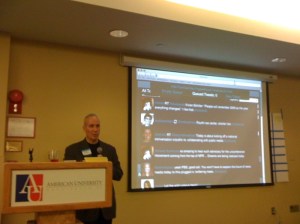
John Boland at Pubcamp

John Boland at Pubcamp

“TV, radio and pro journalism still matter in this new ecosystem”-John Boland, PBS.

This past weekend, I attended Public Media Camp, an unconference at American University in Washington, D.C.

I came away from the two days of sessions, talks, informal discussions, random encounters and rapid-fire information exchange inspired, exhilarated and a bit exhausted. That last is why it took a day to get a post up. By its nature, I couldn’t go to everything. What I did attend, I tried to take notes upon and livestream to Livestream.com and uStream. When it comes to the archiving that video, unfortunately, I endured two crashes and suffered from the lack of a decent mic. Happily, much better video will be coming online from other sources over the next week. What follows are my thoughts, links and video from “Pubcamp.”

Citizen Journalism and public media

The first session of the day remains one of the most memorable. Citizen journalists and local bloggers have much to learn from – and about – one another. “We the media” is a theme I pick up later in this post. Suffice it to say that democratization of the tools for information sharing has taken some producers unaware and left many stations understaffed, at least at the level it takes to effectively engage with those in the community creating the content. That said, many NPR editors and writers are doing quietly effective work in finding, engaging and collaborating with bloggers in the community. I mentioned Universal Hub in Boston, although I’ll leave it to Adam Gaffin, Radio Boston and WBUR to relate exactly how well that relationship works.

@jessieX referenced the tensions in this session in her post on generational differences, “My Takeaway,” where she captures the insight she shared with me in person.

Video of the  citizen journalism session is available on-demand.

Tools for curation of audience-generated content

This was one of the best attended sessions of Public Media Camp and, due to any number of reasons, one of the best, at least in my view. The standing room-only group was organized into as a circle and shared dozens of useful tools and services that can aid stations and editors in aggregating, organizing, filtering and curating pictures, video and text generated from listeners.”We all want to open up the floodgates to UGC and crowdsourcing but there’s issues of trust,” said Andrew Kuklewicz.

My favorite metaphor from Public Media came from Andy Carvin here, in the idea of “trust clouds,” or the social network of people around us that represent who we can believe, retweet, link or otherwise invest with our own reputation. A tool for doing just that if at Trustmap.org. Newstrust.net also came up as “a guide to good journalism.”

Such tools and relationships are critical to both the use of user generated content by stations and the decision of readers and listeners to trust and, in the social media world, pass on information. As I commented during the session, increasingly consumers of media follow bylines, not masthead. To borrow David Weinberger’s phrase, “transparency is the new objectivity.” By showing readers how and where the audience was sourced in real-time, media organizations can make a stronger case for the veracity of such information.

Tools included:

Greg Linch shared the approach to curation that Publish2 takes: “Social Journalism: Curate the Real-Time Web.”

Social Media Success

The most obvious case study in social media success may be Andy Carvin himself. The impact of his efforts have been deep and far-reaching throughout NPR’s shows and staffers. As Amy Woo put it, “I feel the same way about Andy and his tweeting as I do about Diane Rehm.”

Carvin offered compelling examples of success, like an NPR partnership with content discovery service Stumbleupon to create a reciprocal connection w/Twitter. With a little tweaking, a retweet can equal a stumble.

Another site, criticalexposure.org, “teaches kids to take pics as a way to be advocates for social change,” said Carvin.

He also said that NPR’s Facebook fan page generates some 8% of NPR web traffic. Their testing shows 1 post every 60-90 minutes is ideal for audience. That connection came courtesy of a listener, at least at the outset: The NPR fan page on Facebook was created by a fan. That fan then gave it back to the organization, says Jon Foreman. Carvin’s curation of public radio content took it to the next level.

Hurricanewiki is likely to be cited as a classic case in social media success, where more than five hundred people came together, organized through Twitter by @acarvin. You can see the results  at Hurricanewiki.org. Carvin also created a hurricane resources community for Gustav on Ning, built in about 48 hours.

One example that came up in multiple sessions is NPR’s Vote Report . Jessica Clark and Nina Keim wrote a report on it: “Building #SocialMedia Infrastructure to Engage Publics.” And while Carvin pointed out where Vote Report fell short, the idea behind enabling listeners to “help NPR identify voting problems” holds some promise. The use of social media for election monitoring is spreading globally now, as can be seen in Votereport.in in India.

The was a different issue with InaugurationReport:- volume. Carvin said that there was simply “too much social media content to effectively curate.” By way of contrast, even a few hundred engaged listeners could effectively use the #factcheck hashtag by http://npr.org/blogs/politics to fact check the U.S. presidential debates in real-time.

Greg Linch shared a collection of social media guidelines curated at Publish2, including NPR’s social media guidelines. There’s a careful eye keeping watch here on the ethics that go with the new territory: the @NPR ombudsman was present (she’s @ombudsman on Twitter) and brought attention to how the public will relate to any perceived bias shown on social media platform.

A standard for conduct matters. It’s not all peaches and cream, after all, given the ugliness that online discourse descend into on many occasions. “Posting on our site is a privilege, not a right,” said Carvin regarding the scrum on comment trolls, online spammers & NPR sites.

Video of the social media success session is available online at uStream.com.

Public Media and Gaming

One of the more entertaining and creative sessions at Public Media Camp was the hour on gaming. Educational gaming can raise literacy rates in children, after all – could NPR deliver further by reaching into this interactive medium? Nina Wall (@missmodular) said, in fact, that PBS Kids will soon have available an API similar to NPR’s for educational games.

An excellent summary of this discussion can be found at AmericanObserver.net. Video of the public media and gaming session is available online at uStream.com.

PictureTheImpossible is one intriguing example of the genre. The online, community-based game jointly developed by RIT & the Rochester Democrat & Chronicle.

The discussion also included  Kongregate and their “social gaming” model, which provides a platform & revenue share for developers. Could NPR follow suit?

Or what if NPR created a fantasy league for news? Points could be accrued for newsgathering, with players trading shows or writers.

It’s been done for politics – check out the case study of an @NPR fantasy league, from Julia Schrenkler: Minnesota Public Radio’s “fantasy legislature.”

My favorite suggestion, however, came from Andy Carvin: a social “Wait, Wait, don’t tell me!” game where the audience can create news quizzes and then challenge one another on Facebook or the Web.

Social Media FAIL

The first FAIL from Andy Carvin? When the hype around crowdsourcing with Amazon’s Mechanical Turk didn’t deliver. Here’s the Wired story on questions about crowdsourcing.

Video of the social media FAIL session is available on-demand. Amy Woo and other attendees offered many more examples of failures.

Apps for Public Media

The last session of Pubcamp kicked off with a description of @AppsForDemocracy by Peter Corbett. Interesting examples about:

ParkItDC helps people find parking in DC, including which meters are broken.

AreYouSafeDC shows potential threats.

StumbleSafely is a guide to bars & avoiding crime in DC.

FixMyCityDC is a web-based application that allows users to submit service requests by problem type.

And the winner, DC311, enables iPhone access (download from iTunes) to the District’s 311 city service site, coupled with a  Facebook App.

There’s more to come: In 2 years, the vision laid out by Corbett  includes “muni data standardization, open civic app ecology and the ‘real-time muni web.’ And in 5 years, the vision for includes ideas seemingly lifted out of science fiction: augmented civic reality, AI-driven civic optimization & “virtual flow working.”

What could be created for public media? Apps that enable listeners to create channels from the API for specific topics. Apps that combine real-time data feeds from government sources with local bloggers and radio stations. Apps that allow listeners to help filter the flood of information around events, like the Vote Report project.

Why develop such apps? Andy Carvin believes that  “the line between content, services & apps is blurring. To create a more informed public, it now takes more.” To not create such innovation would, in effect, be irresponsible.

More posts, eclectica and public media resources

The PBS News Hour has partnered with the Christian Science Monitor on “Patchwork Nation.”

The work of Doc Searls at the Berkman Center on “vendor relationship management” came up, mentioned by one Keith Hopper. More details at http://projectvrm.org.

FrontlineSMS.com is a free group text messaging tool for nonprofit that is useful in disaster and crisis response.

Swiftapp.org was shared by @kookster: free, #opensource toolset for crowdsourced situational awareness.

Plenty of social media application develop is going on at PBS. Their social media guru, Jonathan Coffman,  pointed to the tools at PBS.org/engage.

The Participatory Culture Foundation has launched Videowtf.com.

Economystory.org is a cooperative effort of public media producers to provide financial literacy.

Check out Radio Drupal and Radioengage.com for open source public netcasting information.

Session notes for @PublicMediaCamp are going up at the wiki at PublicMediaCamp.org and are being aggregated under #pubcamp on Delicious.com by Peter Corbett.

My Takeaways

There a lot of smart, savvy, funny geeks in public media, passionate about delivering on the core mission of education, media literacy and good  journalism.

This same cadre is pushing innovative boundaries, whether it’s engaging the audience, creating new technology platform or expanding the horizons of computer assisted reporting. Database journalism is alive and well at NPR – just look at this visualization of the U.S. power grid.

Vivian Schiller said during her keynote that “2009 was the year everything changed.” Out of context, that statement drew raised eyebrows online. In person, there was more clarity. The massive disruption to the newspaper and traditional media industry is now resulting in significant layoffs and a seachange in how people experience events, share information and learn about the issues. Despite the issues presented by ingesting a torrent of new sources of information, the concept of “We the media” has deep roots, given that so many more people now have the ability to contribute news and help analyze it now that the tools for communication have been democratized and often made freely available online.

What’s missing in that fluid mix of updates, streams and comments is trust in veracity. As we all move into the next decade of the new millennium, the central challenge of public media may be making sense of the noise, taking much the same approach that it has in the past century: report on what’s happening, where it happened, who did it and why it’s important, with a bit more assistance from the audience. Given the loyalty of tens of millions of listeners, “we the media” might just have some legs.

Mark all as read
Refresh
Feed settings…

digiphile: Next up from @acarvin’s presentation of #socialmedia successes: @VoteReport: “Help NPR Identify Voting Problems” http://j.mp/1fysxf #pubcamp

digiphile: Next up from @acarvin’s presentation of #socialmedia successes: @VoteReport: “Help NPR Identify Voting Problems” http://j.mp/1fysxf #pubcamp
Add starShareShare with noteKeep unreadSend to
Reblog this post [with Zemanta]

7 Comments

Filed under blogging, journalism, social bookmarking, social media, technology, Twitter

Does RT = spam? Unlikely. A retweet is social media currency.

Two small cans of Spam. One is closed and the ...
Image via Wikipedia

I’m still working through my notes and interviews from the past week’s Enterprise 2.0 Conference in Boston. Many people, ideas and presentations will stay with me —  I look forward to writing another article and several blog posts today and tomorrow — but I wanted to make sure I captured one particular moment that actually irked me: The statement by a member of a panel in a session on Twitter that a RT is spam.

Apparently, @IsaacGarcia is determined to hold onto that position in the face of substantial counter opinion. I’m left to speculate how much he has used or read about Twitter; I gather from his comments on the panel that he has used the medium to find customers for his company and sell the product. The irony of that use is that by searching for mentions of his brand or looking for potential prospects and replying to them, he is in fact engaging in unsolicited commercial messaging.

I believe there’s a word for that.

Humor aside, I did reflect for a while on Garcia’s contention, which he tweeted during the panel: “How is recvng RTs about a topic/person that I didn’t choose to Follow not spam? Am recvng unsolicited info from the originator.” Isaac isn’t an obtuse man; Central Desktop was used by the Obama campaign to manage field operations in Texas.n, as Josh Catone blogged in ReadWriteWeb.

So where’s the disconnect? I wrote about the retweet last November for WhatIs.com, in “Buzzword Alert: The retweet (RT) is the FWD of 2008.” To retweet is to repost the tweet of another Twitter user using your own account.

It would probably be helpful to review what spam IS again, other than a fatty breakfast meat that’s likely to survive a nuclear winter. Wikipedia (currently) calls “Spam the abuse of electronic messaging systems to send unsolicited bulk messages.” CNET reported that, in 2009, spam makes up 90% of all email. If anything, that’s actually down from the 95% estimate I read a few years ago. That may be a result of shutting down ISPs that allow sending spam; it’s not likely, at least in this pundit’s eyes, to be a result of the CANN-SPAM Act, which created standards for sending commercial email. To be compliant, you must have a way for users to unsubscribe and do so if asked.

Twitter, of course, makes subscribing and unsubscribing from efforts rather easy — follow or unfollow. There are many technical hiccups that sometimes hinder that process, but by and large that’s the way it works. I choose to subscribe to your tweets. If don’t like something about the experience, I stop listening.

Fortunately, I’ve been gifted by thousands of smart, savvy followers, and when I asked them all if a RT is spam, I received 11 immediate @replies, followed by a few more. I’ll share their thoughts, as I believe they speak eloquently in defense of the role of the retweet.

First, my friend and colleague on the Touchbase blog, Leslie Poston, offered her perspective:

Photo_97_normal
geechee_girl: some RT = spam, blogged em on Uptown Uncorked last week

Leslie clearly has had it with some of the hijinks that have been going on Twitter, including a basic lack of netiquette and yes, some genuine spam. In “Retweeting Etiquette, RT Spam, RT Flash Mobs, RT Linkbait,” Leslie points out many of the issues around the convention that have sprung up as Twitter has exploded in popularity and the usual shady netizens have moved in. The post is worth reading, but, in the frame of my question, her concern is around retweeting spam, not that RT itself constitutes it.

Avatar_normal
sleddd: RT not really spam, more sharing information. Like a phone tree or saying hey check this out to the people who do follow you. RTs, DMs, replies, as well as general tweets are what help make social media social.

Stales3_normal
stales: RT=spam? No, not at all. When you “follow”, you’re giving that tweeter the right to pass on ANY info.. regardless of source

New-chris-headshot-forweb_normal
chrisbechtel: a Retweet is not spam – it is a share of something the sharer deems potentially valuable to their community.

Vatar_green_normal
pmhesse: a RT is about sharing information with your friends that you found valuable, informative, or entertaining.

Ericandersen_normal
eric_andersen: I couldn’t possibly follow all of the original sources of info/links I’m interested in; rely on others to RT. IMHO sharing info via retweets is part of the “lifeblood” of Twitter; without sharing much appeal of the medium is lost.

Faseidl-260x260_normal

faseidl: It *may* be spam, but in general I would say false. See my comment on that question on this post: http://bit.ly/Wg7lp

Face1-el-fixed-488x655_iran_normal
craighuff: some of us find RTed information valuable and welcome it.

686124135_cf3e686522_normal
saccades: RT can “reflect the” light of a bright idea

Eric_turquoisefish_normal
turquoisefish
: a RT from me is something I liked, found interesting, or wanted 2 share.

Here’s my version: A retweet is social media currency. It’s a validation of the tweet you are passing on and a stamp that you have not changed it. I use PRT, for partial retweet, if I have to edit for length.

I use via or HT for “hat tip” if I pass along  someone’s link but write my own text, which provides proper attribution. The HT has been a convention of blogging for over a decade; there’s no sense in changing the netiquette simply because the blog is smaller. If Ben Parr is correct in his assessment of the trend, we’ll soon be seeing RS on Facebook, as people reshare information in that real-time environment.
In many ways, reshare is a much better word, as it captures the essence of the action: passing along information that we thought was worthwhile, funny, useful or otherwise worth seeing. It’s precisely the sort of action, in other words, that makes someone want to follow another person on Twitter or not.

As any longtime of Twitter knows, there is in fact plenty of spam on Twitter. There’s even a @spam account to report it to. #hashtags spam has become a problem, given that whenever a topic becomes trending on Twitter, spammer hop on and advertise whatever the scheme of the day might be. Nastier folk lurk there too, twishing for unsuspecting users.

Even reputable companies have engaged in it, as Mashable noted yesterday, when Habitat Used Iran Twitter Spam to Pimp Furniture.‎

(Habitat has since apologised for its Twitter ‘hashtag spam.’)

Patrick LaForge, a long-time user of Twitter and director of the copy desks for the New York Times, had the last word in my @reply stream. I tend to take his view as definitive on the subject. (The emphasis below is mine.)

Photo_266_normal
palafo: If you don’t like my tweets, don’t follow. Only spam is follow-spam and reply-spam. “RT” is ugly/confusing but quick.

In other words, it’s not that there isn’t spam on Twitter — it’s just not the RT.
Reblog this post [with Zemanta]

9 Comments

Filed under blogging, journalism, microsharing, social bookmarking, social media, technology, Twitter

Framing problems with ow.ly: Why I won’t click, RT or use your links

I’ve had it. I see ow.ly links all over Twitter and I’m not going to take it anymore.

What’s the issue? Framing and search engine optimization (SEO).

I just read through a comment thread on “The Day I Decided to be Evil [URL Shorteners]” at SiliconAngle.com on whether we should use URL shorteners at all.

I’m on the “yes” side of this argument, both because I would be horrifically hypocritical (I’ve shared thousands of shortened links on Twitter) and because microblogging virtually requires the use of shorteners to work as a means to share and spread data, links, pictures and other forms of media.

So there’s that, in the interests of disclosure.

My post comes late to the SEO debate and, to be frank, there are others who are much better equipped to argue the point. Fortunately, since this is the Web, I can point you in the right direction:

The authority on the subject is absolutely Danny Sullivan, who posted Which URL shortening service should you use? last month. What’s the nut of the SEO issue? The kind of redirect used. As Sullivan writes:

”A top issue to me, and many others, is that a URL shortening service does a “301 redirect” to the full URL. That number stands for the code a web server issues to a browser (or search engine) when a URL is requested.

A 301 redirect says that the URL requested (the short URL) has “permanently” moved to the long address. Since it’s a permanent redirect, search engines finding links to the short URLs will credit all those links to the long URL (see the SEO: Redirects & Moving Sites section of the Search Engine Land members library for more about redirection).

In contrast, a 302 redirect is a “temporary” one. If that’s issued, search engines assume that the short URL is the “real” URL and just temporarily being pointed elsewhere. That means link credit does not get passed on to the long URL.

In short, if you’re hoping that links you tweet will generate link credit for your web site, you want a service that issues a 301 redirect. Also keep in mind that while 301s might be issued today, a shortening service could shift to 302 directs at any time (and if they do, I hope scorn gets poured upon them).

Ok, so there’s the SEO background and issues at hand. So which does ow.ly use? I tried Rex Swain’s “Rex Swain’s HTTP Viewer” tool, linked to from Danny’s post, on the following link: http://ow.ly/cB3E

Here’s what I received:

HTTP/1.1•200•OK(CR)(LF)
Date:•Sat,•06•Jun•2009

Sure looks like a 200, not a 301 redirect, right? That would imply that A.J. Ghergich of AuthorityDomains was wrong when he wrote that ow.ly uses 301 redirects. When I tried the HTTP Status Codes Checker tool provided by SEOConsultants.com, however, I received two different server responses:

#1 Server Response: http://ow.ly/cB3E
HTTP Status Code: HTTP/1.1 301 Moved Permanently

And:

#2 Server Response: http://www.engadget.com/2009/06/06/40-second-toothbrush-complicates-horrifies/
HTTP Status Code: HTTP/1.1 200 OK

So that looks like both! Ah, confusion. Hootsuite certainly thinks that it’s doing it right, as evidenced by the following statement on their blog:

”Ow.ly links won’t harm SEO because they’re designed to allow Google and other search engine spiders access to the content without stealing any Google juice.”

Color me unconvinced. I think I’ll stick with bit.ly, which I know uses the correct redirect every time.

UPDATE: I asked Danny Sullivan in October (on Twitter, no less) what he thought of ow.ly. Sullivan tweeted that “any shortener that frames is bad for SEO as you don’t get credit [link to his URL shortener post] standalones doing this feel more evil to me.” Further, he replied that “su.pr, diggbar & facebook all frame. not so bad as designed to do from within their systems. not that i like it much still.”

As Jennifer Van Grove (@jbruin) points out on Mashable in “HootSuite 2.0: Get More Twitter Tabs, Columns and Stats,” the HootSuite platform itself has continued to improve and offer easier management of everything from “profile feed options (like mentions, DMs, pending tweets), multiple keyword tracking (up to 3 keywords per column), search terms, and groups.” That’s a compelling offering. As she writes, “ow.ly links via HootSuite to track click-throughs will also love that stats are more detailed. So, summary stats on links are supplemented with individual tweet statistics showing total clicks and user rating.”

That’s long been one of the more attractive features of ow.ly for publishers, given the need for them to prove ROI, measure audience feedback and test different compositions of microcontent. That said, bit.ly offers similar features without the burden of that bar.

In other words, I think Web publishers who use Hootsuite are getting good value, especially considering that the cost is precisely zero.

I do, however, think they risk damaging their brand equity and irking users with the social bar – and that there’s a larger ethical issue around the framing that the ow.ly bar creates, including potential violations to terms of service and copyright. If you read Malcolm Coles, “Ow.ly and Hootsuite are in widespread breach of newspaper and other sites’ TOCs,” you’ll gather that he does as well.

Hootsuite itself writes the following:

“Generate money from your tweets! Add your Google Adsense code to enable ads on your ow.ly links. We’ll show your ads half the time, and our ads half the time.”

Also of note: when I clicked the “Learn more” link below the Adsense copy, I ended up at a 404 page with the following URL: http://blog.hootsuite.com/monetized-twitter-yes-we-did

Of course, thanks to Google, you can still view the page in cache:
http://74.125.47.132/search?q=cache:SbJvI1CM3XIJ:blog.hootsuite.com/monetized-twitter-yes-we-did/+http://blog.hootsuite.com/monetized-twitter-yes-we-did/&cd=1&hl=en&ct=clnk&gl=us&client=firefox-a

Following is a quote from the post, entitled in a decidedly Yoda-esque fashion: “Monetized Twitter: Yes We Did.”

“Got a link that prompts a re-tweet? As your ow.ly link gets passed from person to person, so does the featured ad! If your link is retweeted by enough people, it can continue to make you money.

Ever wonder how Twitter’s getting monetized? We’ve just shown you. It’s easy to configure, it’s easy to share, and it easily integrates with Twitter.

Note: So that we can keep HootSuite as a free service for our users, there is a 50% chance that your ad will appear in a link, and a 50% chance that one of our ads will appear.

Got that? As the link to the third party’s content is passed along – content that the user (who shortened it) and Hootsuite (the shortener) did not create – both of those parties will earn money by framing it with ads.

It’s worth observing that Hootsuite does provides an option NOT to include Adsense in Settings, simply by leaving the field unoccupied: “(leave empty to disable AdSense)”

Also crucial to note is that the updated, slimmer version of Hootsuite’s social bar does not appear to play well with Google Adsense, though the precise reason for the issue isn’t clear.

According to Hootsuite, “We are currently experiencing issues with AdSense integration. Your ads may not be displayed. We are in communication with Google about this issue, and we will keep our users updated.”

I should note that I’m not a lawyer, but a quick read of Google’s Adsense policies would seem to put ow.ly in violation:

Copyrighted Material: AdSense publishers may not display Google ads on webpages with content protected by copyright law unless they have the necessary legal rights to display that content. Please see our DMCA policy for more information.”

Framing another site’s content with a bar that contains advertising to other parties would appear to do precisely that.

It could be a formatting issue, it could be something else entirely – I wonder whether Google’s notoriously savvy legal team has seen this issue.

If any publishers do decide to use ow.ly, I believe they would be well-advised to do so.

At least one lawyer shares that view. In the comments section of Greg Lambert’s post on GeekLawBlog, Product Review: HootSuite & OW.LY – Do The Benefits Outweigh The Problems?, Doug Cornelius posted a strong opinion, albeit one filtered by his standard lawyerly disclaimer:

Incarnation of Satan may be a bit much, but definitely a spawn of Satan.

I am not a copyright expert, but it seems to me that framing is a copyright violation. (There was the TotalNews case, but it was settled before we could could get some law on this. Infer what you want from TotalNew stopping the framing as part of the undisclosed settlement.) I expect that this feature of Ow.ly won’t last long, once the lawyers start sniffing around.

Even if it is not illegal, it robs websites of traffic. You, like me, put up blog posts because we feel like saying something. We don’t sell ads, we don’t have sponsors and nobody pays us to write. All I (and I assume you) want in return is some page hits and the occasional comment. We want to know that someone is listening and that we are not just talking to ourselves.

Ow.ly seems to rob us the page hits so I would not know that you viewed my page or where you came from. I don’t ask for much, but it is nice to know that you stopped by and who sent you. Ow.ly takes that away.

Don’t get me started on the adsense feature of ow.ly. If I wanted ads associated with my site, I would put them there. I don’t want someone framing my content with a Viagra ad.

Lambert himself expresses considerable reservation:

The Whole “OW.LY” Thing….

Alright, this is the big one. I barely got my first test Tweet out on HootSuite when someone called me out for “annoying” if not “illegal” framing of web content. Now, I confess that I didn’t realize what OW.LY was doing until after I had sent out the Tweet, so I was pretty ignorant of the drawbacks of using OW.LY as my URL shrinker. At first glance, the frame is a little annoying, but also a little useful. So, I had a nice little discussion with Doug Cornelius about the benefits. Whereas I thought HootSuite’s ability to gather statistics and feedback could be a benefit to the person Tweeting the link — Doug thought it was something close to the incarnation of Satan himself (okay, I’m being a little over dramatic on Doug’s response… but, not that far off!)

After looking at the positives and the negatives, I decided that framing of other people’s content really isn’t a great idea. It is annoying for one, and it borders on the unethical for another. I would ask the folks at HootSuite to give the users of their product an option to use a non-framing version of OW.LY that would still gather the metrics of who did the click-thru, without annoying the hell out of them!!

As for the putting Google Adsense code on OW.LY to generate revenue from your Tweets, I’d have to say that would not be something that I would do, or recommend. Some may argue that people would not have gone to these websites if it were not for your Tweets, but I’d have to say that there seems to be a certain sliminess about that type of revenue generating that I do not like.

There are other reasons to be concerned, as content publisher. As Espen Antonsen writes on cloudave.com in “The Problem with URL Shorteners: Ow.ly server errors,” your audience may be confronted with a server error by the shortener, even if the end resource is live. I should note that has nothing to do with SEO or framing issues, but it’s worth considering:

“If you currently click on a ow.ly shortened URL you will be shown a server error page at ow.ly – not the URL you or the publisher intended you to see. Proponents of these services have so far ignored the main problem; trusting a third party. I guess they see the problem now when potential visitors to their site are stopped by a server error on someone else’s site.

The question of trust in this regard is especially important because these services has no working business model. Also any developer can create such a service in less than an hour making the barriers of entry for this service extremely low. Expect to see URL shortener services changing their tactics: Digg launched their already much hated DiggBar last week. This service unlike most other url shortener services wraps the actual landing page in a frame and adds a top-frame bar with Digg information. Ow.ly is also now doing this (unsure if this feature is new to this service). The problem for site owners is that they have no control over how these services will change. DiggBar is already “stealing” link-juice by having a digg-shortened link on Delicious instead of the original url. Also DiggBar and Ow.ly responds with a frameset (200 http status code) instead of a redirect (301 http status code). This can result in a lower pagerank as Google will not see the link from “Site X” to “Site Y” but instead from Digg.com to “Site Y”. In my view URL shorteners are just plain evil. They add an extra unnecessary layer on the web.”

Angie Haggstrom, of ProfessionalWebContent.com, expressed similar reservations to Cornelius in the comments of that post:

“After one of my readers complained about me using HootSuite’s ow.ly links (he thought the framing raised some copyright issues), I asked HootSuite about giving me the option to remove it.

They responded that the ability to move the frame will be an option in their “premium” account, meaning that you will have to pay for it.

By the way, the HootSuite tool bar has been in place as long as I have been using it, which is for 3 months.”

“The other beef with services such as Ow.ly that many haven’t mentioned is the fact that they are making money off content that doesn’t belong to them. Google Adsense for example. Shouldn’t web owners get a cut? At least those who do not want to share their content?”

So where does this leave me?

The Hootsuite blog states that it offers an opt-out, that doesn’t fix the ad framing issue:

“One click opt-out. We recognize everyone is different. So, if you or your users happen not to like it? Not a problem. One click and anyone can opt-out of ever seeing an Ow.ly social bar again.”

That doesn’t do it for me: I won’t be using ow.ly.

As I’ve previously stated, I will not share or retweet ow.ly links.

I’ll look for another provider that is sharing the same news.

If it’s original content from that publisher, I’ll navigate to the source and re-shorten the link, if the story is compelling enough to do so.

Thankfully, I can shorten URLs using http://bit.ly and Twittelator Pro, simply replacing “http” with “twit” in mobile Safari on my iPhone, though it’s obviously onerous to do so.

I hope that Hootsuite will simply permanently remove the Adsense feature. After all, it’s not working now.

And I hope that I’m wrong about the SEO issue – though as I wrote, it appears ow.ly has a 200, not a 301 redirect. That’s something Hootsuite can and should fix soon.

The social bar isn’t likely to go away, just like the social bars from LinkedIn, Facebook and Digg. It’s not hard to anticipate scenarios where content publishers raise copyright concerns should third-party advertising end up in those bars as well, a future that may well be coming given the considerable pressures to monetize these platforms and social networks.

In the meantime, we as users and publishers can choose not to use them and encourage reforms in their technical underpinnings.

Reblog this post [with Zemanta]

17 Comments

Filed under blogging, social bookmarking, social media, technology, Twitter

What is the ROI in Social Media? Humana, EMC, MarketSpace, Communispace at MassTLC

Partial map of the Internet based on the Janua...
Image via Wikipedia

A forum organized by the Massachusetts Technology Leadership Council addresses one of the hottest questions in social media: how do you measure the return on investment (ROI) for these platform? The panel, part of a “Social Media Summit” hosted in Microsoft’s Cambridge offices, was moderated by Dave Vellante, co-founder of the Wikibon Project and featured Fred Cremo of Humana, Leslie Forde of Communispace, Chuck Hollis of EMC and Katrina Lowes of Market Bridge. The panel followed danah boyd’s keynote on “social media evolution and digital ethnography.”

Chuck Hollis kicked off the panel by defining the challenge of measuring this kind of interaction and usage. “How do you measure a good conversation? A good idea? You guys are measuring the wrong thing.”

Lowes, whose focus on results and specific case studies throughout, put ROI in the context of creating relationships with Medicare recipients. The campaigns she has been involved with have been razor-focused on measuring all of the interactions, including what people are interested in. She described a partnership with Eons to host and provide discussion groups. Using them, they watch what people are talking about. As people move towards trigger point for Medicare, they watch more closely. As Lowes noted, “you get one chance to get a 65 year old into Medicare. If you can get people interacting with you three times before 64, you become relevant. That will have an impact on conversion rates.” At present, they’re taking a research-based approach to measuring impact utilizing a control group for direct mail and comparing it to the conversion rates of different groups based on a mix of social media presentations.

After a while, the audience grew restive, looking for a measure of hard ROI that could be used to justify social media use. The panelists understand the issues, especially at a large enterprise:

“When executives ask about social media ROI, they’re asking about risk. Why should I change decades of experience?”-@ChuckHollis

Hollis noted, in following, that managing risk in social media is challenging but possible: “negativity is passion that needs to be channeled to constructive conversations,”

Forde also sees the challenges for engagement marketing. With consumers (and users in general on the public Internet, you simply don’t know what you’re going to hear. (Note the Skittles experience). As she noted “in opening dialogue, you get serendipity & surprises.” For instance, Forde cited a case study provided by Kraft. People on their discussion boards were talking about weight loss through portion control. “Why can’t you make a tiny bag?” Kraft listened — and in the first six month, Kraft’s “Calorie Pack” earned more than $100 million dollars of revenue. Forde noted that the marketing campaign and manufacturing cycle in a one third of the time.

Forde noted as well that “It’s amazing how self-policing communities can be.” In her experience, community managers rarely have to step in and intervene. It is necessary, on occasion, to send private emails or direct messages and pull aside members to assert norms. How do you manage risk? Hollis noted that “EMC had a governance board for each project. They met once — and never met again. We never had a problem – but the structure was there to address it if necessary.”

When queried about adoption of social media by enterprises, Lowes voiced a key concern: “Everyone is in love with the technology. They haven’t thought about maintaining the conversations.” In her view, a company needs to have someone passionate to engage people and answer questions. The issue that many organizations are having with community management and conversation curation lies in a widespread tendency to put lower-paid people customer service reps. It’s not about technology or governance. It’s about skills, behaviors and attitudes. In Forde’s view, it’s about “trust, transparency and demonstration of listening.” That means that organization need to allow customers to be heard, with the understanding that it’s crucial to nurturing a long term relationship. That means “building websites around their interests and preferences, raising awareness of a company as a trusted partner,” according to Cremo — not through pushing sales directly.

When I stepped out, however, I returned to a groundswell of pushback for the panel. Where are quantitative social media metrics? Hard ROI? “The problem with social media is that we’re all talking to each other,” as one audience member put it. He stated that the total social media spend is “0.4% of the total annnual advertising budget in Fortune 500.” (That number was cited as $250B). Where’s the real return?

In response, Katrina Lowes offered the most substantive response of the day. “Consider: I’ve got a video to put online or on broadcast. You need to calculate the advertising comparison impact between the two mediums… How much would I have had to pay to get this exposure in traditional media?” She suggest looking at click through rates (CTR) of a cluster demographic from a social media platform or campaign back to the launch page of your website. Measure “Media equivalent purchase value” and conversion traffic, in other words, when it comes to ROI.

Forde noted that it’s also key to consider cultural differences, especially overseas, particularly with respect to hierarchical processes. If decisions are made once a month by a small group, observe how that can be improved. For instance, asynchronous tools can help – a lot – with time to market for products or campaigns. She cited one client where a 52-week time to market was cut to 14 weeks.

Considerable concern still remained in the audience with regard to unleashing social media internally. “What about the sexting that’s going to happen in my company.” Executives are worried about risk.

They should be, as Lowes noted. By tracking & gathering people’s personally identifiable information (PII) at Humana, they’re liable under HIPAA. That’s a major responsibility. Given the longevity & permanency of data on these platforms, organizations must be mindful of measuring ROI in more than conversion; they need to consider the risks of the overall project.

Reblog this post [with Zemanta]

5 Comments

Filed under blogging, research, social bookmarking, social media, Twitter

dana boyd on social media evolution and digital ethnography

facebook myspace orkut bebo linkedin
Image by .Andy Chang. via Flickr

dana boyd kicked off a discussion on the ROI of social media in Cambridge with a rapid-fire, necessarily abridged keynote on the history of social networks and their associated digital ethnographies in the United States. dana boyd presented on her research (available at zephoria.org/thoughts). A longer version of her presentation. “Living and Learning with Social Media,” is available online, though without the pretty pictures.

Her first point is that social media isn’t new, either as a concept or platform. It’s just part of a broader part of Web 2.0. She framed Web 2.0 for different audiences in the following ways:

  • For the tech crowd, Web 2.0 is “about a change in development and deployment; constant innovation; perpetual beta; open source/real time”
  • For the business crowd, “it’s about hope. Emerged from bust. Bubble 2.0 followed.”
  • For users: “It’s about organizing communication around friends, communities of interest. Boundaries became blurred.”

One clear distinction boyd made was between social network websites and social networking sites. The former are distinctly not about finding jobs; they’re about finding communities of interest. When rhetorically discussing how social network sites gained traction in the US, boyd cited the network effects created by these self-organizing communities of interest.

When she looked back at the history of these communities, she started with Friendster. (Paul Gillin noted Classmates.com as the first in “Why people love social networks“earlier this week). Friendster, as boyd noted, was designed to be online dating. The three original demographics that populated it were gay men, the “digerati,” and 20-something hipsters that cycle around the playa — aka “burners” at Burning Man.

The trouble Friendster’s leadership found is that “Fakesters started popping up.” These fake profiles, of bands, places or really anything that wasn’t an authentic person with a personal profile, were seen as polluting the community — at least by Friendster’s leadership. They tried to stop it and were faced by a  rebellion. The infusion of Fakesters was followed by another wave: indie rock bands that wanted to connect with fan. Both, in boyd’s words,’ fueled the ire of Friendster and were encouraged to leave. And, in quick order, the early adopters left, moving to Tribe.net or, in the case of those musicians, to Myspace.

Facebook’s introduction followed soon there after, growing meteorically since then, alongside of MySpace. As Boyd noted, however, along with that growth came a series of “digital panics” over culture and risk as embodied in these social networks.

The assumption tended to be that MySpace was about social deviance and sexual meetups, an image that was fueled by sensational reports of sexual predators and exploited teends in the media. Part of this was a division of between Facebook and MySpace in the US that boyd had famously written about in “Viewing American class divisions through Facebook and MySpace” and her subsequent response. Boyd’s dissertation, “Taken out of context,” deals with precisely this issue.

The castes and tribes called out aesthetic differences between the two massive social networks but, as boyd pointed out this was about class. As played out in media, this lens shaped how we understood them, though the websites were functionally and practically quite similar.

For those look for ways looking for ways, to measure the utility or effectives of social networks, Zephoria suggests measuring network density. Look at the activity of clusters. Look at stickiness. If someone is using it but none of his or her friends are, they aren’t likely to stick around. Look for way to measure the health of the community – not just individuals.

When discussing the differences betwen adults and teens, boyd sees fundamentally different cultural, socioeconomic and power structures in play. Teen conversations can look inane from the outside — at best. boyd suggests thinking of them as hallway conversations, part of the process of “digital social grooming.” As she notes, you can have isolated kids in the corner offline too. Wall posts on Facebook are, in her eyes, simply forms of ritualistic hallway talk.

As knowledge workers joined Facebook, they started hanging out with friends — but what they did there was fundamentally different than the teens. Adult are much more likely to create status messages that broadcast outwards, while their “About me” sections are basically resumes, rarely offering up to date bits. Teens are more likely to include what they want friends to know about now.

boyd also noted they way that social media is shifting, including the relevant demographic. The median age of Twitter, for instance, is 31 and shifting higher. Teens aren’t engaging with the site at all. As boyd wryly noted, “for some reason, it’s more the Demi Moore” crowd.

Why? It may be an issue of power, which teens generally don’t have with respect to US society, especially with respect to building digital tools themselves. All of us care about how searchable we are, particularly with respect to the about people who have power searching for data, like law enforcement, potential bosses or academic institutions. We haven’t always been searchable, a reality that boyd put a geeky spin on when she noted that “Mom would have loved to be able to write “grep” or “find” to track me down as a kid.”

Virtual worlds didn’t escape notice. When asked about how social network mixed, boyd first refined the question: “anything that allows us to create social space w/avatars” vs 3D immersive online environments. She noted that teenagers aren’t using Second Life but are using console or online gaming environments to escape and have fun. Such world necessarily require real-time synchronous interaction, which is quite powerful for those who can get online at the same time to play, say, World of Warcraft.

Given that mobile phones are still the number one way to get online, however, there are inherent limits. (That could change if WoW really does work well on the iPhone). Virtual worlds therefore require “dumbing down” or different access patterns. And, in fact, boyd said that “70% of teenagers share the password for their social networking sites with their friends” so that their virtual identities could be curated by others. For the security-minded, this is of course anathema, but for a teenage member of a digital tribe, this is apparently close to the norm.

boyd talked about other cultural differences that vary by country and platform.  Cyworld, for instance, a social network in Asia, is shared family experience. She notes that micropayments are working in Cyworld, sometimes in unexpected ways. “You can buy poop on a friend’s profile, which they then have to pay to clean up.” When she noted that she would “like to see that on LinkedIn,” the audience enjoyed a chuckle. More seriously, however, she observed that as long as teenagers are part of an “oppressed demographic” in the US, our social networks won’t be like Asia. The US market is just beginning to get “all you can eat text messaging plans.” She suggested that the audience “consider the weirdness of someone else having to PAY to receive your message” and the worst cases where cyberbullies blasts someone w/txts, incurring costs.

In closing, boyd noted that social networks and social media in general are here to stay.

As we all create our digital identities, teens and adults alike are aware of the reality of “invisible audiences” that require us to adjust our projections to those who might see us. Once of the central challenges of social media use is how we adjust in the absence of social cues when the rules are still a moving target. The numerous firings that have now occurred after poorly-considered status updates bear witness to this reality. Firing is relatively minor compared to consequences elsewhere, as boyd noted in the the example of journalists in China. They write at two different levels to escape the censors to convey information.

There is now a massive blurring of public and private spheres. boyd doesn’t see privacy as dead — “it’s just very, very, very confused right now.”

Reblog this post [with Zemanta]

Leave a comment

Filed under research, social bookmarking, social media

Notes and Tweets from the TechTarget ROI Summit at #TTGTSummit

Marilou Barsam at the TechTarget Online ROI Summit

Marilou Barsam at the TechTarget Online ROI Summit

The week before last, before I went off to San Francisco to be immersed in security, compliance and cloud computing at the RSA Conference, I was lucky to be present at TechTarget‘s annual ROI Summit. The event, held in Newton, Mass., showcases the best research, advice and case studies from TechTarget’s online marketing efforts. I attended at the invitation of Dave Bailey, an estimable director of corporate marketing at TechTarget, sitting in on his panel with Sean Brooks on the ROI of Social Media.

Before that session, however, I was privy to a full slate of presentations and findings in the main ballroom. The following post is a reflection of the “best of the back channel,” as represented by posts (so-called “tweets”) to Twitter from attendees and TechTarget staff on site. The hashtag for the event was #TTGTSummit, as you can see if you visit search.twitter.com and search for it. Tweets are presented in chronological format here, as opposed to the most recent additions you’ll find in the links above.

Given the 140 character limit to each post, there is naturally a need to condense the insight and add context and resources with hyperlinks or other usernames. In aggregate, however, this conversation provides some useful insight into the state of online marketing, as practiced by one of the leaders in the space. I enjoyed the opportunity to “micro-report” on it using my personal account @digiphile.

You can read Marilou Barsam’s “Takeaways from the TechTarget 2009 East Online ROI Summit” at “My Educated Guess.’

Introductions & Keynote from Greg Strakosch

digiphile: The TechTarget Online #ROI Summit is getting rolling here. Follow the #TTGTSummit hashtag. More info: http://TechTargetSummit.TechTarget.com

digiphile: Glad to find @RandyKahle @GSasha @AqaMarketing @Cathie_Briggett @rsk1060 @ESalerno here. Consider using #TTGTSummit & following @ITAgenda

digiphile: My CEO is up at the #TTGTSummit. Enterprise IT pros researching at the same activity level during this #recession, despite budget tightening

digiphile: Over 60 websites in the TechTarget network as of April 2009. In aggregate, that’s the largest audience of IT pros on the Web. 

digiphile: Barsam introduced the concept of the “hyperactive lead” at the #TTGTSummit | My take: IT pros consume media like bears eat blueberries.

digiphile: An IT pro here at the #TTGTSummit describes himself as an “informavore” – always foraging for information. I share that hyperactivity.

Online Marketing Case Studies

InboundMarketer: At TechTget Online ROI Summit (#TTGTSummit) talking abt nurturing in 2 ways-inside ur environment & outside of it, both need 2 b synergistic

digiphile: Panel on #OnlineMarketing drives home importance of integrated media & customized, thoughtful messages. Many touchpoints. 

digiphile: The # of tools #OnlineMarketers have now is unprecedented. Virtual trade shows, videocasts, social media, data/Web analytics 

digiphile: Detailed case studies of how #OnlineMarketers use automated CRM tools/dashboards to gather & track leads at the #TTGTSummit | Analytics key.

digiphile: PRT @InboundMarketer Tableau software uses Eloqua; “great 4 a small co,” uses CRM (Salesforce.com) 4 visual scoring w/dashboards 

Andy Briney’s Presentation on trends for CIO spending

cappypopp: IT in ’00s: ‘webify’ servers, apps, infrastructure. Bandwidth leasing, compliance. #ttgtsummit

cappypopp: Online ROI Summit #ttgtsummit http://twitpic.com/3b4jg

cappypopp: To succeed IT is going to need to rejustify its role in the business #ttgtsummit

cappypopp: Only 29% of companies to grow their IT budgets in ’09 | #ttgtsummit

digiphile: Andy outlining major IT trends for 2009 : Consolidation (virtualization, outsourcing w/cloud/SaaS) & compliance. >regs coming |

cappypopp: 96% of co.’s (of 500) believe that IT’s role in compliance hugely important; 70% of IT pros surveyed will focus on it in ’09 

digiphile: What’s the #1 IT spend area in 2009? According to Briney @ #TTGTSummit, it’s disaster recovery. Hurricanes had an impact on banks/insurance.

cappypopp: What is ‘business intelligence?’ Getting more and better data faster. | #ttgtsummit

ITCompliance: PRT @cappypopp 96% of Fortune500 co’s believe IT’s role in compliance hugely imptnt; 70% IT pros surveyed will focus on it in 09 

ITCompliance: RT @ITAgenda Major recession-proof areas of IT spending: Business Intelligence/BPM, Compliance, Disaster Recovery, Consolidation

digiphile: RT @CappyPopp “Consolidation, compliance, DR, & BI are not “opportunities” for IT: they are imperatives” -Andy Briney 

InboundMarketer: http://twitpic.com/3b6cv – Techtarget Online ROI Summit #TTGTSummit main session room

ITCompliance: Andy Briney gave http://SearchCompliance.com special note at the #TTGTSummit. USGov/EU regs have made “IT” a crucial issue for #2009.

cappypopp: IT marketers: target proj. teams, not all stakeholders, and audience closest to your product or pain. Use independent content | #ttgtsummit

digiphile: Good advice for #OnlineMarketers: Focus on unique value prop, stick to the truth, get specific, speak prospect’s lingo -Briney 

Tedesign: RT @ITAgenda: There are 4 major recession-proof areas of IT spending – BI/BPM, Compliance, Disaster Recovery, Consolidation #TTGTSummit

CIO Panel

Note: Linda Tucci wrote about this panel at SearchCIO.com, publishing “In Great Recession of 2009, three CIOs do more with flat IT budgets” the next day.

digiphile: At a #TTGTSummit #CIO panel. Jay Leader, iRobot’s CIO here. Noted Roomba & IED detection. Also: a gutter cleaning robot http://bit.ly/1ikd

digiphile: CIOs for TAC Worldwide (http://tacworldwide.com) & PlumChoice (http://plumchoice.com) also presenting on #TTGTSummit #CIO breakout panel.

cappypopp:#CIO panel #ttgtsummit: focus on speed and resilience. Keep up w/ speed of business.

digiphile: @cappypopp iRobot #CIO kept IT budget flat in 2009? Focus on managing IT as a business is key for all orgs, profitable or not.

ITCompliance: “SOX is the magic word that gets it past the CFO.” #CIOs on #TTGTSummit panel note poetic license in GRC software purchasing.

ITCompliance: A #CIO at the #TTGTSummit noted necessity of “J-SOX” #compliance at the Tokyo Stock Exchange. Wikipedia def: http://bit.ly/2p0gu

digiphile: iRobot #CIO places 2009 focus not on tools (has BI & ERP) but on getting better use from them & optimizing data/biz processes | #TTGTSummit

digiphile: Top drivers for #virtualization for these CIOs are consolidation & DR. Reduce # of servers, contain costs, provision faster. 

digiphile: Watching @ltucci take notes on today’s #CIO panel. Her last post shed light on CISO risk mngmt mind-set: http://bit.ly/10dul

digiphile: Key Q for a #CIO: What can we *do* with it? What business problem does it solve? Applies to SOA, Twitter, UC, you name it. 

digiphile: “It’s not the solution, it’s the box that goes with it. Support, implementation costs, configuration, etc.”-Jay Leader, #CIO

cappypopp: iRobot #CIO Jay Leader: never vets technical products, done lower in hierarchy. He does business eval: does it solve a problem? #ttgtsummit

cappypopp: Very hard to access #CIO s to sell to them. Panelists almost never talk to vendors. If they do you better KNOW your product. #ttgtsummit

cappypopp: ‘Sell your product in a way that tells me how it solves MY problem. Understand my business. No webinars!’ #CIO panel #ttgtsummit

digiphile: “A ‘#green data center’ only matters to a #CIO consuming megawatts of energy or dealing w/colocation. I’m a capitalist.” 

JeanSFleming: RT @digiphile: “Understand who I am & express your solution to me in a way that shows me how to address a problem.” 

cappypopp: #CIO Jay Leader (iRobot): DONT CARE a/b green tech. I’m a captalist. Green tech == no $ for us. Solves no problem in my space. #ttgtsummit

rotkapchen: @digiphile Or “don’t waste my time” Problem: High cost to ALL of that — figuring it out. Must be mutual discovery. #CIO

digiphile: @rotkapchen I agree. There IS a high cost to figuring out how to market to an enterprise #CIO. First step: Understanding IT.

Social Media ROI Session

cappypopp: #ttgtsummit Measuring #ROI of social media panel with @seanbrooks @digiphile David Bailey. Waiting for the @radian6 mention. :)

digiphile: Panel on #SocialMedia ROI starting at #TTGTSummit. @SeanMBrooks up. Nearly every hand went up when asked who uses SM. ~75% on Twitter now.

digiphile: Case study in #socialmedia success from the audience. #Intuit promoted a webinar w/Twitter, blogged it, engaged influencers.

cappypopp: Amazing difference in one year of audience survey of %age that use social media. Easily 75% of hands up. Last year: maybe 20%. #ttgtsummit

digiphile: Uses of #socialmedia from @SeanRBrooks: Focus groups, new distribution channels, feedback, real-time product/company tracking 

digiphile: Quick hits on corporate #socialmedia case studies getting ROI on Twitter from @SeanRBrooks: @CAInfraMan @NetBackup

cappypopp: ‘take a breath, learn how to respond.’-@SeanRBrooks Re: #Twitter | #ttgtsummit

digiphile: “Instant feedback using Twitter or other #socialmedia platforms is easy & quite powerful.”-@SeanRBrooks. Example: Try @TwtPoll | #TTGTSummidigiphile: “Empower your employees to participate in #socialmedia. They’re already doing it.”-@SeanRBrooks on suggesting best practices. | 
digiphile: Other #socialmedia best practices: Strategy 1st, don’t sell, offer help, make it P2P, allow criticism, accept feedback, have fun 

cappypopp: ‘sitting quietly and letting comments sit’ not a great idea. #Socialmedia is 2-way – @seanrbrooks | #ttgtsummit

digiphile: Measuring success? @SeanRBrooks suggests #socialmedia metrics like ROMO (return on marketing objective) vs ROI. RTs/links. 

digiphile: Suggested #socialmedia tracking tools from @CappyPopp: http://twitalyzer.com | http://tweetgrid | http://tweetstats.com

digiphile: Effects of #socialmedia? @SeanRBrooks asks: “How big is your reach? Traffic benefits? Happier customers? ‘Influencers’ linking?” 

cappypopp: Serena Software #socialmedia campaign case study – generated 14x avg CTR on #Facebook. #ttgtsummit

cappypopp: #Norton brand advocates: #Symantec built 15k customer advocates using #socialmedia and raised their Amazon ratings accordingly #ttgtsummit

digiphile: Dave Bailey presenting on thought leadership in #SocialMedia. Start w/strategy, objective & audience. Then choose tools. 

digiphile: Bailey showed a detailed media plan summarizing a Dell campaign at @ITKE that integrated multiple #socialmedia components. 

digiphile: Next #socialmedia case study @ #TTGTSummit: #IBM‘s B2B play across multiple platforms: @MrFong | http://ConnectMrFong.com

digiphile: Remember blogs? Dell does. Ideastorm blog went from “worst to first” (-@JeffJarvis). -27% negative blog posts. =$100M in ads? 

digiphile: More on measuring #socialmedia: Reach, Traffic, Leads, Interaction. Watch subscription #s, CTR, PVs, RTs/@replies & comments.

Google/TechTarget Research

digiphile: Final session at #TTGTSummit features research from the @Google/@TechTarget Roadshow: http://bit.ly/aTzZ | #Search behaviors of IT buyers.

digiphile: Next from @Google #search? Perhaps: concept clustering, filtering w/in results, categorization by page type, on-hover preview 

IBM_ECM: RT @digiphile: This post from @ChrisBrogan is for those in #SocialMedia session wondering where to start: http://bit.ly/TOeN

Closing Notes

InboundMarketer: Create a separate remessaging strategy based on content consumption & velocity of consumption – good advice, #ttgtsummit

ITAgenda: Online media complexity creates opportunity – examine metrics carefully and see how media plan improves SEM/SEO strategy #TTGTSummit

digiphile: Closing notes at the #TTGTSummit from co-founder Don Hawk: “Complexity creates competitive advantage.” Execution matters — & it’s not easy.

cappypopp: Thanks to all at TechTarget Online ROI Summit. Great job. #ttgtsummit

rsk1060: @jhurwitz shared some great ideas about articulating new concepts to IT professionals at #TTGTSummit – thank you!

rsk1060: Peter Varhol’s session at #TTGTSummit provided interesting research information indicating the #SOA is, in fact, not dead.

LeahRosin: Article on #TTGTSummit #CIO Panel: “In the #Recession of 2009, 3 CIOs do more with flat IT budgets” http://bit.ly/2eYA9k (HT @digiphile)

digiphile: “Content is still king in IT marketing.” @BennettStrategy, on @TechTarget/@Google research: http://tr.im/j468 | #TTGTSummit | HT @MarkMartel

ITAgenda: Marilou Barsam’s key technology marketing takeaways and wrap-up from the #TTGTSummit on My Educated Guess blog http://bit.ly/XlLkG

Reblog this post [with Zemanta]

1 Comment

Filed under microsharing, personal, photography, social bookmarking, Twitter, Uncategorized, video

When shouldn’t an organization use social media?

My social Network on Flickr, Facebook, Twitter...
Image by luc legay via Flickr

Facebook broke 200 million users this month. Wikipedia is one of the most well-known websites in the world. Blogs affect stock prices. NPR is all over podcasting. Celebrities talk about Twitter on late night TV. The POTUS even used Twitter to announce he’d be taking questions for his livestreamed townhall at the White House with Google Moderator and blogged about it. Heck, President Barack Obama’s Open Government Directive will encourage Federal agencies to tweet and use other social media tools to achieve greater transparency.

Paul Gillin made some excellent points in a recent BtoB Magazine article, “When to avoid social media,” that I think Sarah Peres undersells in her recent post on ReadWriteWeb, When NOT to use Social Media, without perhaps giving full weight to his experiences talking to large enterprises about how they use technology.

I find Gillin’s last point most compelling, given that privacy and regulatory concerns that pertain to social media are an area I’m paying close attention to right now — and not just because I work at a public company myself:

Privacy and regulatory concerns. While a few health care companies have started blogs and social networks, most are proceeding with justifiable caution. If you’re in an industry where people can go to jail for what they say in public, you should be careful. Much as I hate to say it, you should probably get the lawyers closely involved.

Most large enterprises and governmental agencies have protected, proprietary or personally identifiable information that they can face considerable liability for disclosing or failing to protect against a data breach.

In those environments — and let’s be clear here, we’re not talking about a “handful of examples,” given the proportion of the economy constituted by big business, government, law and healthcare — jumping in to Twitter, Facebook, LinkedIn or other public-facing social media tools may hold much more risk than reward if it’s not done carefully. For attorneys, for instance, individual features like “Recommendations” on LinkedIn may pose ethical issues. Paul’s right; if such an organization doesn’t have a strategic vision or buy-in from upper management, they’re likely better off staying out of actively — and be clear with staff that that is the expectation for them as well. That doesn’t mean they shouldn’t be doing active brand management; just that posting publicly may not be optimal.

All of this pertains to social media as it exists on the public Internet. Once the various tools, including blogs, wikis and microblogging platforms, move behind the firewall, however, many of the issues posed by corporate communications and data leaks are addressed. That is, if the software is secured like rest of the enterprise’s systems. Adoption of social media tools in the form of collaborative social software at enterprises, or “Enterprise 2.0,” provides an entirely different value proposition and list of considerations that I’ll leave to folks like Professor McAfee to pose. I would note that if the CIA could create, extend and maintain an Intellipedia, there’s hope for even the most hidebound, hierarchical organizations to follow suit.

Reblog this post [with Zemanta]

1 Comment

Filed under blogging, microsharing, social bookmarking, social media, technology, Twitter

10 Delicious links to remember on Twitter, Google and Newspapers

Google in 1998
Image via Wikipedia

When I scrolled down this blog this afternoon, I noticed that my list of Delicious social bookmarks was a succinct, useful snapshot of the resources or ideas I’d found worth saving over the past week. As the platform and tools that I can use to tag, share or store information online has expanded, Delicious has remained an important tool for leaving useful digital breadcrumbs I can use to retrace my travels later on. This list struck me as particularly meaningful, both because of how useful the links are and what they reflect in the moment of my life when I saved them.

For instance, I saved the Google AdWords: Keyword Tool link after I enjoyed quick workshop with my SEO guru. I use it whenever I blog or write. The link needed to be in my bookmarks.

I’ve been exploring new ways to syndicate and share digital content for years. The Top 20 Ways to Share a Great Blog Post at Mashable put most of them in the same place. Score.

I found Classroom 2.0 looking for information about how collaborative software is being use in education. Classroom 2.0 is a social network for “those interested in Web 2.0 and collaborative technologies in education.” Perfect.

I came across an anonymous blogging guide provided by Global Voices, “Global Voices Advocacy » Anonymous Blogging with WordPress & Tor,” through an email from the Berkman Center at Harvard Law School. It’s an important resource for any journalist or citizen in repressive regimes that need to get information out but can’t risk being identified. Given the enormous risks to life, liberty and family dissidents face for  in many parts of the globe, I wanted to make sure I saved it to review again later. Flash drive + Tor + WordPress = Anonyblogging. Smart.

I’d come across Tweet Congress before. It’s a visible element of an online movement to get Congress on Twitter. As the site notes, “Twitter enables real conversation between lawmakers and voters, in real time.” We’re all seeing it already, as Congressional staffs, Senators and Representatives adjust to the new dynamic. There’s no need for a TweetWhitehouse, as @BarackObama is already back in use again.

I’ve been reading and thinking a lot about the future of online news, newspapers and digital journalism. One of the thinkers I read the most and certainly use as a hub for information is Jay Rosen, a journalism professor at NYU. His list of 12 essays to read, a “Flying Seminar In The Future of News,” is a must-read on the topic.

I tagged Utimaco’s compliance and regulation portal after I attended on a seminar they hosted on the new MA data protection law. I wrote about what I learned there on SearchCompliance.com: Panels reveal risks of noncompliance with Mass. laws.

I saved Bostonist’s post @ Boston’s First Official Google Meetup because Tom Lewis recorded a short interview with me at the event. I embedded it below.

One of the starkest, clearest headlines I’ve read recently was on Washington Post.com: Daily Red Meat Raises Chances Of Dying Early. The link text really says it all.

Google Moderator rounds out this “top 10” because of its use by the WhiteHouse in soliciting questions before  the recent online town hall. I’d tweeted about the TipJar before,  where users can rate “money saving tips submitted and ranked by the Web community.” I learned at the Google Meetup in Boston that Google itself uses the moderation tool every Friday internally.

I don’t usually reblog Delicous links — this was just a helluva good week for ’em. If you use delicious, share similar interests and would like to extend your network, you can find me at delicious at http://delicious.com/alexanderbhoward.

Reblog this post [with Zemanta]

Leave a comment

Filed under article, blogging, journalism, microsharing, personal, social bookmarking, social media, Twitter