Category Archives: personal

Collecting stories

On his personal blog, New York Times technology journalist Nick Bilton mused about “collecting air” in his travels around the globe. He closes his post with this thought, drawn from a recent conversation on a flight:

The man looked at me and asked, “Do you collect anything?”

At first I didn’t know how to respond, I hadn’t thought about it in some time. And then I instinctively told him that I actually collect stories —about people, or events, or places, or companies, or moments in time. That I collect these stories and keep them as words and photos.

I looked out of the plane window for a while as we zipped above the clouds at 35,000 feet, and then I looked back at the man and said, “I guess you could say I collect air.”

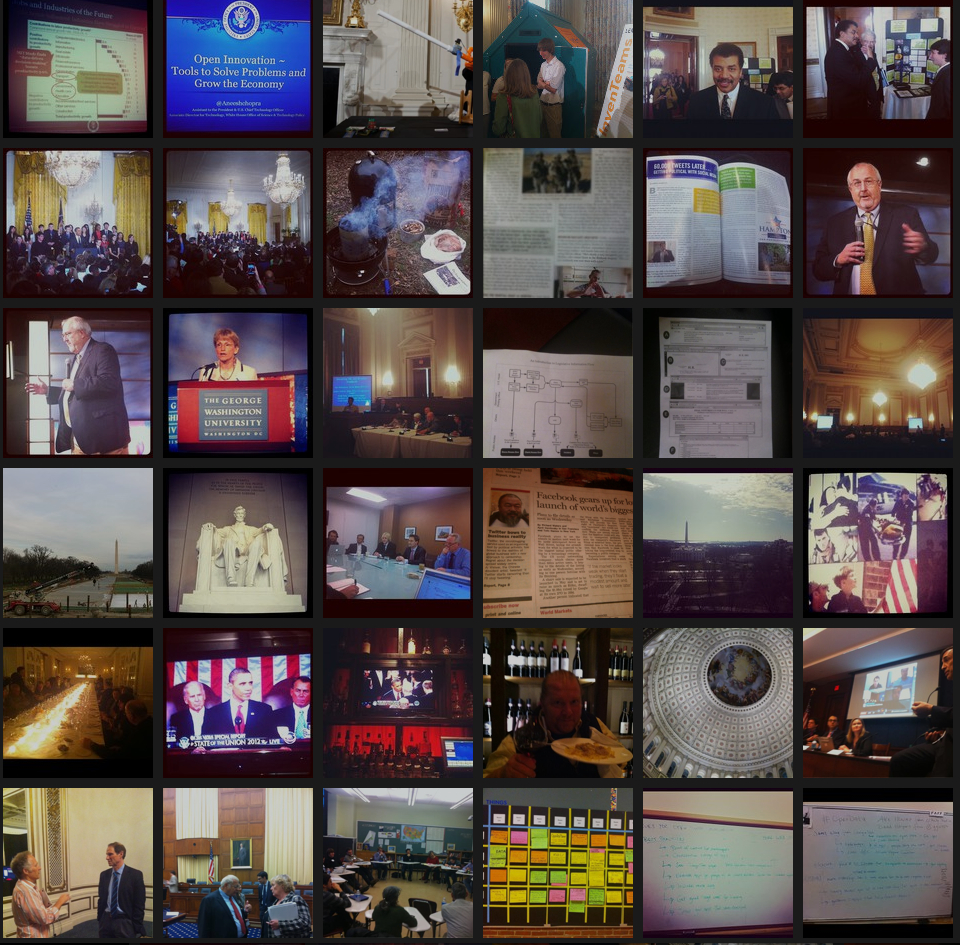
I felt the same instinct over the holidays, when asked to describe what I do or what a day in my life is like now. The photostream I’ve shared to Twitter or Tumblr over the past two weeks offers vignettes of a mobile life:

public Instagram photostream shared to Twitter

My Instagram photostream on Twitter

Those windows on my worlds, reflected as they are in a growing multitude of glowing screens, are a collection that I value much in the same way that a philatelist or numismatist in a previous generation might adore her stamps or her coins. I hope that some of the stories they represent are at least as enduring.

2 Comments

Filed under art, blogging, journalism, microsharing, personal, photography, social media, technology, Twitter

Make Washington more awesome through microphilanthropy

My friend Jennifer 8. Lee was on NPR’s Marketplace tonight, talking about microphilanthropy at Awesome Foundation. You can listen to her segment on “giving awesomely” over at Marketplace.org,

Full disclosure: I’m a trustee here in DC. We’ve given a lot of great grants over the past year. Just this past month, $1000 went to support CodeNow, a new “startup nonprofit” that focused on closing the digital divide by teaching disadvantaged kids to code. The White House is impressed withCode Now’s work in this area, too.

You can see other awesome ideas in DC that inspired us at the Awesome Foundation blog.

If you have more ideas that would make the Washington area more awesome and think you can make it happen, please apply. We’re all ears.

1 Comment

Filed under art, friends, microsharing, personal

Thank you, Steve Jobs

The world has lost one of the rarest of men: someone who not only thought differently but helped create objects that opened all of our eyes too. Tonight, the Associated Press reported that Apple co-founder Steve Jobs had passed away. A letter from Apple’s board went online. And then apple.com changed to an iconic, arresting new image. Steve Jobs

Wired.com went black. Google.com linked to apple.com.

Social networks worldwide lit up with tweets and updates about the death of Steve Jobs.

And, at least for a night, the Web itself felt united in its grief.

Jobs told us “how to live before you die” in a 2005 commencement speech at Stanford University.

“Your time is limited, so don’t waste it living someone else’s life. Don’t be trapped by dogma — which is living with the results of other people’s thinking. Don’t let the noise of others’ opinions drown out your own inner voice. And most important, have the courage to follow your heart and intuition. They somehow already know what you truly want to become. Everything else is secondary.”

While I listened to the speech, I ventured onto a Web absolutely ablaze with sadness, memories, elegies, celebrations and eulogies to Jobs. Following are a few of the voices and perspectives I found.

“Michelle and I are saddened to learn of the passing of Steve Jobs. Steve was among the greatest of American innovators – brave enough to think differently, bold enough to believe he could change the world, and talented enough to do it.

By building one of the planet’s most successful companies from his garage, he exemplified the spirit of American ingenuity. By making computers personal and putting the internet in our pockets, he made the information revolution not only accessible, but intuitive and fun. And by turning his talents to storytelling, he has brought joy to millions of children and grownups alike. Steve was fond of saying that he lived every day like it was his last. Because he did, he transformed our lives, redefined entire industries, and achieved one of the rarest feats in human history: he changed the way each of us sees the world.

The world has lost a visionary. And there may be no greater tribute to Steve’s success than the fact that much of the world learned of his passing on a device he invented. Michelle and I send our thoughts and prayers to Steve’s wife Laurene, his family, and all those who loved him.”-President Obama.

“Jobs proved the appeal of well-designed intuitive products over the sheer power of tech itself”-Wall Street Journal

Apple transformed “not only product categories … but also entire industries”-John Markoff

“Bill Gates put a computer on every desk. Steve Jobs put one in every pocket, purse, dorm room and bedroom.”-New York Times

“He completely changed how we interact with technology”-Wired

“The world rarely sees someone who has had the profound impact Steve has had, the effects of which will be felt for many generations to come. For those of us lucky enough to get to work with him, it’s been an insanely great honor. I will miss Steve immensely.”-Bill Gates

“Steve Jobs saw the future and brought it to life long before most people could even see the horizon”-Mike Bloomberg

Steve Jobs “realized what we wanted before we understood it ourselves”-Ted Anthony

Jobs’ career merged the ’60s and Silicon Valley “in a way that re-imagined business itself”-Steven Jay Levy. “Steve Jobs’ reality field actually came into being. And we all live in it.”

Think back: “There’s about to be a new delivery vehicle in higher education in America”-Steve Jobs, 1987, C-SPAN.

“May the uncompromising vision of Steve Jobs live on, inspiring others, making them reach further, do better.”-Tim O’Reilly

“The people who are crazy enough to think they can change the world are the ones who do”-Gizmodo

“His ambitions took him, and us, to extraordinary places”-Harry McCracken

Steve Jobs “brought together art, humanities and tech: he was one of a kind”-Laura Sydell

Walt Mossberg wrote about “The Steve Jobs I Knew.”

“Yesterday, I lived on a world with a Steve Jobs in it. Tonight, I don’t.”-Andy Ihnatko

“Every generation has its heroes.”-Om Malik

Jobs embodied “a glorious piece of what it is to be American with all our contradictions”-Alexis Madrigal

Steve Jobs said “don’t let the noise of others’ opinions drown out your own inner voice.” I won’t.

He gave us inspiration to write our own melodies, to insist on hearing the songs in our heads voiced to the world, whether that vision was wrought in gleaming glass and aluminum, drawn in fanciful pixels or published, echoing Gutenberg’s first revolution.

Thinking back, my first computer was an Apple II+. In 1985, I wrote a story on it. In 1995, I made my first Web site on a Mac. In 2011, I share my world on an iPhone. 27 years later, I’m making my living on a Macbook Pro and tapping on an iPad.

Thank you, Steve Jobs.

2 Comments

Filed under art, personal, technology, video

The Web is what we make of it

I saw a Google Chrome commercial twice tonight that struck a chord with me. The extended version, embedded below, has been online since May.

On the one hand, it’s a slick ad for a search engine giant’s Web browser that features a glowing treatment of a megacelebrity and her happy fans.

On the other, it’s a view into a changed world that still feels very much of the moment, months after its debut. It reminded me that the Internet has fundamentally changed how we can directly connect with the people who inspire us and on another.

There’s something both deeply joyful and poignant seeing Lady Gaga’s fans dance and sing along with her to that particular song.

On a night where I also saw so much pain, anger, fear, cruelty and misunderstanding flow over the same global electronic network of networks, it felt good to be reminded of how much more connected we can be. If we choose, we can reach out and connect to hundreds of other millions of humans, who are both different and fundamentally the same, looking at a growing mobile Web of billions of screens, small, medium and large.

We can see, share and celebrate the best of human nature in real-time or mourn, censor and condemn that which is worst in us. We go online and find ourselves, for good or ill, and leave a Web that is what we make of it.

Every time we log on, we have an opportunity to change how we think or connect with someone else around this pale blue dot.

Thank you for sharing that journey and teaching me something new, every day.

4 Comments

Filed under art, friends, music, personal, social media, technology, video

Japanese ‘Tsunami dog’ reunited with owner after 3 weeks at sea

As a dog owner, I teared up a bit upon watching this.

In these dark days, good stories can be hard to come by. The devastation and loss of life in Japan after last month’s earthquake and tsunami continues to be deeply affecting. This moment offered a welcome positive note.

Leave a comment

Filed under personal, video

Smarter social networking at SMCDC

Tonight, I’ll be moderating a discussion at Porter Novelli DC about what “smarter social networking” means.

Fortunately, posing questions to this particular set of panelists will be much more easier than trying to herd LOLcats.

Some time shortly after 7 PM EST, I’ll start asking Frank Gruber (@FrankGruber), CEO & co-founder of TechCocktail, Shana Glickfield (@dcconcierge), partner at Beekeeper Group, and Shonali Burke (@shonali), principal at Shonali Burke Consulting, what “smarter social networking” means in 2011. We’ll be talking about forming relationships and acting professionally in the context of the Internet. I might even ask about what good “netiquette” means.

I expect to see Federal News Radio Chris anchor Chris Dorobek (@cdorobek) to be there in person to heckle me online, along with the rest of one of the more connected group of people in the District of Columbia. The DC Social Media Club, after all, comes heavily loaded with BlackBerrys, iPhones, iPads and Android devices. Some will even have two of those devices – one official, one not, and will be wired into Facebook, Twitter, email and txt messaging.

This is clearly a group of people that has thought a lot about how to practice “smarter social networking.” As prepared for the discussion last night, I was reminded that the actions that humans take online increasingly are aligned what they do offline.

That’s because the idea of a separate “cyberspace” is on life support. That’s was one conclusion that Clay Shirky brought to a discussion of the recent report by the Pew Internet and Life Project on the social side of the Internet at the State of the Net Conference.

In wired communities, people are increasingly integrating their online lives with their offline actions. As that trend grows with more of humanity coming online, the role of the Internet as a platform for collective action increases. The world has seen some of that power at work in Tunisia and Egypt this winter.

Those connections are not always strongly made, due to the anonymity sections of the Web of 2011 provide. You only have to look at the quality of civil discourse between commentary on YouTube or newspaper comment threads without moderation to see how anonymity can enable the id of humanity to wash over a page. Teachers, freedom fighters, activists, law enforcement, aid workers, insurgents, journalists or criminals can and will use the Internet for different ends. When any tool is put to ugly or evil use, naturally it provokes outrage, concern, regulation or outright bans.

As Stowe Boyd wrote this weekend in his essay on cognition and the Web, however, “throwing away the web because you don’t like what you see is like breaking a mirror because you don’t like your own reflection. It is us we are staring at in that mirror, on the web: and it is us looking out, too.”It is us we are staring at in that mirror, on the web: and it is us looking out, too.”

In this age of radical transparency, it’s becoming harder and harder to hide to hide demonstrated bad character over time. That’s even more true of people who choose to live their lives more publicly on Facebook, Twitter, Foursquare and where ever else there digital nomadism leads them next.

This isn’t an entirely happy development, as the number of citations of social networking in divorce filings suggest. By the end of the next decade, more people may well be paying money to assure their privacy than to gain more publicity.

In that context, “smarter social networking” in an age of digital transparency may well rely more on good character, better business ethics and placing value in building trusted relationships than faster wireless broadband, the newest smartphone or millions of followers or fans.

3 Comments

Filed under article, blogging, friends, personal, social media, technology, Twitter, Uncategorized

Hired: I’m the new #Gov20 DC Correspondent for @OReillyMedia!

I’m thrilled to announce that I have a new job! Earlier today, I accepted an offer from Tim O’Reilly to be the Washington, D.C. correspondent on Government 2.0 for O’Reilly Media.

I’m hitting the ground running here in the District of Columbia, since O’Reilly’s upcoming 2010 Government 2.0 conference is only a few weeks away — and there’s plenty to do.

Over the following months, I expect to write – a lot – about how technology is being used to help citizens, cities and national governments solve big problems.

I also expect to frequently explain what “government 2.0” is, since the term is in my title! I’ve written before about the language of government 2.0, the history of disruptive innovation and the ways government adapts to technological change. That’s part of it. So is Tim O’Reilly’s concept of government 2.0 as a platform, naturally.

And so is writing about government transparency, the Open Government Directive, relaunches of .gov websites like SupremeCourt.gov or Reboot.gov, and the people behind the technologies that are driving change and innovation.

There’s no shortage of case studies to highlight, from the local town green right on up to the federal or international level. Just listen to the voices from the Gov2.0 LA unconference for a small sample of the perspectives on the issue.

O’Reilly’s goal in Washington D.C. is to “create a context in which people can think” differently about the role of technology in government, and the role of government in society. I look forward to helping to create that context.

In service of that goal, I’ll be blogging, conducting short interviews with government officials and industry participants, writing features and using the rest of the tools for digital curation I’ve been honing in the past several years.

I’m very excited to get started. I expect my new position to be challenging, engaging, rewarding, occasionally frustrating and never dull.

I also expect the process of writing about government 2.0 case studies to be a reciprocal process, as readers help me to understand more about what stories are important to them and which voices deserve to be heard.

I hope that in the days and months to come that you’ll share your perspectives, ideas and suggestions with me.

The story of government 2.0 is already being written every day by citizens, civic hackers, advocacy groups, government employees, researchers and technologists.

As a digital pilgrim, I look forward to chronicling that progress.

29 Comments

Filed under journalism, personal, technology

On Twitter, neither a Luddite nor Biltonite be. Simply be human.

The wrangling about whether Twitter is revolutionary, useful or mindless twaddle simply will not end. Given the continued interest in the microblogging platform in the media, that is perhaps to be expected.

Last month, David Carr wrote in the Sunday edition of the The New York Times that “Twitter will endure,” exploring how he’d initially dismissed the platform and then found it useful. In late January,  The New Yorker‘s George Packer responded to  Carr, deriding Twitter as “information hell” and comparing it to an addiction to crack in “Stop the world.” That brought a flood of attention from online media outlets, including Nick Bilton, lead writer for the excellent Bits blog at the Times, who wrote that “The Twitter train has left the station,” defending Twitter from the point of view of a journalist who has found utility amidst the stream.  On Thursday, Mr. Packer offered a rebuttal, positioning himself as neither a “Luddite or a Biltonite.” Jeffrey Goldberg has now weighed in at the Atlantic, consigning Bilton and others who might share his conviction to the arena of “info freaks.”

Well and good. (At least Goldberg tweets.) Two disclaimers:

1) I am a long-time reader of George Packer’s excellent work in the New Yorker. I found “The Assassin’s Gate” to be one of the best books written about the early stages of the war in Iraq.

2) I’ve found considerable utility in Twitter since I joined in March of 2007.

I don’t expect either truth to be degraded by the spat between Bilton and Packer.

I was, however, surprised that Packer had chosen to criticize a platform that he hadn’t used. Few serious technology journalists, book reviewers, movie or restaurant critics would consider rendering judgment without personal experience. Such considerations don’t hold back millions of Twitter users, bloggers or, I believe, any number of television pundits, but since I admire Mr. Packer’s professionalism, that approach surprised me.

When he wrote “The Revolution Will Not Be Blogged” six years ago, my sense was that, despite his misgivings and evident frustration with pajama-clad pundits, he’d read some blogs, even if he doubted their utility as serious platforms for commentary or criticism. Given the maturation of blogs in the years since (including, I might note, at New Yorker.com), I wonder if revisiting that analysis might have been more useful, rather than dismissing Twitter without first dipping into the ebb and flow of news there.

In his second pass, Packer wrote that he had, in fact, “sought out a Tweeter,” without linking to or identifying that person. Well and good, but perhaps a weak strawman. As a commenter at Packer’s blog reflected, much of the content produced there is ambient noise, or digital “phatics” as Kevin Marks has rightly described them.

Twitter is profoundly social. That’s is why, despite the mindless hype surrounding the phrase, “social media” has had staying power in describing Twitter, Facebook or other platforms that allow two way conversations.

Twitter, like so many other things, is what you make of it. Some might go to a cocktail party and talk about fashion, who kissed whom, where the next hot bar is or any number of other superficial topics. Others might hone in on politics, news, technology, media, art, philosophy or any of the other subjects that the New Yorker covers. If you search and listen, it’s not hard to find others sharing news and opinion that’s relevant to your own interests.

Using intelligent filters for information, it’s quite easy to subscribe and digest them at leisure. And it’s as easy as unfollowing someone to winnow out “babble” or a steady stream of mundanity. The impression that one is forced to listen to pabulum, as if obligated to sit through a dreary dinner party or interminable plane ride next to a boring boor, is far from the reality of the actual experience of Twitter or elsewhere.

There’s also genuine utility there for the journalists who choose to experiment. When stories break, we can use it for real-time news and information. In the case of Haiti, Twitter was relevant, immediate and helpful, given that phones went down and the Internet stayed up. NPR was able to use Twitter and Skype to find sources on the ground. Disaster relief agencies were able to coordinate with one another. And in one notable instance, Doctors Without Borders was able to call attention using Twitter at @MSF_USA to the fact that its plane was getting turned away. Ann Curry heard them and helped to amplify the issue:

“@usairforce find a way to let Doctors without Borders planes land in Haiti: http://bit.ly/8hYZOK THE most effective at this. 11:52 AM Jan 17th

Packer and others are right to caution against hype and techno-worshipers. On balance, however, Packer errs in tarring much of the online community with a broad brush.

One passage in particular stands out: “There’s no way for readers to be online, surfing, e-mailing, posting, tweeting, reading tweets, and soon enough doing the thing that will come after Twitter, without paying a high price in available time, attention span, reading comprehension, and experience of the immediately surrounding world.” As Marc Ambinder tweeted earlier today, “I read many, many books in 2009. Including yours. And I Tweet.”

The same is true for me, and for many others. I read much of the New Yorker, the Economist and the Atlantic each month, along with numerous newspapers and technology blogs or trade publications online. (I write for one of the latter.) I also read on average 2-3 books every month, depending upon the rigor of travel, conferences or other factors. I also dip in and out Twitter throughout the week. That may not be an ideal information diet for everyone but for this tech journalist, it works. Even if I miss a story, it’s extremely rare that my network of friends and sources won’t find it and share it.

That’s why this “social news” phenomenon has become of keen interest to Google, as evidenced by the inclusion of social search into its results.

I share Packer’s concern about how the use of the Internet is changing literacy, critical thinking and creativity. Well and good, if not exactly novel. I look forward to more research on how and where those effects are found. I find hypotheses that place high consumption rates video games, television and movies is at the heart of poor information literacy instead of the wired world more convincing.

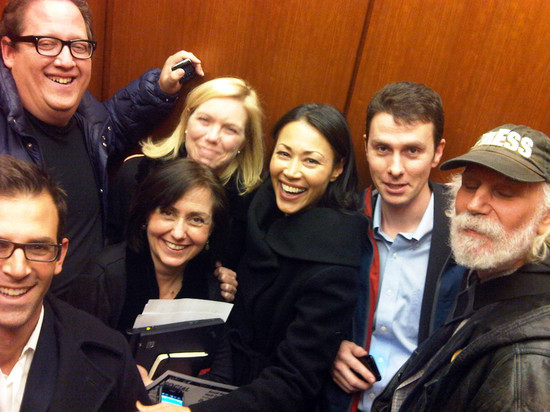
As for another comment regarding the tweets that flew about Ann Curry being stuck in the elevator, I share the amusement from the perspective of the man who sat next to that remarkable woman for ninety minutes. (So did the folks at Gawker, who wrote about the elevator incident at length.) Ann and I talked about Haiti, changes in media, religion, the utility of the iPad and yes, Twitter, all gloriously offline and in depth. I enjoy that memory; there’s a lovely montage of images up at GeoGeller.com, whose camera took the excellent shot below.

The fact that the world knew we were all stuck in that elevator was merely amusing, however, as opposed to a critical message that would best be conveyed to a 911 operator. We all found the intercom more useful than our smartphones, given the awful reception.

Sharing our experience with our networks of friends, however, was a natural extension of life in 2010. It certainly wasn’t breaking news but the act of communicating about it offered me, at least, an opportunity to interact with a broader audience of other humans around globe. That’s an unalloyed good.

I agree that “cheerleading uncritically” is not useful, nor a mentality that any writer should adopt. I do not share Packer’s conviction, however, that the news landscape can’t be occupied by more technological platforms, including reporters tapping away on BlackBerrys. One important example of that is Mark Knoller, the CBS White House correspondent whose tweets read like a they’ve been adapted from a history book already written.

If Mr. Packer would like to meet over coffee in DC to talk further about how life has changed in the age of Twitter, consider this an open invitation. Given my experience with his writing, I am certain that @GeorgePacker would be worth following.

-Alexander B. Howard
@digiphile.

7 Comments

Filed under blogging, journalism, microsharing, personal, photography, social media, technology, Twitter

It’s not about the numbers. It’s about the connections.

Connections
Image by Amodiovalerio Verde via Flickr

Last night, I had a surprise:  my follower count on Twitter dropped by 148 in one fell swoop.

At first, I thought it was something I had tweeted – oversharing about the Forrester tweetup, or disinterest in sharing a clip of Supreme Court nominee Sotomayor. That didn’t jibe, however, with my gut.

What was inflammatory? What had I done that resulted in a huge loss of followers? As I drifted off to sleep, I thought: how important is this, really, in the grand scheme of things?

I’ve long since learned one hallmark of netiquette on Twitter (Twittiquette, if you will) was not to talk about one’s follower numbers. (If only I could retrieve some of the replies I received back in 2007 after doing so, I’d be thrilled. No good.)

A paraphrase of most of them essentially boiled down to this: are you here to get followers or here to connect?

It didn’t take long to see where the real value was. And, more than two years later, I’m elated to look back and see how many marvelous connections I’ve made, many of which have led to friendships offline. Why is that important?

For me, that’s a a simple answer: we live in a number-obsessed culture. Thinks about how many metrics we track, filter and can recall: poll numbers, net worth, MPG, CTR, Web uniques, 0-60 in __, GPA, APR, circulation, P/E ratios, DJIA, TCO, Mbps, R/W speed…on and on.

And, naturally, for those in the social networking world,we count subscribers,  friends and followers. I’ve received far too many messages and spam promising me thousands of followers if I use this software or that service.

Honestly, they all leave me with the taste of fermented cough syrup in my mouth, with a healthy side of cod liver oil.

It’s not about the numbers: it’s about the connections.

Every follower or friend I’ve made has been through a conscious choice or organic growth. I’m proud of that. I’ve done it in what I might term the “new-fashioned way,” using much the same approach that Chris Brogan describes in his Twitter FAQ: “be helpful, share, communicate, use @replies a lot.” I tend to attribute “by @username” or “via @” nearly as much as directly @reply these days but the sense is the same.

Yesterday, I met Josh Bernoff, co-author of Groundswell. I had dinner with Shava Nerad and her beau, “Fish Fishman,” with Laurel Ruma joining in a bit later. I saw dozens of other friends from the local social media scene at two different tweetups.

I shared some groundbreaking journalism tools and advice, like best practices for journalists curating the Web. I shared messages and stories with newsies at the New York Times, Guardian, Wired, Gizmodo, Slate, The Register,The Center for Democracy & Technology and many others.

I read Stephen Baker on what may become of BusinessWeek and Bernard Lunn on creative destruction in publishing

I shared a lovely bit of science fiction made real, via the irrepressible Steve Garfield, watching the latest in augmented reality:

I reviewed my sources, notes and interviews from a conference earlier this week and wrote an article. I enjoyed a two hour workshop with my colleagues, analyzing the strengths and weaknesses of our journalism. I even enjoyed a late night cocktail with someone I love deeply.

In all of that, what does a dip in follower numbers mean? Not a helluva lot.

And, as it turns out, the scuttlebutt that Twitter is doing another purge of spammers and bots, a process that I recall from last year as well. My existential angst was unwarranted, my concern without merit – but the thought process and recounting it led me to was worth it.

I’m proud of my connections and my friends, of the social news network we’re all collaborating upon, and up the quality of the communication within it. I’m glad to bring it with me to Washington in a few short weeks.

The spammers can go live on whatever lower circle of digital Hades is reserved for ’em.

Reblog this post [with Zemanta]

1 Comment

Filed under blogging, friends, microsharing, personal, social media, technology, Twitter, video

Post from the comments: “Let’s go give away some oranges”

Fight Club
Image via Wikipedia

Yesterday, Chris Brogan wrote about Secret Fight Club, adapting the concept of Fight Club to social media for social change.

My first response? The first rule of #SecretFightClub: No one talks about Secret Fight Club!

In a comment on Chris’s blog, I suggested that “eTyler Durden is gonna be so annoyed. I suggest you change your soaps and don’t eat soup for months.”

The irony is that, given the reach of Chris’ blog, many people WILL of course be talking about SFC, though perhaps even more will simply keep on spreading that good will silently.

“Buying free plates of bacon at the bar” isn’t a bad metaphor at all — I can’t forget when someone did just that at the #140Conf — but passing out oranges to the homeless catches something closer to my heart.

A member of my family always carried oranges in Philly and Baltimore growing up, where there are major homeless populations, most of whom have major Vitamin C deficiencies.

Instead of giving them money, he passed out oranges. A few homeless people became upset, since they wanted $ for whatever other cause, but most were incredibly grateful.

Chris Brogan passes out oranges all the time.

He posts portraits of independence on his blog, tweets  about worthy causes, explains how he tweets, writes about favorite children’s books, pastors or software he likes.

Some cynics might say that’s name dropping or crass brand mentions, like the unfortunate choice of Magic Johnson to mention KFC five times during MJ’s memorial.

I don’t buy into that.

In the social media world, regardless of what digital outpost you’re on, sharing information and being helpful is the best and most important form of digital currency we have to share.

Instead of beating each other up to escape the banality of corporatized modern life, in order to FEEL something, we are all collaborating on building a global network of digitized human experience, caught on video, pictures or memorialized in 140 characters or more.

I’d say thank you to Chris for risking eTyler Durden’s wrath but I think it’s possible he’s playing him here. He remembers how long many of us have been at this online.

Do you remember when we all passed around The Hunger Site and everyone clicked to give rice? I do.

And guess what? That website just celebrated its 10th anniversary.

FreeRice gives away rice if you play simple word games. And charity : water just celebrated a similar digital success, borne on a wave of social media good karma.

The netizens using and sharing those ideas represent precisely the kind of Secret Fight Club I’m both proud to belong to and recruit others to join.

Let’s go give away some oranges.

Note: This post first appeared as a comment on Chris Brogan’s blog. I decided it was worth editing and posting here. I’m following Chris’ example when he posted “On Public Radio” as a surprise guest post on chrisbrogan.com.

Reblog this post [with Zemanta]

1 Comment

Filed under personal, social media, technology