Category Archives: journalism

INTERVIEW: What is Government 2.0? Why does it matter?

I sat down for an interview with the “Don’t Worry About The Government” folks earlier today to talk about government as a platform, open data and more. (Bonus: I’m still sporting my summer beard from Maine.)

The interview request was triggered by my post on whether government innovation can rise above partisan politics. In an ideal world — which we of course do not live in — this presidential election would focus more upon what role government should or should play in our society, at the city, state and federal level, and whether and how we the people should finance it.

Over the last century in the United States, the size of the federal government has grown immensely, from entitlement programs (Medicaid, Medicare, and Social Security) to the immense defense budget. Technology provides new opportunities to both save taxpayers dollars and detect and prevent corruption and fraud, but the larger question of the role government itself should play in society is one that should occupy more of the national conversation, frankly, than Representatives skinny dipping on foreign trips, campaign trail gaffes or the latest celebrity foibles.

Leave a comment

Filed under government 2.0, journalism, technology, video

On acts of journalism, social media, credentialing, shield laws and press freedom

Anyone with a smartphone can now do reporting: share geolocated photos, video or stream what’s happening. I’m here, you’re not, here’s what I see. Does such “citizen reporting” rise to an “act of journalism” and need to protected under the First Amendment? Increasingly, I tend to think that it does — and that’s going to be a key question in the not-so-distant future, if Congress gets around to re-examining shield laws. Shield laws have been an issue for years, in the context of how the digital media ecosystem has democratized the means of publication, particularly of reporting images and video.

Currently, there is no federal shield law to protect sources and methods. Last year’s ruling in Oregon cemented the reality that 20th century shield laws lag today’s social media realities, even if the blogger in question turns out to have gone far beyond where many of the people initially defending her realized. A subsequent clarification showed that the judge who made the ruling believes bloggers can be journalists.

Honestly, some days I find the gatekeeping and credentialism I still see and hear disquieting. Since my degree is in biology and sociology, not “journalism,” should I get kicked out of the profession? Without getting testy, this attitude is exactly what will allow governments to arrest people livestreaming because they aren’t “members of the media.” (I also think it’s why there are still tables for “print only” in Congressional hearing rooms and 20th century rules for hard press passes for broadcast, radio or print journalists in the Senate and restrictions on the use of computers in some House subcommittees.)

Who gets to decide if someone is a journalist? Is someone who works at the Daily Enquirer who posts pictures of a naked celebrity a journalist — but someone who posts pictures of a cop beating a student is not? What about a columnist who writes about the Greatest Athlete EVER versus a blogger who chronicles how well documented city council hearings are and issues with the document format or codec type from the software vendor? The odds are good that it will be U.S. Senators and judges who make that call: it’s important to think carefully about which side you come down upon and why.

This stuff is ALL really blurry. Is Twitter journalism or isn’t it?. What about tweets? Blog posts? Video?
Remember, there are companies who have tried to criminalize linking or embedding. There also folks out there in media land who have say linking is unfair aggregation. Both could be an issue for what some practitioners have called social journalism.

We need to be careful about being quick to exclude or defend turf in a historic moment when the practice of journalism has become more open to all then ever before, particularly when press freedom continues to be under pressure globally and whistleblowers are being prosecuted domestically. The bloggers vs journalists debate has significant potential downstream impact that matters, even as it morphs into “curators vs journalists.”

Honestly, I’m starting to think that the term “curators” should have been left in museums, where it was quite clear what they did. How about “editors vs curators?” Fuzzier, right?

Hey, I love it when people link and share my work, personally. I hate it when they plagiarize, don’t link or attribute it. Curate me, please!

Personally, if someone produces work that is fair, accurate, adds necessary context and based on the available evidence, I’m generally happy to call it journalism, regardless of whether the author is on a masthead somewhere or has the right B.S. on a sheepskin.

This post has been updated with links and commentary.

6 Comments

Filed under blogging, government 2.0, journalism, microsharing, social media, technology, Twitter

In the Capital, influence on social media in DC is more than Twitter followers

It’s hard to believe that it’s been over a year since I implored the DC tech community and media scene at large to stop holding influence contests. Deja vu, all over again.

It was brilliant of In The Capital to hire a smart journalist to cover notable events in the political and tech scene. That coverage put them on the District’s radar during Social Media Week.

It was not brilliant of them to put together this week’s smudged sterling example of linkbait, which stands to damage their credibility with new readers who are not friends of those selected.

Look: I’ve met 80% of the people on this list of the “DC’s Top 10 Social Media Influencers” and follow many of them. I have much respect for their smarts, digital savvy and professionalism.

But if this is the” top 10,” what, exactly, does being an DC “influencer in social media” mean here? Online influence is not just about having a lot of Twitter followers.

For instance, I’m ahead of @LukeRussert by more than 33,000+ and have a higher Klout score, due in part to a large following on Google+ and Facebook. Does that mean that I’m more influential? Maybe on social media and certainly with respect to technology, but certainly not on broadcast news, which still retains enormous influence in our country. It also wasn’t hard to think of another person in DC who’s more influential with respect to social media than either one of us:

What about more “influential in the startup and DC tech scene, which “In the Capital” says it covers? Are all ten of these people more influential than Peter Corbett, Frank Gruber or Jen Consalvo, the co-founders or DC Week and organizers of the huge DC Tech Meetup? I’d don’t think so. And neither does Russert:

In a larger sense, does anyone believe that Russert is more of an “influencer” on social media in Washington than President Obama, between @WhiteHouse and @BarackObama? (I certainly don’t kid myself about my “clout” relative to POTUS.) What about @SpeakerBoehner or House Majority Leader @EricCantor or @SenJohnMcCain? Is the rest of the list is more “influential” than @MarkKnoller or @MarcAmbinder or @MikeAllen? A recent study of Twitter use in Congress, in fact, found that SenatorSanders was the most “influential” member of Congress on social media. (Or at least on Twitter.) one could go deeper on the list of people in media and government but the point is clear enough.

Mark Drapeau, director of innovative engagement in Microsoft’s office of civic engagement — and a member of the list — offered a dissenting perspective:

all these lists are kinda different or the same based on peoples’ biases and what they hope to accomplish and the audience they hope to reach. The Washington Post turns it into a ridiculous game. In the Capital picked… people they think are cool. Politico made the same exact list [of top DC Twitterers] and it’s all – gasp – politicos! The LA Times made the same list [DC twitterers], and they simply ranked people by followers – lazy! I made the same list based on how people interact with their communities – lots of people I know from… my community! All the lists are right, all the lists are wrong, there is nothing to debate, complain about, or mock.

In DC social media, there’s lots of actual social data to crunch to enable some measure influence and connected, not just from PeerIndex or Klout but from Google back links or Twitter/Facebook engagement numbers. Or they could have run their own data on how much engagement or amplification people get on Twitter, Facebook, Tumblr, Google+, etc. That’s just not what happened today.

This feels straightforward, at least from where I sit tonight: If editors make lists, they need to be able to back them up with criteria and methodology. That’s why people read Consumer Reports, for instance, when they buy things. Lists and ratings from credible publications influence the buying and hiring decisions of consumers. That’s why there’s a market for them and why people and brands get excited about being selected.

If “In The Capital” really wanted to measure “influence” and do a Top 10 List, “In the Capital” could have cited Klout or PeerIndex, flawed as those services may yet be. Gadi-Ben Yehuda, social media strategist for IBM’s Center on the Business of Government, made this comment:

The easiest way to have voided any controversy would have been not to use the title “DC’s Top Ten Influencers in Social Media,” which is confusing in any case. Honestly, when I saw who was on the list (the majority was women), I thought “OK, this must be people who do primarily social media activities, i.e. they don’t publish substantive articles on important government events (like Alex), they don’t run tech/innovation companies (like Peter Corbett), they don’t work in the innovation office of cabinet-level agencies (like @AlecJRoss). These are people who’s skill is in the medium that others of us use as a tool to accomplish other things.”

That seemed to answer the question of what the article was about, but only if one focused on the words “in social media.” But what about this words “top” and “influencer” what do those words even mean? Klout defines influence as the ability to spur others to take action. If that’s what an influencer is, then I don’t think there can be a top ten list without Obama, or at least Macon Phillips. Again, Peter Corbett (he got more than 10K people here for DCWeek, after all). Alan Rosenblatt should also likely be on that list.

Based upon Byrne’s comments and some background gathered at last night’s DC Social Media Happy Hour, the list was originally pitched to be about 10 awesome women who consult and teach others in the DC community about how to use social media. Shireen Michell, for instance, is influential with segments of the District’s community who are not in the government or media space.

Then In The Capital appears to have dropped two of them, added Russert and Drapeau, and changed the title and premise, which was not and is not supportable based upon qualititative or quantitative grounds. When asked about the substance behind the list, the author of the post offered this response:

Lisa Byrne, a social strategist at the Pappas Group who was put on the list, offered some insight into what seems to have happened:

“I actually gave a lot of input (originally it was all female so I never spoke of any guys who should be noted),” she commented. “I was not advised it would be titled Influencers. I listed people who were community leaders in the social space – online and specifically offline.”

1 Comment

Filed under blogging, government 2.0, journalism, social media, technology, Twitter

Collecting stories

On his personal blog, New York Times technology journalist Nick Bilton mused about “collecting air” in his travels around the globe. He closes his post with this thought, drawn from a recent conversation on a flight:

The man looked at me and asked, “Do you collect anything?”

At first I didn’t know how to respond, I hadn’t thought about it in some time. And then I instinctively told him that I actually collect stories —about people, or events, or places, or companies, or moments in time. That I collect these stories and keep them as words and photos.

I looked out of the plane window for a while as we zipped above the clouds at 35,000 feet, and then I looked back at the man and said, “I guess you could say I collect air.”

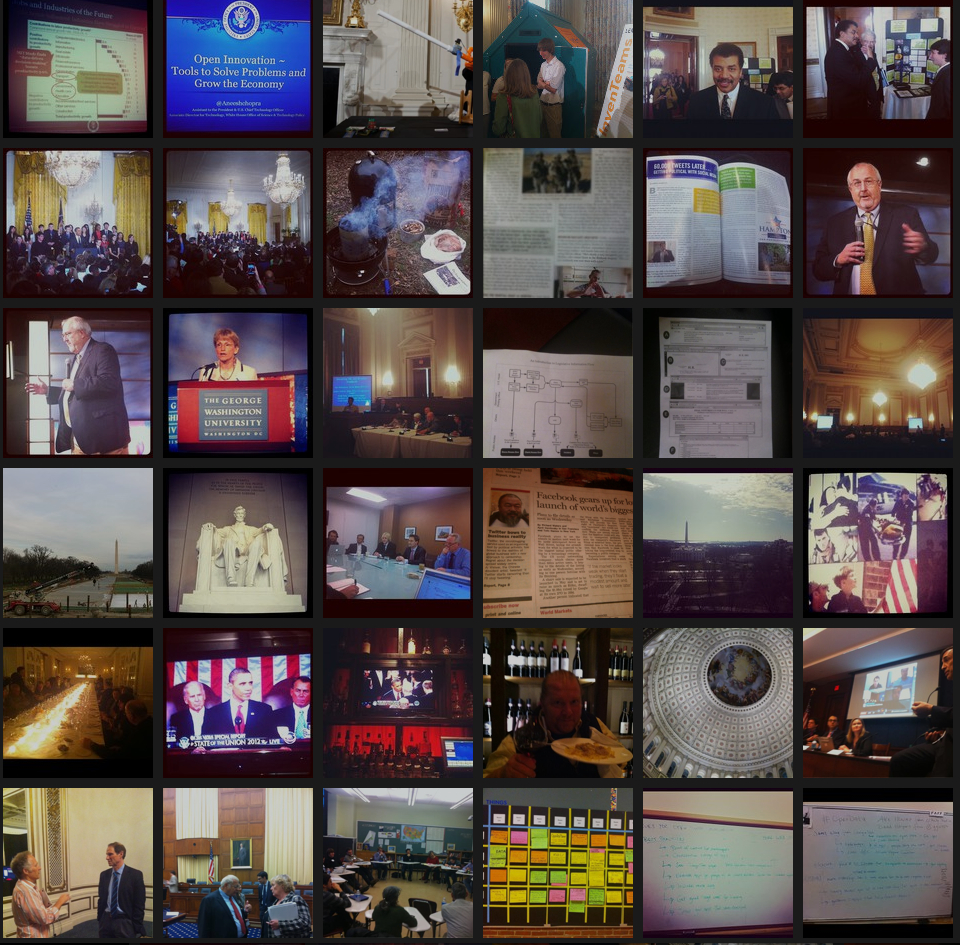
I felt the same instinct over the holidays, when asked to describe what I do or what a day in my life is like now. The photostream I’ve shared to Twitter or Tumblr over the past two weeks offers vignettes of a mobile life:

public Instagram photostream shared to Twitter

My Instagram photostream on Twitter

Those windows on my worlds, reflected as they are in a growing multitude of glowing screens, are a collection that I value much in the same way that a philatelist or numismatist in a previous generation might adore her stamps or her coins. I hope that some of the stories they represent are at least as enduring.

2 Comments

Filed under art, blogging, journalism, microsharing, personal, photography, social media, technology, Twitter

New Sky News social media policy would cripple journalists working on the real-time Web of 2012

Another month, another firestorm over a poorly thought out social media policy from a massive media company. This time, it’s Sky News that’s made a misstep.

I think Reuters social media editor Anthony De Rosa is spot on in his assessment of assessment of the failings of the new social media policy advanced by Sky News: it’s longing for a return to the Victorian Internet

Cory Bergman nailed why it’s OK for journalists to be human on Twitter and Mathew Ingram, as usual, offered his usual common sense analysis of what makes sense, in context. (

Where I think Anthony knocks it out of the park, however, is with respect to the professional rationale for retweeting other accounts: “The idea here at Reuters when it comes to social media is to be the beacon for all news, which makes us the go-to source, no matter what the source may be, after being put through our own filters of verification.”

Just so.

If you’re on a beat, you want to be THE source for news on it. Generally, that means you’ll get beaten on being first to a story. No worries: RT them, then blog it, and link in articles. Over time, people (and algorithms) will value you for that work.

Any entity that distributes content online — whether they’re in the media, government, academia, nonprofit or other organizations, needs to be thinking about search engine optimization (SEO) and social media optimization (SMO) in 2012. Any policies that force journalists into internal silos will eviscerate that capability.

A RT is social media currency. Instructing journalists not to give them out where deserved is like sending them into a conflict or disaster zone with no funds for a fixer, fuel or food. It’s not just bad form. It’s bad business.

1 Comment

Filed under blogging, journalism, microsharing, social media, Twitter

5 Social Media Week DC 2012 Panels: Conversations, Politics, Technology, Public Diplomacy and eDemocracy

Social Media Week DC  is going to be a busy conference for me this year. If you haven’t heard about it yet, the week-long festival starts 12 days from now. The week will feature speakers, panels, workshops, events, and parties all across the District celebrating tech and social media in the Nation’s Capital, including a special edition of the DC Tech Meetup. I’m going to be moderating four panels and participating on a fifth. I’m excited about all five and I hope that readers, friends, colleagues and the DC community comes to one or more of them.

If the panels that I’m involved in aren’t your cup of tea, you might find something more to your taste in the full SMW DC schedule.

Social Media Week DC 2012

Following is the breakdown of the five panels that I’ll be participating in this year:

  • Creating & Managing High Quality Online Conversations
    Location: Science Club
    Date: Monday, February 13 at 6:30 PM – 8:00 PM |  Add to Google Calendar | Add to iCal
    Description: Discussions in online comment sections and social media can be tricky to manage. Some sites are bogged down full of low quality comments, spam, and more. How do we create high quality online discussions? How do we filter out the noise – the spam, the solicitation, harassment, and hateful speech that often becomes part of any online discussion? We will discuss examples of those that have done it well, and some that haven’t. We will also speak to individuals who have dealt with harassment and negativity online and learn how they fought back and still used social media tools for constructive discussion and engagement.
  • Politics and technology: the media’s role in the changing landscape: ASK QUESTIONS
    Location: Powell Tate
    Date: Tuesday, February 14 at 10:00 AM | Add to Google Calendar | Add to iCal
    Description
    : Digital platforms have changed the media landscape forever, but how has it changed the way the media covers politics? We’ll ask a panel of reporters from Gannett, National Journal, ABC News and Politico as they discuss 2012 election coverage.
  • Social Politics: How Technology Has Helped Campaigns: ASK QUESTIONS
    Location: Powell Tate
    Date: Tuesday, February 14 at 2:00 PM | Add to Google Calendar | Add to iCal
    Description: The social media landscape has changed drastically since 2008. We’ll hear directly from panelists from Google, Twitter and Facebook as they delve into the tools and innovations that candidates and campaigns have utilized as the 2012 campaign heats up.
  • Public Diplomacy in the Age of Social Media
    Location: New America Foundation
    Date: Thursday, February 16 at 9:30 AM – 11:00 AM | Add to Google Calendar| Add to iCal
    Description
    : How does social media change how statecraft is practiced in the 21st century? Who’s participating and why? What have been some lessons learned from the pioneers who have logged on to listen and engage? Three representatives from the U.S. Department of State will share case studies and professional experiences gleaned directly from the virtual trenches.
  • Social Media, Government and 21st Century eDemocracy
    Location: The U.S. National Archives
    Date: Friday, February 17 at 1:00 PM – 2:00 PM | Add to Calendar | Add to iCal
    Description: While Sean Parker may predict that social media will determine the outcome of the 2012 election, governance is another story entirely. Meaningful use of social media by Congress remains challenged by a number of factors, not least an online identity ecosystem that has not provided Congress with ideal means to identify constituents online. The reality remains that when it comes to which channels influence Congress, in-person visits and individual emails or phone calls are far more influential with congressional staffers.“People think it’s always an argument in Washington,” said Matt Lira, Director of Digital for the House Majority Leader. “Social media can change that. We’re seeing a decentralization of audiences that is built around their interests rather than the interests of editors. Imagine when you start streaming every hearing and making information more digestible. All of a sudden, you get these niche audiences. They’re not enough to sustain a network, but you’ll get enough of an audience to sustain the topic. I believe we will have a more engaged citizenry as a result.”

    This conversation with Lira (and other special guests, as scheduling allows) will explore more than how social media is changing politics in Washington. We’ll look at its potential to can help elected officials and other public servants make better policy decisions.

If you’re not in DC, check to see if there is a Social Media Week event near you: in 2012, the conference now include New York, San Francisco, Miami, Toronto, London, Paris, Rome, Hong Kong, Tokyo, Singapore, and Sao Paulo.

2 Comments

Filed under article, government 2.0, journalism, social media, technology

Visualizing conversations on Twitter about #SOPA

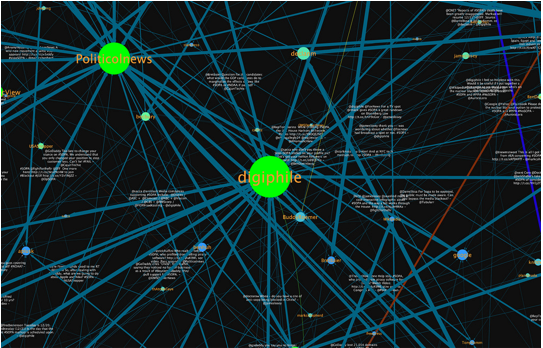
Kickstarter data dude Fred Berenson visualized conversations around SOPA on Twitter: View visualization

@digiphile snapshot

His data crunching strongly implies that I’ve been a “supernode” on this story. I’m not surprised, given how closely I’ve been following how the Web is changing Washington — or vice versa.

Leave a comment

Filed under art, article, journalism, microsharing, research, social bookmarking, social media, technology, Twitter

On the value of blog comments

paper blogs

"Paper Blogs" by bookwyrmish

Over at GigaOm, Matthew Ingram weighs in on whether blogs should allow comments or not, spurred by a debate between venture capitalist Fred Wilson and Tech Crunch blogger-turned-venture capitalist M.G. Siegler:

MG Siegler, who doesn’t have comments on his blog and has written several posts defending his decision, saying they are 99-percent bile and a waste of his time. On the other side of the debate is fellow VC Fred Wilson, who says Siegler is missing a lot by not allowing comments.

I think Wilson is right — while comments can be a royal pain at times, they are a crucial part of what makes a blog more than just a bully pulpit.

For my part, I respect MG Siegler‘s choice to have a place on the Internet where only he can share his thoughts, whether we call it a blog or not, just as I do that of Seth Godin or John Gruber. If someone wants to comment on a given post, he or she can do so and respond via email, social networks, YouTube or their own blog(s). Or all of the above. There is no shortage of options on the Web of 2012 to share and opinion of something online and link to it. Just the opposite, really. If I want to publicly comment on one of Siegler’s posts, I can do so right here on my blog. Or Facebook. Or Google+. Or  @reply to @parislemon on Twitter, albeit in fewer characters.

From where I sit tonight, whether you choose to have comments or not speaks to whether you want to create an online community, which requires a human’s touch to manage and moderate, or to simply publish your thoughts publicly online, without making the necessary commitment of time and patience.

As is often the case, I agree with Mathew Ingram: blog comments are worth the effort.

He cites two important examples of high functioning people who maintain blogs with excellent comment sections, Anil Dash and Fred Wilson.

Dash and Wilson both spend time reading and responding to comments. For those who have been online for a few years, you know that’s not the case with many other blog authors. In a frank post last year, Dash observed that if your website is full of bad behavior, it’s your fault. He clearly thinks it’s worth it:

“When you engage with a community online in a constructive way, it can be one of the most meaningful experiences of your life. It doesn’t have to be polite, or neat and tidy, or full of everyone agreeing with each other. It just has to not be hateful and destructive.”

It’s worth noting that both men have also put into place architectures for participation that enable them to create better norms for discourse alongside social norms created by community. Dash uses Facebook comments, Wilson Disqus.

Some of the worst comments online still show up on YouTube or unmoderated newspaper comment sections. That’s one reason newspapers have been rethinking anonymous commenters. (Another, of course, is that knowing more about your readers’ demographics matters for online advertising and lead generation.)

It’s on that count that Ingram has extra credibility with me, since he used to be the social media editor at the Globe and Mail in Canada. While Canadians generally have a reputation for being polite, online that can change. Despite years of exposure to the best and worst of humanity on his screen, however, Mathew still supports having them:

“…I still defend comments as a crucial element of what blogging is, and more than that I defend anonymity as well. A blog without comments is a soap-box, plain and simple. Not having comments says you are only interested in passing on your wisdom, without testing it against any external source (at least not where others can watch you do so) or leaving open the opportunity to actually learn something from those who don’t have their own blogs, or aren’t on Twitter or Google+. That may make for a nicer experience for you the blogger, and it may make your blog load faster, but it is still a loss — for you, and for your readers.”

Moderating and responding to comments is a full-time job at high traffic blogs. If you’re a one man outfit, small business or don’t have a full time community manager, that’s going to take time away from research, writing and interviews — and that’s a legitimate problem for a writer, much less an entire news outfit. MG made this point today, commenting on the decision by Macstories to remove all comments:

It’s one thing for a single person site (like this one) to make a call to remove comments. It’s another for a larger team blog to do so. In fact, I can’t think of any without comments.

Right or wrong, the mentality is that to build a next generation media publication on the web, you need comments. That’s why we never got rid of them on TechCrunch (believe me, plenty of us wanted to — Facebook comments were a compromise).

Even more interesting is the psychology behind “needing” comments on big sites. Let’s be honest: most of these sites defend comments because if they don’t, it will seem like they’re taking a shit on their readers. It’s along the lines of “the reader is always right” — even when only half a percent are commenting and the vast majority of those are trolls.

For me, keeping up with email, Google+ and Facebook, @replies on Twitter, txts and IMs frankly can feel a bit exhausting. One of my New Year’s Resolutions for 2012, in fact, is remove communications cruft from my digital life wherever possible, cutting way down on bacn and spam. (Note Bene: I’m not giving up bacon in meatspace.)

That said, I think keeping up that level of engagement is worth it. It’s important to me. I hear from readers that it’s important to them. I plan to continue to publish posts this year that have comments enabled because I believe, as Mathew Ingram does, that they’re worth it, both for me and for other readers. If I ever think that they aren’t, I’ll either turn them off or advocate that we do so — but I’m not expecting a change of heart any time soon.

I’m looking forward to an upgrade at the O’Reilly Radar that should make it much easier for our community to ring in. Given that O’Reilly Media has legions of smart readers, I expect to learn a great deal from them, although I suspect I’ll take my lumps as well if I make mistakes or errors of reasoning. For me, that remains a worthwhile trade.

203 Comments

Filed under blogging, journalism, social media

On Twitter suspensions, spam, censorship and SOPA

Suspended OwlEarlier this afternoon, David Seaman claimed that Twitter suspended his account for tweeting too much about “Occupy Wall Street … and talking too much about the controversial detainment without trial provisions contained in the FY 2012 National Defense Authorization Act (NDAA).”

His account is now back online. Twitter’s official response to him, according to Seaman, was that his account was ‘caught up in one of spam groups by mistake.

Seaman continued to suggest otherwise and implied that Twitter is banning accounts because of their content.

Speaking only for myself, I believe this was completely unrelated to NDAA or OWS and was instead tied to his behavior using a new account. I think what happened today was an auto-suspension of a new account exhibiting behavior associated, not intentional censorship by Twitter. Jillian C. York, the director for international freedom of expression at the Electronic Frontier Foundation, agreed:

I’m writing without an official statement from Twitter but I’d bet that’s what happened. (If I receive such a statement, I’ll post it here.)

UPDATE: Here are the emails Seaman posted to his post, containing Twitter’s responses. They validates my understanding of Twitter’s anti-spam protocols.

At approximately 7:37pm ET, my Twitter account was restored, and I received the following message from Twitter support: “Hello, Twitter has automated systems that find and remove multiple automated spam accounts in bulk. Unfortunately, it looks like your account got caught up in one of these spam groups by mistake. I’ve restored your account; sorry for the inconvenience. Please note that it may take an hour or so for your follower and following numbers to return to normal.” At 8:29pm ET, a second email from Twitter support was received: “Hello, As a clarification, your account was suspended twice; the initial suspension was due to a number of unsolicited duplicate or near-duplicate messages being sent using the @reply and/or mention feature. These features are intended to make communication between people on Twitter easier. Twitter monitors the use of these features to make sure they are used as intended and not for abuse. Using either feature to post messages to a bunch of users in an unsolicited or egregious manner is considered an abuse of its use, which results in an automated account suspension. However, the second suspension after you navigated the self-unsuspension page was due to a known error we are working to fix; our apologies for the re-suspension. Please let me know if you have any questions.”

As far as I know, Twitter accounts aren’t automatically suspended based upon a journalist writing about a controversial issue. You can read the Twitter FAQ on suspensions for their official position. Suspensions are only supposed to happen when a user breaks the Twitter Rules, not because of what they describe or report on. Again, York:

Suspending accounts on Twitter is precedented behavior. What’s less so is a self-identified journalist making a sweeping claim of censorship like this without confirmation, corroboration or analysis of Twitter’s past practices. My account was suspended 2 years ago when @Twitter swept it up on people tweeting on the #g2s hashtag. It was restored the day after wards, along with other people tweeting from the IP address.

I doubt Seaman’s contention that this suspension was related to content. I think it was a mistaken outcome based upon interactions. New accounts are more likely to be flagged automatically as @spam. What happened wasn’t about any one tweet: it’s came through nine tweets in a row of nearly duplicate content to non-followers from a new account. Specifically, “How #Occupy and the #TeaParty could end their struggle tonight: http://read.bi/vL02ZI #NDAA #SOPA #OWS”

Bottom line: Seaman made a sensational claim that probably shouldn’t have been made without more legwork and a statement from Twitter. He used Business Insider’s platform to bring attention to a mistake. It may have brought Business Insider a lot of traffic today but I think, on balance, that Seaman damaged his credibility today.

That’s unfortunate, given that the episode could have been leveraged to make an important point about how governments might work with private social media platforms to remove content that they do not wish to see published.

On that count, learn more about the Stop Online Piracy Act at Radar.

Update: Conor Adams Stevens picked up the Business Insider post and wrote a largely uncritical op-ed at International Business Times that repeated the claim that “NDAA, SOPA, Occupy Wall Street and Anonymous may be off-limits on Twitter.” (If that were true, I wouldn’t have been able to tweet for quite a few months now.)

Update: Nick Judd picked up the story at techPresident, adding some context to the latest episode of Twitter denying another censorship accusation. Judd observes that Deamon’s post “appears to be flat out wrong”:

Seaman still seems to think that some occult hand is at work against opponents of NDAA, questioning the veracity of Twitter’s response to him. This makes no sense, given that NDAA has generated at least 117,000 tweets in the last seven days. None of those have been swept under the digital rug.

There’s also a conspiracy theory floating around about why Twitter has not listed NDAA as a trending topic. Mat Honan bursts that bubble in a post from last week for Gizmodo, which is actually focused on a hashtag memorializing the late Christopher Hitchens. Its title is succinct: “Shutup, Twitter Isn’t Censoring Your Dumb Trends.”

Image Credit: Steve Garfield

13 Comments

Filed under blogging, journalism, social media, technology, Twitter

What open source can teach open journalism

Faced with continuing disruptions to the way that information is collected, shared and published, foundations, academics and media companies are all looking for better answers about the future of news. One rich source of ideas that some would tap lie in the history and culture open source software.

This evening at the National Press Club in Washington, D.C., two

Melanie Sill, journalism executive in residence at USC’s Annenberg School for Communications and Journalism, talked about her new paper about “open journalism. Following Sill, George Washington University professor Nicki Usher talked about she envisages that relationship of open source software and culture to this idea of open journalism. Notably, the principles that both aspired to for open journalism in a networked society have much in common with those expressed in the open government movement.

According to Sill, “open journalism” is:

Transparent
Who are we? what do we do? How can you check our work?

Responsive
That means that sites include options to comments or requests to follow: do you reply? What value do you show you place in the time or opinion of the reader?

Accountable
If readers try to find who’s in charge, how to report an error, or how to give a tip to a media outlet, how easy is it to do?

Participatory
Amongst journalists, sources, contributors. in open journalism, participation is part of what they do, not an add-on. Participatory journalism is part of the working day. It’s not relegated to a ‘user-generated content’ area bolted on to another part of the site.

Networked
Open journalism links out. It establishes journalists as active participants in a universe of information sharing.

Sill says that media organizations need to break old way of one-way patterns. Social media offers new opportunities and changes expectations of journalists. People need simple ways — better reader interfaces – to contribute to the work of journalists, quoting Jay Rosen, a process that she said will improve the quality of the work.

Sill asserted that increasing understanding of what it takes to create quality journalism can build public support for it. She also sees promise in ‘digital first’ newsrooms, examples of which she cited in her reports.

We have to go beyond simply implementing new production routines, suggested Sill, building ideas of relationship and connection into the process of newsgathering, thereby becoming less insular and more outwardly focused.

How open source relates to open journalism

Usher gives shoutouts to HacksHackers, Newsfoo, Knight, Google, Mozilla and other organizations experimenting with open source software, including several of the winners of the Knight News Challenge and the growing ‘newsroom stack.

News is suddenly an interesting ‘problem space’ to hackers, says Usher. One of the things that open source begins with is “scratching an itch.” There are misconceptions — that open source has has to be noncommercial or without leadership. Open source is not just about code or hackers, says Usher. It’s about ideas and culture. Usher organizes her metaphor around 4 elements:

Transparency – bug tracking is a lot like fact checking, in this sense. Usher suggests thinking of hackers not as criminals but thinking differently about them as people as obsessed with sharing information. In the larger sense, sharing info for great good. Usher thinks it would be helpful for people to see stories as reported, as a way of transparency leads to loyalty.

Tinkering – Usher suggests privileging play & experimentation, process vs product, embracing playfulness, remixing, experimenting, doing good. Journalism could do with a little more tinkering and less “complete reinvention.”

Iteration – there’s a spirit of continual release in open source and technology, says Usher. Think of journalism as iteration, she says. She’s heard the tropes heard again and again: idea that journalism needs to be a lot more like Silicon Valley. The reason we hear that is that in Silicon Valley, companies are allowed to fail. That’s part of the culture there: it’s OK in journalism too, says Usher. Newsrooms have been for a long time afraid of failure. Instead of “reinventing the newsroom,” take small pieces at a time and reorient workflow.

Participation – for open source projects to succeed, they need to get as many people involved as possible. Usher suggests thinking of journalism in the ethic of participation. Instead of opening up journalism as just a service, she says we need to make people part of the process. Open source brings people together in a way that distributes their intelligence, so that they can construct collaborative frameworks.

When you’re participating, have to feel like what you’re participating counts. Open source platforms fail without participation, Usher says. The same is true of open journalism.

6 Comments

Filed under article, journalism, technology