Tag Archives: social media

Is it ethical for journalists to “friend” sources on Facebook or LinkedIn?

In this video, Sree Sreenivasan, dean of student affairs & professor at the Columbia Journalism School, answers my question about whether it’s ethical for journalists to friend sources on social networks like Facebook or LinkedIn. Sreenivasan was speaking at a workshop on social media tools and tips hosted by the Online News Association in Arlington, Virginia.

Sreenivasan has posted many useful social media resources.

5 Comments

Filed under journalism, social media, technology, Twitter, video

Tech Term of the Week: Location-based service (LBS) bacn

Over the past year, I’ve grown increasingly frustrated by the prevalence of notifications about mayorships and badges on Foursquare or finds on Gowalla.

During the SXSW festival, it grew monumentally worse.

As location-based services (LBS) like Foursquare and Gowalla have picked up users over the past year, many of them have chosen to share their activity on Twitter.

I have a term for that sort of notification, pushed towards followers: “LBS bacn.

I define LBS bacn as default notifications from location-based services that are autoposted to social networks.

In my view,  LBS bacn adds bits and bytes of “datafat” to otherwise useful lifestreams. For those who aren’t familiar with this porktacular digital slang, Wikipedia defines bacn as:

email which has been subscribed to and is therefore not unsolicited, but is often unread by the recipient for a long period of time, if at all. Bacn has been described as ’email you want but not right now.'”

According to WhatIs.com’s definition for bacn,

“The term was coined in August 2007 at Podcamp Pittsburgh, a social media “unconference” attended by bloggers and podcasters. The term “bacn” was chosen because of its similarity to spam. Both are popular pork products and both can fill up your inbox pretty quickly. The term “ham,” by way of contrast, is sometimes used to refer to email that a user wants to both receive and read right away.”

Some of Foursquare, Gowalla, BrightKite or other location-based service post can be useful or entertaining. After all, a location is a relevant response to Twitter’s original question: “What are you doing?” After all, it’s not so far off as an answer to the new question, “What’s happening?” either.

Annotated locations are even interesting, in most cases. One of the best check-ins of that sort pushed to Twitter came from Amy Senger, who tweeted:

“Skilling v the U.S. (@ Supreme Court of the United States) http://4sq.com/6HSdgV

But LBS bacn, at least to me on Twitter, is not. As ever, with Twitter everyone’s approach will be different. And if LBS bacn gets too much from a given source, it’s much easier to stop reading it then to give up bacon in the real world: you can just unfollow the bacnator. I don’t hate the idea of a location-based services, or the people that use them,  although location-based services do raise online privacy concerns. Everyone will can — and will — use Twitter differently, so don’t please take this as me telling anyone what to do.

I’m just as tired of reading LBS bacn as I am of notifications from Facebook or updates that I have new friends on Friendster. No, Seriously.

/rant

Leave a comment

Filed under application, social media, technology, Twitter

Tech delegation explores Siberia, looks for connection through digital diplomacy [#RusTechDel]

Delegations from the State Department to Russia haven’t generally been accompanied by  great fanfare. In an information age where a growing social layer for the Internet provides unprecedented means for people to share their experiences online, the progress of the “innovation delegation” through Moscow and Siberia has been marked by a steady progression of tweets, online video and photos.

This is, after all,  a group of “geek luminaries” that has considerable reach online and into popular culture. Unsurprisingly, the member of the tech delegation that’s attracted both the attention of mainstream media in the US and fans abroad is Hollywood actor Ashton Kutcher. Kutcher brought with him more than 4.5 million followers as Twitter’s most-followed user (@aplusk) and, perhaps even more crucially, an iPhone equipped with a video camera and a uStream account.

The delegation is led by Jared Cohen of the State Department’s Office of Policy Planning and Howard Solomon of the National Security Council. US Chief Technology Officer Aneesh Chopra joined them in Moscow. They  are also traveling with:

“We’re trying to look at how Russia can utilize its population as a health resource, as an education resource, as an anti-corruption resource, as an anti-trafficking resource,” said Cohen, as quoted at Wired’s Epicenter blog.

According to Wired:

“the group hopes to emerge with clear deliverables. Women in remote areas could receive information — either online or using the SMS feature on their cellphones — on how to have healthy pregnancies. And in order to prevent Russian cellphone companies from being pressured into divulging the names and locations of those who report human-trafficking violations by SMS, the complaints could be cleaned and anonymized outside of the country, according to Cohen.

“The State Department is not bringing these people over as CEOs,” Cohen added. “John Donahoe is the CEO of eBay, but he’s also an expert on e-commerce and building platforms that move large sums of money in ways that aren’t corrupt, so he’s an expert on ‘e-anti-corruption.’”

The success of the mission hit at least one roadblock: Moscow traffic.

Despite tweeting about people, the ballet, the Kremlin, food and one another, the tech delegation was quiet about missing a meeting with Russia’s communications minister — and six Russian tech companies.

Other visits, at least viewed from through Kutcher’s livestream and Cohen’s able narration, have been more productive. Twitter gained another high profile user, after Jack helped Donahoe sign up on Twitter.


[http://www.flickr.com/photos/edyson/ / CC BY-NC 2.0]

Sometimes the best record of an event is in pictures of the delegation’s progress. Three of the pictures in this post  are from Esther Dyson’s Flickr photostream. While the tweets of delegation tell a tale, as do reactions from Russian students and the rest of the online audience, her pictures and captions is the most eloquent storytelling I’ve encountered to date.

Search engines and science

What’s the fastest growing search engine in the world? Apparently  Yandex.ru, as the delegates learned when they visited Yandex.ru headquarters. The Russian search engine has the fastest rate of growth in the world, according to Comscore. After we met on Twitter, Nick Wilsdon also shared statistics on Russia’s top social networksVKontakte.ru & Odnoklassniki.ru.

Students and social media

As with students elsewhere,  Russian students are using phones and social networking to exchange information. Warrior shared a picture of the students gathered at Novosibirsk on Twitter, tweeting about an “energizing chat w/ univ students, topics ranged from talent, innov., corruptin, beer pong.”

Given the return of state control of domestic television networks in Russia, the Internet’s role as a vital means of communication and global news has perhaps never been as acute.


What else will come of the “innovation delegation?”

Veterans of the Cold War might wonder why the U.S. or its entrepreneurs are offering advice or a forum to a former opponent. Even if the “missile gap” is a remnant of the past, Russian and U.S. relations haven’t been exactly sunny over the decades.

It may be that this delegation is a physical expression of the hopes that Hillary Clinton expressed in her speech on Internet freedom. And, in fact,  Jared Cohen tweeted the State Department’s  innovation delegation is  “an example of 21st century statecraft driven by Hillary Clinton.”

But putting concerns about aiding Russian industry aside, creating the conditions that make Silicon Valley or NYC fertile grounds for tech entrepreneurship won’t be easy. “We’re developing joint projects w/Russia on education, anti-trafficking, health, e-gov, anti-corruption using tech,” Cohen tweeted earlier today.

“Novosibirsk is Russia’s 4th largest city,” tweeted Cohen, “less than 100yrs old, Russia’s hub of innovation, & just northeast of India in middle of Siberia. [The] challenge in Siberia is not lack of innovation, but rather avenues for entrepreneurs to attract start-up capital.”

Giving young Russian entrepreneurs confidence about both patents and ownership of intellectual property would help, as would mentors. “I’ve been interested in Russia, working in computer science, engineering, mathematics for a long time,” said Dorsey in Novosibirsk. “Russia has been a major part of the story. I’ve found that there’s a real desire to create projects and an entrepreneurial spirit but not enough face to face discussion.”

Dorsey pointed out that the U.S. tech community regularly has meetups in Silicon Valley and New York City where the largest companies constantly invite people to come in. “When you have that supportive culture, it’s very easy to take risks,” he said. In Russia, Dorsey observed, “There’s not this desire, or a structure, or momentum, to get together and talk about what we want to create together. If you bring people who can fund this from the beginning, you start building angel networks, which are the basis for all innovation in the US these days.”

Desire, control of intellectual property and a tech community would be an incremental change on a larger continuum. As Fraser Cameron wrote in a recent op-ed in the New York Times, Russian President Dmitri Medvedev has called for a number of reforms, including a return to elections and freedom.

Cameron points out that Putin “failed to encourage investment in new industries, technologies or infrastructure.” In that context, will access to Western angel investors or social media matter?

Or, to reiterate the questions I asked to the delegation last night:

What uses of tech do Russians admire in the US? Where could new ICT help there now? How important is free, open speech to stimulating a culture of innovation? What about the use of open source tech? (Listen in for answers in Kutcher’s archived streams.)

Kutcher (above, in his own Twitpic) evidently has gained some perspective, at least on the impact of state involvement. “My perception of Russia and Russian technologists was always based on Russia’s ability and interest in scientific achievement,” he said. “The one thing I’ve found since we’ve been here, without Russian government controlling the room, is that it becomes a much more vibrant, expressive room. My perception of control levels and the reality were two different things.”

Donahoe, former head of Bain & Company, had different considerations. He said that while he saw potential to expand eBay into Russia, it would be on the condition: that law enforcement and the Russian government cooperate on anti-cybercrime.

Donahoe was impressed by a number of experiences, particularly in a new view of Siberia. “There’s a wealth of talent, real opportunity to build on a tech center,” he said. “I’m truck by the talent of Russian engineers. They should continue to play a leadership role in the World Wide Web, as they have continued to do with Google, Paypal and  Skype.”

On techno-utopianism and digital diplomacy


[Photo Credit: Jarod Liebman]

The ability of social media platforms to provide a platform for conversations was repeatedly shown in 2009, particularly in Iran’s elections. As Jack said to ABC News, “when you can see more of what’s happening you can really see more of the opposition is arguing about and take those arguments head on and have a conversation about them.”

The same communication tools can and have, however, been used in “digital dictatorships,” as Evgeny Morosov wrote in the Wall Street Journal on Saturday. Rita J. King’s considered rebuttal in the “The Evolution of Revolution,” pointing out where digital diplomacy has had effect.

Cohen’s own involvement in the Alliance of Youth Movements (AYM) conferences would seem to extend from a similar belief in the potential for 21st Century statecraft.

Some of the most important interactions, after all, are likely to always be in person. As Jack tweeted, “having lunch together is so much more important to creating something than a business meeting -@edyson.”

The role of ICT


[Yuri Marin of Samizdal.ru, a self-publishing/printing site in Novosibirsk. Credit: http://www.flickr.com/photos/edyson/ / CC BY-NC 2.0]

As I listened to the discussions with Russian technologists about what could be done to improve innovation, particularly for civic gain, I thought of a long post that MIT Professor Andrew McAfee posted earlier this month on information and communication technologies (ICT).

As he wrote in “The Oxygen of Bandwidth, or How I Spent My Winter Vacation,” “researchers report that people in the developing world are willing to skip meals in order to buy more bandwidth.”

McAfee’s advice for helping the people of the developing world is simple: “Help them acquire technology that lets them help themselves, and that lets others help them. To paraphrase Winston Churchill: give them the ICT tools, and they will finish the job.”

Mitigating the dangers of journalism in Russia isn’t likely any time soon., but given Russia’s technological base, many of its engineers, students and scientists are equipped with the ability to create such tools already.

Whether this trip will create avenues for better communication, investment in startups or anti-corruption is an open question. It’s one of many that the delegates themselves will no doubt continue to answer in the days ahead.

Leave a comment

Filed under article, photography, research, social bookmarking, social media, technology, Twitter

The world “diggs” virtual farming for social gaming online [#RusTechDel]

Russians and Americans both love virtual farming?

The popularity of  Zynga’s “Farmville” for among Facebook’s 400 million users is well known. Given 69 million active monthly players, Farmville is bigger than Twitter.

A less publicized statistic is that users of Russia’s top social network, VKontakte.ru, also have a farming application the top social game.

Earler today, I met Nick Wilsdon, a Russian online marketer, by following the #RusTechDel hashtag on Twitter.  (In doing so, I was reminded again that #hashtags on Twitter are like channels on cable TV.) I asked Wilsdon if he knew how many unique visitors vKontackte & others receive monthly.

Wilsdon answered with a quick report on vKontackte and Odnoklassniki.ru. According to the statistics he cites, “Happy Farmer” has more than 6 million users and revenues estimated at $200 million dollars per month.

Judging from the gallery of Happy Farmer fans at English Russia, the social game has inspired a passionate following.

And, as a post at The Next Web points out, a farming game is atop the list of most popular social games in China.

Whether or not gaming addiction is an issue, China’s burgeoning social gaming market shows how popular – and profitable – this phenomenon has become.

As VentureBeat’s reporting on online faming games suggests, there’s a “new agrarian revolution” in China. It’s tempting to summarize a global interest in social gaming on the farm as a common virtue, as millions tend virtual gardens for a few minutes every day across different cultures.  It would be lovely if it spoke to yuor shared interest in growing things.

Unfortunately, there’s a dark side to virtual farming parallel to perils of factory farming in the real world: the profit motive.

As Elliott Ng writes:

Some fear that this new social farming revolution may not contribute to the positive development of society. A central feature of social farm games in China is stealing vegetables. Official state media People’s Daily reports that 70 percent of users on Kaixin001 cite it as their favorite feature, and it has even spawned the popular phrase “How many vegetables have you stolen today?”

This key addictive feature has created news stories of business executives “obsessed” with stealing vegetables and broken relationships over vegetables stolen on the night shift. The game is so addictive — with players setting alarm clocks at all hours of the night to check crops — that it 
“destroys jobs and relationships.”

“Simplicity and stickiness are behind the global epidemic of farm games. Anyone can learn to grow crops within minutes and reap a reward for getting friends — or the entire office — addicted too,” said BloggerInsight Co-Founder Lucas Englehardt.

There’s a business in serving that intense interest, along with providing others a means to slay monsters in World of Warcraft. There’s no small amount of psychology at work behind the incentive structures of these games, as designer look for ways to induce users to spend money on virtual good or services. And, as Michael Arrington pointed out in “Scamville” in TechCrunch last year, the “social gaming ecosystem” can lead to bad behavior.

For good or ill, however, more of us are planting virtual seeds each day.

Leave a comment

Filed under blogging, research, social media, technology, Twitter

Google reacts to negative Buzz, improves privacy settings. Will it be enough?

As the Wall Street Journal reported today, Google’s development team has been working “feverishly” to tweak Buzz privacy settings. Earlier tonight, Google responded to widespread privacy concerns about Buzz, its new social messaging platform.

Todd Jackson, Buzz product manager, annouced on the Gmail blog that Google will make three updates to Buzz users’ startup experience to address the negative feedback it has received concerning its new social network. The previously announced Buzz improvements based upon user feedback simply did not go far enough to address legitimate privacy flaws or the uglier critiques in the blogosphere.

What has Google done?

  1. Google will add a tab specifically for Buzz in Gmail. While Google has not chosen to separate Buzz entirely from Gmail, as many readers thought might be the case after reading a story in SearchEngineLand.  Instead, as Danny Sullivan reports there, Google may offer Buzz independently from gmail in the future. This move addresses user experience, creating a clear means to configure the social messaging platform or disable it.

  2. Buzz will no longer automatically connect Google Reader or Picassa. Both of these environments could be limited to closed networks of friends or contacts.  When someone wrote “F*** You, Google,” its development team was apparently listening. According to the New York Times story on Buzz privacy settings, Google reached out to the aggrieved user and made changes to address some of her concerns.
  3. Crucially, Google Buzz will move from auto-follow to auto-suggest. Instead of simply connecting a new user to existing gmail contacts, Buzz will now present the user with suggested users from within that social network.

In other words, Google took Harry McCracken (and others) up on a simple solution to Buzz privacy problems: start with users following nobody by default.

Will it be enough to address the concerns of aggrieved users and convince bystanders to try Buzz? As Neil Gaiman tweeted, “Google DID work late. And DID fix it. I don’t think I’ll ever turn it on now, but good on them.” Or as Jay Rosen put it, “I waited, read the news about Google Buzz, absorbed the accounts and experiences of people I trust, and disabled it before ever opening it.”

Whatever the impact of tonight’s changes, Google has moved quickly to improve the areas of Buzz that have caused such angst online. As Gina Trapani, a self-described “Google fangirl” tweeted,  “no doubt Buzz’s privacy issues are seriously problematic, but at least they’re iterating quickly and openly.”

The question that remains is why none of these privacy concerns were clear at the outset. “Google addressed most concerns – good job,” tweeted Evgeny Morozov. “But strange they hadn’t expected the backlash. What were they really thinking?”

Morozov, whose trenchant analysis of the “wrong kind of buzz around Google Buzz,”  has been an prominent voice in highlighting the risks of using public social networks for citizens in countries where voicing dissent can carry a death penalty. As he wrote, “I am extremely concerned about hundreds of activists in authoritarian countries who would never want to reveal a list of their interlocutors to the outside world.”

This change may address that concern, though an “evil genie” may already be out of the bottle if intelligence services have already mined activists’ social networks. It’s not just citizens within authoritarian governments that had much to lose, after all. As danah boyd observed, “automated connections (a la Google Buzz) are particularly dangerous for at-risk populations.” Lawyers have other concerns: exposing clients through email addresses could violate confidentiality agreements.

Another tweak will help a bit with some of the above. As Jason Kincaid wrote at TechCrunch, “private e-mail addresses that were exposed in Buzz @replies are now covered up by asterisks.

That said, Google has now followed Facebook in making a major change to user privacy without testing it first or, crucially, allowing its users to opt out. Instead of making joining Buzz an option, Gmail users were added by default. And the only means users had to disable Buzz completely was akin to a nuclear option: deleting a Google profile.

I haven’t found the algorithmic authority or relevancy in Buzz that I’d expected yet. As Zach Seward tweeted, there’s “something to be said for Google Buzz: When @robinsloan hosts a fascinating discussion, you can link to it.”  Buzz support for open data standards may prove to be both disruptive and beneficial for the open Web. Now that I’ve taken steps to hide my contact, I plan to continue using Google Reader to share news to my Google Profile and Buzz to participate in discussions.

That said, this brush with privacy may have tainted the launch of Buzz in much the same way that the death of a luger in Vancouver put a pall over the beginning of the Winter Olympics. Google may have more information about online users that any entity on the planet. By exposing those relationships without offering users the opportunity to opt-out of the new service on launch, the Internet giant has put trust in privacy at risk, an existential worry given that data that Google has about so many.

As Stan Lee put it, “with great power, there must also come great responsibility.” The past week’s backlash has reminded millions of the stakes for such trust.

3 Comments

Filed under blogging, social bookmarking, technology

Google Buzz: adding algorithmic authority and relevance to social media

A few minutes ago, Google Buzz went live at http://buzz.google.com. Google posted a video introducing the Buzz, which ties together Google contacts into a distributed social network accessed through a new tab in Gmail.

In a live webcast on YouTube, Bradley Horowitz (@elatable) explained what Google was after with Buzz: a way to add relevance to the information firehose represented by social messaging and activity. The Web application will act as a user interface to for social data.

Based upon the demo, it will be a snappy app for processing, sharing and annotating images, video and conversations. “Organizing the world’s social information has been a large problem, the kind @Google likes to solve,” said Buzz product manager Todd Jackson, explaining at least some of the why behind the application of algorithmic authority to social media. Jackson writes more in his introduction to Google Buzz at Google’s official blog.

Content shared on Buzz can be posted publicly to a Google Profile (like the one for, say, Alexander Howard) or sent privately within a network. At first glance, the user interface and contrls looks like a Friendfeed clone, with the additional of familiar keyboard shortcuts from gmail and Google Reader. And, notably, Google has adopted the “@reply” convention from the Twitter community as a means of initiating a conversation with contact.

To get a user started with a network, Buzz will autofollow people you’ve emailed. In other words, as Jeremiah Owyang predicted last summer, Google made email into a social network.

Buzz is also mobile.

The mobile Web application, which works on both iPhone and Android, includes geotagging and voice recognition, allowing the user to make spoken updates. While Google profiles will aggregate a user’s Buzz activity, “Places” will aggregate location-based reviews. (In other words, look out Yelp.) A “Nearby” button provides location-based context for Buzz users. Google also launched a new mobile verion of  Google Maps, adding a a social layer to its maps. The new “conversation bubbles” on Google Maps indicate geotagged Buzz updates and look like a lightweight, useful version of Twittervision.

Coming soon to the enterprise

Google Buzz will be launched as an enterprise product, says Horowitz. Buzz would likely serve as microblogging layer for Google Apps, providing helpful filtering for the noise of the social Web, unlike Wave, which added it. “A lot of the functionality is inspired by Wave,” said Horowitz, a likely nod to a decision to adopt the best features of the often maligned social messaging platform.

Google co-founder Sergey Brin was on hand to share his personal experience with Buzz, offering a preview of how it might be pitched to other business executives or CIOs. “I found a huge amount of productivity from using Google Buzz internally,” said Brin. “I posted [an] OpEd to Buzz. I looked at the broad categories and did a general edit based on that feedback. It was far more efficient.”

Open APIs?

Public feeds are supported as an XML feed and are fully supported by PubSubHub as of today, said another Google exec. By going open API and openly courting developers to join them on Google Code, Google may be after the same fertile ecosystem that surround Twitter.

What does Google Buzz mean?

All of the above gives an idea of what Google’s newest Web application can do and how it might work. Altimeter Group’s Jeremiah Owyang has already posted a quick take on what Google Buzz will mean. Key insights:

  • At the high level, this is a strong move for Google, they continue to aggregate other people’s social content, and become the intermediatry. This helps them to suck in Twitter, Flickr, and any-other-data type as the APIs open up, giving them more to ‘organize’. This is Google acting on its mission to the world.
  • For consumers, the risk of privacy will continue to be at top of mind. Although the features allow for sharing only with friends or in public. expect more consumer groups to express concern. Overtime, this will become moot as the next generation of consumers continues to share in public.
  • For consumers, this could potentially have more adoption than Twitter as Gmail has a large footprint Google told me it’s tens of millions (active monthly unique). Of course, most Gmail users likely aren’t Twitter users, but there could be a large platform to draw from.
  • For Facebook, this is a direct threat, these features emulate Friendfeed and the recently designed Facebook newsfeed. Expect Google to incorporporate Facebook connect, commoditizing Facebook data as it gets sucked into Google and displayed on Google SERP.
  • For small busineses and retailers, this will impact their search engine results pages, as a single top ‘buzzer’ could cause their content to be very relevant, if that person was relevant, then their influential content could show at top of SERP pages. Expect Google to continue to offer advertising options now around buzz content –fueling their revenues.
  • Strong, near real-time analysis from Owyang. One area he didn’t dwell as much on is the utility to both businesses and many users of the social Web who want relevance for work or for specific topics, without the noise that often obscures both on Twitter, Facebook or other social networks. Power users have had to evolve many strategies to filter signal from the noise, including shadow accounts, lists, keyword searches or alerts. Google Buzz has the potential to allow over 150 million gmail users to quickly filter the most useful content from the social Web and then selectively share it with either friends, colleagues or the open Web. That action, often termed “curation” in the digital journalism space, is singularly useful.

    If Buzz easily enables that activity for mobile users, it will have the potential to massively disrupt the nascent mobile social networking space that currently includes Yelp, Gowalla, Brightkite, Loopt and Foursquare. If users turn to Buzz for reviews, to find who is nearby or what’s being discussed in the neighborhood, Google will also have made Google Maps much stickier, which could in turn make it a more useful platform for contextual mobile advertising. Given the potential for targeted ads based on location to be more useful, that might in turn be of great utility to both users and the search engine giant, though electronic privacy advocates are likely to look at the move with concern.

    Will people use Buzz? That’s the multi-million dollar question. Facebook and Twitter own the social Web, as it stands. If Buzz offers a UI that adds relevance, it has a shot. If users find utility in the way that Buzz helps them filter social media from other platform, it could stack up well against Brizzly, Seesmic or similar “social dashboards.”

    I’ll keep an eye out for the function to go live in my inbox in the meantime and read TechMeme for other reactions.

    2 Comments

    Filed under application, blogging, microsharing, social bookmarking, social media, technology, Twitter, video

    On Twitter, neither a Luddite nor Biltonite be. Simply be human.

    The wrangling about whether Twitter is revolutionary, useful or mindless twaddle simply will not end. Given the continued interest in the microblogging platform in the media, that is perhaps to be expected.

    Last month, David Carr wrote in the Sunday edition of the The New York Times that “Twitter will endure,” exploring how he’d initially dismissed the platform and then found it useful. In late January,  The New Yorker‘s George Packer responded to  Carr, deriding Twitter as “information hell” and comparing it to an addiction to crack in “Stop the world.” That brought a flood of attention from online media outlets, including Nick Bilton, lead writer for the excellent Bits blog at the Times, who wrote that “The Twitter train has left the station,” defending Twitter from the point of view of a journalist who has found utility amidst the stream.  On Thursday, Mr. Packer offered a rebuttal, positioning himself as neither a “Luddite or a Biltonite.” Jeffrey Goldberg has now weighed in at the Atlantic, consigning Bilton and others who might share his conviction to the arena of “info freaks.”

    Well and good. (At least Goldberg tweets.) Two disclaimers:

    1) I am a long-time reader of George Packer’s excellent work in the New Yorker. I found “The Assassin’s Gate” to be one of the best books written about the early stages of the war in Iraq.

    2) I’ve found considerable utility in Twitter since I joined in March of 2007.

    I don’t expect either truth to be degraded by the spat between Bilton and Packer.

    I was, however, surprised that Packer had chosen to criticize a platform that he hadn’t used. Few serious technology journalists, book reviewers, movie or restaurant critics would consider rendering judgment without personal experience. Such considerations don’t hold back millions of Twitter users, bloggers or, I believe, any number of television pundits, but since I admire Mr. Packer’s professionalism, that approach surprised me.

    When he wrote “The Revolution Will Not Be Blogged” six years ago, my sense was that, despite his misgivings and evident frustration with pajama-clad pundits, he’d read some blogs, even if he doubted their utility as serious platforms for commentary or criticism. Given the maturation of blogs in the years since (including, I might note, at New Yorker.com), I wonder if revisiting that analysis might have been more useful, rather than dismissing Twitter without first dipping into the ebb and flow of news there.

    In his second pass, Packer wrote that he had, in fact, “sought out a Tweeter,” without linking to or identifying that person. Well and good, but perhaps a weak strawman. As a commenter at Packer’s blog reflected, much of the content produced there is ambient noise, or digital “phatics” as Kevin Marks has rightly described them.

    Twitter is profoundly social. That’s is why, despite the mindless hype surrounding the phrase, “social media” has had staying power in describing Twitter, Facebook or other platforms that allow two way conversations.

    Twitter, like so many other things, is what you make of it. Some might go to a cocktail party and talk about fashion, who kissed whom, where the next hot bar is or any number of other superficial topics. Others might hone in on politics, news, technology, media, art, philosophy or any of the other subjects that the New Yorker covers. If you search and listen, it’s not hard to find others sharing news and opinion that’s relevant to your own interests.

    Using intelligent filters for information, it’s quite easy to subscribe and digest them at leisure. And it’s as easy as unfollowing someone to winnow out “babble” or a steady stream of mundanity. The impression that one is forced to listen to pabulum, as if obligated to sit through a dreary dinner party or interminable plane ride next to a boring boor, is far from the reality of the actual experience of Twitter or elsewhere.

    There’s also genuine utility there for the journalists who choose to experiment. When stories break, we can use it for real-time news and information. In the case of Haiti, Twitter was relevant, immediate and helpful, given that phones went down and the Internet stayed up. NPR was able to use Twitter and Skype to find sources on the ground. Disaster relief agencies were able to coordinate with one another. And in one notable instance, Doctors Without Borders was able to call attention using Twitter at @MSF_USA to the fact that its plane was getting turned away. Ann Curry heard them and helped to amplify the issue:

    “@usairforce find a way to let Doctors without Borders planes land in Haiti: http://bit.ly/8hYZOK THE most effective at this. 11:52 AM Jan 17th

    Packer and others are right to caution against hype and techno-worshipers. On balance, however, Packer errs in tarring much of the online community with a broad brush.

    One passage in particular stands out: “There’s no way for readers to be online, surfing, e-mailing, posting, tweeting, reading tweets, and soon enough doing the thing that will come after Twitter, without paying a high price in available time, attention span, reading comprehension, and experience of the immediately surrounding world.” As Marc Ambinder tweeted earlier today, “I read many, many books in 2009. Including yours. And I Tweet.”

    The same is true for me, and for many others. I read much of the New Yorker, the Economist and the Atlantic each month, along with numerous newspapers and technology blogs or trade publications online. (I write for one of the latter.) I also read on average 2-3 books every month, depending upon the rigor of travel, conferences or other factors. I also dip in and out Twitter throughout the week. That may not be an ideal information diet for everyone but for this tech journalist, it works. Even if I miss a story, it’s extremely rare that my network of friends and sources won’t find it and share it.

    That’s why this “social news” phenomenon has become of keen interest to Google, as evidenced by the inclusion of social search into its results.

    I share Packer’s concern about how the use of the Internet is changing literacy, critical thinking and creativity. Well and good, if not exactly novel. I look forward to more research on how and where those effects are found. I find hypotheses that place high consumption rates video games, television and movies is at the heart of poor information literacy instead of the wired world more convincing.

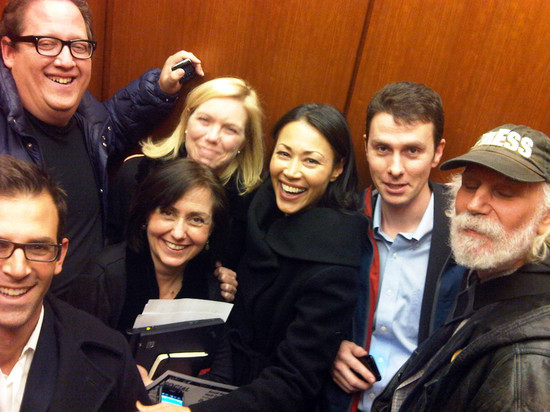
    As for another comment regarding the tweets that flew about Ann Curry being stuck in the elevator, I share the amusement from the perspective of the man who sat next to that remarkable woman for ninety minutes. (So did the folks at Gawker, who wrote about the elevator incident at length.) Ann and I talked about Haiti, changes in media, religion, the utility of the iPad and yes, Twitter, all gloriously offline and in depth. I enjoy that memory; there’s a lovely montage of images up at GeoGeller.com, whose camera took the excellent shot below.

    The fact that the world knew we were all stuck in that elevator was merely amusing, however, as opposed to a critical message that would best be conveyed to a 911 operator. We all found the intercom more useful than our smartphones, given the awful reception.

    Sharing our experience with our networks of friends, however, was a natural extension of life in 2010. It certainly wasn’t breaking news but the act of communicating about it offered me, at least, an opportunity to interact with a broader audience of other humans around globe. That’s an unalloyed good.

    I agree that “cheerleading uncritically” is not useful, nor a mentality that any writer should adopt. I do not share Packer’s conviction, however, that the news landscape can’t be occupied by more technological platforms, including reporters tapping away on BlackBerrys. One important example of that is Mark Knoller, the CBS White House correspondent whose tweets read like a they’ve been adapted from a history book already written.

    If Mr. Packer would like to meet over coffee in DC to talk further about how life has changed in the age of Twitter, consider this an open invitation. Given my experience with his writing, I am certain that @GeorgePacker would be worth following.

    -Alexander B. Howard
    @digiphile.

    7 Comments

    Filed under blogging, journalism, microsharing, personal, photography, social media, technology, Twitter

    Trends and challenges for social media in 2010

    What will the rest of 2010 hold for social media? I’m certain will see collaborative technologies be used to cover events and disasters on the real-time Web.

    I’m also certain that three issues will dominate the space over the next year:

    Identity, Privacy and Security.

    Below is an interview where I talk about precisely these issues from Twtrcon:

    As you’d imagine, there is no shortage of other opinion on what else the year will hold in social media. For other takes, try:

    I left the following comment on Chris’ post:

    I suspect the Fortune 500 will go looking for talent to bring in-house, if early adopters aren’t available internally. There’s still a high ceiling — and need — for decent corporate blogs, authentic social media managers and innovative internal implementations of social computing platforms.

    Aside from personnel, it’s fun to think about the bigger picture, too. Government is increasingly a big player in this space, as is Google. Social is going to be more mainstream and have more money flow into it than ever before, if marketing investment projections line up.

    Here’s hoping that the snake oil is wrung out in the process. I suspect another casualty may be the word “social” itself, as I commented at length on Andy McAfee’s blog. Collaboration and results are in, hype and hysteria are out.
    Protecting identity, security and trust will plague adoption of all of these platforms, whether they’re in the public or private space. If we’re giving away our data, social graphs, interactions and transactions, we’ll expect to retain our identities, credentials and privacy. Companies that abuse that relationship will experience viral backlash that beggars the ire we’ve seen to date.

    What do you think? What are the trends in collaboration technology that will matter this year?

    Please let me know in the comments or reply to @digiphile on Twitter.  I’ll be speaking tomorrow at the inaugural Social Media Breakfast in Washington, D.C. on this very topic.

    Update: Here’s the presentation on Social Media Trends for 2010 from Prezi.com.

    2 Comments

    Filed under social bookmarking, social media, Twitter, video

    George Washington’s Rules for Social Media

    George Washington will always be counted amongst the greatest citizens of the United States, for any number of reasons. The first President of the United States was far from a perfect man, given his history as a slave owner, but his contemporaries saw in him a rare nobility of character that still distinguishes Washington today. My heart may lie with Franklin, my spirit with Jefferson, and my mind with Hamilton… but Washington lays claim to respect, for any number of good reasons.

    Last year, I came across a list of rules for civility and decent behavior that were ascribed to him by the editors of Foundation Magazine. Their origin?

    According to the article:

    “By age sixteen, Washington had copied out by hand, 110 Rules of Civility & Decent Behavior in Company and Conversation. They are based on a set of rules composed by French Jesuits in 1595. Presumably they were copied out as part of an exercise in penmanship assigned by young Washington’s schoolmaster.

    The first English translation of the French rules appeared in 1640, and are ascribed to Francis Hawkins the twelve-year-old son of a doctor.”

    It struck me as a worthy mental exercise to adapt each to the present day online culture.

    The following “rules” are interpretation of his intent, not President Washington’s words.

    Make of them what you will and share them as you like.

    Note Bene: As I observe below, everyone will use social media differently. A given person’s position, industry or context may mean a given suggestion doesn’t make sense.

    And as my friend Paul Gillin has written, it’s important to recognize when to avoid using social media.

    As we look ahead to the new year ahead, astute observers may even ditch “the s word” in favor of collaborative media. I’ve commented that I’m open to that terminology when if it comes into wider use.

    [Image Credit: wallyg on Flickr / CC BY-NC-ND 2.0]

    For now, here are “George Washington’s Rules for Social Media.”

    On the left is Washington’s original phrase. To the right, my interpretation.

    Every Action done in Company, ought to be with Some Sign of Respect, to those that are Present. Every public update to social networks should be made with respect for your audience.
    When in Company, put not your Hands to any Part of the Body, not usually Discovered.
    When you’re on the webcam, keep your hands above board and out of your nose.
    Show Nothing to your Friend that may affright him. Don’t post NSFW pictures or links to them on the enterprise social network. Or mask them in links on public ones.
    In the Presence of Other, Sing not to yourself with a humming Noise, nor Drum with your Fingers or Feet. Don’t hum on conference calls or on Skype, nor tap on the table.
    If You Cough, Sneeze, Sigh, or Yawn, do it not Loud but Privately; and Speak not in your Yawning, but put Your handkerchief or Hand before your face and turn aside. No coughing, sneezing, sighing or yawning while on a call. Unless you’re on mute.
    Sleep not when others Speak, Sit not when others stand, Speak not when you Should hold your Peace, walk not on when others Stop. Stay awake in meetings, bring enough chairs, listen first, don’t stay and chat on empty IRC threads.
    Put not off your Cloths in the presence of Others, nor go out your Chamber half Dressed. Avoid NSFW avatars on public social networks, or bathrobes on Web conferences.
    At Play and at Fire its Good manners to Give Place to the last Commer, and affect not to Speak Louder than Ordinary. Whether you’re online or at home, welcome guests and don’t shout. (NO CAPS, friends.)
    Spit not in the Fire, nor Stoop low before it neither Put your Hands into the Flames to warm them, nor Set your Feet upon the Fire especially if there be meat before it. Don’t bury shared bandwidth during the day with P2P filesharing. Don’t dry out your socks in the office microwave.
    When you Sit down, Keep your Feet firm and Even, without putting one on the other or Crossing them. Ergonomics will help Web workers avoid repetitive stress injuries. Avoid slumping, position keyboard properly.
    Shift not yourself in the Sight of others nor Gnaw your nails. You don’t need that fourth Red Bull. Nail clippers are a helpful gadget to be used at home. Easy to type with shorter talons.
    Shake not the head, Feet, or Legs roll not the Eyes lift not one eyebrow higher than the other wry not the mouth, and bedew no mans face with your Spittle, by approaching too near him when you Speak. Truly listen first to what someone else says or read it through with care. Avoid instant “WTF” or “FAIL” comments. Respect the intellect of others.
    Kill no Vermin as Fleas, lice ticks &c in the Sight of Others, if you See any filth or thick Spittle put your foot Dexterously upon it if it be upon the Cloths of your Companions, Put it off privately, and if it be upon your own Cloths return Thanks to him who puts it off. If you must block spammers and trolls, do so quietly and without malice. Inform the community moderator and move on. If you see the opportunity to vote down nasty comments from a discussion thread, do so for the community’s sake.
    Turn not your Back to others especially in Speaking, Jog not the Table or Desk on which Another reads or writes, lean not upon any one. Be mindful of generational or vocational differences around the use of smartphones in person. Don’t lean on the keyboards of others.
    Keep your Nails clean and Short, also your Hands and Teeth Clean yet without Showing any great Concern for them. Keep your Web design clean and simple. What are people there to do? Help focus that user interface on those tasks.
    Do not Puff up the Cheeks, Loll not out the tongue rub the Hands, or beard, thrust out the lips, or bite them or keep the Lips too open or too Close. A goofy avatar may express your personality and professionalism perfectly. Then again, it may not.
    Be no Flatterer, neither Play with any that delights not to be Play’d Withal. Don’t mindlessly RT, share or echo the insights of others. If you admire someone, tell them as much and share content because of its worth, not because of social gain.
    Read no Letters, Books, or Papers in Company but when there is a Necessity for the doing of it you must ask leave: come not near the Books or Writings of Another so as to read them unless desired or give your opinion of them unasked also look not nigh when another is writing a Letter. Think again before addictively checking your email or texting next to someone. If you have to, explain why it’s important. If you see someone else’s private messages, don’t comment unless invited to do so.
    Let your Countenance be pleasant but in Serious Matters Somewhat grave. Tune your speech, replies and links to the context of the conversation they are being shared within.
    The Gestures of the Body must be Suited to the discourse you are upon. Use language appropriate to the forum you are speaking within. In general, don’t post anything you wouldn’t want your mother to see.
    Reproach none for the Infirmities of Nature, nor Delight to Put them that have in mind thereof. Don’t mock anyone because of social facts, nor celebrate the mockery of others.
    Show not yourself glad at the Misfortune of another though he were your enemy. Don’t publicly celebrate the failures of competitors.
    When you see a Crime punished, you may be inwardly Pleased; but always show Pity to the Suffering Offender. Share the news of verdicts or fines but do so, if possible, with empathy.
    Do not laugh too loud or too much at any Public Spectacle. Share your humor, your goodwill and the reasons for it — but don’t overloard the stream of others.
    Superfluous Complements and all Affectation of Ceremony are to be avoided, yet where due they are not to be Neglected. Show respect for the time and experience of others. Use concise greetings and salutations in social messaging. Get to the point quickly.
    In Pulling off your Hat to Persons of Distinction, as Noblemen, Justices, Churchmen &c make a Reverence, bowing more or less according to the Custom of the Better Bred, and Quality of the Person. Amongst your equals, expect not always that they Should begin with you first, but to Pull off the Hat when there is no need is Affectation, in the Manner of Saluting and resaluting in words keep to the most usual Custom. Introduce yourself or provide context when initiating a conversation. Treat each person you encounter with respect, until evidence to the contrary is introduced.

    You can learn from anyone, even if it’s how not to do something.

    Tis ill manners to bid one more eminent than yourself be covered as well as not to do it to whom it’s due. Likewise he that makes too much haste to Put on his hat does not well, yet he ought to Put it on at the first, or at most the Second time of being asked; now what is herein Spoken, of Qualification in behavior in Saluting, ought also to be observed in taking of Place, and Sitting down for ceremonies without Bounds is troublesome. Relatively, it’s worse manners to remind someone else of a lack of netiquette than whatever deficiency they are showing. Observe proper netiquette when ever entering a conversation, especially when social messages are broadcast to an audience that is unfamiliar with you.

    Look around to see what the established norms for appearance and speech are on a given platform before contributing.

    If any one come to Speak to you while you are are Sitting Stand up though he be your Inferior, and when you Present Seats let it be to every one according to his Degree. Respond to @replies, comments and direct messages, if you can. Respect and offer thanks for whomever has taken the time to offer an opinion, with the singular exception of spammers.
    When you meet with one of Greater Quality than yourself, Stop, and retire especially if it be at a Door or any Straight place to give way for him to Pass. If you cite the insights or build on the ideas of a bonafide online authority, make sure you link to him or her. Web karma comes around.
    In walking the highest Place in most Countries Seems to be on the right hand therefore Place yourself on the left of him whom you desire to Honor: but if three walk together the middest Place is the most Honorable the wall is usually given to the most worthy if two walk together. At conferences, offer the best viewing angles to those who plan to livestream. Share access to outlets.
    If any one far Surpasses others, either in age, Estate, or Merit yet would give Place to a meaner than himself in his own lodging or elsewhere the one ought not to except it, So he on the other part should not use much earnestness nor offer it above once or twice. Be gracious in all areas of netiquette, especially to all those, young or old, who are new to a medium or platform. If you receive invitations to betas, try to pass them to those who will actually test the services.
    To one that is your equal, or not much inferior you are to give the chief Place in your Lodging and he to who ‘is offered ought at the first to refuse it but at the Second to accept though not without acknowledging his own unworthiness. Make sure it’s easy for everyone to comment upon or share your content. Always attribute to the original source of a link, photo, tweet or story with a hat tip and link.
    They that are in Dignity or in office have in all places Precedency but whilst they are Young, they ought to respect those that are their equals in Birth or other Qualities, though they have no Public charge. Founders of companies or other “c-level” executives have the final say in most matters and merit respect. That said, on the Internet, netizens can be from any age, creed or station. An opinion or perspective can have merit on its own, regardless of the source.
    It is good Manners to prefer them to whom we Speak before ourselves, especially if they be above us with whom in no Sort we ought to begin. Listen first and give others the opportunity to express a perspective, especially if his or her expertise on a topic exceeds your own.
    Let your Discourse with Men of Business be Short and Comprehensive. Get to the point, especially with VCs, CIOs or other business executive. Have an elevator pitch memorized, and a goal for meetings.
    Artificers & Persons of low Degree ought not to use many ceremonies to Lords, or Others of high Degree but Respect and highly Honor them, and those of high Degree ought to treat them with affability & Courtesy, without Arrogance. Writers or authors that have earned authority should be respected but not fawned over. Likewise, people in those positions should neither dismiss commenters nor fail to mentor young talent.
    In speaking to men of Quality do not lean nor Look them full in the Face, nor approach too near them at lest Keep a full Pace from them. Don’t cyberstalk Web celebrities – or general celebrities and business personalities, for that matter. Everyone deserves privacy, especially with respect to family.
    In visiting the Sick, do not Presently play the Physician if you be not Knowing therein. Suggesting drugs or treatments for others online if you are not a physician isn’t recommended. Generally, even doctors will not make diagnoses or treatment recommendations without an in-person examinations. Social media may create new outlets for healthcare. Sharing personal experiences with treatments, diseases or physicians may be helpful. Using online platforms always should be done with an eye towards preserving electronic privacy.
    In writing or Speaking, give to every Person his due Title According to his Degree & the Custom of the Place. If you are writing about others, take the time to properly spell names, titles and identify employers or other affiliations, preferably with a link to a biography.
    Strive not with your Superiors in argument, but always Submit your Judgment to others with Modesty. Focus on presenting solutions to problems, not in assigning blame. Always look for ways to elevate the good ideas of others.
    Undertake not to Teach your equal in the art himself Professes; it Savours of arrogance. Don’t remind savvy bloggers or published authors how to write. If you see a mistake in a link or copy, point it out with tact and, if possible, privacy. Everyone makes mistakes.
    Let thy ceremonies in Courtesy be proper to the Dignity of his place with whom thou converses for it is absurd to act the same with a Clown and a Prince. Adopt the conventions of whatever online forum you are in, keeping in mind basic codes of online conduct. Don’t be shocked if gamerspeak about fragging & “n00bs” doesn’t go over well in a healthcare debate.
    Do not express Joy before one sick or in pain for that contrary Passion will aggravate his Misery. Be mindful about celebrating business successes or promoting sports and entertainment news during moments of national tragedy.
    When a man does all he can though it Succeeds not well blame not him that did it. Recognize good faith efforts to contribute something of value, even if the end result falls short of the quality required.
    Being to advise or reprehend any one, consider whether it ought to be in public or in Private; presently, or at Some other time in what terms to do it & in reproving Show no Sign of Cholar but do it with all Sweetness and Mildness. Look for ways to correct behavior or express your displeasure in a direct message or email, as opposed to a comment, unless such public commentary serves the greater common good of an online community. Look for ways to lead with a compliment, if possible.
    Take all Admonitions thankfully in what Time or Place Soever given but afterwards not being culpable take a Time & Place convenient to let him him know it that gave them. Accept constructive criticism of your words or actions with grace. If you were not at fault for a given outcome, follow up to explain why and suggest a resolution, if possible.
    Mock not nor Jest at any thing of Importance nor make Jests that are Sharp Biting, and if you Deliver any thing witty and Pleasant abstain from Laughing thereat yourself. For the few topics don’t lend themselves well to humor, abstain. For the rest, look ways to joke that aren’t demeaning, cruel nor mocking. If you do deliver a perfect one-liner, don’t repeat it until it isn’t funny anymore.
    Wherein you reprove Another be unblameable yourself; for example is more prevalent than Precepts. If you’re going to publicly critique another’s social media use, be mindful of whether you’ve made the same mistake. If so, be helpful tactfully.
    Use no Reproachful Language against any one neither Curse nor Revile. Skip the curses, misogyny, racism or any other sort of ‘isms that come to mind.
    Be not hasty to believe flying Reports to the Disparagement of any. Follow rumors, bad news & smears to a primary source to judge validity, particularly before sharing them with your network. Alternately, quote attribution for such news, allowing your audience the opportunity to debunk it.
    Wear not your Cloths, foul, ripped or Dusty but See they be Brushed once every day at least and take heed that you approach not to any Uncleaness. Make sure to take a good, clear picture for your avatar. Or use high resolution logos for a corporate identifier. Check your blog or profile pages against multiple browsers make sure templates or CSS code display correctly.
    In your Apparel be Modest and endeavor to accommodate Nature, rather than to procure Admiration. Keep to the Fashion of your equals Such as are Civil and orderly with respect to Times and Places. Stay away from busy backgrounds, garish color schemes or eye-popping animations. Assume users will be browsing your content on mobile browsers, too.

    Observe Web standards for accessibility.

    Run not in the Streets, neither go too slowly nor with Mouth open go not Shaking your Arms kick not the earth with R feet, go not upon the Toes, nor in a Dancing fashion. Don’t overwhelm your followers or audience with status updates or banal content. Focus on being useful, not being first.
    Play not the Peacock, looking every where about you, to See if you be well Decked, if your Shoes fit well if your Stockings sit neatly, and Cloths handsomely. Be considered about adopting the newest trend in avatars or adding so many widgets or script to a page. Load time matters.
    Eat not in the Streets, nor in the House, out of Season. Be thoughtful about sharing sports news or spoilers from highly anticipated movies until the next day.
    Associate yourself with Men of good Quality if you Esteem your own Reputation; for ‘is better to be alone than in bad Company. We are informed by those we follow. We are defined by those who follow us.
    In walking up and Down in a House, only with One in Company if he be Greater than yourself, at the first give him the Right hand and Stop not till he does and be not the first that turns, and when you do turn let it be with your face towards him, if he be a Man of Great Quality, walk not with him Cheek by Joul but Somewhat behind him; but yet in Such a Manner that he may easily Speak to you. When commenting on a blog, in a distribution group or other forum, make sure to read the comments of others before you. Take time to read the post itself and comment meaningfully.

    Acknowledge good contributions and make sure that your comment doesn’t simply echo others or ignore facts that controvert the original post.

    Never express anything unbecoming, nor Act against the Rules Moral before your inferiors. Keep in mind that your comments on social media platforms ma reflect upon your employer. They will certainly reflect upon you should you be seeking employment.
    Be not immodest in urging your Friends to Discover a Secret. If you need help learning something, make sure it isn’t a fact that can be learnt through a simple search of the Web.
    Utter not base and frivolous things amongst grave and Learned Men nor very Difficult Questions or Subjects, among the Ignorant or things hard to be believed, Stuff not your Discourse with Sentences amongst your Betters nor Equals. Tailor your language and references to the conversations you are engaged within, focusing on expressing your point in as few words as possible.
    Speak not of doleful Things in a Time of Mirth or at the Table; Speak not of Melancholy Things as Death and Wounds, and if others Mention them Change if you can the Discourse tell not your Dreams, but to your intimate Friend. Death, taxes and war are facts of life. That said, constant reminders of them may not endear you to others unless you’re, say, a war journalist, IRS agent or ER doc.
    A Man ought not to value himself of his Achievements, or rare Qualities of wit; much less of his riches Virtue or Kindred. Bragging is rarely attractive. Focus on being useful and relevant, not on sharing what you’ve done or how smart you are, much less your net worth or family connections.
    Break not a Jest where none take pleasure in mirth. Laugh not aloud, nor at all without Occasion. Deride no mans Misfortune, though there Seem to be Some cause. Jokes without context don’t work well. It’s easy to mistake sarcasm for cruelty. Humor isn’t welcome in every context. Writing “LOL” also may not convey professionalism, though the need for that is also contextual.
    Speak not injurious Words neither in Jest nor Earnest Scoff at none although they give Occasion In general, avoid trashing your company, coworkers or other services in public. HR departments can and will use those comments to pre-screen you. Legitimate issues can easily be expressed constructively and are much more likely to be resolved by doing so.
    Be not froward but friendly and Courteous; the first to Salute hear and answer & be not Pensive when it’s a time to Converse. Approach each conversation with positivity. It comes through. Listen to what people are saying about you and thank others for their compliments.
    Detract not from others neither be excessive in Commanding. Cede the glory of a link, scoop or witty remark to someone else. Share his or her content. Try to avoid the trap of saying “this is how to use [x] service” unless asked. (There’s some irony of writing this is in the context of this guide. Please forgive its author.)

    Everyone uses social media differently.

    Go not thither, where you know not, whether you Shall be Welcome or not. Give not Advice without being Asked & when desired do it briefly. Use PowerTwitter to expand small URLs to avoid phishing or malware. Be mindful of tracking cookies and virus-infected sites, or of allowing unfamiliar third-party Facebook apps access to your data. Thinking before clicking.
    If two contend together take not the part of either unconstrained; and be not obstinate in your own Opinion, in Things indifferent be of the Major Side. Argue constructively. Try to understand what someone else’s position or grievance is thoroughly before stating your own position. Take debates that are not helpful to the public private.
    Reprehend not the imperfections of others for that belongs to Parents Masters and Superiors. Be helpful, not critical. Be useful, not scornful. Karma can be rough.
    Gaze not on the marks or blemishes of Others and ask not how they came. What you may Speak in Secret to your Friend deliver not before others. Humans are by nature imperfect beings. Highlighting the physical, emotional, spiritual or relational imperfections isn’t likely to endear one over time. Avoid “DM fails” at all cost; don’t write anything on a social network, protected or not, that you wouldn’t want everyone to read. Cut and paste is easy.
    Speak not in an unknown Tongue in Company but in your own Language and that as those of Quality do and not as the Vulgar; Sublime matters treat Seriously. Write in the language that others in a conversation are using. Use translators integrated into the Web to aid the effort, or the feature in Tweetdeck that does the same. Avoid cursing.
    Think before you Speak pronounce not imperfectly nor bring out your Words too hastily but orderly & distinctly. Self-edit and spellcheck twice before hitting send. Get to the point with the best words possible. If you’re podcasting or video blogging, take the time to annunciate.
    When Another Speaks be attentive your Self and disturb not the Audience if any hesitate in his Words help him not nor Prompt him without desired. Interrupt him not, nor Answer him till his Speech be ended. Listen first. Read your @replies and comments and, if possible, respond. Wait a beat on webinars and podcasts to ensure that speakers don’t cross over (and to make editing easier).
    In the midst of Discourse ask not of what one treateth but if you Perceive any Stop because of your coming you may well intreat him gently to Proceed: If a Person of Quality comes in while your Conversing it’s handsome to Repeat what was said before. Put answers to public question in context; one half a conversation is a challenge. If someone joins a conversation with something substantive to say, offer a quick summary to get him or her up to speed – or provide a link to the thread.
    While you are talking, Point not with your Finger at him of Whom you Discourse nor Approach too near him to whom you talk especially to his face. Don’t poke or nudge people. Seriously. Just talk to them.
    Treat with men at fit Times about Business & Whisper not in the Company of Others. Focus on sharing hard news that you want to see read on Monday – Thursday mornings. Soft news will play better in the weekends, particularly on sports, entertainment and gaming.
    Make no Comparisons and if any of the Company be Commended for any brave act of Virtue, commend not another for the Same. Share links liberally and equitably. If you have a broad audience, try to share the views of those who don’t.
    Be not apt to relate News if you know not the truth thereof. In Discoursing of things you Have heard Name not your Author always; A Secret Discover not. Confirm a link goes to where it says it does before sharing it. If your job is to curate news, make it clear where something is sourced and attribute/quote accordingly. Don’t pass on unattributed, unsourced rumor, especially if it’s by anonymous sources. Cultivate a network that does the same. Trust is currency.
    Be not Tedious in Discourse or in reading unless you find the Company pleased therewith. Get to the point, both in writing and speaking. Save the 9,000 word rants for a personal blog you aren’t depending upon professionally.
    Be not Curious to Know the Affairs of Others neither approach those that Speak in Private. Don’t hack into the servers or Web accounts of others. If you find digital identities or sensitive data online, whether on a P2P site or other board, don’t publish it for profit. Respect the privacy of others.
    Undertake not what you cannot Perform but be Careful to keep your Promise. Your word is your bond. If you commit to work, meet that expectation. Don’t overpromise and underdeliver.
    When you deliver a matter do it without Passion & with Discretion, however mean the Person be you do it too. When it comes to controversial news, if you choose to pass on news, stick to the facts. If you don’t, understand you’re going to segment or outright lose some audience.
    When your Superiors talk to any Body hearken not neither Speak nor Laugh. Save unconstructive criticism of a boss for offline discussions. (Or skip it entirely.) Don’t tweet or update anythiing you wouldn’t want him or her to read.. After all, forgetting that you’ve friended a superior can be worse than embarrassing.
    In Company of these of Higher Quality than yourself Speak not til you are asked a Question then Stand upright put of your Hat & Answer in few words. If you’re going to ask a celebrity, politician or busy executive a question, listen first to how or she uses a platform and consider whether an answer is likely. If so, be informed, be polite and get right to the point.
    In Disputes, be not So Desirous to Overcome as not to give Liberty to each one to deliver his Opinion and Submit to the Judgment of the Major Part especially if they are Judges of the Dispute. If you’re using social media for a dialogue, as opposed to a monologue, make sure to actually listen to the responses of others. Is your aim to “win the argument” or to get to the truth of the matter being discussed. If the consensus of a community supports a policy decision that you disagree with, voice the difference of opinion with clarity, respect and evidence supporting your contention. An uniformed majority isn’t always right in the long run.
    Let thy carriage be such as becomes a Man Grave Settled and attentive to that which is spoken. Contradict not at every turn what others Say. During meetings, be aware that updating a service or focusing on the social media backchannel instead of those present is often a breach of etiquette. Face to face meetings are too valuable to damage the relationship by prioritizing any request that can wait. Listen first, reply with context. And don’t always take a contrary position.
    Be not tedious in Discourse, make not many Digressions, nor repeat often the Same manner of Discourse. Keep your copy short and your voice messages even shorter. Brevity is a vertue. Focus on the topic at hand and what you want the reader to take away. Avoid redundancy.
    Speak not Evil of the absent for it is unjust. Posting unconstructive criticism or personal attacks to conference backchannels reflects more poorly upon the writer than the speaker.
    Being Set at meat Scratch not neither Spit Cough or blow your Nose except there’s a Necessity for it If you’re out to dinner with friends, family or colleagues, focusing too frequently on your smartphone may be regarded in the same way as spitting or burping loudly.
    Make no Show of taking great Delight in your Victuals, Feed not with Greediness; cut your Bread with a Knife, lean not on the Table neither find fault with what you Eat. Unless you’re a chef or food critic that adds a lot of flavor to the update, reconsider updating social media platforms with whatever you’re eating. Notable meals deserve recognition, just like good books, movies or any other media form you “consume,” but banal updates about eating humdrum food aren”t likely to endear you to friends.
    Take no Salt or cut Bread with your Knife Greasy. Don’t use smartphone touchscreens after eating pizza, fries or other greasy fast good. Especially the devices of others.
    Entertaining any one at the table, it is decent to present him with meat; Undertake not to help others undesired by the Master. Unless the circumstance demands extra security or privacy, make it easy for visitors to register to comment or view content. Once acquired, don’t pass out your login credentials to other parties.
    If you Soak bread in the Sauce, let it be no more than what you put in your Mouth at a time and blow not your broth at Table but Stay till Cools of it Self. Avoid directly linking to large media files on social media platform unless you offer clear information to readers concerning what users may be clicking upon.
    Put not your meat to your Mouth with your Knife in your hand neither Spit forth the Stones of any fruit Pie upon a Dish nor Cast anything under the table. Don’t spam the comments of blogs with unrelated links or simply to promote a product or service. Don’t flood a popular hashtag on Twitter or a Facebook group with links to a similar service, especially if it’s unrelated to the topic.
    It’s unbecoming to Stoop much to ones Meat. Keep your Fingers clean & when foul wipe them on a Corner of your Table Napkin. Be aware of both posture and keyboard position. Logging many of typing without care puts you at increased risk of repetitive strain injuries.
    Put not another bit into your mouth till the former be swallowed. Let not your morsels be too big for the jowls. Wait for a while between updates, especially if you’re in charge of curating an organization’s content. On Twitter, that might be 15 minutes. On Facebook, the ideal may be closer to 60-90 minutes, at least for NPR.
    Drink not nor talk with your mouth full; neither gaze about you while you are drinking. Don’t update social media platform when you’re drunk. Unless you want uncomfortable publicity about drunk tweets.
    Drink not too leisurely nor yet too hastily. Before and after drinking, wipe your lips; breath not then or ever with too great a noise, for its uncivil. If a fact seems doubtful, out of place for a user or it’s a breaking news story, take a moment to validate the link and the source before passing it on. Getting it right should often trump posting it first.
    Cleanse not your teeth with the table cloth napkin, fork, or knife; but if others do it, let it be done without a peep to them. If you see a breach of social media etiquette, bad link or copy error, try to alert the author to it discretely if possible.
    Rinse not your mouth in the presence of others. Take the necessary steps to secure email accounts that control your social media accounts or, says, DNS settings.
    It is out of use to call upon the company often to eat; nor need you drink to others every time you drink. Begging for links, retweets or only promoting your own work is neither welcome nor community-minded. Share the best of what others have written or advised. Look for opportunities for reciprocity.
    In the company of your betters, be not longer in eating than they are; lay not your arm but only your hand upon the table. If you’re participating in a roundtable or moderating a chat, give equal time to the contributions of contributors.
    It belongs to the chiefest in company to unfold his napkin and fall to meat first, but he ought then to begin in time & to dispatch with dexterity that the slowest may have time allowed him. If influential members of a community are given prefential access to the Web, power outlets or other resources in scarcity, offering others the opportunity to log on, charge up or ask questions is an admirable courtesy.
    Be not angry at the table whatever happens & if you have reason to be so, show it not; put on a cheerful countenance especially if there be strangers, for good humor makes one dish of meat a feast. Avoid recording video in the heat of an angry moment. If you’ve been treated poorly by an organization, don’t take it out on a online representative if he or she isn’t personally at fault. Offering candid, constructive and critical reviews of bad service, faulty products or unprofessional is beneficial for consumers. Couching feedback in good humor is generally welcome.
    Set not yourself at the upper of the table; but if it be your due or that the master of the house will have it so, contend not, least you should trouble the company. If you’re given special treatment, a beta invite or a prototype of the year’s hottest widget, be humble about it. Share details that inform others, as opposed to celebrating privilege.
    If others talk at the table, be attentive but talk not with meat in your mouth. If you’re participating in a podcast or chat, wait a second or two after others speak to allow for easier editing.
    When you speak of God or his attributes, let it be seriously & with reverence. Honor & obey your natural parents although they be poor. If you must discuss religion in online forums, be respectful and tolerant of differing views. If you become friends with your parents on social networks, be kind: keep submissions to MyParentsJoinedFacebook anonymous.
    Let your recreations be manful not sinful. Lean towards offline activities that inform that mind, enliven the spirit or energize the body.
    Labor to keep alive in your breast that little spark of celestial fire called conscience. Conscience is an ability or a faculty that distinguishes whether one’s actions are right or wrong.”-WikipediaBefore using any form of social media, consider whether that action – tweet, link, comment, share or update – is ethical. “Google never forgets.” – Seth Godin

    16 Comments

    Filed under blogging, microsharing, social media, Twitter

    When “we are the media,” how does it change us or society?

    The changes that smartphones with camera and an Internet connection are wreaking in society have been both thoughtfully reported upon, relentlessly evangelized and ruthlessly derided, depending upon the angle or intent of the commentator.

    The past days will occupy a few lines in the history books. Last night, the U.S. House of Representatives passed a milestone healthcare bill. And earlier in the week, a soldier killed fellow servicemen and women at Fort Hood.

    Today, Paul Carr wrote that “citizen journalists can’t handle the truth at TechCrunch.

    I agreed with him on a few things. The video from “This American Life” (below) that Carr embedded was deeply affecting on this point, in terms of what becoming an observer can do to our involvement in what we are filming.

    Changing an avatar to green or changing a location to Tehran did not, despite good intentions, prove to substantively help students escape repression. I gather from reading accounts from journalists that the solidarity demonstrated by doing so was both noticed and appreciated there. And there was a tipping point in terms of the use of the platform to bring attention to a political cause.

    Where I was left frustrated is in Carr’s suggestion that those who are watching should be doing something more, whether in the hospital or, in the case of Neda, on the streets of Tehran, instead of documenting events with the digital tools at hand.

    Mathew Ingram posted a thoughtful response about this notion on his blog, “Citizen Journalism: I’ll take it, flaws and all.” David Quigg wrote   a thoughtful reply to Carr’s post as well. Dave Winer was less charitable.

    I found the example of Neda to be unworthy of the point I think Carr was trying to make.

    It also brushed off two key factors: the effect that the release of that video had in revealing the death of a protester and that of the bullet’s impact itself on her heart.

    As Suw Charman-Anderson pointed out in her detailed critique and debunking of Carr’s post, “Killing Strawmen,” (which I won’t repeat here), there was a doctor on-site, who was unable to do anything because of the massive trauma to her chest.

    In my limited experience, you provide the standard of care to which you are certified and are able to deliver, ceding primary responsibility to others more able as they arrive on scene. As an EMT couldn’t do much more, for instance, than to gauge consciousness, stanch bleeding, stabilize injuries, provide oxygen and transport people. Your choices must change if someone is in the wilderness but in most scenarios, that’s accurate. Paramedics, nurses, doctors and surgeons each have progressively more expertise and responsibility.

    In all of that, communication with the nearest hospital and ER docs available is crucial. Transferring information to both medical professionals and law enforcement is something a bystander can and should do.

    And to some extent, communication and documentation is precisely what a member of the public equipped with a cameraphone can contribute, despite the vigor with which Carr has chosen to deride that role.

    I don’t doubt that seasoned correspondents, armed with an understanding of the ethics and laws that pertain to reporting, are needed to convey information from the battlefield or to analyze the meaning of the trends that confront us.

    In fact, Brock Meeks, one such trusted newsman, made a comment on my post about Twitter lists that emphasized just how important getting the facts right is to both the audience and media.

    I was left wondering about other situations where the “citizen journalists” Carr derides are providing an important function in the newsgathering ecosystem, whether in reporting national disasters, disease, voting irregularities or consumer sentiment.

    A more calm approach might consider whether models of “hyperlocal” journalism that marry traditional media to online platforms might have a chance of success.

    My intention is not to suggest that observers couldn’t play a useful role in a crisis. It was to say that when there are qualified staff on scene, documenting what is happening in the absence of mainstream journalists may be useful for those that follow – including news outlets that may use video or audio gleaned on site.

    I agree with Paul that running images shouldn’t occur without a full understanding of the ethics or privacy rights involved.

    Unfortunately, many tabloids have shown a poor grasp of either historically.

    The fact that technology changes behavior doesn’t make it inherently bad. We’re all struggling to make sense of exactly what living in a modern panopticon created by one another will mean. It changes news, our conception of privacy, and even our perception of self.

    The traits for good character and decency that the Greeks described millennia ago remain applicable, however, just as the ethics taught in journalism schools pertain to modern reporters armed with Flip cams, iPhones and a direct line to YouTube.

    There will continue to be moments when war correspondents are confronted what choices about how covering conflict, versus participating in it, will mean.

    Similarly, people driving by an accident will need to be thoughtful about “playing paparrazzi” as opposed to making sure that those involved are receiving the aid they need. Anyone who has a conflict about whether to “tweet or treat” might to do well to consider what basic human decency means to them, personally.

    Does an event need to be documented? Or does calling 911 and then moving to help trump rendering assistance?

    Citizens are looking for truth, honesty and facts, where ever we can find them.  That need was frequently the subject of discussion during Public Media Camp, after which I wrote that “2009 is the year of We, the Media.”

    Perhaps, as news organizations and citizens alike contribute to the body of knowledge online, a new model for collaborative journalism will emerge that serves each better.

    Reblog this post [with Zemanta]

    4 Comments

    Filed under blogging, journalism, social media, technology, Twitter, video