
[Hat tip: Lance Ulanoff]
Advertising as film: Virtuoso stop motion ad inspired by Takeuchi
[HT to the Daily Dish]
As I mentioned on Twitter, however, Olympus might have done well to more overtly credit the creator of “A wolf loves pork”, Taijin Takeuchi. That video is embedded below.
I retain my standard reticence to embrace commercial adaption of art. Both are technical and artistic achievements.
In this case, perhaps imitation is the truest form of flattery.
Filed under Uncategorized
It’s not about the numbers. It’s about the connections.

- Image by Amodiovalerio Verde via Flickr
Last night, I had a surprise: my follower count on Twitter dropped by 148 in one fell swoop.
At first, I thought it was something I had tweeted – oversharing about the Forrester tweetup, or disinterest in sharing a clip of Supreme Court nominee Sotomayor. That didn’t jibe, however, with my gut.
What was inflammatory? What had I done that resulted in a huge loss of followers? As I drifted off to sleep, I thought: how important is this, really, in the grand scheme of things?
I’ve long since learned one hallmark of netiquette on Twitter (Twittiquette, if you will) was not to talk about one’s follower numbers. (If only I could retrieve some of the replies I received back in 2007 after doing so, I’d be thrilled. No good.)
A paraphrase of most of them essentially boiled down to this: are you here to get followers or here to connect?
It didn’t take long to see where the real value was. And, more than two years later, I’m elated to look back and see how many marvelous connections I’ve made, many of which have led to friendships offline. Why is that important?
For me, that’s a a simple answer: we live in a number-obsessed culture. Thinks about how many metrics we track, filter and can recall: poll numbers, net worth, MPG, CTR, Web uniques, 0-60 in __, GPA, APR, circulation, P/E ratios, DJIA, TCO, Mbps, R/W speed…on and on.
And, naturally, for those in the social networking world,we count subscribers, friends and followers. I’ve received far too many messages and spam promising me thousands of followers if I use this software or that service.
Honestly, they all leave me with the taste of fermented cough syrup in my mouth, with a healthy side of cod liver oil.
It’s not about the numbers: it’s about the connections.
Every follower or friend I’ve made has been through a conscious choice or organic growth. I’m proud of that. I’ve done it in what I might term the “new-fashioned way,” using much the same approach that Chris Brogan describes in his Twitter FAQ: “be helpful, share, communicate, use @replies a lot.” I tend to attribute “by @username” or “via @” nearly as much as directly @reply these days but the sense is the same.
Yesterday, I met Josh Bernoff, co-author of Groundswell. I had dinner with Shava Nerad and her beau, “Fish Fishman,” with Laurel Ruma joining in a bit later. I saw dozens of other friends from the local social media scene at two different tweetups.
I shared some groundbreaking journalism tools and advice, like best practices for journalists curating the Web. I shared messages and stories with newsies at the New York Times, Guardian, Wired, Gizmodo, Slate, The Register,The Center for Democracy & Technology and many others.
I read Stephen Baker on what may become of BusinessWeek and Bernard Lunn on creative destruction in publishing
I shared a lovely bit of science fiction made real, via the irrepressible Steve Garfield, watching the latest in augmented reality:
I reviewed my sources, notes and interviews from a conference earlier this week and wrote an article. I enjoyed a two hour workshop with my colleagues, analyzing the strengths and weaknesses of our journalism. I even enjoyed a late night cocktail with someone I love deeply.
In all of that, what does a dip in follower numbers mean? Not a helluva lot.
And, as it turns out, the scuttlebutt that Twitter is doing another purge of spammers and bots, a process that I recall from last year as well. My existential angst was unwarranted, my concern without merit – but the thought process and recounting it led me to was worth it.
I’m proud of my connections and my friends, of the social news network we’re all collaborating upon, and up the quality of the communication within it. I’m glad to bring it with me to Washington in a few short weeks.
The spammers can go live on whatever lower circle of digital Hades is reserved for ’em.
![Reblog this post [with Zemanta]](https://i0.wp.com/img.zemanta.com/reblog_e.png)
Filed under blogging, friends, microsharing, personal, social media, technology, Twitter, video
Post from the comments: “Let’s go give away some oranges”

- Image via Wikipedia

Yesterday, Chris Brogan wrote about Secret Fight Club, adapting the concept of Fight Club to social media for social change.
My first response? The first rule of #SecretFightClub: No one talks about Secret Fight Club!
In a comment on Chris’s blog, I suggested that “eTyler Durden is gonna be so annoyed. I suggest you change your soaps and don’t eat soup for months.”
The irony is that, given the reach of Chris’ blog, many people WILL of course be talking about SFC, though perhaps even more will simply keep on spreading that good will silently.
“Buying free plates of bacon at the bar” isn’t a bad metaphor at all — I can’t forget when someone did just that at the #140Conf — but passing out oranges to the homeless catches something closer to my heart.
A member of my family always carried oranges in Philly and Baltimore growing up, where there are major homeless populations, most of whom have major Vitamin C deficiencies.
Instead of giving them money, he passed out oranges. A few homeless people became upset, since they wanted $ for whatever other cause, but most were incredibly grateful.
Chris Brogan passes out oranges all the time.
He posts portraits of independence on his blog, tweets about worthy causes, explains how he tweets, writes about favorite children’s books, pastors or software he likes.
Some cynics might say that’s name dropping or crass brand mentions, like the unfortunate choice of Magic Johnson to mention KFC five times during MJ’s memorial.
I don’t buy into that.
In the social media world, regardless of what digital outpost you’re on, sharing information and being helpful is the best and most important form of digital currency we have to share.
Instead of beating each other up to escape the banality of corporatized modern life, in order to FEEL something, we are all collaborating on building a global network of digitized human experience, caught on video, pictures or memorialized in 140 characters or more.
I’d say thank you to Chris for risking eTyler Durden’s wrath but I think it’s possible he’s playing him here. He remembers how long many of us have been at this online.
Do you remember when we all passed around The Hunger Site and everyone clicked to give rice? I do.
And guess what? That website just celebrated its 10th anniversary.
FreeRice gives away rice if you play simple word games. And charity : water just celebrated a similar digital success, borne on a wave of social media good karma.
The netizens using and sharing those ideas represent precisely the kind of Secret Fight Club I’m both proud to belong to and recruit others to join.
Let’s go give away some oranges.
Note: This post first appeared as a comment on Chris Brogan’s blog. I decided it was worth editing and posting here. I’m following Chris’ example when he posted “On Public Radio” as a surprise guest post on chrisbrogan.com.
Filed under personal, social media, technology
Amazon’s Mechanical Turk’s potential for social science, commerce
Today at Harvard Law Schools’s weekly Berkman Center lunch, Aaron Shaw presented into the potential Amazon‘s Mechanical Turk(AMT) holds for social science and the culture that surrounds it. His talk drew upon research-in-progress from the Berkman Center’s Online Cooperation group, in collaboration with Daniel Chen and John Horton.
Although the presentation itself, cheekily entitled “HIT me baby one more time, Or: How I learned to stop worrying & love Amazon Mechanical Turk,” was a bit light on statistics, the conversation within Berkman’s community around the issues of labor laws, privacy, methodology and technological potential were fascinating, as always.
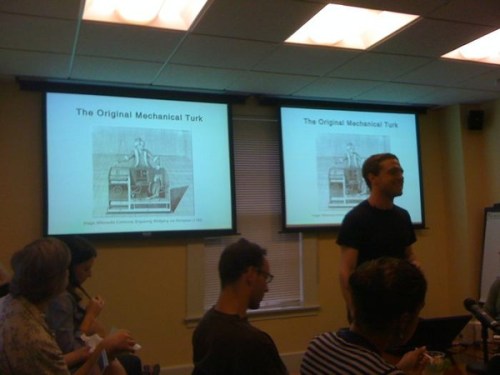
Aaron Shaw at Berkman
As Shaw noted, the origin of the name for Amazon‘s Mechanical Turk lies in a chess-playing “automaton” that was no mechanical creation at all, but instead a clever contraption that hid a chessmaster inside. Amazon’s version farms out small tasks — or “HITs” — that require a human to accomplish.
As an aside, I have to note that, as Peggy Rouse pointed out in Mechanical Turk, Powerset and enterprise search, there may be considerably more to Amazon’s strategy than the creation of a crowdsourcing market for simple tasks. She thinks Mechanical Turk may play a role in enterprise search down the road. She’s a canny observer, I’d recommend reading her thoughts.
Early in his presentation, Shaw offered up a shoutout to Andy Baio (@waxpancake) who asked two questions late last year in “Faces of Mechanical Turk“: “What do [Amazon Turk users] look like, and how much does it cost for someone to reveal their face?”
![Faces of Mechanical Turk [Credit: Andy Baio]](https://digiphile.info/wp-content/uploads/2009/07/faces_of_mechanical_turk.jpg?w=121&h=300 "faces_of_mechanical_turk")
Credit: Andy Baio, Faces of Mechanical Turk
As Shaw noted, however, when it comes to the Turk, no public, trustworthy, aggregate data is available. What evidence is available derives from self-selecting surveys and experiments. Those samples showed a large number of women, from many countries of residence (although mostly in the US & India). Speculatively, he noted that the age of users appears to be low, while education and income is high.
Shaw posited that the geographically component is likely correlated to Amazon’s requirement that users hold a US banking account. As a result, Shaw’s research relied upon whatever his team could collect on the Turk or through interviews with users and Amazon executives.
So, does the Mechanical Turk work for its users? Sometimes. Shaw noted that once you get a few people performing a given task, the accuracy rate for completion goes up overall, providing the example of machine-learning algorithms.
As he noted wryly, it’s “Not all bots, cheaters and scripts.”
Task selection and design is important to that success rate: skill matters, on both sides. It’s not just the skill of users and their ability to follow instructions – success also relies upon the skill of the creators of the HITs. Social scientists — scientists of any stripe, really — recognize the issue here in experimental design.
The uses of Turk cover a broad spectrum, though by nature each represents some form of crowdsourcing. Amazon itself used to Turk to generate product descriptions, questions and answers, thereby “spamming itself,” as Shaw put it.
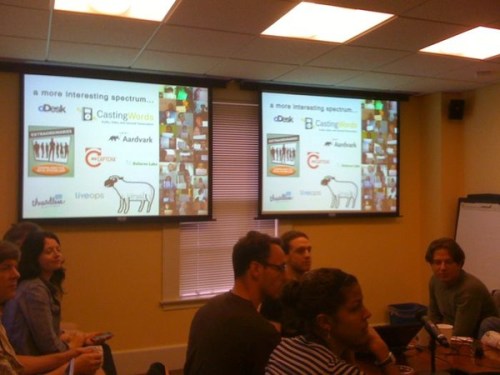
Spectrum of users of Amazon Mechanical Turk
How else is the Mechanical Turk being put to use?
- The Extraordinaries: “micro-volunteer opportunities to mobile phones that can be done on-demand and on-the-spot”
- CastingWords.com is using it for transcription
- AaronKoblin.com uses Mturk to create art. For .02, he pays users to draw a sheep facing left. He then sells sheets of them for $20, some portion of which is donated to charity.
- Also noted: oDesk, reCAPTCHA, Threadless, Aardvark, liveops
Aside from commercial, artistic or volunteer uses, Shaw believes that Mechanical Turk has considerable potential to enhance social science.
Specifically:
- As a pool of subjects for randomized experiments
- As a pool of inexpert raters for distributed observation, or “coding”
Advantages to labs?
Low cost of use, ease of paying subjects, speeds, diverse subjects (potentially), one HIT = one person, workers do not (usually) interact.
Experiments can consist of contextualized real-effort tasks. As the Turk has created a real labor market, as for text transcription, there’s utility in many areas, like canonical games in economics and paired surveys.
In other words, its neither reducible to a manifestation of the “Internet hivemind” or some sort of “latter day child labor,” at least in Shaw’s view. The online conversation around the presentation, which included Esther Dyston, was more skeptical on the latter point, noting that the potential for skirting labor laws was not inconsiderable. Shaw readily conceded that the issue is salient, although he sees such labor issues as “downstream,” he expects to see more given that the “tension is so clear, so stark.”
Shaw has been advised by Yochai Benkler while at Berkman, who evidently considers the Turk to be of use for content analysis for distributed observations. In this context, the ability for researchers to randomly assign HITs for raters to code objects is helpful. Shaw brought up Klaus Krippendorf, of UPenn, in the context of understanding some of the theory here; I’ll need to go do my due diligence in understanding Krippendorf’s work.
Yochai has noted that specific groups involved in distributing computing types, like SETI, have performed admirably. According to Shaw, in fact,“The Knights who say “Nee” perform quite well when measured against other countries with distributed computing.”
I also heard about the “Turkopticon,” a Firefox extension that allows users to submit feedback about HIT creators. Although Shaw said that it is not widely installed, there’s clearly a step towards community self-policing.
When asked about the utility of using the Turk for searching for missing computer scientist Jim Gray or searching for Steve Fossett’s plane, Shaw immediately recognized the value but hadn’t examined the data sets in question at length.
The question itself begged for a follow up, given the release of Chris Andersen’s “Free” this week: How and why are users motivated to provide hits when altruism is involved? Is work of higher quality when there is money involved?
Shaw offered a cautious affirmation, though with reservations: Payment vs free is “such a loaded issue in society. The symbolic value of money or donation is humongous.”
A Berkman Fellow in attendance, Chris Soghoian, noted that his advisor pays 5-10x the market rate and gets email about when the next task is coming, along with decent results.
In Shaw’s view, there needs to be “a more serious examination of the question. Experimental evidence of research suggest sub-populations of people who would respond differently. Some people will be motivated by doing good, others don’t care, want the .05. We need better ways to test. It’s situation-specific.”
As he wryly noted, “We’re not all homo economicus.”
As usual, this was an excellent lunch.You can view the archived video of the presentation as a .mov.
Following the presentation, Aaron wrote me to add the following:
“Daniel and John’s contributions to the field of experimental research on online labor markets include
- recognizing that AMT could serve as a venue for experimental studies;
- conducting the earliest labor market experiments on AMT;
- solving a bunch of difficult problems so that they could make valid causal inference based on the results of these experiments.”
I have to note one other organization I learned about today: “TxtEagle.” TxtEagle is a innovative concept for active “mobile crowdsourcing,” distributing small-scale jobs via SMS and payment the same method.
In other words, microjobs with micropayments. The mobile platform’s founders recognize that there are more than 2 billion mobile phone users in the developing world that could potentially be leveraged to perform tasks. The BBC wrote that “txteagle is changing the dynamics of outsourcing labour.” Hard to disagree with that.
Filed under blogging, research, technology
Does RT = spam? Unlikely. A retweet is social media currency.

- Image via Wikipedia

I’m still working through my notes and interviews from the past week’s Enterprise 2.0 Conference in Boston. Many people, ideas and presentations will stay with me — I look forward to writing another article and several blog posts today and tomorrow — but I wanted to make sure I captured one particular moment that actually irked me: The statement by a member of a panel in a session on Twitter that a RT is spam.
Apparently, @IsaacGarcia is determined to hold onto that position in the face of substantial counter opinion. I’m left to speculate how much he has used or read about Twitter; I gather from his comments on the panel that he has used the medium to find customers for his company and sell the product. The irony of that use is that by searching for mentions of his brand or looking for potential prospects and replying to them, he is in fact engaging in unsolicited commercial messaging.
I believe there’s a word for that.
Humor aside, I did reflect for a while on Garcia’s contention, which he tweeted during the panel: “How is recvng RTs about a topic/person that I didn’t choose to Follow not spam? Am recvng unsolicited info from the originator.” Isaac isn’t an obtuse man; Central Desktop was used by the Obama campaign to manage field operations in Texas.n, as Josh Catone blogged in ReadWriteWeb.
So where’s the disconnect? I wrote about the retweet last November for WhatIs.com, in “Buzzword Alert: The retweet (RT) is the FWD of 2008.” To retweet is to repost the tweet of another Twitter user using your own account.
It would probably be helpful to review what spam IS again, other than a fatty breakfast meat that’s likely to survive a nuclear winter. Wikipedia (currently) calls “Spam the abuse of electronic messaging systems to send unsolicited bulk messages.” CNET reported that, in 2009, spam makes up 90% of all email. If anything, that’s actually down from the 95% estimate I read a few years ago. That may be a result of shutting down ISPs that allow sending spam; it’s not likely, at least in this pundit’s eyes, to be a result of the CANN-SPAM Act, which created standards for sending commercial email. To be compliant, you must have a way for users to unsubscribe and do so if asked.
Twitter, of course, makes subscribing and unsubscribing from efforts rather easy — follow or unfollow. There are many technical hiccups that sometimes hinder that process, but by and large that’s the way it works. I choose to subscribe to your tweets. If don’t like something about the experience, I stop listening.
Fortunately, I’ve been gifted by thousands of smart, savvy followers, and when I asked them all if a RT is spam, I received 11 immediate @replies, followed by a few more. I’ll share their thoughts, as I believe they speak eloquently in defense of the role of the retweet.
First, my friend and colleague on the Touchbase blog, Leslie Poston, offered her perspective:

geechee_girl: some RT = spam, blogged em on Uptown Uncorked last week
Leslie clearly has had it with some of the hijinks that have been going on Twitter, including a basic lack of netiquette and yes, some genuine spam. In “Retweeting Etiquette, RT Spam, RT Flash Mobs, RT Linkbait,” Leslie points out many of the issues around the convention that have sprung up as Twitter has exploded in popularity and the usual shady netizens have moved in. The post is worth reading, but, in the frame of my question, her concern is around retweeting spam, not that RT itself constitutes it.

sleddd: RT not really spam, more sharing information. Like a phone tree or saying hey check this out to the people who do follow you. RTs, DMs, replies, as well as general tweets are what help make social media social.

stales: RT=spam? No, not at all. When you “follow”, you’re giving that tweeter the right to pass on ANY info.. regardless of source

chrisbechtel: a Retweet is not spam – it is a share of something the sharer deems potentially valuable to their community.

pmhesse: a RT is about sharing information with your friends that you found valuable, informative, or entertaining.

eric_andersen: I couldn’t possibly follow all of the original sources of info/links I’m interested in; rely on others to RT. IMHO sharing info via retweets is part of the “lifeblood” of Twitter; without sharing much appeal of the medium is lost.

faseidl: It *may* be spam, but in general I would say false. See my comment on that question on this post: http://bit.ly/Wg7lp

craighuff: some of us find RTed information valuable and welcome it.

saccades: RT can “reflect the” light of a bright idea

Here’s my version: A retweet is social media currency. It’s a validation of the tweet you are passing on and a stamp that you have not changed it. I use PRT, for partial retweet, if I have to edit for length.
I use via or HT for “hat tip” if I pass along someone’s link but write my own text, which provides proper attribution. The HT has been a convention of blogging for over a decade; there’s no sense in changing the netiquette simply because the blog is smaller. If Ben Parr is correct in his assessment of the trend, we’ll soon be seeing RS on Facebook, as people reshare information in that real-time environment.
In many ways, reshare is a much better word, as it captures the essence of the action: passing along information that we thought was worthwhile, funny, useful or otherwise worth seeing. It’s precisely the sort of action, in other words, that makes someone want to follow another person on Twitter or not.
As any longtime of Twitter knows, there is in fact plenty of spam on Twitter. There’s even a @spam account to report it to. #hashtags spam has become a problem, given that whenever a topic becomes trending on Twitter, spammer hop on and advertise whatever the scheme of the day might be. Nastier folk lurk there too, twishing for unsuspecting users.
Even reputable companies have engaged in it, as Mashable noted yesterday, when Habitat Used Iran Twitter Spam to Pimp Furniture.
(Habitat has since apologised for its Twitter ‘hashtag spam.’)
Patrick LaForge, a long-time user of Twitter and director of the copy desks for the New York Times, had the last word in my @reply stream. I tend to take his view as definitive on the subject. (The emphasis below is mine.)

palafo: If you don’t like my tweets, don’t follow. Only spam is follow-spam and reply-spam. “RT” is ugly/confusing but quick.
In other words, it’s not that there isn’t spam on Twitter — it’s just not the RT.
Filed under blogging, journalism, microsharing, social bookmarking, social media, technology, Twitter
Takeaways from Day 1 of #140Conf: The real-time Web disrupts the media
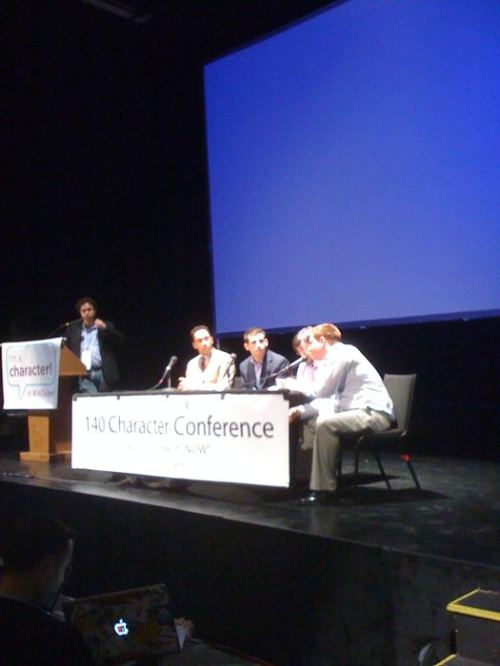
Newspapers & Twitter panel
Kudos to Jeff Pulver and his staff for creating what turned out to be an extraordinary day of discussion and learning, not to mention more than a little music and humor.
Following is a digest of some of my favorite moments, as tweeted. I already blogged about the extraordinary discussion that took place between Ann Curry, Robert Scoble and Rick Sanchez: “RickSanchezCNN was listening to #CNNfail: Did Twitter change CNN coverage?”
Aaron Strout also liveblogged the 140 Conference and @stevegarfield has added many #140conf pics on Flickr.
I will note, and indeed tweeted, that I was surprised that no one on the Twitter for business panel talked about when NOT to use Twitter, given the legal or compliance issues in regulated industries. I’ll be writing more about that later this trip.
After all, collecting links and ideas from the day from a conference about Twitter from Twitter makes sense, no? I remain sad that I missed the keynotes by @JeffPulver, @Jack, @FredWilson and @TimOReilly that started the day but know that I’ll be able to watch them later and that the hundreds of other attendees here will summarize those words and insights perfectly well for the rest of the Web.
On TV
“Twitter is not cost-prohibitive. @JimmyFallon has 1.3 million followers. He tweeted a Zack Morris pic before the show. That became a trending term before the show aired.”-@GavinPurcell
On Newspapers
Twitter is changing newspapers, both in their relationship to readers and within the newsroom. Editors and writers are collaborating more on news or events, in real-time. As Patrick LaForge (@palafo) said during the panel when he was watching Twitter, he saw a tweet come in that “There’s a plane in the Hudson.” The Village Voice has created a private account to coordinate coverage.
Journalists are receiving tips and sharing news with their followers, engaging in so-called “process journalism.”
On Digital Journalism
JohnAByrne of BusinessWeek shared that perspective, noting that “now journalism” — reporting on news as it breaks and evolves on the real-time Web, is enabled and extended by Twitter. Reporters now use Twitter to report, share & discuss news. The extension of news gathering and sharing into these digital platforms changes it from a product to a process. Indeed, Byrne believes that “Twitter as a collaborative and engagement tool is essential to any kind of forward-thinking journalism.”
A journalist from the Middle East, @moeed, of http://aljazeera.net, stated that “Micro reporting has transformed how we do reporting, particularly in crisis situations, like war.” He shared a number of innovative digital platforms that are enabling Al Jazeera to both disseminate information and to leverage the distributed eyes, ears and phones of people scattered across a region.
- Al Jazeera set up a Twitter account specifically for the Gaza conflict: @AJGaza and then fed it back into ALJazeera.net
- Geolocation of Tweets was used to feed this mashup: labs.aljazeera.net/warongaza
- ushahidi.com was used to crowdsourced crisis coverage. Examples include <a href="http://votereport.in/" target="_blank"votereport.in and swineflu.ushahidi.com
On Music
Chris (@1000TimesYes) of http://RollingStone.com and the @VillageVoice) is reviewing 1000 records on Twitter in 2009. Michael brought down the house, too. He was both hilarious & darkly poetic in bemoaning the death of the music critic.“Crowdsourcing killed punk rock,” in his view, along with many other alternative or indie genres.
On Love, Microsyntax, @CNNBrk, Kodak & Power
Panels and speeches also included the following, all of which you can find commentary and quotes from or about on #140conf:
- a love letter to Twitter from @pistachio
- @stoweboyd on his microsyntax nonproject at Microsyntax.org
- @imajes on the story behind @CNNBRK (he created a script that posted CNN email alerts into Twitter)
- @JeffreyHayzlett on Kodak and Twitter, which included a crowdsourced term: “twanker” for a Twitterers that show bad form
- @ajkeen on Twitter and power (a contrarian’s take to be sure)
Sessions to come include panels on Twitter cewebrity wtih @adventuregirl @ijustine @juliaroy and @chrisbrogan, Twitter for social good, which includes @drew & @twestival.
On the real-time Web
This was aa tremendous day. The conversation that has been unfolding on the tension between information about events coming in over the real-time Web and so-called “old media” organizations that seek to uphold journalistic standards honed over decades is fascinating. It follows on the blog up…er, blow up between TechCrunch and the New York Times regarding process vs product journalism earlier this month. For journalists, getting the story right, with corroboration, attribution and validity is crucial. Finding a way to do that in the context of the torrent of real-time news will be a central challenge of newsrooms in the month to come.
These are tough questions, debated by the world’s best thinkers on digital journalism and technology. My Twitter conversation with Jason Pontin yesterday lingers: what are the opportunities for distributed, “open source” journalism? Twitter and blogs from #IranElection are a novel source. And as Jason pointed out, we know that there’s misinformation and rumors there; how can journalists do real reporting on Twitter?
Journalists are filing links to pictures and video, which helps — harder to fake the latter — but there are real challenges. As Jason tweeted, “reporting requires verification from at least three sources, posted or printed in an authoritative, independent publication. If I were editing #iranelection stories, I’d want: who is the open source? What conflicting interests? Cross-verification? Open source journalism, appropriately handled, could provide verification.”
It’s possible some technologists in today’s audience or in Silicon Valley, India, Israel or home from MIT for the summer might find a way to provide all of that. For now, I’m looking forward to learning more from the Web luminaries here at the 140 Characters Conference.
Filed under blogging, journalism, microsharing, social media, technology, Twitter
@RichSanchezCNN was listening to #CNNFail: Did Twitter change CNN coverage?
I’m still mulling over an extraordinary discussion around newsgathering held here in New York City this morning. One pane stands out, however, and no doubt will continue to for years to come.
It’s not just that I had the chance to meet Ann Curry, who was passionate, thoughtful and deeply insightful.
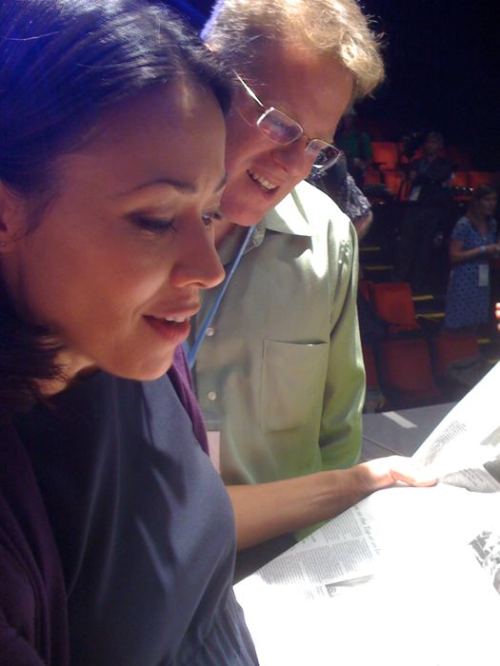
I’ll always remember Ann Curry reading @zittrain’s quote on Twitter’s impact on the election in Iran in the New York Times to Robert Scoble (and me) at the 140 Characters Conference
How can I not admire a television journalist who spoke with such passion and conviction about journalism, facts and getting it right?
She noted with considerable gravitas that she took her responsibility to “never Twitter something that is wrong” seriously.
Curry suggested to citizen journalists covering global stories that “I want you to shoot that story like it’s your sister, brother or mother.”
She also offered a perspective I can appreciate, based upon my own experience:
“My followers are my own newspaper.”
Aside from Curry’s comments, all of which I hope become available online as soon at the conference videographers can manage it, there’s another story to tell.
Last Saturday, CNN anchor Rick Sanchez noticed something happening on Twitter.
That’s nothing new: @RickSanchezCNN has in many ways bet his show, even career, on his integration with social media.
His use has paid off, according to the remarks Sanchez made at JeffPulver’s 140 Characters Conference, and not just in terms of his 95,000 followers: social media, particularly Twitter, has pushed CNN to cover the existence of fraud or overall validity of the elections in Iran.
After his comments on the panel, Sanchez described to me and others how his email about #CNNFail on Twitter went up to the highest levels of the network. And, after the network’s business, PR and marketing staff was pulled in, coverage the next day shifted.
In other words, just as the audience here in New York grew restive after hearing Sanchez and Robert Scoble talk about #CNNfail and asked to hear from Curry, CNN’s online audience on Twitter pushed the network to cover the news differently.
I wasn’t watching CNN on either day — I was focused on tracking Twitter, YouTube and other online sources — but I’m now incredibly curious about how Sunday’s broadcasts on CNN were different.
I do know that Sanchez said to me that CNN stayed with Ahmadinejad’s speech on Sunday much longer than they would have otherwise.
During the panel, Sanchez that “at no time did CNN drop the ball” — based upon his remarks following, however, I have to wonder whether there was an appreciation in the C-suite at CNN that the online backlash on Twitter was a hint that Amanpour reporting live from Tehran wasn’t capturing the whole scene, and that US citizens were hungry for more information about what was happening on the streets and rooftaps of Iran.
I know now that, on some subtle level, there were changes — and that’s a win for all of those in the US who wanted CNN to cover events in Iran more closely. There’s a long road for newspapers and cable news networks to travel yet as they adjust to the real-time Web and its audience gathering information and publicly critiquing coverage decisions of network.
Even digital natives are still working out the standards for validation, attribution and information sharing. Old school publishers and broadcasters, by and large, are behind. It could be that the events in the Middle East this weekend could change that.
Sanchez was honest about the economic realities there, including the competition with Fox. Unfortunately, given the existence of a profit motive and ratings driven by celebrity stories and natural disasters, there are real barriers to the cable news networks shifting their airtime to just serious news stories.
In a public company, after all, ratings rule when shareholder value must be maximized.
Ann Curry suggested another, more sobering root cause: “It’s hard to get Americans to care about international issues.”
If journalists can frame, analyze and convey the stories of our collective humanity, whether it’s in Darfur, North Korea, Iran, China or some other global spot, perhaps that will change. Nick Kristof won a Pulitzer for his coverage in the New York Times.
Here’s hoping others follow in his footsteps.
Filed under blogging, journalism, social media, technology, Twitter
Top 50 Twitter Acronyms, Abbreviations and Initialisms

- Image by luc legay via Flickr
This past January, I wrote up the “Top 15 Twitter acronyms” for @pistachio‘s Touchbase blog. As readers rightly pointed out, many were abbreviations or initialisms – hence the title for this post. I followed that up with a “Top 10 NSFW Twitter Abbreviations.” This list combines the two, and includes key additions like HT, RE and FML. If you have others you think I missed, please add ’em in the comments – and follow me on Twitter!
@
Reply to [username]
AFAIK
As Far as I Know
b/c
Because
BFN
Bye For now
BR
Best Regards
BTW
By the Way
DM
Direct Message. d username sends one.
EM
Email
FB
Facebook
FF
Usually #FF for Follow Friday. #FollowFriday is supposed to work better than it does. If you #FF someone, take the characters to explain why.
FFS
For F–k’s Sake
FML
F–k My Life
FTF
Face To Face. Also, F2F. Or the Fair Trade Federation. Many other options.
FTL
For The Loss
FTW
For The Win
FWD
Forward
FWIW
For What It’s Worth
HT
Hat tip
HTH
Hope That Helps
IMHO
In My Humble Opinion
IMO
In My Opinion
IRL
In Real Life
J/K
Just Kidding
LI
LinkedIn
LMAO
Laughing My Ass Off
LMK
Let Me Know
NSFW
Not Safe For Work
OH
Overheard
OMFG
Oh My F–king God
OMG
Oh My God
PRT
Partial Retweet (at the start of a tweet). Sometimes “Please Retweet” Old School: Party
RE
In reply to. As in, use RE for @replies on Twitter. Used in front of the @ to ensure all followers can see the conversation. Further ontext: “Community, @replies, #fixreplies and Change”
RR
Re-Run
RT
Retweet
RTF
Read The FAQ. RTFF shows up too. RTF also stands for Rich Text File.
SNAFU
Situation Normal All F–ked Up
SOB
Son Of a Bitch
STFU
Shut The F–k Up
TMB
Tweet Me Back
via
My one cheat: “via” is not an abbreviation or acronym. It simply means that a tweet is from @username, though in some cases it may mean that it’s also an exact retweet. Tricky, this online user-defined lingo and twitribution is.
WTF
What The F–k
WTH
What The Hell
BONUS:
Since this list was first published, some of these have become more popular and others have emerged. RT is still – by far – the most frequent acronym. New additions are added below, along with many suggestions in the comments.
TIL
Today I learned.
TIL in Hawaii that Poke Tacos are a thing.A delicious, delicious thing.
— Xeni Jardin (@xeni) February 19, 2013
NB
Nota Bene. Make sure to read the comments, where there are many great additions.
ICYMI
In Case You Missed IT [HT @BrianStelter]
Update: Justin Kownacki thinks we should stop saying “in case you missed it” on Twitter. (That includes ICYMI, too.) I agree.
CX
Correction
RTQ
Read The Question or Retweet Question
TL
Timeline
RT = retweet, MT = modified tweet, DM = direct message, FF = Follow Friday, h/t = hat tip, TL = Timeline, OH = overheard. Now you know.
— Margarita Noriega (@margafret) April 1, 2014
TL;DR
Too long; Didn’t Read.
TT
Translated Tweet.
Reminder: when I use TT in front of a tweet, it means “translated tweet.” I’m mostly using my high-school French and Google, so be warned.
— Andy Carvin (@acarvin) January 16, 2013
RLRT: Real Life Retweet. To repeat on Twitter what someone said in person.
RLRT: I love the Internet. – @yurivictor
— Matt Mansfield (@mattmansfield) May 17, 2014
Filed under blogging, social media, technology, Twitter
IT innovation in Massachusetts: MIT-style business plan competition
Another day, another opportunity to meet Deval Patrick and report on innovation and technology in the Commonwealth.
Actually, it wasn’t just another day: I livestreamed the governor’s announcement of the MassChallenge Venture Funds Competition. His twitter account @MassGovernor picked it up and shared it with the rest of the Commonwealth.
That was, as they say, nifty. I embedded his speech below; Patrick begins speaking twenty minutes in.
Vodpod videos no longer available.
If you listen carefully, you’ll even hear me ask a question about how the Commonwealth will use Mass.gov to make the bidding process open and transparent. Patrick noted my “little camera” and asked one of the VCs involved to come speak at the podium — the Governor was online media-savvy today.
I wrote about the details of the MVFC over on the TotalCIO blog at TechTarget’s ITKnowledgeExchange: “Massachusetts launches MassChallenge Venture Funds Competition”
The rest of the day? Well, clearly there’s plenty of passion, desire and insight in the local tech community about how innovation can be fostered, nurtured and funded here in Massachusetts.
I heard about the state of the Mass. IT economy, as described by researchers at the UMass Donahue Institute.
Good data points: The composition of Mass. IT industry is shifting. Hardware/networking shrinking, software/IT services growing. There are more than 176,000 IT workers in Massachusetts, making the industry second only to healthcare. The IT execs surveyed put business costs (71%) at the top of their list of challenges, followed by IT infrastructure (57%). Lck of collaboration in R&D was also cited as an issue.
I heard more substantive evidence of IT’s enabling effect on other industries, including mobile, marketing and robotics, not to mention productivity in general.
I heard, from Akamai’s CEO, that that company exists because of “pure, academic research,” funded by DARPA, that an entrepreneur thought could be made profitable. (Current market cap: 3.84 billion [Yahoo Finance])
I saw, yet again, how well thoughtful event planers can prepare for online participation and use free, open tools to engage participants in real life and extend the discussion onto the Web, capturing the insights and resources shared in a persistent way.
The organizers used one of the large screens to pull in the twitterstream, bringing the online conversation back into meatspace.
There was also a useful collaborative discussion tool for the Communications Breakout Session: @Google Moderator: http://bit.ly/wNinM
I learned about STEM, as referenced by @Google‘s @SteveVintner: http://stemedcoalition.org
I discovered http://theventurecafe.com, located at http://cictr.com, and read a Boston Globe story about it: http://bit.ly/BjGwg
I heard about a digital marketing organization in San Francisco that is working towards creating partnerships between schools and corporations: @SFBig & http://sfbig.com/education
I even had the microphone for a minute and advocated that attendees consider working towards more mentorship, co-op programs and show students how technologists and IT execs worked towards a path to success. I noted the course described by David Brooks in a recent NYTimes OpEd piece on “Genius”: http://bit.ly/11bkVM |
And, of course, that aforementioned livestream netcasted the session on scaling large organizations to the online audience.
I’ve embedded “a dialogue about growing Massachusetts enterprises to scale” below.
Vodpod videos no longer available.
You can read much of the discussion on Twitter at the #innovateMAtech hashtag.
Filed under blogging, journalism, research, social media, technology, Twitter, video


 digiphile