
[Hat tip: Lance Ulanoff]
Category Archives: video
It’s not about the numbers. It’s about the connections.

- Image by Amodiovalerio Verde via Flickr
Last night, I had a surprise: my follower count on Twitter dropped by 148 in one fell swoop.
At first, I thought it was something I had tweeted – oversharing about the Forrester tweetup, or disinterest in sharing a clip of Supreme Court nominee Sotomayor. That didn’t jibe, however, with my gut.
What was inflammatory? What had I done that resulted in a huge loss of followers? As I drifted off to sleep, I thought: how important is this, really, in the grand scheme of things?
I’ve long since learned one hallmark of netiquette on Twitter (Twittiquette, if you will) was not to talk about one’s follower numbers. (If only I could retrieve some of the replies I received back in 2007 after doing so, I’d be thrilled. No good.)
A paraphrase of most of them essentially boiled down to this: are you here to get followers or here to connect?
It didn’t take long to see where the real value was. And, more than two years later, I’m elated to look back and see how many marvelous connections I’ve made, many of which have led to friendships offline. Why is that important?
For me, that’s a a simple answer: we live in a number-obsessed culture. Thinks about how many metrics we track, filter and can recall: poll numbers, net worth, MPG, CTR, Web uniques, 0-60 in __, GPA, APR, circulation, P/E ratios, DJIA, TCO, Mbps, R/W speed…on and on.
And, naturally, for those in the social networking world,we count subscribers, friends and followers. I’ve received far too many messages and spam promising me thousands of followers if I use this software or that service.
Honestly, they all leave me with the taste of fermented cough syrup in my mouth, with a healthy side of cod liver oil.
It’s not about the numbers: it’s about the connections.
Every follower or friend I’ve made has been through a conscious choice or organic growth. I’m proud of that. I’ve done it in what I might term the “new-fashioned way,” using much the same approach that Chris Brogan describes in his Twitter FAQ: “be helpful, share, communicate, use @replies a lot.” I tend to attribute “by @username” or “via @” nearly as much as directly @reply these days but the sense is the same.
Yesterday, I met Josh Bernoff, co-author of Groundswell. I had dinner with Shava Nerad and her beau, “Fish Fishman,” with Laurel Ruma joining in a bit later. I saw dozens of other friends from the local social media scene at two different tweetups.
I shared some groundbreaking journalism tools and advice, like best practices for journalists curating the Web. I shared messages and stories with newsies at the New York Times, Guardian, Wired, Gizmodo, Slate, The Register,The Center for Democracy & Technology and many others.
I read Stephen Baker on what may become of BusinessWeek and Bernard Lunn on creative destruction in publishing
I shared a lovely bit of science fiction made real, via the irrepressible Steve Garfield, watching the latest in augmented reality:
I reviewed my sources, notes and interviews from a conference earlier this week and wrote an article. I enjoyed a two hour workshop with my colleagues, analyzing the strengths and weaknesses of our journalism. I even enjoyed a late night cocktail with someone I love deeply.
In all of that, what does a dip in follower numbers mean? Not a helluva lot.
And, as it turns out, the scuttlebutt that Twitter is doing another purge of spammers and bots, a process that I recall from last year as well. My existential angst was unwarranted, my concern without merit – but the thought process and recounting it led me to was worth it.
I’m proud of my connections and my friends, of the social news network we’re all collaborating upon, and up the quality of the communication within it. I’m glad to bring it with me to Washington in a few short weeks.
The spammers can go live on whatever lower circle of digital Hades is reserved for ’em.
![Reblog this post [with Zemanta]](https://i0.wp.com/img.zemanta.com/reblog_e.png)
Filed under blogging, friends, microsharing, personal, social media, technology, Twitter, video
IT innovation in Massachusetts: MIT-style business plan competition
Another day, another opportunity to meet Deval Patrick and report on innovation and technology in the Commonwealth.
Actually, it wasn’t just another day: I livestreamed the governor’s announcement of the MassChallenge Venture Funds Competition. His twitter account @MassGovernor picked it up and shared it with the rest of the Commonwealth.
That was, as they say, nifty. I embedded his speech below; Patrick begins speaking twenty minutes in.
Vodpod videos no longer available.
If you listen carefully, you’ll even hear me ask a question about how the Commonwealth will use Mass.gov to make the bidding process open and transparent. Patrick noted my “little camera” and asked one of the VCs involved to come speak at the podium — the Governor was online media-savvy today.
I wrote about the details of the MVFC over on the TotalCIO blog at TechTarget’s ITKnowledgeExchange: “Massachusetts launches MassChallenge Venture Funds Competition”
The rest of the day? Well, clearly there’s plenty of passion, desire and insight in the local tech community about how innovation can be fostered, nurtured and funded here in Massachusetts.
I heard about the state of the Mass. IT economy, as described by researchers at the UMass Donahue Institute.
Good data points: The composition of Mass. IT industry is shifting. Hardware/networking shrinking, software/IT services growing. There are more than 176,000 IT workers in Massachusetts, making the industry second only to healthcare. The IT execs surveyed put business costs (71%) at the top of their list of challenges, followed by IT infrastructure (57%). Lck of collaboration in R&D was also cited as an issue.
I heard more substantive evidence of IT’s enabling effect on other industries, including mobile, marketing and robotics, not to mention productivity in general.
I heard, from Akamai’s CEO, that that company exists because of “pure, academic research,” funded by DARPA, that an entrepreneur thought could be made profitable. (Current market cap: 3.84 billion [Yahoo Finance])
I saw, yet again, how well thoughtful event planers can prepare for online participation and use free, open tools to engage participants in real life and extend the discussion onto the Web, capturing the insights and resources shared in a persistent way.
The organizers used one of the large screens to pull in the twitterstream, bringing the online conversation back into meatspace.
There was also a useful collaborative discussion tool for the Communications Breakout Session: @Google Moderator: http://bit.ly/wNinM
I learned about STEM, as referenced by @Google‘s @SteveVintner: http://stemedcoalition.org
I discovered http://theventurecafe.com, located at http://cictr.com, and read a Boston Globe story about it: http://bit.ly/BjGwg
I heard about a digital marketing organization in San Francisco that is working towards creating partnerships between schools and corporations: @SFBig & http://sfbig.com/education
I even had the microphone for a minute and advocated that attendees consider working towards more mentorship, co-op programs and show students how technologists and IT execs worked towards a path to success. I noted the course described by David Brooks in a recent NYTimes OpEd piece on “Genius”: http://bit.ly/11bkVM |
And, of course, that aforementioned livestream netcasted the session on scaling large organizations to the online audience.
I’ve embedded “a dialogue about growing Massachusetts enterprises to scale” below.
Vodpod videos no longer available.
You can read much of the discussion on Twitter at the #innovateMAtech hashtag.
Filed under blogging, journalism, research, social media, technology, Twitter, video
MIT Panel: “Machines with eyes & texting spies” [privacy]
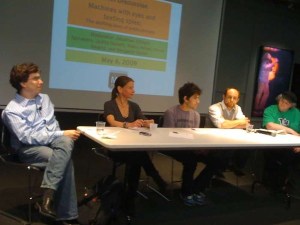
"Spies and texting eyes panel at MIT"
“Big Brother has nothing on growing up as a minister’s daughter in a small town.”
Shava Nerad, Development Director / former Executive Director of the Tor Project, offered that trenchant observation in the context of a panel on privacy held at the MIT Museum earlier this month,”Machines with spies & texting eyes: The shifting lines of public/private.” As she noted, she’s been writing provocative things on the Internet since 1982 so this isn’t exactly out of character.
Jonathan Zittrain, co-founder of the Berkman Center for Internet & Society at Harvard University, moderated the panel. Judith Donath (Director of the Sociable Media Group), Aaron Swartz (Founder of watchdog.net and reddit.com) and Benjamin Waber, (Researcher, Human Dynamics Group at the MIT Media Lab) joined Nerad behind the table.
The event put special focus on the MIT Media Lab‘s Sociable Media Group’s exhibition, “Connections.” When asked about the purpose of the exhibit, Donath said that “We wanted people to step back and think about privacy. One mundane step after another has brought us to a deeply transformed world.”
Shava noted that “mischaracterizations of your identity are more likely to result than the real thing at the exhibit.” That result is “an artifact of scraping,” where data is pulled from many pools online without context or interpolation.
In general, the exhibit is meant to pull into focus Donath’s central question: “What is the cost we have to pay in terms of privacy to cement society together?”
You can take a virtual tour of the museum (from 2008) below:
Using the dry wit that makes his public appearances so enjoyable, Zittrain kicked off the panel with an explication of prurient. As he noted, prurient is a “funny word.” It refers to something that attracts you and then a moment later disgusts you. It’s wholly applicable and useful to our relationship with privacy in our changing world, as lifestreaming, Twitter, Facebook and mobile technology rapidly intermingle our public and private selves.
As Norath noted, “we’re all leaving trails of data…email, every time we comment, when we go through FastLane, when we go shopping. Some we’re aware of, some we’re not. There’s a growing shadow behind us.”
The privacy panel recognized that the data trails left by teens online may be particularly meaningful for future employment or educational opportunities. Is acting out on Facebook a way of showing off imperviousness?
Nerad noted just how how persistent data is. In reply, @zittrain suggested declaring “reputational bankruptcy” at 18. Hilarity ensued. Shava suggested extending the age to 25.
Regardless, a “data shadow” is a useful metaphor for these data trails that accompany our online activity, especially when combined with the work of the Sunlight Foundation and Watchdog.net, the “good government site with teeth” project started by Swartz. It’s safe to say that we’re all watching each other now. Adding to the lighthearted but thoughtful tone of the discussion, @aaronsw recalled the day @EFF‘s Kevin Bankston was caught smoking by Google Street View.
Benjamin Waber noted that with Bluetooth scans on cellphones you might be able to accurately track who might be infected by a disease. As Zittrain quipped on one case, referring to swine flu, you could even epidemiologically trace it back to “Pig Zero.”
Waber makes the comparison to the membership cards offered by Shaws that enable consumers to receive discounts in return for registering. “If we owned our Bluetooth data, could we sell it? You get something for your data, for giving up your purchasing patterns. If your cellphone distributed certain information, would you be willing to trade it?”
The panel took note of the cultural differences between Japan and the U.S. with regards to @Google Street View. Protections around privacy and awareness of the impact of mobile video on it are greater there, perhaps by virtue of the technological edge that exists with Japanese society. Does greater tech penetration result in greater awareness of privacy issues? An Aussie in the audience notes that this privacy discussion appeared to be predicated by being held in the U.S. “When you’re a net importer of culture, you’re used to skirting around things.”

sociometer
In Waber’s case, certainly, one would have to note that the privacy discussion is both academic and our in the real world. He passed around the “sociometer” that Waber and others are using to conduct research with at the Media Lab. Zittrain quipped that it “reminds me of an alithiometer” — a reference to Pullman’s “His Dark Materials” epic fantasy trilogy. This geek guffawed. To be fair, in many ways, this device is downright magical, at least when its simple form factor is compared to its function. A sociometer is a wearable sensor package for measuring face-to-face interactions between people.
Afterwards, I was lucky enough to go out for Chinese with the panelists , where@zittrain further moderated a “roundtable” on the potential for malicious use of@Amazon‘s Mechanical Turk. @aaronsw @bwaber and @zephyrteachout and others contributed to a vigorous discussion of Google’s role in privacy, dominance of search and the role of citizens and law in encouraging more transparent government and corporate practices.
There’s more on electronic privacy and online governance at the Complexity and Social Networks Blog at Harvard and some thoughtful comments on the event page on Facebook.
Readers interested in privacy may also find WeLiveInPublicTheMovie.com of interest.
Notes and Tweets from the TechTarget ROI Summit at #TTGTSummit

Marilou Barsam at the TechTarget Online ROI Summit
The week before last, before I went off to San Francisco to be immersed in security, compliance and cloud computing at the RSA Conference, I was lucky to be present at TechTarget‘s annual ROI Summit. The event, held in Newton, Mass., showcases the best research, advice and case studies from TechTarget’s online marketing efforts. I attended at the invitation of Dave Bailey, an estimable director of corporate marketing at TechTarget, sitting in on his panel with Sean Brooks on the ROI of Social Media.
Before that session, however, I was privy to a full slate of presentations and findings in the main ballroom. The following post is a reflection of the “best of the back channel,” as represented by posts (so-called “tweets”) to Twitter from attendees and TechTarget staff on site. The hashtag for the event was #TTGTSummit, as you can see if you visit search.twitter.com and search for it. Tweets are presented in chronological format here, as opposed to the most recent additions you’ll find in the links above.
Given the 140 character limit to each post, there is naturally a need to condense the insight and add context and resources with hyperlinks or other usernames. In aggregate, however, this conversation provides some useful insight into the state of online marketing, as practiced by one of the leaders in the space. I enjoyed the opportunity to “micro-report” on it using my personal account @digiphile.
You can read Marilou Barsam’s “Takeaways from the TechTarget 2009 East Online ROI Summit” at “My Educated Guess.’
Introductions & Keynote from Greg Strakosch
digiphile: The TechTarget Online #ROI Summit is getting rolling here. Follow the #TTGTSummit hashtag. More info: http://TechTargetSummit.TechTarget.com
digiphile: Glad to find @RandyKahle @GSasha @AqaMarketing @Cathie_Briggett @rsk1060 @ESalerno here. Consider using #TTGTSummit & following @ITAgenda
digiphile: My CEO is up at the #TTGTSummit. Enterprise IT pros researching at the same activity level during this #recession, despite budget tightening
digiphile: Over 60 websites in the TechTarget network as of April 2009. In aggregate, that’s the largest audience of IT pros on the Web.
digiphile: Barsam introduced the concept of the “hyperactive lead” at the #TTGTSummit | My take: IT pros consume media like bears eat blueberries.
digiphile: An IT pro here at the #TTGTSummit describes himself as an “informavore” – always foraging for information. I share that hyperactivity.
Online Marketing Case Studies
InboundMarketer: At TechTget Online ROI Summit (#TTGTSummit) talking abt nurturing in 2 ways-inside ur environment & outside of it, both need 2 b synergistic
digiphile: Panel on #OnlineMarketing drives home importance of integrated media & customized, thoughtful messages. Many touchpoints.
digiphile: The # of tools #OnlineMarketers have now is unprecedented. Virtual trade shows, videocasts, social media, data/Web analytics
digiphile: Detailed case studies of how #OnlineMarketers use automated CRM tools/dashboards to gather & track leads at the #TTGTSummit | Analytics key.
digiphile: PRT @InboundMarketer Tableau software uses Eloqua; “great 4 a small co,” uses CRM (Salesforce.com) 4 visual scoring w/dashboards
Andy Briney’s Presentation on trends for CIO spending
cappypopp: IT in ’00s: ‘webify’ servers, apps, infrastructure. Bandwidth leasing, compliance. #ttgtsummit
cappypopp: Online ROI Summit #ttgtsummit http://twitpic.com/3b4jg
cappypopp: To succeed IT is going to need to rejustify its role in the business #ttgtsummit
cappypopp: Only 29% of companies to grow their IT budgets in ’09 | #ttgtsummit
digiphile: Andy outlining major IT trends for 2009 : Consolidation (virtualization, outsourcing w/cloud/SaaS) & compliance. >regs coming |
cappypopp: 96% of co.’s (of 500) believe that IT’s role in compliance hugely important; 70% of IT pros surveyed will focus on it in ’09
digiphile: What’s the #1 IT spend area in 2009? According to Briney @ #TTGTSummit, it’s disaster recovery. Hurricanes had an impact on banks/insurance.
cappypopp: What is ‘business intelligence?’ Getting more and better data faster. | #ttgtsummit
ITCompliance: PRT @cappypopp 96% of Fortune500 co’s believe IT’s role in compliance hugely imptnt; 70% IT pros surveyed will focus on it in 09
ITCompliance: RT @ITAgenda Major recession-proof areas of IT spending: Business Intelligence/BPM, Compliance, Disaster Recovery, Consolidation
digiphile: RT @CappyPopp “Consolidation, compliance, DR, & BI are not “opportunities” for IT: they are imperatives” -Andy Briney
InboundMarketer: http://twitpic.com/3b6cv – Techtarget Online ROI Summit #TTGTSummit main session room
ITCompliance: Andy Briney gave http://SearchCompliance.com special note at the #TTGTSummit. USGov/EU regs have made “IT” a crucial issue for #2009.
cappypopp: IT marketers: target proj. teams, not all stakeholders, and audience closest to your product or pain. Use independent content | #ttgtsummit
digiphile: Good advice for #OnlineMarketers: Focus on unique value prop, stick to the truth, get specific, speak prospect’s lingo -Briney
Tedesign: RT @ITAgenda: There are 4 major recession-proof areas of IT spending – BI/BPM, Compliance, Disaster Recovery, Consolidation #TTGTSummit
CIO Panel
Note: Linda Tucci wrote about this panel at SearchCIO.com, publishing “In Great Recession of 2009, three CIOs do more with flat IT budgets” the next day.
digiphile: At a #TTGTSummit #CIO panel. Jay Leader, iRobot’s CIO here. Noted Roomba & IED detection. Also: a gutter cleaning robot http://bit.ly/1ikd
digiphile: CIOs for TAC Worldwide (http://tacworldwide.com) & PlumChoice (http://plumchoice.com) also presenting on #TTGTSummit #CIO breakout panel.
cappypopp:#CIO panel #ttgtsummit: focus on speed and resilience. Keep up w/ speed of business.
digiphile: @cappypopp iRobot #CIO kept IT budget flat in 2009? Focus on managing IT as a business is key for all orgs, profitable or not.
ITCompliance: “SOX is the magic word that gets it past the CFO.” #CIOs on #TTGTSummit panel note poetic license in GRC software purchasing.
ITCompliance: A #CIO at the #TTGTSummit noted necessity of “J-SOX” #compliance at the Tokyo Stock Exchange. Wikipedia def: http://bit.ly/2p0gu
digiphile: iRobot #CIO places 2009 focus not on tools (has BI & ERP) but on getting better use from them & optimizing data/biz processes | #TTGTSummit
digiphile: Top drivers for #virtualization for these CIOs are consolidation & DR. Reduce # of servers, contain costs, provision faster.
digiphile: Watching @ltucci take notes on today’s #CIO panel. Her last post shed light on CISO risk mngmt mind-set: http://bit.ly/10dul
digiphile: Key Q for a #CIO: What can we *do* with it? What business problem does it solve? Applies to SOA, Twitter, UC, you name it.
digiphile: “It’s not the solution, it’s the box that goes with it. Support, implementation costs, configuration, etc.”-Jay Leader, #CIO
cappypopp: iRobot #CIO Jay Leader: never vets technical products, done lower in hierarchy. He does business eval: does it solve a problem? #ttgtsummit
cappypopp: Very hard to access #CIO s to sell to them. Panelists almost never talk to vendors. If they do you better KNOW your product. #ttgtsummit
cappypopp: ‘Sell your product in a way that tells me how it solves MY problem. Understand my business. No webinars!’ #CIO panel #ttgtsummit
digiphile: “A ‘#green data center’ only matters to a #CIO consuming megawatts of energy or dealing w/colocation. I’m a capitalist.”
JeanSFleming: RT @digiphile: “Understand who I am & express your solution to me in a way that shows me how to address a problem.”
cappypopp: #CIO Jay Leader (iRobot): DONT CARE a/b green tech. I’m a captalist. Green tech == no $ for us. Solves no problem in my space. #ttgtsummit
rotkapchen: @digiphile Or “don’t waste my time” Problem: High cost to ALL of that — figuring it out. Must be mutual discovery. #CIO
digiphile: @rotkapchen I agree. There IS a high cost to figuring out how to market to an enterprise #CIO. First step: Understanding IT.
Social Media ROI Session
cappypopp: #ttgtsummit Measuring #ROI of social media panel with @seanbrooks @digiphile David Bailey. Waiting for the @radian6 mention. :)
digiphile: Panel on #SocialMedia ROI starting at #TTGTSummit. @SeanMBrooks up. Nearly every hand went up when asked who uses SM. ~75% on Twitter now.
digiphile: Case study in #socialmedia success from the audience. #Intuit promoted a webinar w/Twitter, blogged it, engaged influencers.
cappypopp: Amazing difference in one year of audience survey of %age that use social media. Easily 75% of hands up. Last year: maybe 20%. #ttgtsummit
digiphile: Uses of #socialmedia from @SeanRBrooks: Focus groups, new distribution channels, feedback, real-time product/company tracking
digiphile: Quick hits on corporate #socialmedia case studies getting ROI on Twitter from @SeanRBrooks: @CAInfraMan @NetBackup
cappypopp: ‘take a breath, learn how to respond.’-@SeanRBrooks Re: #Twitter | #ttgtsummit
digiphile: “Instant feedback using Twitter or other #socialmedia platforms is easy & quite powerful.”-@SeanRBrooks. Example: Try @TwtPoll | #TTGTSummidigiphile: “Empower your employees to participate in #socialmedia. They’re already doing it.”-@SeanRBrooks on suggesting best practices. |
digiphile: Other #socialmedia best practices: Strategy 1st, don’t sell, offer help, make it P2P, allow criticism, accept feedback, have fun
cappypopp: ‘sitting quietly and letting comments sit’ not a great idea. #Socialmedia is 2-way – @seanrbrooks | #ttgtsummit
digiphile: Measuring success? @SeanRBrooks suggests #socialmedia metrics like ROMO (return on marketing objective) vs ROI. RTs/links.
digiphile: Suggested #socialmedia tracking tools from @CappyPopp: http://twitalyzer.com | http://tweetgrid | http://tweetstats.com
digiphile: Effects of #socialmedia? @SeanRBrooks asks: “How big is your reach? Traffic benefits? Happier customers? ‘Influencers’ linking?”
cappypopp: Serena Software #socialmedia campaign case study – generated 14x avg CTR on #Facebook. #ttgtsummit
cappypopp: #Norton brand advocates: #Symantec built 15k customer advocates using #socialmedia and raised their Amazon ratings accordingly #ttgtsummit
digiphile: Dave Bailey presenting on thought leadership in #SocialMedia. Start w/strategy, objective & audience. Then choose tools.
digiphile: Bailey showed a detailed media plan summarizing a Dell campaign at @ITKE that integrated multiple #socialmedia components.
digiphile: Next #socialmedia case study @ #TTGTSummit: #IBM‘s B2B play across multiple platforms: @MrFong | http://ConnectMrFong.com
digiphile: Remember blogs? Dell does. Ideastorm blog went from “worst to first” (-@JeffJarvis). -27% negative blog posts. =$100M in ads?
digiphile: More on measuring #socialmedia: Reach, Traffic, Leads, Interaction. Watch subscription #s, CTR, PVs, RTs/@replies & comments.
Google/TechTarget Research
digiphile: Final session at #TTGTSummit features research from the @Google/@TechTarget Roadshow: http://bit.ly/aTzZ | #Search behaviors of IT buyers.
digiphile: Next from @Google #search? Perhaps: concept clustering, filtering w/in results, categorization by page type, on-hover preview
IBM_ECM: RT @digiphile: This post from @ChrisBrogan is for those in #SocialMedia session wondering where to start: http://bit.ly/TOeN
Closing Notes
InboundMarketer: Create a separate remessaging strategy based on content consumption & velocity of consumption – good advice, #ttgtsummit
ITAgenda: Online media complexity creates opportunity – examine metrics carefully and see how media plan improves SEM/SEO strategy #TTGTSummit
digiphile: Closing notes at the #TTGTSummit from co-founder Don Hawk: “Complexity creates competitive advantage.” Execution matters — & it’s not easy.
cappypopp: Thanks to all at TechTarget Online ROI Summit. Great job. #ttgtsummit
digiphile: RT @SeanRBrooks Presentations & reports from the #TTGTSummit: http://www.techtarget.com/formarketers | via @ITAgenda | #ROI #OnlineMarketing
rsk1060: @jhurwitz shared some great ideas about articulating new concepts to IT professionals at #TTGTSummit – thank you!
rsk1060: Peter Varhol’s session at #TTGTSummit provided interesting research information indicating the #SOA is, in fact, not dead.
LeahRosin: Article on #TTGTSummit #CIO Panel: “In the #Recession of 2009, 3 CIOs do more with flat IT budgets” http://bit.ly/2eYA9k (HT @digiphile)
digiphile: “Content is still king in IT marketing.” @BennettStrategy, on @TechTarget/@Google research: http://tr.im/j468 | #TTGTSummit | HT @MarkMartel
ITAgenda: Marilou Barsam’s key technology marketing takeaways and wrap-up from the #TTGTSummit on My Educated Guess blog http://bit.ly/XlLkG
Filed under microsharing, personal, photography, social bookmarking, Twitter, Uncategorized, video
@Google visits Boston at Cambridge Meetup
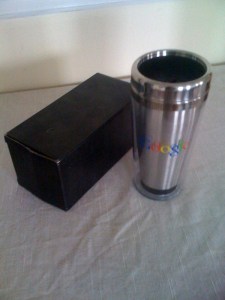
Google Mug | Chrome color?
I stumbled into Adam Lasnik in Harvest Coop in Central Square in Cambridge, Mass. last night on my way to Google’s first official Boston Meetup and asked him if he knew where Enormous Room might. I knew I was in the right general spot but hadn’t been there in a while. Plus, his fleece read “Google” on it.
I think asking Adam where something was may actually count as “googling” something in person.
And, true to his role as Google’s Search Evangelist, Adam was quite helpful.
I walked over and up to Enormous Room with him as his two other Google compatriots finished a snack.
Since I followed him, that may count as using a human version of Google Maps.
After a snagged a tasty “Blue Bear” at the bar, I started circulating and meeting the crowd of local entrepreneurs, webmasters, analysts, marketers, writers, IT pros and other Cambridge tech mavens. Good times.
Eventually, the Google organizer for the event, Nate Tyler, welcomed the packed room to the evening and then turned it over to Adam. He took questions submitted online using Google’s own moderator tool. (See all the archived questions here). Adam mentioned that Google itself uses the tool every Friday to collect questions internally. Great insight into corporate culture.
I tweeted the following posts during the presentation:
- More Q&A here at the @Google tweetup. Q: How is PageRank calculated? A: 42 | #gmupbos
- More Q&A at @Google tweetup. News: Chrome for Mac & Linux is coming. Dedicated teams working to customize look & feel | #gmupbos
- More Q&A @Google tweetup. FriendConnect team is up. Just launched REST & .js API | “Trying to do something entirely dif than FB” | #gmupbos
- More Q&A @Google tweetup. Guess what? They’re hiring. Http://google.com/jobs | “Resumes read by people, not algorithms” | #gmupbos
- Google #Webmaster time a@Google tweetup | http://Google.com/webmasters is crucial but they highly recommend @Yahoo & MSFT tools as well | #gmupbos
When the Q&A ended, the Google guys unexpected asked “Who is digiphile?” and noted I’d been busy on Twitter. They offered me a t-shirt or a mug. I went with the latter (above.
I met many new people, caught up with the local social media crowd that had traveled out west at SXSW in Austin and generally enjoyed the turnout.
Tom Lewis (@tomdog) was on-hand recording videos. He and I have been following one another on Twitter for many months but this was our first meetup “IRL” (in real life) — always satisfying to put a face to a name.
Tom recorded the following video from the event:
Bostonist @ Boston's First Official Google Meetup from Tom Lewis on Vimeo.
Note to self: As I mentioned to him earlier today, I need to remove the word “value” from my personal spoken lexicon and look into the lens more. The light on the HD video camera he brought was, unfortunately, bright enough to make that uncomfortable.
Tom blogged about the Google Meetup much more extensively at Bostonist:
Bostonist @ Google’s Boston Meetup
Filed under photography, podcast, social media, technology, Twitter, video


 digiphile