Category Archives: video

What is Gov 2.0? Carl Malamud putting the SEC online in 1993.

What is government 2.0?

Some days, it seem like there are as many definitions for Gov 2.0 as there are people. Tim O’Reilly says Gov 2.0 is all about the platform. In many ways, Gov 2.0 could be usefully described as putting government in your hands. And in three weeks, people will come from all around the world to learn more about what’s happening in the crucible of people, technology and government at the Gov 2.0 Summit in Washington.

I’m looking forward to the event and have been enjoying writing about many of its constituencies in the Gov 2.0 section of O’Reilly RadarThe Huffington PostReadWriteWeb and Mashable.

As I’ve previously observed in writing about language, government 2.0, jargon and technology, I believe the term should be defined primarily by its utility to helping citizens or agencies solve problems, either for individuals or the commons. Defining it in gauzy paeans evangelizing world-shaking paradigm shifts from the embrace of social media by politicians isn’t helpful on that level. That’s particularly when they’re broadcasting, not having conversations that result in more agile government.

Earlier this morning, I was reminded again of the history of the movement in the United States when, through serendipity, I ended up watching the first few minutes of Tim O’Reilly’s webcast, “What is Gov 2.0?” I participated in the webcast when it premiered this spring but was struck again by a particular vignette:

“The first person who really put Gov 2.0 on my radar was Carl Malamud. Carl is really the father of this movement in so many ways. Back in 1993, that’s pretty darn early in the history of the World Wide Web, he put the SEC online.

He got a small planning grant from the  National Science Foundation, which he used to actually license the data, which at that point the SEC was licensing to big companies.

He got some servers from Eric Schmidt, who was the chief technology at Sun. And he basically put all this data he’d gotten from the SEC online, and he operated that for something like two years, and then he donated it to the federal government.

Carl’s idea was that it really mattered for the public to have access to SEC data.”

He still does.

Just look at PublicResource.org, which is dedicated to making information more accessible. Consider his years of working towards Law.gov, which would provide access to the raw materials of our democracy.

For even more backstory, read more about his work as “Washington’s I.T. Guy” in the American Prospect.

Here’s what the SEC wrote about the effort in 1996.

The Commission would like to extend its appreciation to Carl Malamud and Brad Burdick of Internet Multicasting Service. We would also like to express our thanks to Ajit Kambil and Mark Ginsburg of New York University, Stern School (http://edgar.stern.nyu.edu). Operating under a grant from the National Science Foundation for the past two years, IMS/NYU have been providing the EDGAR database to the public via the Internet as a pilot program. It has been an unquestioned success and has provided a significant public service. After the grant came to an end on October 1, 1995, the SEC decided to continue making the vast EDGAR database available to the public from an SEC facility. In addition to the EDGAR data, the Commission has also made available numerous investor guides, Commission reports, and other securities-related information. Much more will evolve from this initial service in the coming months.

Today, I found it notable to be reminded that Malamud was supported by the future CEO of Google in getting the SEC online. That’s the sort of public-private partnership that has substance beyond a buzzword, like his FedFlix effort to digitize films and videos produced by the government,

If you’re interested in Gov 2.0 and open government, the entire webcast with Tim is about 51 minutes long but well worth the time.

If you have some time, I highly recommend it for perspective on the history of Gov 2.0 and insight into what could be possible in the future.

3 Comments

Filed under government 2.0, movies, social media, technology, video

Sting and the Roots rock the Mall for Earth Day [Video]

The National Mall in Washington, D.C. has had pavilions, windmills and solar panels atop the new grass since the official celebration of Earth Day earlier this week.

One dome even contained an electric motorcyle from Siemens, the beautiful “smart chopper.”

Tonight, the Mall also featured some of the world’s best musicians bouncing rock, rhythm and soul off of the walls of the Smithsonian.

While I didn’t record the cover of “Crazy” that Joss Stone belted out, backed by the Roots and Booker T, or any of John Legend or Bob Weir’s performances, I did manage to capture video of Sting’s performance.

He and the Roots put on a tight four song set. Sorry for the shaky camera work; a man’s gotta dance.

Sting and the Roots: “Fragile”

Sting and the Roots: “Driven to Tears”

Sting and the Roots: “One World

Sting and the Roots: “Message in a Bottle”

For more sights from around today’s Earth Rally on the National Mall, check out my gallery on Posterous.

1 Comment

Filed under music, video

Serendipity at play: On the media roundtable at #140conf

Unlike last year, I haven’t had time to properly write up this year’s 140 Conference in New York City. My takeaways from 2010 were much the same, however: the real-time Web has disrupted the media. This year’s 140conf didn’t have a volcanic panel on #CNNFail or the full attention of the Internet’s digerati, given Facebook’s concurrent f8 developer’s conference, but those in attendance were treated to case studies in how educators, artists, musicians, developers, marketers, fashionistas and journalists were using Twitter.

Given my profession and involvement in the digital response to the earthquake in Haiti, I was particularly interested in the terrific panels on real-time news gathering (watch it) and the evolution of emergency communications in the era of the real-time Internet (watch the panel.) And given my new role for O’Reilly Media and status as a digital resident of Washington, D.C., I was glad to see Peter Corbett speak eloquently about open government and the upcoming Digital Capitol Week (Watch him).

I expected to learn about innovative uses of Twitter, gauge the maturation of the platform and meet many people I’d know virtually for year in the flesh. What I didn’t expect was that I’d be asked to ascend the stage participate in one of the panels! Due to the disruption to air travel caused by the volcano in Iceland, the editors from the Economist that were slated to be on in the couldn’t make it. Jeff Pulver asked me if I’d like to come up.

So I did.

I was honored to join Benjamen Walker (@benjamenwalker), Senior Culture Producer, WNYC, Fred Fishkin (@ffishkin), host of Bootcamp Report and Nick Bilton (@nickbilton), lead technology writer at the New York Times Bits blog, to talk about how Twitter is changing the ways that journalists report, write and share news.

You can watch the media roundtable on-demand. Given that I didn’t prepare at all, I’m happy with the outcome. Social media can allow journalists to pick up on trends, find sources, find audiences and, over time, develop more trust with readers.

I was also happy to learn that NPR’s “On The Media” also stopped by to ask attendees what’s the point of Twitter?. Good question, great answers, particularly from the New York Times David Carr (@carr2n.

I look forward to participating in the upcoming 140conf in DC.

Leave a comment

Filed under journalism, technology, Twitter, video

Using social media for better journalism: @Sreenet at #ONADC

“I used to say “justify every pixel,” said Sree Sreenivasan. “Now I say earn every reader.”

Sreenivasan, a dean of student affairs and professor at the Columbia Journalism School, went beyond “what Jeff Jarvis calls the blog boy dance,” offering up more than an hour of cogent advice, perspective and tips on social media to a packed classroom populated by members of the DC Online News Association at Georgetown’s campus in Virginia.

Where once he used to go around newsrooms to talk about email, then Google and blogs, now he’s moved to new tools of digital journalism grounded in a reciprocal relationship between the audience and the reporter. After all, Sreenivasan had to tailor his talk to the audience, a collection of writers, editors and producers already steeped in the tools of digital journalism, moving quickly beyond listing Twitter, Facebook and LinkedIn to the tools and services that that enable journalists to use those social media platforms improve their reporting, editing and careers.

“The best people find the things that work for them and skip the rest,” said Sreenivasan. Services need to be useful, relevant and extend the journalist’s work. Quoting a student, now at the Wall Street Journal, Sreenivasan observed that you “can have greatest content in world but will die on the vine if we don’t have a way for our readers to find it.” He classified the utility of social media for journalists into four broad categories:

  • tracking trends on a given beat
  • connecting with the audience, where ever it is online
  • putting that audience to work, aka crowdsourcing
  • building and curating the journalists personal brand

“Tools should fit into workflow and life flow,” he said. “All journalists should be early testers and late adopters.” In that context, he shared three other social media tools he’s tried but does not use: Google Wave, Google Buzz and Foursquare. Sreenivaan also offered Second Life as as an example, quipped that “I have twins; I have no time for first life!”

The new Listener-in-Chief

One group that undoubtedly needs to keep up with new tools and platforms is the burgeoning class of social media editors. Sreenivasan watches the newly-minted “listeners-in-chief” closely, maintaining a list of social media editors on Twitter and analyzing how they’re using the social Web to advance the editorial mission of their mastheads.

He showed the ONA audience a tool new to many in the room, TagHive.com, that showed which tags were trending for a group. What’s trending for social media editors? This morning, it was “news, love, work, today, great, people, awesome and thanks.” A good-natured group, at least as evidenced by language.

Sreenivasan also answered a question I posed that is of great personal interest: Is it ethical to friend sources on social networking platforms?

The simple answer is yes, in his opinion, but with many a caveat and tweaks to privacy settings. Sreenivasan described the experiences of people in NGOs, activists and other sources whose work has been impaired by associations on social media. To protect yourself and sources, he recommended that Facebook users untag themselves, practicing “security by obscurity,” and use lists. As an example of what can go wrong, he pointed to WhatTheFacebook.com.

Where should journalists turn next for information? Follow @sreenet on Twitter and browse through the resources in his social media guide, which he referenced in the four videos I’ve embedded in this post. He’s a constant source of relevant news, great writing and good tips.

1 Comment

Filed under blogging, education, journalism, social bookmarking, social media, technology, Twitter, video

Is it ethical for journalists to “friend” sources on Facebook or LinkedIn?

In this video, Sree Sreenivasan, dean of student affairs & professor at the Columbia Journalism School, answers my question about whether it’s ethical for journalists to friend sources on social networks like Facebook or LinkedIn. Sreenivasan was speaking at a workshop on social media tools and tips hosted by the Online News Association in Arlington, Virginia.

Sreenivasan has posted many useful social media resources.

5 Comments

Filed under journalism, social media, technology, Twitter, video

The past and future of .com: Bill Clinton on the first Internet Presidency [#25years]

How much has the online world changed in the past quarter of a century? In the years since Synbolics.com was registered, hundreds of millions of websites have followed that first domain name. According to the VeriSign Domain Name Industry Report, at the end of 2009 there were 192 million domain name registrations across all of the Top Level Domain Names (TLDs).

Of those, .com continues to have the highest base. “The world we live in today is the most interdependent in history,” said former President Bill Clinton, speaking within the Reagan building in Washington D.C. last week at the Policy Impact Forum. “The real question is what can we do through the present state of the Internet to improve the path we’re on.”

Clinton was introduced by VeriSign president Mark McLaughlin as the “first Internet President,” a reasonable contention given the explosive growth of the online world during his terms in office. As McLaughlin pointed out, under Mr. Clinton Internet governance passed to ICANN and the first White House website. (For those interested, you can still hear Socks meow.) McLaughlin and others blogged about 25 years of .com on Facebook.

Clinton made his comments on the day that the FCC’s National Broadband Plan was released, putting the question of how connectivity, innovation and speech should be stimulated (or regulated) into clear relief. Clinton suggested that access framework proposed by the FCC might be needed.

“In America, we opted for a degulation approach in the Internet and cellphone business,” he said, “but a lot of our competitorsnow have better cell phone coverage than we do because they had some regulation to guarantee a framework of universal access.”

In the present, “I’m worried about unequal access,” Clinton said. “We devoted 870 million a year to education technology. We developed the E-Rate so that information could be more publicly shared.”

“In general, our entrepreneurial approach is the best one,” said Clinton, but “there are limits to it and sometimes we need a framework to make sure the markets can continue to grow by having more universal access. So I’m hoping the FCC proposals will do that.”

Clinton talked about how the Internet has been indispensable to the work of his foundation. He also focused on the importance of information technology to his administration.

In 1996, then-President Clinton issued Executive Order 13011 on federal information technology, which ordered the heads of all federal agencies to “refocus information technology management to support directly their strategic missions,” create agency CIOs and “cooperate in the use of information technology to improve the productivity of Federal programs.”

When the decision  came to support as a medium, said Clinton, “the Internet was either going to be to the private reserve of a few or to the positive good of all. All the decisions that came were a result of seeing in its infancy the staggering potential we see today.” Clinton also gave credit to Al Gore, who “took unmerciful abuse about a claim he never made.”

Clinton chose to highlight a proposal from President Obama and the Secretary of State for a global health initiative that will leverage information technology. “There has to be a limit to ability to wealthy countries helping poor countries by treating discrete health problems,” he said. “Sooner or later, they have to have [functioning] health systems.  In the end, you have to give people the ability to support themselves.”

When considering potential answers to that immense challenge, does the Internet have anything to do with solutions? One area where the Internet has proven its utility is enabling distributed fundraising. Clinton himself said that over half of donations made to victims of the Indonesian tsunami were made online.

In 2010, Clinton said that MassiveGood.com, could a micropayment fundraising model where every time a consumer buys a plane ticket, reserves a hotel room or rents a car, they can choose to donate a small amount to AIDS, tuberculosis, malaria or childrens’ healthcare. “None of this would be conceivable without the Internet,” said Clinton.

“We’re going to have instantaneous posting of all donations and expenditures,” he said. “That’s what we did after the tsunami, with stunning effects in reducing corruption and increasing transparency.”

Clinton took some time to talk about both healthcare, the issue of the day, and climate change, perhaps the issue of the decade. “There are four countries which signed the Kyoto protocoal,” said Clinton: Denmark, Sweden, Germany and the UK. Clinton asserted that was because of the way that they consume and produce energy. ” A wealthy country has to have a new source of jobs every 5-8 years, he said. “The only way can be distributed is through the adequate use of IT. In the years ahead, we ought to do whatever we can increase access, compress time, improve connectivity.” ABC News’ Julie Percha reported more on Clinton’s talk at the Tech Forum, focusing on his remarks on healthcare.

Clinton also issued a challenge to those in the audience that work in technology: “What is the role of IT in dealing with the capacity problems of the poor and the rigidity problems of the wealthy?

What is necessary to ensure open global access? “First of all, you can’t if nations disagree,” he said. “If they decide to control access, they have some ability to do it. Look at the role tech played at bringing to light what happened in the Iranian election.” Clinton suggested too that the audience consider the impact of cell phones in poor countries. “For every 10% increase of cellphone usage in poor countries, they gain .6% to GDP,” said Clinton, citing a recent mobile research report.

In looking back at the importance of the Internet, Clinton said that “the potential for impact has gone far beyond what I expected. On balance, it’s an instrument of freedom, not repression.”

The former President offered some insight into his use of technology during a question and answer with McLaughlin after his keynote. When asked what his three favorite websites were, Clinton chose political ones: Politico, the Huffington Post and FireDogLake. Clinton affirmed the substantive contributions that websites can make, although “don’t have to do what newspapers have to do every day,” as “some only have to have three serious articles a week.” Clinton said that he’s “worried about the ability to maintain any newspaper” in the years ahead.

Clinton also fessed up to his favorite device: an iPhone, “because I can get everything on it.” He said he tried to stay away from the BlackBerry “because I’m still obsessive,” sharing in the process that former President George H. W. Bush was “constantly doing email.”

Kara Swisher from All Things Digital was also on hand at the 25 Years of .Com Tech Impact Forum, where she moderated a panel on the future of Web technology. She recorded a video of the Q&A after the keynote that can be viewed at Boomtown, in “Bill Clinton talks about his Internet legacy.”

Leave a comment

Filed under article, blogging, technology, video

On @OKGo, viral video and going independent: What is Band 2.0?

Mental Health Break: the wonderfully creative video for “This Too Shall Pass,” from the OK Go album, “Of the Blue Colour of the Sky.”

According to the shownotes on YouTube, the video was directed by James Frost, OK Go and Syyn Labs and produced by Shirley Moyers.

The video was filmed in a two story warehouse, in the Echo Park neighborhood of Los Angeles, CA. The “machine” was designed and built by the band, along with members of Syyn Labs ( http://syynlabs.com/ ) over the course of several months. OK Go thanks State Farm for making this video possible.

I was the 7,869,145th person to discover it. [HT Mark Drapeau] I’m ok with that. The success of this video built further on “Here It Goes Again,” one of the most popular viral videos ever:

This past week, OK Go took one step further along their transition to “Band 2.0” — they left EMI Records to form Paracadute Recordings. (Paracadute is parachute in Italian, for those wondering, along with being really fun to say.) Fittingly, the move was a;so announced on YouTube:

As Kulash indicated in a New York Times op-ed, “WhoseTube” earlier this year, however, there’s more of a backstory here. As Kulash observed, EMI prevented users from embedding the label’s videos on other websites, a move which likely targeted at increasing the label’s streaming royalties from YouTube. Kulash argued that the policy hamstrung the “viralability” of the video:

When EMI disabled the embedding feature, views of our treadmill video dropped 90 percent, from about 10,000 per day to just over 1,000. Our last royalty statement from the label, which covered six months of streams, shows a whopping $27.77 credit to our account.

Clearly the embedding restriction is bad news for our band, but is it worth it for EMI? The terms of YouTube’s deals with record companies aren’t public, but news reports say that the labels receive $.004 to $.008 per stream, so the most EMI could have grossed for the streams in question is a little over $5,400.

With that move, the “most-downloaded band ever” followed Radiohead and NIN into independent distribution and promotion. Given a press release that credits OK Go with 180 million video streams and counting, perhaps Damian Kulash, Tim Nordwind, Dan Konopka and Andy Ross figure they can make it without a label’s backing.

Given the challenges of selling music online, this hybrid model of sponsored viral media, touring and merchandise sales might allow OK Go to make enough to support families. Not every artist is going to be able to pull this off. As Jonathan Coulton showed in 2007, however, for some savvy musicians, the Web offers a new media model. Code Monkey went viral – and fans got involved:

Both Coulton and OK Go have embraced video, blogging, Twitter, Facebook and other online networks to distribute their work, promote their appearances and — crucially — engage their fans. Making money from that investment of time is the secret sauce, of course, but for some, “band 2.0” will pay off. Not every band will be able to make more than $2 million dollars from digital downloads, as Radiohead managed to do through inrainbows.com, but OK Go’s success does show how creativity can be rewarded.

In the meantime, enjoy that Rube Goldbergian video.

UPDATE: NPR’s On the Media ran a terrific show on the the music business this weekend. Highly recommended listening. Direct MP3 download: Facing the (Free) Music

Leave a comment

Filed under blogging, music, social media, technology, video

Iron Man 2, Tron Legacy and a Blade Runner Pistol [#Scifi Mental Health Break]

Iron Man 2 arrives on May 7. I’m looking forward to it, which is no surprise to fellow scifi geeks who know me. The most recent trailer is embedded above.

Later this year, Tron Legacy will hit theaters, revisiting one of the all-time great scifi virtual worlds. Tron set a new standard for movie special effects. I’m not sure if Tron Legacy will similarly raise the bar, given the cinematic heights that Avatar scaled, but it’s safe to say there will be some fine eye candy on display.

After a long day, I’m happy to say I thoroughly enjoyed watching both of these trailers.

Oh, and that perfect Blade Runner pistol that Adam Savage created? Feast your eyes on this, courtesy of Gizmodo:

Maker brilliance. Thanks for sharing his awesomeness, Gizmodo!

Leave a comment

Filed under scifi, technology, video

What can news organizations learn from the DC media market?

It’s no secret that the media industry has been massively disrupted by the Internet and mobile communications technology. Newspapers no longer have monopolies on the market for local advertising. And news breaks in real-time across social networks like Twitter, splashing on the the 24 hour news networks minutes later.

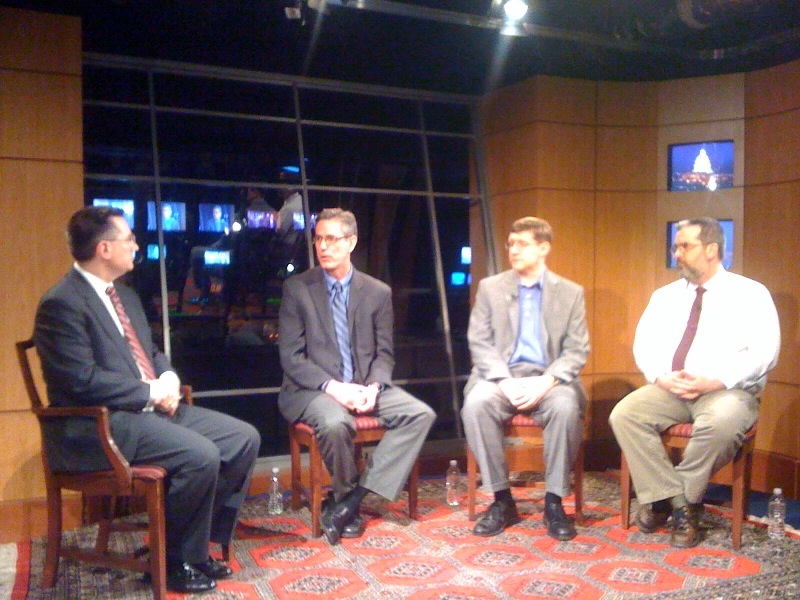
The media market in Washington, D.C. has been similarly affected by technological change, particularly as new, nimble online players have moved into the nation’s capitol. Last night, I visited FedNet’s officers in D.C. for the Online News Association‘s February meetup. The night featured a panel moderated by Keith Carney, President of FedNet and featured Mike Mills (@Mike_Mills), Editorial Director of the Congressional Quarterly/Roll Call Group; Howard Kamen (@hkamen) Partnership Editor for USA Today, and Karl Eisenhower, Editor, New Media Strategy for NationalJournal.com. Fednet will be posting video soon; in the meantime, the livestream I recorded is below:
Vodpod videos no longer available.

more about “#ONADC on USTREAM: The Online News As…“, posted with vodpod

The panel primarily focused on the business of online news as practiced by these different organizations. Congressional Quarterly (CQ) and Roll Call have a combination of a subscription model focused on high-value, scarce information gleaned from dedicated reporting on the minutiae of legislation, lobbying and political news. The combination of access, high value eyeballs and profit didn’t escape another provider of high value information: As Mills observed, the Economist Group owns both Roll Call and CQ now. The same media group also runs Congress.org, which Mills says is for “citizens to learn about Congress engage in grassroots activity.” He’s not worried about losing content to search engines, either, given a closed subscription model. “We’re not on the Internet, we’re on the intranet,” said Mills.

USA Today, by contrast, is a national newspaper with a generalist focus. According to Kamen, partnerships with other organization are providing USAToday.com with data for interactive graphics. Those interactive features in turn provide sustained traffic over time to support an advertising revenue model. When asked by Carney if a paywall might show up at USA Today to match the reported metered model at the New York Times, Kamen responded that “I don’t think that’s going to happen any time soon.” USA Today has moved into mobile news, recording over 2.5 million downloads of its free iPhone app. “We made it free to get eyeballs first,” said Kamen.

Even though the paper’s leadership has focused on retaining its position as the most widely circulated paper in the US, Kamen’s comments made it clear that USAToday.com is an important part of its future. “I truly think we do have an ‘online first’ model now,” said Kamen, although there coordinating print and online remains a “work in progress.”

The bridge between writers and coders has been bridged at National Journal, where Eisenhower said every newsroom has dedicated IT resources. The need to connect developers with reporters is felt across town, too: “The real merger that needs to happen is between editorial and IT,” said Mills.

National Journal is also shifting with the times, looking carefully at where and when readers are consuming their content. “Knowing our audience means knowing their work habits,” said -Eisenhower. “Mobile is very important.” Like other glossy weekly magazines, National Journal is experimenting with new advertising models as print circulation wanes.

Each publication also fits into a hypercompetitive emerging media landscape in DC. Whether it’s Politico, the DailyCaller.com, the Fiscal Times or Bloomberg’s coming “BGov” http://bit.ly/cTD1m8, there’s a host of new players that are competing for eyeballs and ad dollars with the Washington Post, Washington Times, the Hill, the Washington City Paper, the Metro Weekly. And that doesn’t even factor in local blogs like the DCist, KStreetKate and We Love DC, or the influence of NPR/WAMU and local TV stations.

What will 2010 bring? Innovation and disruption, without question. Certain takeaways from last night, however, should be of use to every media organization, even those without immense national circulations or access to information of interest to readers with attractive demographics for advertisers.

First, go where the readers are. Mills observed that failures in business models were often rooted in not following the audience to where they’re getting information.

Second, go mobile. Create applications, stripped down websites and email alerts that allow the audience to get news on the go.

Third, use data to create evergreen content. Organizations like Gallup or even governments themselves are providing data feeds or sets that can be used for interactive graphics.

Finally, get social. Facebook recently passed Yahoo as the second-most visited site in the world. Many news organizations are finding that social networks are a significant source of traffic, as the audience shares what it’s reading.

All in all, a great night. I enjoyed talking with the always-entertaining Tiffany Shackleford about celebrity culture online and Lee from NPR’s “Tell Me More” about digital distribution and syndication. Even as old models crumble, there’s no shortage of innovation in how we share the news in 2010.

Leave a comment

Filed under blogging, journalism, social media, technology, video

Voices from the #Gov20LA Unconference: On Innovation and #Gov20

Earlier this month, I stopped in Los Angeles to see what was happening at Goverment 2.0 LA, a hybrid of the unconference/camp and conference model organized by Alan W. Silberberg and Lovisa Williams. I’ve already shared some thoughts on what I learned about language of government 2.0, the history of disruptive innovation and the ways government adapts to technological change.

While I’m proud of those posts, one of the themes that emerged from the weekend was the importance of video for communication. I’m not at all on “video as the new text,” especially for countries with low Internet penetration or bandwidth, but there’s no denying that online video has extraordinary power in conveying messages. Just look at video of Iranian protesters on the streets of Tehran, reports from the earthquake in Haiti or the President of the United States on YouTube. Tune in to CitizenTube any minute of the day to witness that power in action.

Following are short videos from Gov2.0 LA organizers and attendees that share their takeways from the event.

Lovisa Williams

@lovisatalk talks about the goals of the Gov2.0 LA Camp.

Ben Berkowitz

@BenBerkowitz is the CEO of SeeClickFix.

Lewis Shepherd

@LewisShepherd discusses collaborative technology and government.

Wayne Burke

@wmburke talks about Govluv.org, on online platform for connecting to government representatives using Twitter.

Antonio Oftelie

@AntonioOftelie conducted a Government 2.0 Survey for Harvard’s Kennedy School.

Alan Webber

@AlanWebber talks about the international flavor of the Gov2.0 LA Camp.

Laurel Ruma

@LaurelRuma on her impressions from Day 1.

Lisa Borodkin

@LisaBorodkin on the language of Government 2.0.

Christina Gagnier

Christina @Gagnier on communicating about Government 2.0.

Justin Herman

@JustinHerman goes West Coast.

Adriel Hampton

@AdrielHampton on his impressions from Day 1.

Finally, here’s GovFresh.tv‘s video that features interviews with some of the people above and more:

2 Comments

Filed under application, blogging, friends, journalism, microsharing, research, social bookmarking, social media, technology, Twitter, video