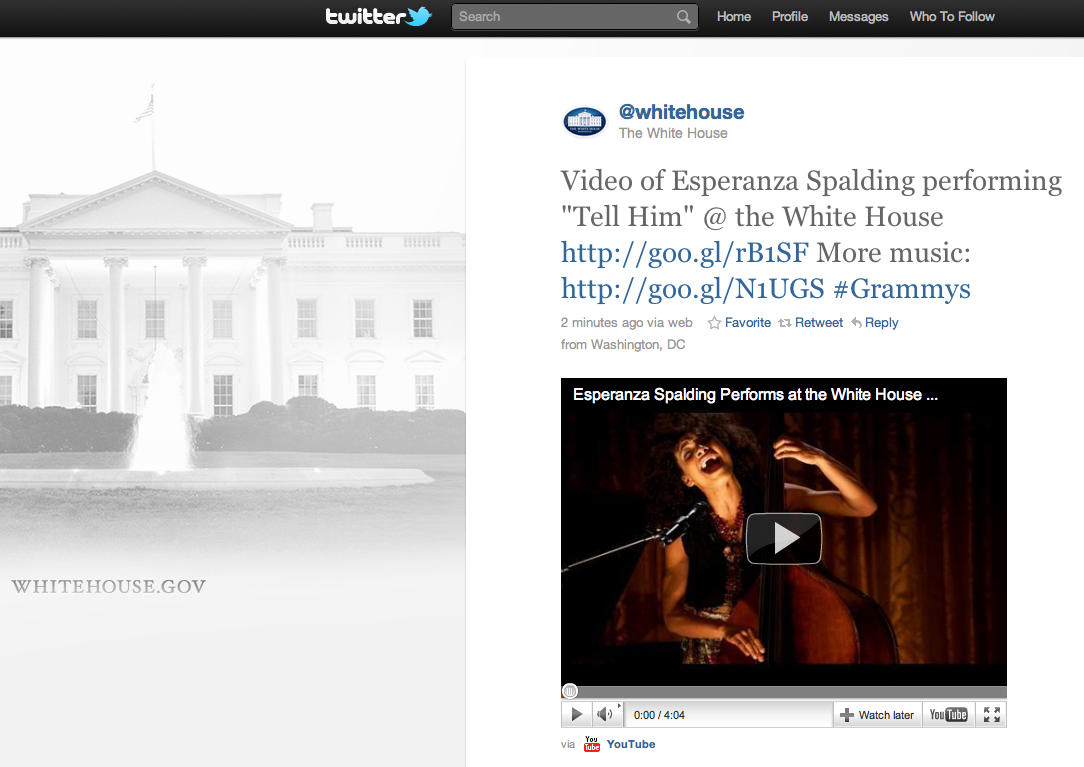
Esperanza Spalding won a Grammy for Best New Artist tonight. She’s an extraordinary talent. Moments after her win, White House new media director Macon Phillips congratulated her on Twitter and linked to a video of her performance at the White House Poetry Jam on YouTube:
Shortly after that, the White House account shared the same video, along with a link to all of the performances on the White House YouTube channel.
It’s good to know there are some music fans down the road at 1600 Pennsylvania Avenue. Congratulations to Spalding for the well-deserved recognition.
Some days, a joyous video can bring a tear to your eye. (That happens even more easily to when you’re planning your own wedding.) This “flash wedding” in Prudential Center last December in Boston did just that, riffing on the idea of a “flash mob.”
Unlike many flash mobs, however, this one had a point. Mazel tov, folks.
2010 was full of amazing stories and experiences, both personal and professional. I’m grateful for the many opportunities I had speak to brilliant, fascinating people about technology, government, media and civil society. I’ve learned a tremendous amount from my interviews this year, many of which were captured on video. Some were filmed with my iPhone 4, others with a Canon 110si, others by O’Reilly Media’s professional video team after I joined the company as its new Gov 2.0 Washington Correspondent.
Regardless of the quality of light, image or sound, each interview taught me something new, and I’m proud they’re all available on the Web to the public. The list below isn’t exhaustive, either. There are easily a dozen other excellent interviews on my channel on YouTube, O’Reilly Media’s YouTube channel, uStream and Livestream. Thank you to each and every person who took time to talk to me this past year.
20. Professor Fred Cate on electronic privacy protections and email
19. Google Open Advocate Chris Messina on Internet freedom
18. Foursquare Creator Dennis Crowley on the NASA Tweetup and #IVoted
17. Co-Chairman of the Future of Privacy Forum Jules Polonetsky
16. NASA CTO Chris Kemp on cloud computing and open source
15. Portland Mayor Sam Adams on open data
14. Former Xerox Chief Scientist and PARC Director John Seely Brown on education
13. NPR’s Andy Carvin on CrisisWiki
12. ISE Founder Claire Lockhart on government accountability
11. Cisco CTO Padmasree Warrior on the evolution of smarter cities
10. Ushahidi Co-Founder Ory Okolloh on crowdsourcing
9. Senator Kate Lundy on Gov 2.0 in Australia
8. Intellipedia: Moving from a culture of “need to know” to “need to share” using wikis
7. ESRI Co-Founder Jack Dangermond on mapping
6. Sunlight Foundation Co-Founder Ellen Miller on Open Government
5. HHS CTO Todd Park on Open Health Data
4. FCC Tech Cast with Expert Lab’s Gina Trapani
3. Apple Co-founder Steve Wozniak on the Open Internet
2. United States CTO Aneesh Chopra on Open Government
Last weekend, I was proud to join a fascinating group of people in the first News Foo out in Phoenix, Arizona. I’m still thinking through what it all meant to me. Covering events in Washington has kept me extremely busy from the moment I returned.
Almost by definition, you can’t go to everything at an unconference. And by definition, an unconference is what you make of it, meaning that if you to a session to happen, you need to propose it. If you don’t like the one you’re in, vote with your feet. The open structure means that everyone will have a different experience, a reality that was reflected in the tweets, blogposts and feedback that have emerged in the days since the first News Foo concluded in Phoenix.
Newsfoo is a variant of Tim O’Reilly’s famed Foo camps, which have a wiki unconference format. People create the sessions as they go, and they camp out together. The social + intellectual experience is a bonding opportunity. There is also, for example, a Sci Foo camp which is consponsored by O’Reilly, Nature mag and Google. Now there is a push to do a Newsfoo, which would bring technologists and journalists together in a high-level discussion, that looks forward rather than back. It would tackle cool problems, both content side and business side.
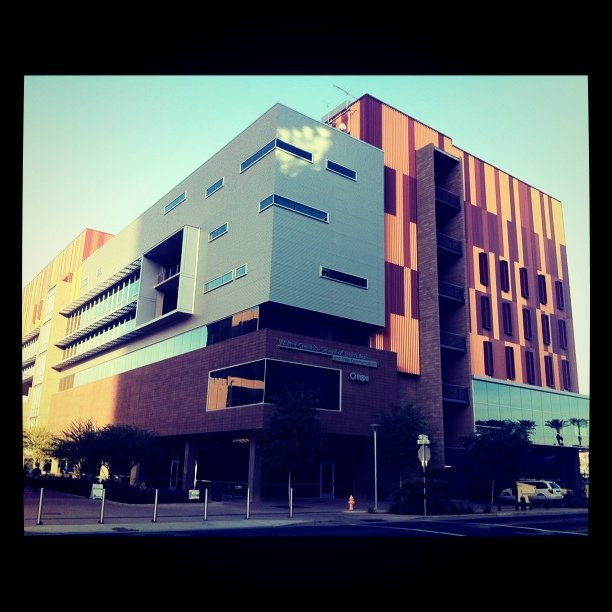
To expand on that concept, posted before the event, News Foo was a collaboration between O’Reilly Media, Google and the Knight Foundation. Each hour or so, four or five sessions frequently competed for attention, along with freewheeling conversations in hallways, tables and in the open spaces of Arizona State University’s beautiful journalism center. As with every unconference, the attendees created the program and decided which sessions to attend, aggregating or disaggregating themselves.
If you’re interested in other reactions to News Foo, several excellent posts have made their way online since Sunday. I’ll be posting more thoughts on Newsfoo soon, along with book recommendations from the science fiction session.
For those who were not present, a post by Steve Buttry is particularly worth reading, along with the lively dialogue in the comments: “News Foo Camp: Not fully open, but certainly secret.” Buttry reached out to Sarah Winge, who provided a lengthy, informative comment about what Foos are about and how “Friend D.A.” works. If you’re not familiar with either, go check out Steve’s excellent post.
As he notes there, heavy tweeting was discouraged by the organizers, a request supported by the thinking that being “fully present,” freed of the necessary attention that documenting an event accurately requires of a writer, will result in a richer in-person experience for all involved.
Over the course of the weekend, I certainly tweeted much less than I would at the average conference or unconference. But then foo isn’t either.
I did take a few moments to share resources or stories I heard about at newsfoo with my distributed audience online. Following are 28 tweets, slightly edited (I took out the #Newsfoo hashtag and replies in a few) that did just that, rather like I’d microblogged it. If you’re confused about the “twitterese” below, consult my explainer on the top 50 Twitter acronyms and abbreviations and my thinking on how #hashtags on Twitter are like channels on cable TV. For many more tweets from other attendees, check out “Newsfoo at a Distance,” a Storify curation.
1. #Newsfoo is an unconference in Phoenix, AZ this weekend. Technologists & journalists talking about “what’s next.”
Earlier tonight, ReadWriteWeb dropped the news that PBS has rolled out a major new redesign. The news about the rebooted PBS.org and a new iPad app confirmed a notable aspect of the digital future that PBS vice president of digital strategy, Robert Bole, described at Fedtalks. His talk is embedded below:
As Curt Hopkins points out at ReadWriteWeb:
18 months ago, PBS launched an initiative to make the public broadcasting corporation’s site a player in multimedia. They introduced their media player, made 4,700 hours of broadcast offerings available for free, created mobile apps for kids and rolled out a subscription-based teaching platform. The next several months may add significantly to the organization’s new media juice.
Along with that iPhone app, “PBS 2.0” includes national-local integration of programming. People that follow how convoluted the licensing and syndication of public media can be for local stations know that’s a notable evolution.
New PBS apps for the iPhone and iTouch are also on the way. Note: Android apps are “on the road map” but don’t have a delivery date at the moment. I don’t think PBS is afflicted with “shiny app syndrome,” exactly, but it will be worth watching to see if an Android app is forthcoming, along with HTML5 support and more mobile optimization.
In the meantime, PBS viewers who want to watch full length episodes of programs like Frontline can now do so on demand using a Web browser. They can watch Sesame Street on YouTube. And, of course, viewers can let the folks behind all of it know what they think about it and engage them at @PBS on Twitter or Facebook.
The press release about PBS 2.0 also highlights the premiere of the first full episode of series CIRCUS, a documentary about life at the Big Apple Circus, on the new iPad app. CIRCUS can also be streamed today, in advance of the broadcast premiere.
I’ve only been a resident of the District of Columbia for a year or so but, man, does this rap by Remy hit some funny bones. (Sore ones today, given my broken toe.) He laid this down at this year’s Fedtalks, with a big old shoutout to DCRepresents.com.
And here’s an acoustic version of Remy’s DC Metro rap that blew up on YouTube:
“Design is really part of life. In particular, it’s a fundamental ingredient for progress. When technology people and when scientists create revolutions or create something new, designers are the ones who make these revolutions into objects that people can use.”
-Paola Antonelli at this year’s Web 2.0 Expo in New York City.
It’s a marvelous talk, if you’re into art, technology, design or human creativity.
Antonelli also introduced the Web 2.0 community to an exciting prospect:
Talk to Me is an exhibition on the communication between people and objects that will open at The Museum of Modern Art on July 24th 2011. It will feature a wide range of objects from all over the world, from interfaces and products to diagrams, visualizations, perhaps even vehicles and furniture, by bona-fide designers, students, scientists, all designed in the past few years or currently under development. –Talk to Me blog
Booked: A trip to NYC to visit the MoMa next summer!
As a huge fan of Matt Groening, a long-time Apple customer and a serious Twitter user, I found a recent episode of Futurama, “Attack of the Killer App,” to be crackling good satire. Excerpt below:
Futurama’s focus on Apple is, of course, nothing new. Series co-founders David X. Cohen and Matt Groening are both big Apple nerds. We previously chronicled Futurama’s subtle and comical use of Apple and Mac references over here.
The viral Twitworm that creates many zombies is one of the best pop references to botnets and IT security I’ve seen recently, too. And there was one more (seriously geeky) detail that Engadget, Edible Apple and Mashable missed:
“When did the Internet become about losing your privacy?” asks Fry.
The WWW project merges the techniques of information retrieval and hypertext to make an easy but powerful global information system.
The project started with the philosophy that much academic information should be freely available to anyone. It aims to allow information sharing within internationally dispersed teams, and the dissemination of information by support groups.
Reader view
The WWW world consists of documents, and links. Indexes are special documents which, rather than being read, may be searched. The result of such a search is another (“virtual”) document containing links to the documents found. A simple protocol (“HTTP”) is used to allow a browser program to request a keyword search by a remote information server.
The web contains documents in many formats. Those documents which are hypertext, (real or virtual) contain links to other documents, or places within documents. All documents, whether real, virtual or indexes, look similar to the reader and are contained within the same addressing scheme. To follow a link, a reader clicks with a mouse (or types in a number if he or she has no mouse). To search and index, a reader gives keywords (or other search criteria). These are the only operations necessary to access the entire world of data.
On the 47th anniversary of his father’s “I Have A Dream” speech, MLK III spoke at the site of the future memorial. The full version of Martin Luther King Jr’s speech from the steps of the Lincoln Memorial is embedded below:
The video begins with the sound of “We Shall Overcome,” the most prominent freedom song of the civil rights movement. Today, the site of the future memorial rang with over a thousand voices raised in song.
Emerging technology has the power to make democracy stronger or weaker. Understanding where, when, and how is the hard part. Subscribe to Civic Texts to get insights about how technologies are changing our democracy in your inbox.



 digiphile