Category Archives: Twitter

Using social media for better journalism: @Sreenet at #ONADC

“I used to say “justify every pixel,” said Sree Sreenivasan. “Now I say earn every reader.”

Sreenivasan, a dean of student affairs and professor at the Columbia Journalism School, went beyond “what Jeff Jarvis calls the blog boy dance,” offering up more than an hour of cogent advice, perspective and tips on social media to a packed classroom populated by members of the DC Online News Association at Georgetown’s campus in Virginia.

Where once he used to go around newsrooms to talk about email, then Google and blogs, now he’s moved to new tools of digital journalism grounded in a reciprocal relationship between the audience and the reporter. After all, Sreenivasan had to tailor his talk to the audience, a collection of writers, editors and producers already steeped in the tools of digital journalism, moving quickly beyond listing Twitter, Facebook and LinkedIn to the tools and services that that enable journalists to use those social media platforms improve their reporting, editing and careers.

“The best people find the things that work for them and skip the rest,” said Sreenivasan. Services need to be useful, relevant and extend the journalist’s work. Quoting a student, now at the Wall Street Journal, Sreenivasan observed that you “can have greatest content in world but will die on the vine if we don’t have a way for our readers to find it.” He classified the utility of social media for journalists into four broad categories:

  • tracking trends on a given beat
  • connecting with the audience, where ever it is online
  • putting that audience to work, aka crowdsourcing
  • building and curating the journalists personal brand

“Tools should fit into workflow and life flow,” he said. “All journalists should be early testers and late adopters.” In that context, he shared three other social media tools he’s tried but does not use: Google Wave, Google Buzz and Foursquare. Sreenivaan also offered Second Life as as an example, quipped that “I have twins; I have no time for first life!”

The new Listener-in-Chief

One group that undoubtedly needs to keep up with new tools and platforms is the burgeoning class of social media editors. Sreenivasan watches the newly-minted “listeners-in-chief” closely, maintaining a list of social media editors on Twitter and analyzing how they’re using the social Web to advance the editorial mission of their mastheads.

He showed the ONA audience a tool new to many in the room, TagHive.com, that showed which tags were trending for a group. What’s trending for social media editors? This morning, it was “news, love, work, today, great, people, awesome and thanks.” A good-natured group, at least as evidenced by language.

Sreenivasan also answered a question I posed that is of great personal interest: Is it ethical to friend sources on social networking platforms?

The simple answer is yes, in his opinion, but with many a caveat and tweaks to privacy settings. Sreenivasan described the experiences of people in NGOs, activists and other sources whose work has been impaired by associations on social media. To protect yourself and sources, he recommended that Facebook users untag themselves, practicing “security by obscurity,” and use lists. As an example of what can go wrong, he pointed to WhatTheFacebook.com.

Where should journalists turn next for information? Follow @sreenet on Twitter and browse through the resources in his social media guide, which he referenced in the four videos I’ve embedded in this post. He’s a constant source of relevant news, great writing and good tips.

1 Comment

Filed under blogging, education, journalism, social bookmarking, social media, technology, Twitter, video

Is it ethical for journalists to “friend” sources on Facebook or LinkedIn?

In this video, Sree Sreenivasan, dean of student affairs & professor at the Columbia Journalism School, answers my question about whether it’s ethical for journalists to friend sources on social networks like Facebook or LinkedIn. Sreenivasan was speaking at a workshop on social media tools and tips hosted by the Online News Association in Arlington, Virginia.

Sreenivasan has posted many useful social media resources.

5 Comments

Filed under journalism, social media, technology, Twitter, video

Tech Term of the Week: Location-based service (LBS) bacn

Over the past year, I’ve grown increasingly frustrated by the prevalence of notifications about mayorships and badges on Foursquare or finds on Gowalla.

During the SXSW festival, it grew monumentally worse.

As location-based services (LBS) like Foursquare and Gowalla have picked up users over the past year, many of them have chosen to share their activity on Twitter.

I have a term for that sort of notification, pushed towards followers: “LBS bacn.

I define LBS bacn as default notifications from location-based services that are autoposted to social networks.

In my view,  LBS bacn adds bits and bytes of “datafat” to otherwise useful lifestreams. For those who aren’t familiar with this porktacular digital slang, Wikipedia defines bacn as:

email which has been subscribed to and is therefore not unsolicited, but is often unread by the recipient for a long period of time, if at all. Bacn has been described as ’email you want but not right now.'”

According to WhatIs.com’s definition for bacn,

“The term was coined in August 2007 at Podcamp Pittsburgh, a social media “unconference” attended by bloggers and podcasters. The term “bacn” was chosen because of its similarity to spam. Both are popular pork products and both can fill up your inbox pretty quickly. The term “ham,” by way of contrast, is sometimes used to refer to email that a user wants to both receive and read right away.”

Some of Foursquare, Gowalla, BrightKite or other location-based service post can be useful or entertaining. After all, a location is a relevant response to Twitter’s original question: “What are you doing?” After all, it’s not so far off as an answer to the new question, “What’s happening?” either.

Annotated locations are even interesting, in most cases. One of the best check-ins of that sort pushed to Twitter came from Amy Senger, who tweeted:

“Skilling v the U.S. (@ Supreme Court of the United States) http://4sq.com/6HSdgV

But LBS bacn, at least to me on Twitter, is not. As ever, with Twitter everyone’s approach will be different. And if LBS bacn gets too much from a given source, it’s much easier to stop reading it then to give up bacon in the real world: you can just unfollow the bacnator. I don’t hate the idea of a location-based services, or the people that use them,  although location-based services do raise online privacy concerns. Everyone will can — and will — use Twitter differently, so don’t please take this as me telling anyone what to do.

I’m just as tired of reading LBS bacn as I am of notifications from Facebook or updates that I have new friends on Friendster. No, Seriously.

/rant

Leave a comment

Filed under application, social media, technology, Twitter

Anil Dash on Expert Labs, useful online communities and “.com as the new .gov”

“Politicians know they can use social media to talk to people. What they don’t know yet is how to listen.”

That was Anil Dash’s summary of a basicchallenges that lie ahead for many world’s representatives as they explore Twitter, Facebook, YouTube, blogs and other online platforms that allow reciprocal communication. Last year, he wrote that “the most Interesting new tech startup of 2009” was government.

Dash knows a thing or two about tech startups as the first employee of Six Apart LLC, one of the world’s leading blogging companies. He understands online engagement too, after blogging at Dashes.com since 1999. Now, however, he’s set his sights on an even bigger goal: transforming the ways citizens relate to their government through social media using a startup mindset.

2010-03-11-anildashdebbieweil.jpg

Speaking to a group of “digerati” at Baked and Wired, a chic purveyor of cupcakes and Internet in Washington’s tony Georgetown neighborhood, Dash laid out his vision for Expert Labs, “a new independent initiative to help policy makers in our government take advantage of the expertise of their fellow citizens.”

The first project at Expert Labs will be a “ThinkTank App,” an open source web application that aggregates and organizes replies to status updates on Twitter. ThinkTank App was developed by Lifehacker founder Gina Trapani, who has signed on with Expert Labs to develop the platform.

The event was the fourth “Sweets and Tweets” event produced by corporate social media consultant Debbie Weil.

The first client for Expert Labs is one that would make most startup founders swoon, too: the White House will be using the ThinkTank app to get better answers from citizens.

As Dash wrote in describing “Expert Labs, Gina Trapani, ThinkTank App and our Grand Challenges,” he’ll be collaborating with the White House in support of the Grand Challenges initiative.

“We want to create a different space for participation that rewards good answers, said Dash. He cited several online websites with communities that allow meaningful exchange of information without the ugliness that pervades many comment boards, including stackoverflow.com, ask.metafilter.com and the site his wife manages, SeriousEats.com.

“We need to establish our priorities as a nation, with citizens as the think tank,” said Dash.” If we can go from six people in closed door room to sixty thousand addressing a problem, that will be a small win.” Dash asserted that the disruptive influence of online collaborative tools will cause “entire federal agencies will be transformed, just as newspapers have been.”

Given the immense economic, social and technological challenges that lie ahead for the United States and the world in this young 21st Century, that’s a vision worth keeping an eye on.

Dash’s talk was livestreamed on uStream and may be viewed there. Debbie Weil has also blogged about Anil Dash and Expert Labs, along with DC cultural maven @KStreetKate‘s write-up on NBCWashington.com@ClearedJobsNet has also posted photos from the event.

As Weil shared on her blog, there’s no shortage of other places to learn more about Dash’s progress or last night’s event:

Leave a comment

Filed under application, article, blogging, social media, technology, Twitter

Tech delegation explores Siberia, looks for connection through digital diplomacy [#RusTechDel]

Delegations from the State Department to Russia haven’t generally been accompanied by  great fanfare. In an information age where a growing social layer for the Internet provides unprecedented means for people to share their experiences online, the progress of the “innovation delegation” through Moscow and Siberia has been marked by a steady progression of tweets, online video and photos.

This is, after all,  a group of “geek luminaries” that has considerable reach online and into popular culture. Unsurprisingly, the member of the tech delegation that’s attracted both the attention of mainstream media in the US and fans abroad is Hollywood actor Ashton Kutcher. Kutcher brought with him more than 4.5 million followers as Twitter’s most-followed user (@aplusk) and, perhaps even more crucially, an iPhone equipped with a video camera and a uStream account.

The delegation is led by Jared Cohen of the State Department’s Office of Policy Planning and Howard Solomon of the National Security Council. US Chief Technology Officer Aneesh Chopra joined them in Moscow. They  are also traveling with:

“We’re trying to look at how Russia can utilize its population as a health resource, as an education resource, as an anti-corruption resource, as an anti-trafficking resource,” said Cohen, as quoted at Wired’s Epicenter blog.

According to Wired:

“the group hopes to emerge with clear deliverables. Women in remote areas could receive information — either online or using the SMS feature on their cellphones — on how to have healthy pregnancies. And in order to prevent Russian cellphone companies from being pressured into divulging the names and locations of those who report human-trafficking violations by SMS, the complaints could be cleaned and anonymized outside of the country, according to Cohen.

“The State Department is not bringing these people over as CEOs,” Cohen added. “John Donahoe is the CEO of eBay, but he’s also an expert on e-commerce and building platforms that move large sums of money in ways that aren’t corrupt, so he’s an expert on ‘e-anti-corruption.’”

The success of the mission hit at least one roadblock: Moscow traffic.

Despite tweeting about people, the ballet, the Kremlin, food and one another, the tech delegation was quiet about missing a meeting with Russia’s communications minister — and six Russian tech companies.

Other visits, at least viewed from through Kutcher’s livestream and Cohen’s able narration, have been more productive. Twitter gained another high profile user, after Jack helped Donahoe sign up on Twitter.
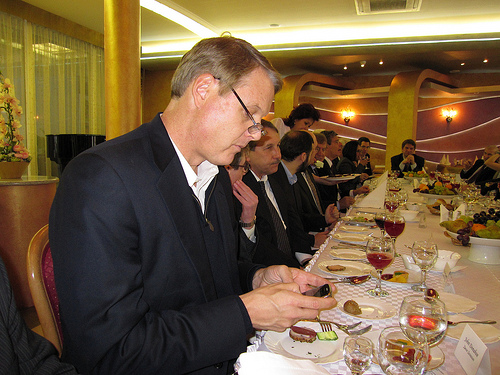

[http://www.flickr.com/photos/edyson/ / CC BY-NC 2.0]

Sometimes the best record of an event is in pictures of the delegation’s progress. Three of the pictures in this post  are from Esther Dyson’s Flickr photostream. While the tweets of delegation tell a tale, as do reactions from Russian students and the rest of the online audience, her pictures and captions is the most eloquent storytelling I’ve encountered to date.

Search engines and science

What’s the fastest growing search engine in the world? Apparently  Yandex.ru, as the delegates learned when they visited Yandex.ru headquarters. The Russian search engine has the fastest rate of growth in the world, according to Comscore. After we met on Twitter, Nick Wilsdon also shared statistics on Russia’s top social networksVKontakte.ru & Odnoklassniki.ru.

Students and social media

As with students elsewhere,  Russian students are using phones and social networking to exchange information. Warrior shared a picture of the students gathered at Novosibirsk on Twitter, tweeting about an “energizing chat w/ univ students, topics ranged from talent, innov., corruptin, beer pong.”

Given the return of state control of domestic television networks in Russia, the Internet’s role as a vital means of communication and global news has perhaps never been as acute.


What else will come of the “innovation delegation?”

Veterans of the Cold War might wonder why the U.S. or its entrepreneurs are offering advice or a forum to a former opponent. Even if the “missile gap” is a remnant of the past, Russian and U.S. relations haven’t been exactly sunny over the decades.

It may be that this delegation is a physical expression of the hopes that Hillary Clinton expressed in her speech on Internet freedom. And, in fact,  Jared Cohen tweeted the State Department’s  innovation delegation is  “an example of 21st century statecraft driven by Hillary Clinton.”

But putting concerns about aiding Russian industry aside, creating the conditions that make Silicon Valley or NYC fertile grounds for tech entrepreneurship won’t be easy. “We’re developing joint projects w/Russia on education, anti-trafficking, health, e-gov, anti-corruption using tech,” Cohen tweeted earlier today.

“Novosibirsk is Russia’s 4th largest city,” tweeted Cohen, “less than 100yrs old, Russia’s hub of innovation, & just northeast of India in middle of Siberia. [The] challenge in Siberia is not lack of innovation, but rather avenues for entrepreneurs to attract start-up capital.”

Giving young Russian entrepreneurs confidence about both patents and ownership of intellectual property would help, as would mentors. “I’ve been interested in Russia, working in computer science, engineering, mathematics for a long time,” said Dorsey in Novosibirsk. “Russia has been a major part of the story. I’ve found that there’s a real desire to create projects and an entrepreneurial spirit but not enough face to face discussion.”

Dorsey pointed out that the U.S. tech community regularly has meetups in Silicon Valley and New York City where the largest companies constantly invite people to come in. “When you have that supportive culture, it’s very easy to take risks,” he said. In Russia, Dorsey observed, “There’s not this desire, or a structure, or momentum, to get together and talk about what we want to create together. If you bring people who can fund this from the beginning, you start building angel networks, which are the basis for all innovation in the US these days.”

Desire, control of intellectual property and a tech community would be an incremental change on a larger continuum. As Fraser Cameron wrote in a recent op-ed in the New York Times, Russian President Dmitri Medvedev has called for a number of reforms, including a return to elections and freedom.

Cameron points out that Putin “failed to encourage investment in new industries, technologies or infrastructure.” In that context, will access to Western angel investors or social media matter?

Or, to reiterate the questions I asked to the delegation last night:

What uses of tech do Russians admire in the US? Where could new ICT help there now? How important is free, open speech to stimulating a culture of innovation? What about the use of open source tech? (Listen in for answers in Kutcher’s archived streams.)

Kutcher (above, in his own Twitpic) evidently has gained some perspective, at least on the impact of state involvement. “My perception of Russia and Russian technologists was always based on Russia’s ability and interest in scientific achievement,” he said. “The one thing I’ve found since we’ve been here, without Russian government controlling the room, is that it becomes a much more vibrant, expressive room. My perception of control levels and the reality were two different things.”

Donahoe, former head of Bain & Company, had different considerations. He said that while he saw potential to expand eBay into Russia, it would be on the condition: that law enforcement and the Russian government cooperate on anti-cybercrime.

Donahoe was impressed by a number of experiences, particularly in a new view of Siberia. “There’s a wealth of talent, real opportunity to build on a tech center,” he said. “I’m truck by the talent of Russian engineers. They should continue to play a leadership role in the World Wide Web, as they have continued to do with Google, Paypal and  Skype.”

On techno-utopianism and digital diplomacy


[Photo Credit: Jarod Liebman]

The ability of social media platforms to provide a platform for conversations was repeatedly shown in 2009, particularly in Iran’s elections. As Jack said to ABC News, “when you can see more of what’s happening you can really see more of the opposition is arguing about and take those arguments head on and have a conversation about them.”

The same communication tools can and have, however, been used in “digital dictatorships,” as Evgeny Morosov wrote in the Wall Street Journal on Saturday. Rita J. King’s considered rebuttal in the “The Evolution of Revolution,” pointing out where digital diplomacy has had effect.

Cohen’s own involvement in the Alliance of Youth Movements (AYM) conferences would seem to extend from a similar belief in the potential for 21st Century statecraft.

Some of the most important interactions, after all, are likely to always be in person. As Jack tweeted, “having lunch together is so much more important to creating something than a business meeting -@edyson.”

The role of ICT
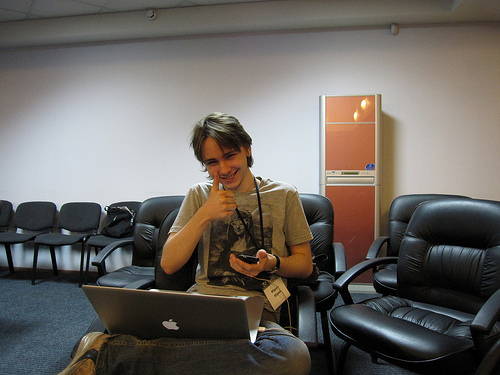


[Yuri Marin of Samizdal.ru, a self-publishing/printing site in Novosibirsk. Credit: http://www.flickr.com/photos/edyson/ / CC BY-NC 2.0]

As I listened to the discussions with Russian technologists about what could be done to improve innovation, particularly for civic gain, I thought of a long post that MIT Professor Andrew McAfee posted earlier this month on information and communication technologies (ICT).

As he wrote in “The Oxygen of Bandwidth, or How I Spent My Winter Vacation,” “researchers report that people in the developing world are willing to skip meals in order to buy more bandwidth.”

McAfee’s advice for helping the people of the developing world is simple: “Help them acquire technology that lets them help themselves, and that lets others help them. To paraphrase Winston Churchill: give them the ICT tools, and they will finish the job.”

Mitigating the dangers of journalism in Russia isn’t likely any time soon., but given Russia’s technological base, many of its engineers, students and scientists are equipped with the ability to create such tools already.

Whether this trip will create avenues for better communication, investment in startups or anti-corruption is an open question. It’s one of many that the delegates themselves will no doubt continue to answer in the days ahead.

Leave a comment

Filed under article, photography, research, social bookmarking, social media, technology, Twitter

The world “diggs” virtual farming for social gaming online [#RusTechDel]

Russians and Americans both love virtual farming?

The popularity of  Zynga’s “Farmville” for among Facebook’s 400 million users is well known. Given 69 million active monthly players, Farmville is bigger than Twitter.

A less publicized statistic is that users of Russia’s top social network, VKontakte.ru, also have a farming application the top social game.

Earler today, I met Nick Wilsdon, a Russian online marketer, by following the #RusTechDel hashtag on Twitter.  (In doing so, I was reminded again that #hashtags on Twitter are like channels on cable TV.) I asked Wilsdon if he knew how many unique visitors vKontackte & others receive monthly.

Wilsdon answered with a quick report on vKontackte and Odnoklassniki.ru. According to the statistics he cites, “Happy Farmer” has more than 6 million users and revenues estimated at $200 million dollars per month.

Judging from the gallery of Happy Farmer fans at English Russia, the social game has inspired a passionate following.

And, as a post at The Next Web points out, a farming game is atop the list of most popular social games in China.

Whether or not gaming addiction is an issue, China’s burgeoning social gaming market shows how popular – and profitable – this phenomenon has become.

As VentureBeat’s reporting on online faming games suggests, there’s a “new agrarian revolution” in China. It’s tempting to summarize a global interest in social gaming on the farm as a common virtue, as millions tend virtual gardens for a few minutes every day across different cultures.  It would be lovely if it spoke to yuor shared interest in growing things.

Unfortunately, there’s a dark side to virtual farming parallel to perils of factory farming in the real world: the profit motive.

As Elliott Ng writes:

Some fear that this new social farming revolution may not contribute to the positive development of society. A central feature of social farm games in China is stealing vegetables. Official state media People’s Daily reports that 70 percent of users on Kaixin001 cite it as their favorite feature, and it has even spawned the popular phrase “How many vegetables have you stolen today?”

This key addictive feature has created news stories of business executives “obsessed” with stealing vegetables and broken relationships over vegetables stolen on the night shift. The game is so addictive — with players setting alarm clocks at all hours of the night to check crops — that it 
“destroys jobs and relationships.”

“Simplicity and stickiness are behind the global epidemic of farm games. Anyone can learn to grow crops within minutes and reap a reward for getting friends — or the entire office — addicted too,” said BloggerInsight Co-Founder Lucas Englehardt.

There’s a business in serving that intense interest, along with providing others a means to slay monsters in World of Warcraft. There’s no small amount of psychology at work behind the incentive structures of these games, as designer look for ways to induce users to spend money on virtual good or services. And, as Michael Arrington pointed out in “Scamville” in TechCrunch last year, the “social gaming ecosystem” can lead to bad behavior.

For good or ill, however, more of us are planting virtual seeds each day.

Leave a comment

Filed under blogging, research, social media, technology, Twitter

Voices from the #Gov20LA Unconference: On Innovation and #Gov20

Earlier this month, I stopped in Los Angeles to see what was happening at Goverment 2.0 LA, a hybrid of the unconference/camp and conference model organized by Alan W. Silberberg and Lovisa Williams. I’ve already shared some thoughts on what I learned about language of government 2.0, the history of disruptive innovation and the ways government adapts to technological change.

While I’m proud of those posts, one of the themes that emerged from the weekend was the importance of video for communication. I’m not at all on “video as the new text,” especially for countries with low Internet penetration or bandwidth, but there’s no denying that online video has extraordinary power in conveying messages. Just look at video of Iranian protesters on the streets of Tehran, reports from the earthquake in Haiti or the President of the United States on YouTube. Tune in to CitizenTube any minute of the day to witness that power in action.

Following are short videos from Gov2.0 LA organizers and attendees that share their takeways from the event.

Lovisa Williams

@lovisatalk talks about the goals of the Gov2.0 LA Camp.

Ben Berkowitz

@BenBerkowitz is the CEO of SeeClickFix.

Lewis Shepherd

@LewisShepherd discusses collaborative technology and government.

Wayne Burke

@wmburke talks about Govluv.org, on online platform for connecting to government representatives using Twitter.

Antonio Oftelie

@AntonioOftelie conducted a Government 2.0 Survey for Harvard’s Kennedy School.

Alan Webber

@AlanWebber talks about the international flavor of the Gov2.0 LA Camp.

Laurel Ruma

@LaurelRuma on her impressions from Day 1.

Lisa Borodkin

@LisaBorodkin on the language of Government 2.0.

Christina Gagnier

Christina @Gagnier on communicating about Government 2.0.

Justin Herman

@JustinHerman goes West Coast.

Adriel Hampton

@AdrielHampton on his impressions from Day 1.

Finally, here’s GovFresh.tv‘s video that features interviews with some of the people above and more:

2 Comments

Filed under application, blogging, friends, journalism, microsharing, research, social bookmarking, social media, technology, Twitter, video

Google Buzz: adding algorithmic authority and relevance to social media

A few minutes ago, Google Buzz went live at http://buzz.google.com. Google posted a video introducing the Buzz, which ties together Google contacts into a distributed social network accessed through a new tab in Gmail.

In a live webcast on YouTube, Bradley Horowitz (@elatable) explained what Google was after with Buzz: a way to add relevance to the information firehose represented by social messaging and activity. The Web application will act as a user interface to for social data.

Based upon the demo, it will be a snappy app for processing, sharing and annotating images, video and conversations. “Organizing the world’s social information has been a large problem, the kind @Google likes to solve,” said Buzz product manager Todd Jackson, explaining at least some of the why behind the application of algorithmic authority to social media. Jackson writes more in his introduction to Google Buzz at Google’s official blog.

Content shared on Buzz can be posted publicly to a Google Profile (like the one for, say, Alexander Howard) or sent privately within a network. At first glance, the user interface and contrls looks like a Friendfeed clone, with the additional of familiar keyboard shortcuts from gmail and Google Reader. And, notably, Google has adopted the “@reply” convention from the Twitter community as a means of initiating a conversation with contact.

To get a user started with a network, Buzz will autofollow people you’ve emailed. In other words, as Jeremiah Owyang predicted last summer, Google made email into a social network.

Buzz is also mobile.

The mobile Web application, which works on both iPhone and Android, includes geotagging and voice recognition, allowing the user to make spoken updates. While Google profiles will aggregate a user’s Buzz activity, “Places” will aggregate location-based reviews. (In other words, look out Yelp.) A “Nearby” button provides location-based context for Buzz users. Google also launched a new mobile verion of  Google Maps, adding a a social layer to its maps. The new “conversation bubbles” on Google Maps indicate geotagged Buzz updates and look like a lightweight, useful version of Twittervision.

Coming soon to the enterprise

Google Buzz will be launched as an enterprise product, says Horowitz. Buzz would likely serve as microblogging layer for Google Apps, providing helpful filtering for the noise of the social Web, unlike Wave, which added it. “A lot of the functionality is inspired by Wave,” said Horowitz, a likely nod to a decision to adopt the best features of the often maligned social messaging platform.

Google co-founder Sergey Brin was on hand to share his personal experience with Buzz, offering a preview of how it might be pitched to other business executives or CIOs. “I found a huge amount of productivity from using Google Buzz internally,” said Brin. “I posted [an] OpEd to Buzz. I looked at the broad categories and did a general edit based on that feedback. It was far more efficient.”

Open APIs?

Public feeds are supported as an XML feed and are fully supported by PubSubHub as of today, said another Google exec. By going open API and openly courting developers to join them on Google Code, Google may be after the same fertile ecosystem that surround Twitter.

What does Google Buzz mean?

All of the above gives an idea of what Google’s newest Web application can do and how it might work. Altimeter Group’s Jeremiah Owyang has already posted a quick take on what Google Buzz will mean. Key insights:

  • At the high level, this is a strong move for Google, they continue to aggregate other people’s social content, and become the intermediatry. This helps them to suck in Twitter, Flickr, and any-other-data type as the APIs open up, giving them more to ‘organize’. This is Google acting on its mission to the world.
  • For consumers, the risk of privacy will continue to be at top of mind. Although the features allow for sharing only with friends or in public. expect more consumer groups to express concern. Overtime, this will become moot as the next generation of consumers continues to share in public.
  • For consumers, this could potentially have more adoption than Twitter as Gmail has a large footprint Google told me it’s tens of millions (active monthly unique). Of course, most Gmail users likely aren’t Twitter users, but there could be a large platform to draw from.
  • For Facebook, this is a direct threat, these features emulate Friendfeed and the recently designed Facebook newsfeed. Expect Google to incorporporate Facebook connect, commoditizing Facebook data as it gets sucked into Google and displayed on Google SERP.
  • For small busineses and retailers, this will impact their search engine results pages, as a single top ‘buzzer’ could cause their content to be very relevant, if that person was relevant, then their influential content could show at top of SERP pages. Expect Google to continue to offer advertising options now around buzz content –fueling their revenues.
  • Strong, near real-time analysis from Owyang. One area he didn’t dwell as much on is the utility to both businesses and many users of the social Web who want relevance for work or for specific topics, without the noise that often obscures both on Twitter, Facebook or other social networks. Power users have had to evolve many strategies to filter signal from the noise, including shadow accounts, lists, keyword searches or alerts. Google Buzz has the potential to allow over 150 million gmail users to quickly filter the most useful content from the social Web and then selectively share it with either friends, colleagues or the open Web. That action, often termed “curation” in the digital journalism space, is singularly useful.

    If Buzz easily enables that activity for mobile users, it will have the potential to massively disrupt the nascent mobile social networking space that currently includes Yelp, Gowalla, Brightkite, Loopt and Foursquare. If users turn to Buzz for reviews, to find who is nearby or what’s being discussed in the neighborhood, Google will also have made Google Maps much stickier, which could in turn make it a more useful platform for contextual mobile advertising. Given the potential for targeted ads based on location to be more useful, that might in turn be of great utility to both users and the search engine giant, though electronic privacy advocates are likely to look at the move with concern.

    Will people use Buzz? That’s the multi-million dollar question. Facebook and Twitter own the social Web, as it stands. If Buzz offers a UI that adds relevance, it has a shot. If users find utility in the way that Buzz helps them filter social media from other platform, it could stack up well against Brizzly, Seesmic or similar “social dashboards.”

    I’ll keep an eye out for the function to go live in my inbox in the meantime and read TechMeme for other reactions.

    2 Comments

    Filed under application, blogging, microsharing, social bookmarking, social media, technology, Twitter, video

    On Language: Government 2.0, jargon and technology [#gov20LA]

    Does the public need to know what Government 2.0 is?

    One might ask Tim O’Reilly, who has written eloquently about the topic and emceed the Gov2.0 Summit last year. One might also ask Mark Drapeau, who asked the question above earlier tonight on his blog, or Laurel Ruma, his co-chair at the Gov2.0 Expo last year, which showcased software and online platforms that used government data in innovative ways.

    Or one might ask the nation’s technology executives, like US CIO Vivek Kundra or CTO Aneesh Chopra, both of whom participated in the Summit in Washington last summer. The attendees of the summit were asked by the organizers to define the term themselves in an online contest, offering up a multitude of interpretations of the nebulous term. Unfortunately, tonight I didn’t seek comment, turning instead to Wikipedia for the crowd’s opinion. As of tonight’s version, Wikipedia’s entry for “Government 2.0” defines it as:

    “a neologism for attempts to apply the social networking and integration advantages of Web 2.0 to the practice of governmentWilliam (Bill) Eggers claims to have coined the term in his 2005 book, Government 2.0: Using Technology to Improve Education, Cut Red Tape, Reduce Gridlock, and Enhance Democracy.[1] Government 2.0 is an attempt to provide more effective processes for government service delivery to individuals and businesses. Integration of tools such as wikis, development of government-specific social networking sites and the use of blogs, RSS feeds and Google Maps are all helping governments provide information to people in a manner that is more immediately useful to the people concerned.[2]

    Well and good. The line I find most compelling in the above explanation for the term is the “attempt to provide more effective processes for government service delivery to individuals and businesses.” If I had to explain the idea to my technophobic friends, that’s the tack I’d take. O’Reilly defined government 2.0 as a platform, which I also find to be a useful metaphor, if one that demands the explanation that O’Reilly himself provided at TechCrunch.

    Getting technical with government

    For those more technically inclined, it might be useful to talk about open data, mashups, Data.gov, the Open Government directive, XML, XBRL, virtualization, cloud computing, social media and a host of other terms that have meaning in context but without prior knowledge do little to inform the public about what, precisely, the “2.0” means. Most people have some sense of what “government” is, though there’s no shortage of opinion about how it should be constituted, run, regulated, managed or funded. Those discussions go back to the earliest days of humanity, well before organizing principles or rules emerged from Hammurabi or were enshrined on the Magna Carta or constitutions.

    In all of that time, the body politic and its regulatory and enforcement arms have been equipped with increasingly sophisticated tools. In 2010, agencies and public servants have unprecedented abilities because of the rapid growth of online tools to both engage and inform both their constituencies, relevant markets and others within government. The question that confronts both citizens and public servants around the globe is how to turn all of that innovation to useful change. Savvy political campaigns have already found ways to leverage the Internet as a platform for both organizing and fundraising. Few observers failed to see the way that the Obama campaign leveraged email, text messaging, online donations and social networking in 2008.

    One area that will be of intense interest to political observers in 2010 will be whether that same online savvy can be harnessed in the Congressional mid-terms. Micah Sifry wrote about an “Obama Disconnect” at length; I leave it to him to explore that question. What I find compelling is whether any of these technologies can be turned to making better policy or delivering improved services. In theory, good data can be aggregated to create information, which can then in turn be used to form knowledge. Whether the Open Government Directive dashboard at White House.gov reveals information or simply adherence to defined policy is on open question.

    Where Web 2.0 matters to Government 2.0

    Does the public need to know what Government 2.0 is, exactly? One might wonder if the public needed to know about what “Web 2.0” was? Judging by search traffic and years of Web 2.0 Conferences, my perception has been that there’s interest, if only to know what the next version of the World Wide Web might be, exactly. After all, the Web that Tim Berners-Lee’s fecund mind brought into being has been one of the most extraordinary innovations in humanity’s short history: what could be better? The short answer has often reflected the definition of Government 2.0 above: a combination of technologies that allows people to more easily publish information online, often with a social software or computing component that enables community between their online identities.

    In 2010, the dominant platforms that represent Web 2.0 are well known: YouTube, Facebook, Twitter, MySpace, Flickr, Delicious, Digg, Ning, StumbleUpon and a host of new mobile communities or platforms. In each case, the company is often defined by what it allows users to do: upload pictures or video, stay connected to friends, track and discover news, save bookmarks or create communities that do all of those things.

    When it comes to government 2.0, I believe that’s precisely how any service be defined: by its utility to helping citizens or agencies solve problems, either for individuals or the commons. The 2.0 term provides an umbrellas term for the movement and the technologies.

    Why explaining Government 2.0 matters

    As a thought experiment, I asked five people in the lobby where I write if they knew what “government 2.0” was. I asked the same question of “Web 2.0.” In every circumstance, no one could explain the term.

    And, in every circumstance, people knew what Facebook, Twitter or YouTube was, including the use of those technologies by government officials.

    That’s one reason why Bill Grundfest’s talk at a “Government 2.0 Camp in Los Angeles was a useful balance this past weekend, not least because as the creator of  “Mad About You” he’s part of the cultural and business fabric of Hollywood.

    Grundfest sat through the morning’s sessions and took copious notes in a way that was novel, at least to this author, capturing the themes, memes and jargon shared in the talks on coffee cups.

    Christina Gagnier, an IP attorney located in LA, wrote about Grundfest’s approach at the Huffington Post in “Gov 2.0: A message from Hollywood to the Beltway.”

    As she captured there, the focus of Grundfest’s frequently entertaining talk was grounded in the entertainment business: communicate clearly, humanize what’s being offered and move away from jargon.

    That message was delivered, by and large, to a room that knew and used the jargon. For that audience, getting advice from a true outsider held utility in both its clarity and lack of pretension. Grundfest may not have developed or managed government programs to deliver services but he has certainly learned how to tell stories.

    Storytelling, as journalists and teachers know well, is one of the most powerful ways to share information. It’s an art form and human experience that goes back to our earliest days, as hunters and gatherers huddled around fires to share knowledge about the world, passing on the wisdom of generations.

    The activity is scarcely limited to our species, as anyone who’s watched a honey bee shimmy and shake to pass on the details of a pollen gathering trip knows, but humanity’s language skills do tend to advance our ability to convey knowledge, along with the technologies we have at our disposal.

    Grundfest recommended the use of video, testimonials and other narrative forms to provide an entrance point into the what, how, where and, especially, why of new government technologies or platforms for engagement.

    Couched in humor, his audience responded with interest to the simplicity of the message. Embedded below is a video on the Gov2.o LA unconference from Govfresh that reflects that recommendation. (For others, visit YouTube.com/digiphile) By and large, I believe Grundfest’s message was delivered to a crowd of “goverati” for whom the message was valuable.

    Instead of dwelling any further on what Government 2.0 might be or couching discussion or branding in jargon, explain what the technology or platform will do — and what problem it will solve. And at the end of the day, remember that on language, usage drives meaning.

    12 Comments

    Filed under application, blogging, social bookmarking, social media, technology, Twitter, video

    If technological change is exponential, how can government adapt?

    Can the agile development cycle be applied to government? Cory Ondrejka, c0-founder of Second Life, offered up a provocative paean for more flexible adaption to new online platforms for citizen engagement and empowerment. “Who will know first if the rules have changed: customers, partners, clients?”

    Ondrejka drew a fascinating parallel between today’s open government movement and an open data case study from another age: the Era of Sail.

    In the The Physical Geography of the Sea,” published in the mid-1800s, a disabled sailor who could no longer serve as crew found something to do from ashore: aggregate the logs of weather, winds and current.

    As Matthew Fontaine Maury started aggregating that data, he found patterns. Maury saw great value in publishing this data “in such a manner that each may have before him, at a glance, the experience of all.”

    Ondrejka suggested that government agencies and those creating applications that use open data “write less code, get more data.”

    When it comes to resources, he asked, “who’s cheaper: a silicon or carbon employee?”

    His observation that social computing platforms will “require different level of trust, support and information” is apt; citizens now have different expectations from a government that’s gone online than existed in an analog world.

    As Ondrejka put it, online users represent the “largest focus group in the world.” And in that content, he says, there is a role for government innovation, and it should be occupied by both leaders and citizens.

    Ondrejka provided one more “analog” example of how government data was used in the 1800s. By studying harpoon designs, Maury found that many whales in the Pacific has previously been harpooned in the Atlantic and vice versa. He used that as evidence of a Northwest Passage. While that didn’t go well for subsequent explorers who went north and ran up against a frozen ocean, the ’49ers were able to use the data to reduce the length of time it took to get around Cape Horn. In those days, it took more than 200 days to travel from New York City to San Francisco.

    The Clipper Ship "Flying Cloud" off the Needles, Isle of Wight, by James E. Buttersworth, 1859-60

    The Clipper Ship "Flying Cloud" off the Needles, Isle of Wight, by James E. Buttersworth, 1859-60

    As the Gold Rush was on, time was at a premium, and for “extreme clipper ships” like Flying Cloud, any advantage that could be derived from patterns in the data had economic value.

    A similar parallel to innovation using government data can be seen today in the use of the global positioning system (GPS) that the U.S. funded.

    With any of these technologies, however, there’s a long-standing pattern in technology adoption, the data around which follows a “fairly predictable” curve, said Ondrejka. That “linear to exponential” is something that’s been true in multiple technologies, from email to the VCR to the DVD to social media platforms like Facebook.

    In government, however, applying such technology has multiple considers, including regulations, transparency and cybersecurity.

    “When you’re driving institutional change, you’re requiring people to be fearless,” said Ondrejka. “Experimental culture doesn’t mean just go try stuff.”

    Measurement is key. “Stay out of the Church of Assumption,” he said. “The plural of anecdote is not evidence.”

    Concerns about data ownership are also central, as are questions about vendor lock-in or the use proprietary formats. “We need to be careful about not releasing the data that taxpayers pay for,” said Ondrejka.

    UPDATE: Ondrejka has posted his presentation online (embedded below), ” Cory Ondrejka Government 2.0 LA Opening Keynote” and blogged about government 2.0 at Ondrejka.net.

    3 Comments

    Filed under blogging, social media, Twitter