Unlike last year, I haven’t had time to properly write up this year’s 140 Conference in New York City. My takeaways from 2010 were much the same, however: the real-time Web has disrupted the media. This year’s 140conf didn’t have a volcanic panel on #CNNFail or the full attention of the Internet’s digerati, given Facebook’s concurrent f8 developer’s conference, but those in attendance were treated to case studies in how educators, artists, musicians, developers, marketers, fashionistas and journalists were using Twitter.
Given my profession and involvement in the digital response to the earthquake in Haiti, I was particularly interested in the terrific panels on real-time news gathering (watch it) and the evolution of emergency communications in the era of the real-time Internet (watch the panel.) And given my new role for O’Reilly Media and status as a digital resident of Washington, D.C., I was glad to see Peter Corbett speak eloquently about open government and the upcoming Digital Capitol Week (Watch him).
I expected to learn about innovative uses of Twitter, gauge the maturation of the platform and meet many people I’d know virtually for year in the flesh. What I didn’t expect was that I’d be asked to ascend the stage participate in one of the panels! Due to the disruption to air travel caused by the volcano in Iceland, the editors from the Economist that were slated to be on in the couldn’t make it. Jeff Pulver asked me if I’d like to come up.
So I did.
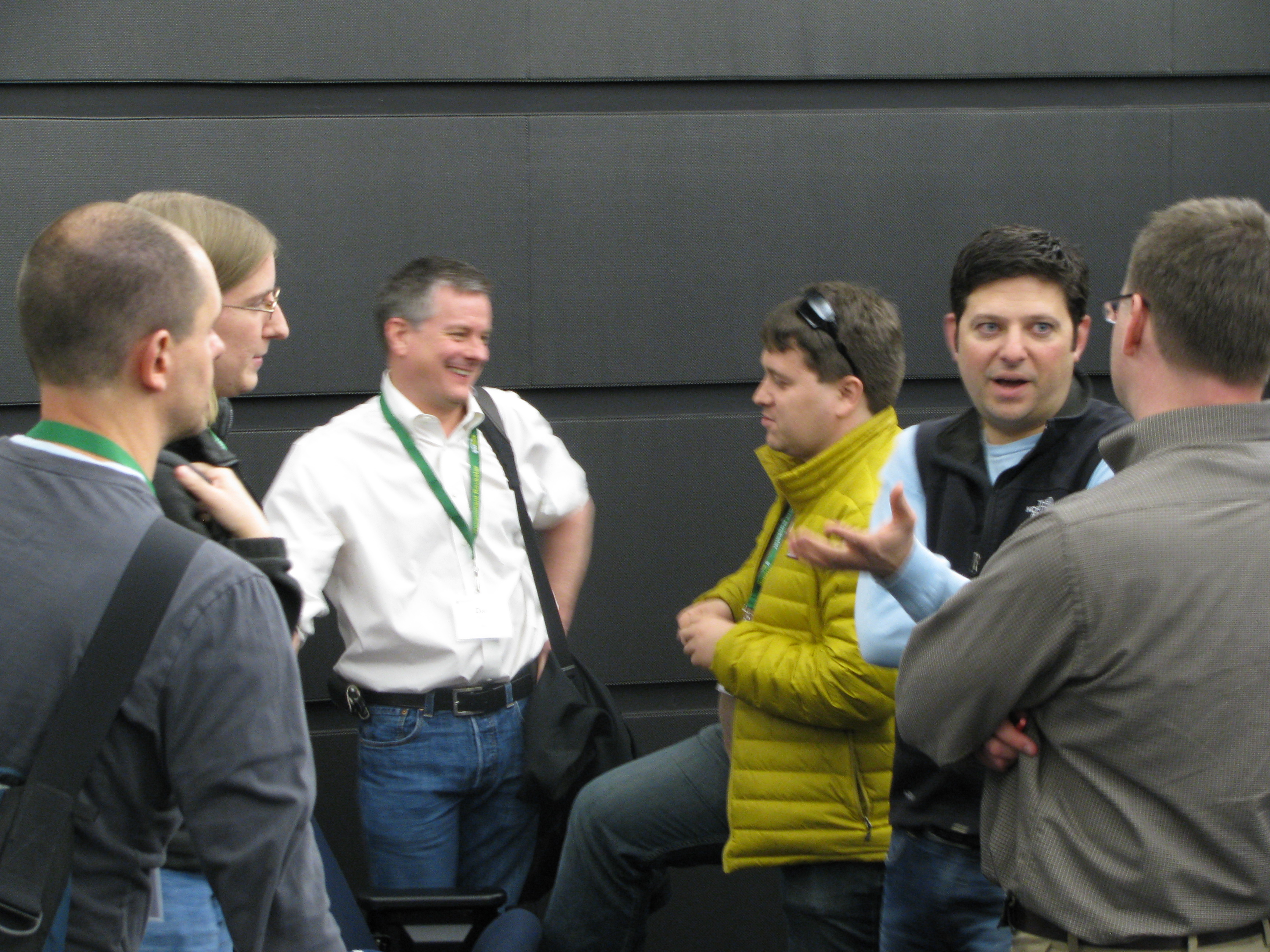
I was honored to join Benjamen Walker (@benjamenwalker), Senior Culture Producer, WNYC, Fred Fishkin (@ffishkin), host of Bootcamp Report and Nick Bilton (@nickbilton), lead technology writer at the New York Times Bits blog, to talk about how Twitter is changing the ways that journalists report, write and share news.
You can watch the media roundtable on-demand. Given that I didn’t prepare at all, I’m happy with the outcome. Social media can allow journalists to pick up on trends, find sources, find audiences and, over time, develop more trust with readers.
I was also happy to learn that NPR’s “On The Media” also stopped by to ask attendees what’s the point of Twitter?. Good question, great answers, particularly from the New York Times David Carr (@carr2n.
I look forward to participating in the upcoming 140conf in DC.
“I used to say “justify every pixel,” said Sree Sreenivasan. “Now I say earn every reader.”
Sreenivasan, a dean of student affairs and professor at the Columbia Journalism School, went beyond “what Jeff Jarvis calls the blog boy dance,” offering up more than an hour of cogent advice, perspective and tips on social media to a packed classroom populated by members of the DC Online News Association at Georgetown’s campus in Virginia.
Where once he used to go around newsrooms to talk about email, then Google and blogs, now he’s moved to new tools of digital journalism grounded in a reciprocal relationship between the audience and the reporter. After all, Sreenivasan had to tailor his talk to the audience, a collection of writers, editors and producers already steeped in the tools of digital journalism, moving quickly beyond listing Twitter, Facebook and LinkedIn to the tools and services that that enable journalists to use those social media platforms improve their reporting, editing and careers.
“The best people find the things that work for them and skip the rest,” said Sreenivasan. Services need to be useful, relevant and extend the journalist’s work. Quoting a student, now at the Wall Street Journal, Sreenivasan observed that you “can have greatest content in world but will die on the vine if we don’t have a way for our readers to find it.” He classified the utility of social media for journalists into four broad categories:
tracking trends on a given beat
connecting with the audience, where ever it is online
putting that audience to work, aka crowdsourcing
building and curating the journalists personal brand
“Tools should fit into workflow and life flow,” he said. “All journalists should be early testers and late adopters.” In that context, he shared three other social media tools he’s tried but does not use: Google Wave, Google Buzz and Foursquare. Sreenivaan also offered Second Life as as an example, quipped that “I have twins; I have no time for first life!”
The new Listener-in-Chief
One group that undoubtedly needs to keep up with new tools and platforms is the burgeoning class of social media editors. Sreenivasan watches the newly-minted “listeners-in-chief” closely, maintaining a list of social media editors on Twitter and analyzing how they’re using the social Web to advance the editorial mission of their mastheads.
He showed the ONA audience a tool new to many in the room, TagHive.com, that showed which tags were trending for a group. What’s trending for social media editors? This morning, it was “news, love, work, today, great, people, awesome and thanks.” A good-natured group, at least as evidenced by language.
The simple answer is yes, in his opinion, but with many a caveat and tweaks to privacy settings. Sreenivasan described the experiences of people in NGOs, activists and other sources whose work has been impaired by associations on social media. To protect yourself and sources, he recommended that Facebook users untag themselves, practicing “security by obscurity,” and use lists. As an example of what can go wrong, he pointed to WhatTheFacebook.com.
Where should journalists turn next for information? Follow @sreenet on Twitter and browse through the resources in his social media guide, which he referenced in the four videos I’ve embedded in this post. He’s a constant source of relevant news, great writing and good tips.
The "Women of ENIAC." For their history, read "Programming the ENIAC."
Some issues trigger a deeper response than others within communities. In the technology world, the education, opportunities and inclusion of women holds unusual resonance.
In the U.S., as Nick Kristof wrote, “schoolgirls are leaving boys behind in the dust.” After graduation, the narrative evolves further. As Claire Cain Miller wrote in the New York Times on Friday, “women now outnumber men at elite colleges, law schools, medical schools and in the overall work force. Yet a stark imbalance of the sexes persists in the high-tech world, where change typically happens at breakneck speed.”
Just 1 percent of girls taking the SAT in 2009 said they wanted to major in computer or information sciences, compared with 5 percent of boys, according to the College Board.
Only 18 percent of college students graduating with computer science degrees in 2008 were women, down from 37 percent in 1985, according to the National Center for Women and Information Technology.
As computer scientist Hillary Masontweeted tonight, “We don’t need affirmative action. We need meaningful culture change and support.”
Based upon the research a colleague gathered tonight, some actions could make an important difference in three ways:
(1) It’s good for men. Inclusion of women and minorities reduce stereotypes, and promotes second-order reflection on latent stereotypes, by providing real, first-hand experience. (Mahzarin R. Banaji and Curtis D. Hardin, Automatic Stereotyping, 7(3) Psychol. Sci. 136-41 (May 1996).)
This leads to better, more accurate evaluation of people’s work – because when people unconsciously use stereotypes, they mis-evaluate work. For example women’s presence in high-level orchestras basically doubled once auditions started to be done gender-blind, focusing only on the music.
(Claudia Goldin and Cecilia Rouse, Orchestrating Impartiality: The Impact of “Blind” Auditions on Female Musicians, 90(4) American Econ. Rev. 715-41 (2000).)
(2) It’s good for women. The absence of women (or very low numbers of women) signals to women that they aren’t welcome or don’t belong, which can in turn cause them to leave the field or choose not to enter it in the first place. (William T. Bielby, Minimizing Workplace Gender and Racial Bias, 29(1) Contemporary Soc. 120-29 (2000))
Research also suggests that when women are invited to the table, they have more energy free to do good work, instead of using half their energy just breaking down the door. Reducing cognitive load on subjects who have to work to overcome stereotypes is not a minor factor.
(3) It’s good for business & technology. Whatever the vertical, the entire industry benefits when the best work is being created and presented. As Miller writes:
Analysts say it makes a difference when women are in the garages where tech start-ups are founded or the boardrooms where they are funded. Studies have found that teams with both women and men are more profitable and innovative. Mixed-gender teams have produced information technology patents that are cited 26 percent to 42 percent more often than the norm, according to the National Center for Women and Information Technology.
In a study analyzing the relationship between the composition of corporate boards and financial performance, Catalyst, a research organization on women and business, found a greater return on investment, equity and sales in I.T. companies that have directors who are women.
The number of senior women doing major research and running labs in traditionally male-dominated fields like physics also offers insight into how efforts to include women can lead to merit-based selection across the broadest set of the best candidates. For instance, consider Lisa Randall, one of the most cited theoretical physicists of the last half-decade. Or Marissa Mayer, a senior Google exec who, as Miller wrote, many women she interviewed cited as “someone who gives them hope.”
Where to learn more
I don’t believe that most people are consciously biased, nor that they intend to be biased. Research into implicit bias suggests, however, that the most pervasive forms of bias are unconscious. Those biases can have tremendous effects on how we evaluate others, mostly to our own detriment – but also to our communities and industries.
Does the issue of women in tech matter to the bottom line? Miller’s reporting suggests that’s so:
In a study analyzing the relationship between the composition of corporate boards and financial performance, Catalyst, a research organization on women and business, found a greater return on investment, equity and sales in I.T. companies that have directors who are women.
Fortunately, there are a growing number of conferences, groups and networks that celebrate and honor women in technology, including:
O’Reilly Community also features an excellent series of essays on women in tech. For the fascinating story of how women were involved in “hacking” the world’s first programmable computer, pictured at the top of this post), read ENIACprogrammers.org. And the recent Ada Lovelace Day listed dozens of inspirational women who are innovators, inventors and educators.
Finally, Nick Kristof has done the world a mitzvah by writing eloquently about womens’ rights in his most recent book, “Half the Sky.” Learn more at HalfTheSkyMovement.org.
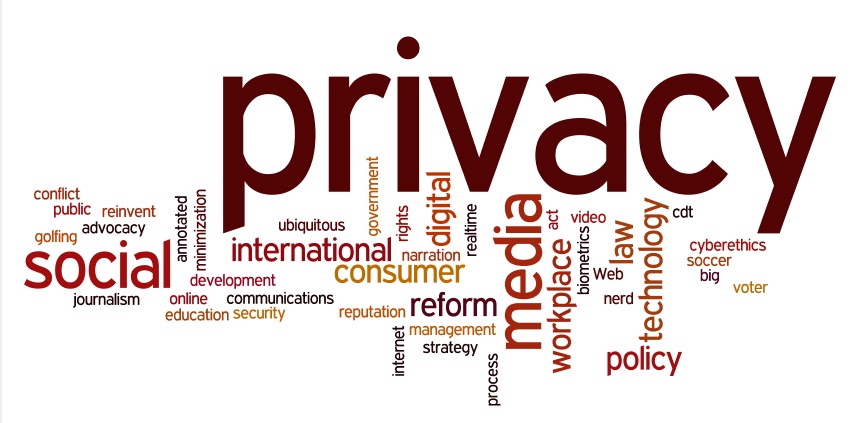
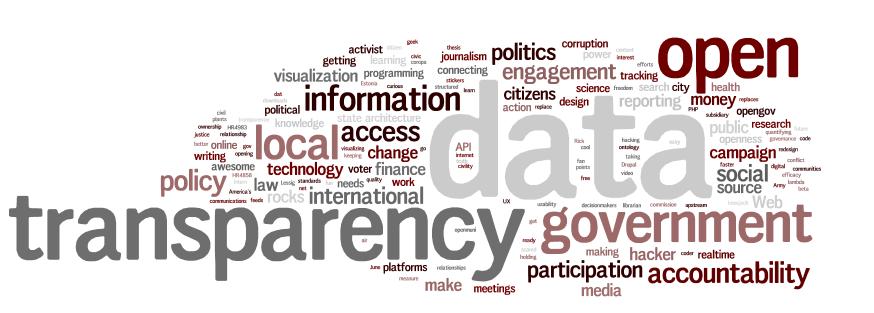
As with every unconference, it kicked off with each participant introducing him or herself with three words that offer insight into their work, identity, passion or wit. Combining them all created the “word cloud” above.
You can follow DC Privacy Camp 2010 in real-time on Twazzup on Twitter.
I’m thrilled to announce that I have a new job! Earlier today, I accepted an offer from Tim O’Reilly to be the Washington, D.C. correspondent on Government 2.0 for O’Reilly Media.
I’m hitting the ground running here in the District of Columbia, since O’Reilly’s upcoming 2010 Government 2.0 conference is only a few weeks away — and there’s plenty to do.
Over the following months, I expect to write – a lot – about how technology is being used to help citizens, cities and national governments solve big problems.
There’s no shortage of case studies to highlight, from the local town green right on up to the federal or international level. Just listen to the voices from the Gov2.0 LA unconference for a small sample of the perspectives on the issue.
O’Reilly’s goal in Washington D.C. is to “create a context in which people can think” differently about the role of technology in government, and the role of government in society. I look forward to helping to create that context.
In service of that goal, I’ll be blogging, conducting short interviews with government officials and industry participants, writing features and using the rest of the tools for digital curation I’ve been honing in the past several years.
I’m very excited to get started. I expect my new position to be challenging, engaging, rewarding, occasionally frustrating and never dull.
I also expect the process of writing about government 2.0 case studies to be a reciprocal process, as readers help me to understand more about what stories are important to them and which voices deserve to be heard.
I hope that in the days and months to come that you’ll share your perspectives, ideas and suggestions with me.
The story of government 2.0 is already being written every day by citizens, civic hackers, advocacy groups, government employees, researchers and technologists.
As a digital pilgrim, I look forward to chronicling that progress.
In this video, Sree Sreenivasan, dean of student affairs & professor at the Columbia Journalism School, answers my question about whether it’s ethical for journalists to friend sources on social networks like Facebook or LinkedIn. Sreenivasan was speaking at a workshop on social media tools and tips hosted by the Online News Association in Arlington, Virginia.
As reported by the Associated Press, the U.S. Court of Appeals in the District of Columbia has ruled against the Federal Communication Commission (FCC) failed to show it had the Title 1 authority under the Communications Act of 1934 to tell Comcast what to do to enforce network neutrality rules over broadband Internet providers. The ruling is a significant victory for Comcast Corporation, which had been involved in a dispute with the FCC over network filtering of P2P filesharing software after its customers complained that the cable giant was interfering with P2P apps.
“The commission has failed to tie its assertion of ancillary authority over Comcast’s Internet service to any statutorily mandated responsibility,” stated a three-judge panel of the DC U.S. Court of Appeals.”
The FCC made the following statement:
“The FCC is firmly committed to promoting an open Internet and to policies that will bring the enormous benefits of broadband to all Americans. It will rest these policies — all of which will be designed to foster innovation and investment while protecting and empowering consumers — on a solid legal foundation.
“Today’s court decision invalidated the prior Commission’s approach to preserving an open Internet. But the Court in no way disagreed with the importance of preserving a free and open Internet; nor did it close the door to other methods for achieving this important end.”
Today’s decision followed a January hearing where the federal court judges showed skepticism of the FCC’s authority to require broadband Internet providers to give equal treatment to packets as they moved over telecom networks. As Karl Bode writes at DSLreports, before Comcast’s win over the FCC:
Again, no FCC fine was levied, no new rules were imposed, and Comcast barely saw a wrist slap for lying to consumers and the press multiple times, in both filings and in print, about throttling all customer traffic, 24/7 using user packet forgery.
Comcast ultimately shifted to a clear 250 GB monthly cap and a more intelligent and less blunt force method of targeting network congestion. Still, Comcast never much liked the precedent the FCC’s actions set, so Comcast lawyers have spent the last few years trying to argue that the FCC never had the authority to dictate how Comcast manages its network. The FCC found themselves on uncertain legal footing because the rather flimsy network neutrality principles (pdf) created by previous FCC administrations were painfully vague.
The decision creates a roadblock in the FCC’s path towards moving forward with elements of its national broadband plan. The decision might mean, for instance, the FCC lacks the necessary powers it requires to shift spectrum from TV companies to wireless providers.
As a result of the ruling, Comcast and other broadband service providers may reasonably be expected to filter P2P filesharing again. As Cecilia Kang reports at the Washington Post the FCC’s loss in the court “comes just days before the agency accepts final comments on a separate open Internet regulatory effort this Thursday. And the agency will be faced with a steep legal challenge going forward as it attempts to convert itself from a broadcast- and phone-era agency into one that draws new rules for the Internet era.”
The full text of the Comcast vs FCC ruling is embedded below. As comment from the FCC and Comcast becomes available, I’ll post it here.
This weekend’s Transparency Camp in Washington, D.C. brought together technologists, journalists, developers, advocates for open data, open government and open data for discussions, case studies, workshops and even, as Micah Sifry put it, some secular colloquy.
Transparency Camp came at a time of immense foment in Washington and the country beyond. A historic healthcare reform had just been signed into law, including an overhaul of student loans. Midterm elections in Congress loom at the end of the year. And the nation’s economy continues towards an uncertain future, perhaps of jobless recovery, after the Great Recession.
The Sunlight Foundation’s engagement director, Jake Brewer, kicked off the morning by asking how much had changed around government transparency since the last Transparency Camp. Make sure to read David “Oso” Sasaki’s notes from Transparency Camp for a superb narrative of his Saturday. (Sasaki is the Director of Rising Voices, a global citizen media outreach initiative of Global Voices Online.)
In 2010, there are more reasons to believe government transparency and open government will see more rapid advancement. As the co-founder of the Sunlight Foundation, Ellen Miller, pointed out in her introduction, there are more significant legislative efforts underway around transparency. The The Public Online Information Act (POIA), HR 4858, introduced by Rep. Steve Israel, would embraces a new formula for transparency: “public equals online.” And an omnibus ethics bill, HR 4983, would “amend the Ethics in Government Act of 1978, the Rules of the House of Representatives, the Lobbying Disclosure Act of 1995, and the Federal Funding Accountability and Transparency Act of 2006 to improve access to information in the legislative and executive branches.”
An Open Data Playbook. Clay described that as “an instruction manual for people inside government to teach them how to open their data
A list of all jurisdictions and elected officials around the country
A data exchange format for data catalogs, in a model like Google did with GTFS.
The success or failure of Transparency Camp can’t be measured by those metrics alone, however, although whether Johnson’s challenges are met by the community are absolutely part of the story of this weekend.
A key element of OIX, as Hamlin pointed out, was the standardization of online privacy principles promulgated though IDManagement.gov. Another important part of the identity picture is Microsoft’s release of part of the intellectual property for its U-Prove ID tokens under Open Specifcation, as detailed at credentica.com.
The Open Government Directive, Datasets and Data.gov
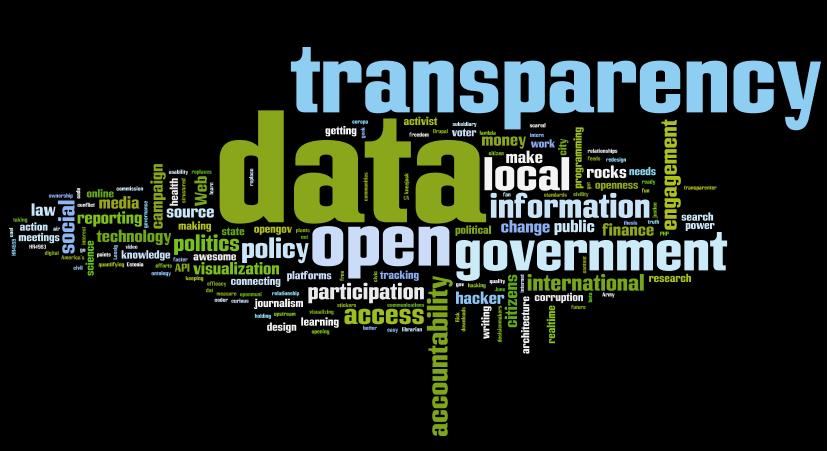
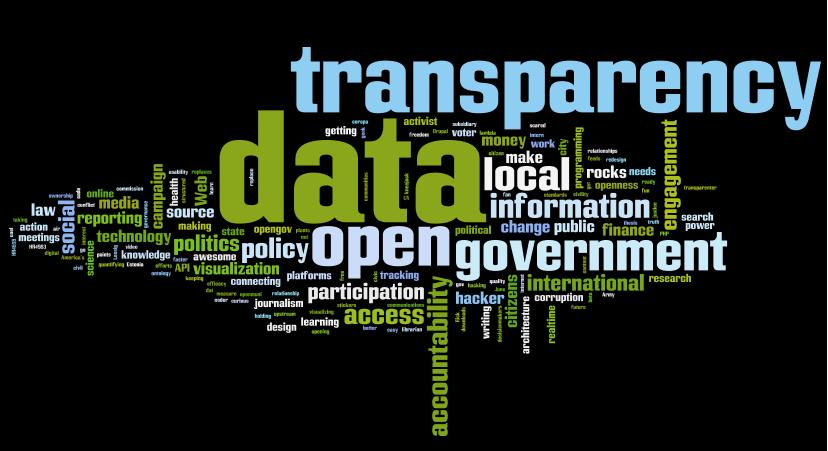
When the “three words” from the unconference were synthesized into a “Wordle” for Transparency Camp, four words emerged as the most powerful themes:
Open, government, transparency and, most of all, data.
The Open Government Directive (OGI) was a significant moment in American history, in terms of putting the data of operations into a format and venue where developers could access and parse it: data.gov.
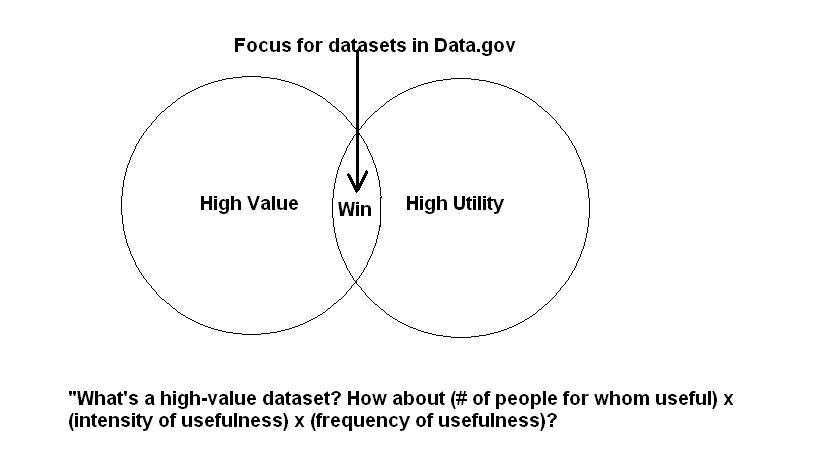
Now that the resource is up, however, there are outstanding concerns about data quality, frequency and, most pertinently, utility. Andrew McLaughlin, the “Deputy Chief Nerd @ the White House” (aka deputy US chief technology officer), suggested that “to get reluctant agencies to embrace data sharing, focus on “high-reward”, not “high-value”, datasets.”
When asked if new guidance was needed, since “high-value datasets” for Data.gov are written into the OGI, McLaughlin responded that “some agencies will use a citizen-utility metric for prioritizing scarce resources. Others will focus on datasets that will are rapidly doable, to help overcome resistance and ease culture change. Both ways of defining “high-value” make sense.” The Venn diagram above illustrates how that might look.
McLaughlin also acknowledged a feature request for data.gov and apps.gov from the Transparency Camp community: more and better metadata, like data quality qualifiers or FISMA compliance status.
At the In Code We Trust: Open Government in New York
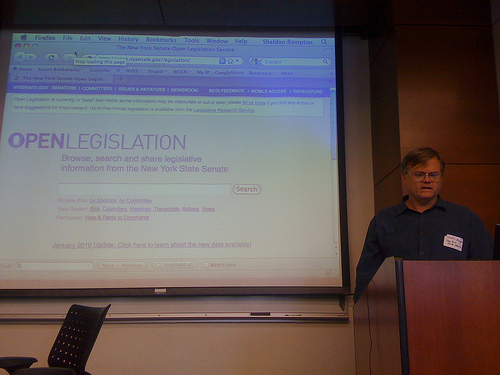
My favorite session for the day was a case study of open government featuring the New York Senate. With a nod to Lawrence Lessig, Noel Hidalgo, Sheldon Rampton and Mark Head showed precisely how law could be turned to code. I livestreamed “In Code We Trust” on uStream. After poor transparency ratings, a broad swath of changes to the New York state senate websites was implemented over the past year. New York was the first state senate to adopt Creative Commons for its intellectual property.
One of the basic principles of an unconference is the “law of two feet.” If you don’t like a session, you move. You own your own experience. Given that livestreamed parts of Transperency Camp, I also “voted with my feed,” moving my window to the Internet along with my body. After a session on the relationship of open government descended into somewhat unproductive discussion about open policy, I moved over to the healthcare information technology (HIT) session, which I recorded in part. Given the billions of dollars that will be flowing into healthcare IT over the next few years, as provisions of the Recovery Act are implemented, this was an important discussion.
Brian Behlendorf, a notable open source technologist, led the session. There’s now an Office of the National Coordinator for Health IT to direct action, available on the Web at HealthIT.gov or on Twitter at @ONC_HealthIT. As Andrew McLaughlin noted, Brian Ahier maintains a great blog on health IT, including details on how the healthcare reform bill affects HIT.
Local Government and the Digital Divide
Another excellent session featured discussions about how transparency is coming to people closer to home.
Literally.
OpenMuni.org provides some perspective on that effort. The Ideascale model of crowdsourced recommendations for better efficiency and governance has been applied to local government, at least in beta, at Localocracy. The first pilot has been put into action at Amherst, Massachusetts.
The local government session at Transparency Camp was also fortunate to have the D.C. CTO, Bryan Sivek, and staff from @octolabs present.
Sivek defined his role as integral to both enabling better services online, like the city resource request center at 311.dc.gov, finding efficiencies for government through IT, and in bringing more citizens the benefit of connectivity. He illuminated a yawning gap in Internet use, observing that “DC has a huge issue with the digital divide. In Wards 5, 7 and 8, 36% of the people are connected.”
Bryan Sivek is now looking for feedback on how to use technology better in the District, elements of which are evidenced at track.dc.gov.
Odds, Ends, Resources and Takeaways
I was reminded of a great travel resource, FlyOnTime.us, and learned about a new one for Washington, ParkItDC.com.
I wish the former existed for Amtrak.
I learned about data and visualizations of local campaign spending at FollowTheMoney.org and government transparency at OpenSecrets.org.
Most of all, I was reminded by how many brilliant, passionate and engaged people are working to improve government transparency and efficiency through technology, collaboration and advocacy.
Here’s a second Wordle for Transparency Camp 2010 that removes the transparency duplicate, since Wordle.net dupes words when they’re capitalized.
Finally, there’s a final Wordle for Transparency Camp 2010, with all capitals removed. Fittingly, I had to clean my data to get a good visualization that accurately represented the data I reported upon.
On March 22, a collection of tech advocates, non-profits and associations opposed to the proposed Anti-Counterfeiting Trade Agreement (ACTA) wrote a letter (embedded below) to Ron Kirk, head of the Office of the U.S. Trade Representative, criticizing the reported draft language of the ACTA.
The lack of transparency around ACTA copyright treaty negotiations has received increased scrutiny from both the media and anti-censorship advocates as provisions have leaked online. Earlier this month, the European Parliament passed a resolution by a 663-13 vote calling for the European Commission, the European Union’s regulatory arm, to release a public draft of the ACTA agreement. President Obama signaled his support for the ACTA copyright treaty at a conference in DC on March 12th. New Zealand is now pushing for greater ACTA transparency as well.
This letter states that “details of the text of the proposed ACTA, and comments and proposals of national participants have apparently but unofficially been made public”. See, for example, this EU document, a working document from the EU Secretariat, document[PDF], and document.
This letter states that “this negotiation is not primarily about counterfeiting or piracy; nor is at all about trade law. The public rationale that the treaty would not impinge on domestic law has been placed in doubt — particularly when one considers whose domestic law would be endangered.”
On this count, the letter states that the “text reveals detailed substantive attention to … The extent to which principles of inducement, newly introduced by the U.S. Supreme Court in the Grokster case, are to be accepted as supporting a separate basis for copyright liability or are a gloss on existing principles of contributory and vicarious infringement. This is not yet clear even in the United States.”
The letter regarding ACTA transparency also states that the “text reveals detailed substantive attention to … How technological measure anti-circumvention provisions are to be interpreted and applied, whether they will apply to access to works, whether they are to be limited to circumventions for infringing purposes, and whether account will be taken of the variations in national law, practice, and context, such as U.S. adherence to fair use and the imposition of levies under other national law.”
Association of College And Research Libraries (ACRL)
Association of Research Libraries (ARL)
Special Libraries Association (SLA)
Canadian law professor Michael Geist’s ACTA coverage has been instrumental to providing details to the global community of the treaty. As he wrote yesterday:
Emerging technology has the power to make democracy stronger or weaker. Understanding where, when, and how is the hard part. Subscribe to Civic Texts to get insights about how technologies are changing our democracy in your inbox.









 digiphile