Category Archives: technology

I Heard It Through The App Vine

After surfing around a bit tonight, I’m not sure yet whether the new Vine App will be to video what Instagram is for pictures. (Vine went live last Friday, when I was on vacation in Anguilla.) The amount of buzz I’ve found upon returning from vacation suggests at least a few of the people I follow and read think it’s possible.

It sounds like the initial launch was a bit buggy for some users, though I had no issues when I downloaded and installed Vine tonight. I found it quite easy to join, find friends from Twitter and my address book (if not Facebook) and then to create and share a 6 second spot using the app, which I promptly deleted.

Vine is Twitter’s first standalone app, like Facebook’s Poke or Messenger. As is the case with tweets, vines have their own permalink and play in embedded tweets, like Twitter CEO Dick Costolo’s tweet that shows how to make steak tartare:

A mobile social network that’s built around mobile sharing of videos from iOS devices and integrated into other media, particularly tweets and blog posts, could have legs online — along with many other body parts. Tonight, posts on multiple outlets suggested that Vine has a “porn problem.”

I’m not sure if this revelation will not shock many long-time observers of people’s behavior online, when faced with webcams. Exhibit A: Chatroulette. I instantly thought of Avenue Q’s classic assessment of what the Internet is for.

(With a little help from Twitter, I was able to source the quote to Ethan Zuckerman’s 2008 talk at ETech on the cute cat theory.)

I tend to agree with Joshua Topolsky’s assessment at The Verge: it’s Apple that has the porn problem, not Twitter or Vine. We’ll see how Apple responds. Steve Jobs was clear in 2010 when he wrote that Apple has a “moral responsibility to keep porn off the iPhone.” Apple does not, however, censor the websites or, critically, user-generated content (UGC) on them when users access them through the Safari mobile Web browser. Treating UGC platforms like Flickr, YouTube, Facebook, Instagram, Twitter, Google+ like Web browsers might make more sense to users. (I don’t know how that approach would sit in Cupertino or the Federal Trade Commission.)

Regardless of the larger issues surrounding Apple’s policies as a powerful gatekeeper for app makers, parents take note: letting young children search raw Twitter feeds or Vine apps for #porn is going to turn up media that’s NSFW, much less NSFK(ids).

While there’s certainly porn to be found, I didn’t see any when I watched the automagically randomized selection of vines at Vinepeek, which I found thanks to a tweet from Mitch Kapor. Despite inevitable flashes of crudity and banality, I found many of these glimpses of shared humanity endearing, just as YouTube can be at its best.

There are many other ways Vine can be used for business or other less salacious purposes, however, as Chris Brogan pointed out on Friday. Given my interest in cooking, I think creative spots that show how to make different recipes, like the one Costolo filmed, could be particularly interesting. While there are plenty of possibilities for media creation, for I’m not sure whether journalists will wholeheartedly move to quickly adopt Vine professionally, although there were certainly plenty of early adopters on Instagram.

I remember the idea of a social network of video shorts when it first floated to the top of my social stream: it was called Seesmic, and Loic Le Meur shuttered it in 2009. That said, the context for Vine is different, given the tens of millions of iPhones and iPads in people’s hands today.

I think Vine will be worth watching, so to speak. If Vine does catch on, expect “vining” and “vines” to become part of the tech vernacular.

7 Comments

Filed under blogging, journalism, microsharing, movies, photography, social media, technology, Twitter, video

“This Isn’t the Petition Response You’re Looking For”

The official response from The White House to the epetition to create a Death Star is, in Internet terms, epic.

By turns geeky, funny, informative about U.S. space programs, and unabashedly supportive of science and technology education, the response to a popular petition on the “We The People” e-petition platform instantly entered the annals of online government history this Friday night.

“The Administration shares your desire for job creation and a strong national defense, but a Death Star isn’t on the horizon,” wrote Paul Shawcross, Chief of the Science and Space Branch at the White House Office of Management and Budget.

“Here are a few reasons:

  • The construction of the Death Star has been estimated to cost more than $850,000,000,000,000,000. We’re working hard to reduce the deficit, not expand it. 
  • The Administration does not support blowing up planets. 
  • Why would we spend countless taxpayer dollars on a Death Star with a fundamental flaw that can be exploited by a one-man starship?” 

However, look carefully (here’s how) and you’ll notice something already floating in the sky — that’s no Moon, it’s a Space Station! Yes, we already have a giant, football field-sized International Space Station in orbit around the Earth that’s helping us learn how humans can live and thrive in space for long durations. The Space Station has six astronauts — American, Russian, and Canadian — living in it right now, conducting research, learning how to live and work in space over long periods of time, routinely welcoming visiting spacecraft and repairing onboard garbage mashers, etc. We’ve also got two robot science labs — one wielding a laser— roving around Mars, looking at whether life ever existed on the Red Planet.

Keep in mind, space is no longer just government-only. Private American companies, through NASA’s Commercial Crew and Cargo Program Office (C3PO), are ferrying cargo — and soon, crew — to space for NASA, and are pursuing human missions to the Moon this decade.

Even though the United States doesn’t have anything that can do the Kessel Run in less than 12 parsecs, we’ve got two spacecraft leaving the Solar System and we’re building a probe that will fly to the exterior layers of the Sun. We are discovering hundreds of new planets in other star systems and building a much more powerful successor to the Hubble Space Telescope that will see back to the early days of the universe.

We don’t have a Death Star, but we do have floating robot assistants on the Space Station, a President who knows his way around a light saber and advanced (marshmallow) cannon, and the Defense Advanced Research Projects Agency, which is supporting research on building Luke’s arm, floating droids, and quadruped walkers.

We are living in the future! Enjoy it. Or better yet, help build it by pursuing a career in a science, technology, engineering or math-related field. The President has held the first-ever White House science fairs and Astronomy Night on the South Lawn because he knows these domains are critical to our country’s future, and to ensuring the United States continues leading the world in doing big things.

If you do pursue a career in a science, technology, engineering or math-related field, the Force will be with us! Remember, the Death Star’s power to destroy a planet, or even a whole star system, is insignificant next to the power of the Force.

Paul Shawcross is Chief of the Science and Space Branch at the White House Office of Management and Budget

When White House director of digital strategy Macon Phillips replied to a tweeted question about an outstanding petition on open access, he proved his Star Wars bonafides with a echo of Yoda’s unusual grammar.

This Star Wars fan is glad to have hilarity to share on The Kojo Nnamdi Show on the power of online epetitions on WAMU next Tuesday.

Photo Credit: Noel Dickover, Carving the Death Star Pumpkin

6 Comments

Filed under blogging, government 2.0, social media, technology, Twitter

Why journalists need to pay attention to Google Author Rank in 2013

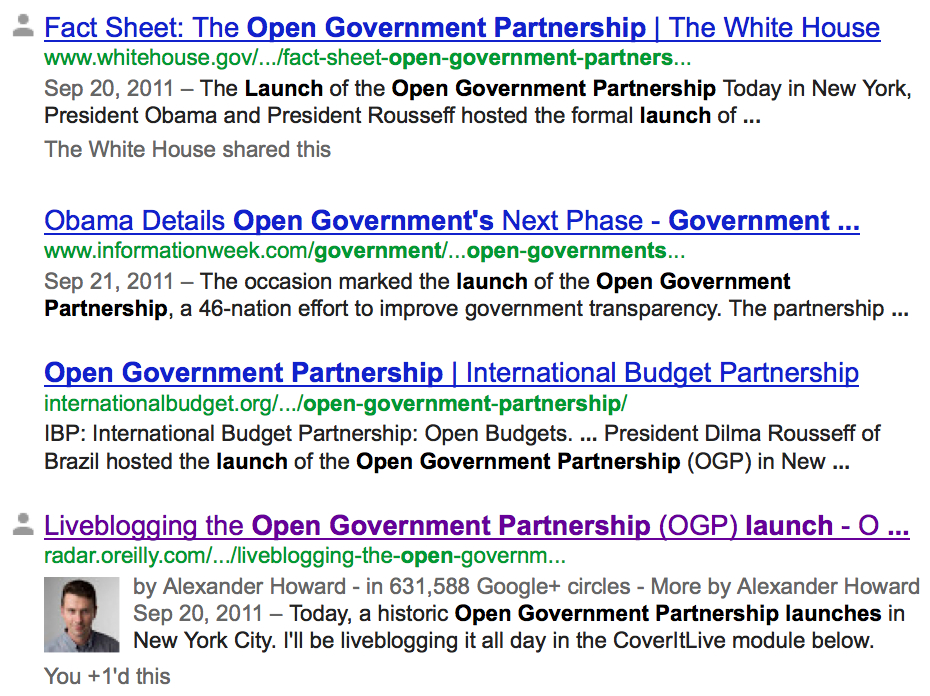
Remember back in 2011, when Google linked the Google Plus profiles of journalists to Google News, and folks like Emily Bell,  Erik Wemple, Amy Gahran, Megan Garber  and I had a cross-platform conversation about it? (OK, probably not.) I thought then that Google integrating Plus with journalism online was probably inevitable. Here we are in 2013, where Google’s “Author Rank” is now putting journalists’ faces into search results and linking to their Google+ profiles.

abh-search-results-ogp

If you focus on online marketing, journalism and SEO — and like it or not, if you publish on the Internet, you need to keep an eye on these areas — this is a noteworthy development. It’s worth taking the time to understand Author Rank, learn how it works, why it matters to SEO, and think about how it might apply to what you do online. To learn more, check out  Google’s Authorship page on Plus.

I’m far from the first to point this out. Denis Pinsky wrote in December 2012 that journalists should care about Author Rank a lot more than Amazon sales rank. Megan Garber, who teased apart some of the issues in a November 2011 post on Google+ at the Nieman Lab, noted Google ran a pilot that in the summer of 2011 that put profiles into search engine results. The article that caught my attention yesterday and prompted this post was by Erin Griffith at Pando Daily, who looked at how Author Rank changes marketing and journalism.

As Griffith suggests, the addition of Author Rank is likely related to the quality of search results. By prioritizing posts written by verified authors who have authority in a given topic in search, Google users will be exposed to better results — and posts created by spammers and link factories will be deprecated. Or so the thinking goes.

According to an SEO agency president cited in a PandoDaily article about the shift, “bylined stories rank higher, and they get more real estate. Most importantly, they return clickthrough rates that are 40 percent greater than normal.”

If accurate, that’s quite a carrot for Google to dangle in front of SEO-obsessed media organizations and freelancers alike, which will lead to influence that may well call for renewed caution about the power the search engine giant holds to organize the world’s information. There are reasonable concerns about how Google has proceeded here. For instance, Google could have given journalists the option to link to a profile on another social network, or to a page on their masthead’s website. Instead, Google Plus is being put forward.

The road ahead

Is linking a Google+ profile to search results a negative for journalists? Given what I’ve seen since 2011, on the whole, I still don’t think so. I’m willing to be proven wrong, as always. As I wrote then (self-plagiarism alert!) Edd Dumbill opened my eyes to the transition ahead of us some time ago in his post about why he thinks Google Plus is the social backbone for the Internet.

I highly recommend reading Edd’s post and thinking through what else might be tied together beyond journalists and their articles. It could be connecting people and places. Or teachers to schools, bartenders to pubs, managers to stores. Or other makers or creators, like musicians to tracks, filmmakers to videos, or photographers to their photos. Connecting coders to their code would be a natural fit for Google. Communities could advance those signals.

Facebook has followed much the same sort of thinking in extending the semantics of its social graph within its network — and has more than 1 billion users at present. Given this shift, I have to wonder whether we’ll eventually see the public Facebook profiles of journalists associated with bylines and stories in Bing search results — and how quickly publishers and journalists will move to associate themselves with Google search engine results.

Media now have a clear choice before them: join Plus to connect profiles with their stories or stay out of the social fray. It will be a different decision than joining Twitter or Facebook was in years past, before it was clear to the general public that social networking would not be a passing fad. There will be more pressure for journalists to join Google Plus now, given the rewards in traffic and profile visibility that will accrue to having your face in Google News and search results.

I chose to tie my profile to my bylines in the summer of 2011, in that pilot, so that people looking for information would see my face in search results and connect to me. New readers are now finding me through many social networks (Twitter, Facebook, LinkedIn, Instagram, Pinterest, Tumblr, Plus and others) and search. Given what I do, it made sense for me.

It will likely not be the right choice for investigative journalists who cover organized crime or government corruption, or for those who operate from conflict zones or under autocratic regimes. For many others, however, being “discoverable” to their communities, beats and colleagues on Plus now looks as professionally relevant as participating on Twitter or Facebook.

8 Comments

Filed under article, blogging, journalism, social media, technology

The White House joins Pinterest, invites users to holiday social

The White House joined Pinterest today. Over the past several years, the White House digital team has sought to leverage the growing unprecedented scale of its connections on these networks to influence national debates on proposed laws, policies and rules, applying public engagement to politics with mixed results. Now the team will be pinning as well as tweeting, blogging, liking and plussing.

Source: whitehouse.gov via Alex on Pinterest

As has often been the case over the past four years, I learned about the news first on Twitter, directly from a tweet by White House Digital Director Macon Phillips:

The White House was able to secure the /whitehouse namespace* and began pinning at pinterest.com/whitehouse.

The decision by the White House to join Pinterest comes as the photo sharing website enjoys a period of hypergrowth in 2012 that resulted in a ranking amongst the most popular social media platforms in the United States. According to Nielsen’s 2012 Social Media Report, Pinterest grew by over 1,000% over in the United States in 2012, with even high year over year growth in unique mobile Web (4,225%) and mobile app (1,698%) users. Given that the White House has an official presence on every other major social media platform, the move recognizes a new reality: Pinterest is now among the top five social destinations in the country, and therefore worth investing time and resources for staff to engage there.

The White House had already joined other popular social networks over the years, including:

Kori Schulman, the director of online engagement for the Office of Digital Strategy in the White House, blogged about the White House joining Pinterest at the WhiteHouse.gov blog. (Sam Byford was quite dubious about that “open” frame in his post at The Verge.)

Schulman described the White House’s new Pinterest account as another way to open up the White House to more people:

From the very beginning, President Obama and the First Lady have taken steps to make this the most open White House in history. “It’s the “People’s House,” said First Lady Michelle Obama, “It’s a place that is steeped in history, but it’s also a place where everyone should feel welcome. And that’s why my husband and I have made it our mission to open up the house to as many people as we can.”

That’s why the White House is open for virtual tours 24/7 through the Google Art Project and why you can follow us on Twitter, Facebook, Flickr and other places around the web. And, it’s why we’re now thrilled to add Pinterest to the list.

The holidays are an especially exciting time for the White House to start pinning. During the 2012 holiday season alone, more than 90,000 visitors will have the chance to tour the White House holiday decorations, all hung with care by a team of crafty staff and volunteers. To kick off our presence on Pinterest, we’re inviting some of our newest followers to join us for a Holiday Social at the White House. Pinners will be invited to check out the décor, meet with the people that helped transform the White House for the holidays, join us for a craft project — and share it all with the Pinterest community.

According to Schulman, the White House will roll out its first pinboards on December 17th, the day of its first “White House Holiday Social,” a new, more general term for an in-person meeting between White House staff and people who follow its official accounts on social media platforms.

The White House has held a series of “tweetups” for Twitter users over the past year, starting with the first Twitter Town Hall. (I went to the second White House tweetup, which coincided with an in-person town hall with President Obama at the University of Maryland, where he told students that he was “absolutely convinced that your generation will help us solve these problems.”

The new approach to a “White House Social” will be more broadly applicable to future meetups, assuming that a second Obama administration continues to value creating bridges between offline and online networks of supporters.

The last descriptor is key: the White House has been experimenting on the Internet, generally — and with social media, specifically — to share the images, media and ideas that the administration wants to promulgate to the country, from proposed policies to political action. White House staff, including communications director Dan Pfieffer, have gone on the record to say that they believe social media campaigns have affected the debt ceiling debate and led to offline outcomes.

The White House’s most recent effort at public engagement through social media, in which the administration encouraged Americans to share what $2,000 dollars meant to them, resulted in 100,000 submissions at WhiteHouse.gov and 250,000 tweets that used the #My2K hashtag. That conversation was catalyzed this past week when President Obama logged on to Twitter himself again for a presidential Q&A in which he urged Americans to call, email and tweet to Congress regarding the so-called fiscal cliff.

As I’ve written before, however, real issues with meaningful use of social media by Congress persist, including an online identity ecosystem that has not provided Congress with ideal means to identify constituents online. The reality, when it comes to which channels influence Congress, in-person visits and individual email or phone calls from constituents remain far more influential with Congressional staffers than tweets. The probability that pins will prove to be any more significant in political debates remains to be seen.

The White House won’t be politically pinning alone on Pinterest. While Massachusetts Senator-Elect Elizabeth Warren’s campaign stayed off of Pinterest because of worries that copyright infringement claims could lead the social sharing site to be shut down, a growing number of political campaigns and government entities have joined the platform over the last six months.

Why? Pinterest represents not just a new horizon for White House digital efforts but one in which a specific interest group — women — can be found in engaged numbers that they are not elsewhere. Pinterest is strongly identified with women, with Pew Internet research back in February 2012 finding that 1 in 5 women on the Internet are on the social sharing service.

Whether the White House’s pins resonate will also depend upon whether politics, Pinterest and political media become more intertwined. To date, blogs, Facebook, YouTube and Twitter have been the primary online forums for digital politics. In 2013, pinning may take on new significance.

*The White House digital team initially could be found as WhiteHouse44, not /WhiteHouse. At some point in December, they were able to secure the standard namespace. The first White House board was “inspiring.”

13 Comments

Filed under government 2.0, social bookmarking, social media, technology

Revisiting standards for moderation and community on social networks

If the Internet and social media represent the new public square, it’s important to talk about the rules of the road.

Over the past year, I’ve seen a lot of spam and pornography links on Google+, Facebook, Twitter and on comment sections of the blogs I maintain.

Google and Facebook both give us the ability to moderate comments and, if we wish, to block other people who do not respect the opinions or character of others.

Now that a lot more people are circling me on Google+, following me on Twitter and subscribing to me on Facebook, it’s time to revisit a post from earlier this years. If you have found your comment removed, I’d like to explain why and offer some guidelines. Here’s how I think about maintaining community, with a nod to ASU journalism professor Dan Gillmor‘s example:

I can and do block spammers and people posting links to pornography in my comment threads.

I generally leave comments on my blogs, precisely because I value conversations, despite the issues that persist online. I have been moderating discussion in online forums and blogs for many years, including those of my publishers. My full thoughts on the value of blog comments — and the social norms that I expect people comments to live within — are here.

Vilely insulting me won’t help your case. Insulting others will ruin it. I was a teacher in my twenties. I would not tolerate disrespectful behavior in my classroom, either to me or to other students. If you can’t be civil and continue to insult others, much less the person hosting the forum, you were asked to leave and see the principal.

If the behavior persists, you will lose the privilege of participating in the class at all. Eventually, you get expelled. On Google+ or blogs, that takes the form of being defriended, banned or blocked from my public updates. I prefer not to block users but I will do so. I respect your right to speak freely on your own blog, Twitter, Facebook or Google+ account, whether that involves cursing or ignorance.

I strongly believe in the First Amendment, with respect to government not censoring citizens. That said, I do not, however, feel obligated to host such speech on my own blog, particularly if it is directed towards other commenters. I believe that building and maintaining healthy communities, online of offline, requires that the people hosting them enforce standards for participation that encourage civil dialogue.

I hope that makes sense to readers. If not, you are welcome to let me know why in the comments. And if your approach differs, please explain how and why.

Following is a storify from a forum I participated in that featured perspectives from other people entrusted with online community moderation:

[View the story “A story of online community, comments and moderation” on Storify]

2 Comments

Filed under blogging, journalism, microsharing, social bookmarking, social media, technology, Twitter

INTERVIEW: What is Government 2.0? Why does it matter?

I sat down for an interview with the “Don’t Worry About The Government” folks earlier today to talk about government as a platform, open data and more. (Bonus: I’m still sporting my summer beard from Maine.)

The interview request was triggered by my post on whether government innovation can rise above partisan politics. In an ideal world — which we of course do not live in — this presidential election would focus more upon what role government should or should play in our society, at the city, state and federal level, and whether and how we the people should finance it.

Over the last century in the United States, the size of the federal government has grown immensely, from entitlement programs (Medicaid, Medicare, and Social Security) to the immense defense budget. Technology provides new opportunities to both save taxpayers dollars and detect and prevent corruption and fraud, but the larger question of the role government itself should play in society is one that should occupy more of the national conversation, frankly, than Representatives skinny dipping on foreign trips, campaign trail gaffes or the latest celebrity foibles.

Leave a comment

Filed under government 2.0, journalism, technology, video

On acts of journalism, social media, credentialing, shield laws and press freedom

Anyone with a smartphone can now do reporting: share geolocated photos, video or stream what’s happening. I’m here, you’re not, here’s what I see. Does such “citizen reporting” rise to an “act of journalism” and need to protected under the First Amendment? Increasingly, I tend to think that it does — and that’s going to be a key question in the not-so-distant future, if Congress gets around to re-examining shield laws. Shield laws have been an issue for years, in the context of how the digital media ecosystem has democratized the means of publication, particularly of reporting images and video.

Currently, there is no federal shield law to protect sources and methods. Last year’s ruling in Oregon cemented the reality that 20th century shield laws lag today’s social media realities, even if the blogger in question turns out to have gone far beyond where many of the people initially defending her realized. A subsequent clarification showed that the judge who made the ruling believes bloggers can be journalists.

Honestly, some days I find the gatekeeping and credentialism I still see and hear disquieting. Since my degree is in biology and sociology, not “journalism,” should I get kicked out of the profession? Without getting testy, this attitude is exactly what will allow governments to arrest people livestreaming because they aren’t “members of the media.” (I also think it’s why there are still tables for “print only” in Congressional hearing rooms and 20th century rules for hard press passes for broadcast, radio or print journalists in the Senate and restrictions on the use of computers in some House subcommittees.)

Who gets to decide if someone is a journalist? Is someone who works at the Daily Enquirer who posts pictures of a naked celebrity a journalist — but someone who posts pictures of a cop beating a student is not? What about a columnist who writes about the Greatest Athlete EVER versus a blogger who chronicles how well documented city council hearings are and issues with the document format or codec type from the software vendor? The odds are good that it will be U.S. Senators and judges who make that call: it’s important to think carefully about which side you come down upon and why.

This stuff is ALL really blurry. Is Twitter journalism or isn’t it?. What about tweets? Blog posts? Video?
Remember, there are companies who have tried to criminalize linking or embedding. There also folks out there in media land who have say linking is unfair aggregation. Both could be an issue for what some practitioners have called social journalism.

We need to be careful about being quick to exclude or defend turf in a historic moment when the practice of journalism has become more open to all then ever before, particularly when press freedom continues to be under pressure globally and whistleblowers are being prosecuted domestically. The bloggers vs journalists debate has significant potential downstream impact that matters, even as it morphs into “curators vs journalists.”

Honestly, I’m starting to think that the term “curators” should have been left in museums, where it was quite clear what they did. How about “editors vs curators?” Fuzzier, right?

Hey, I love it when people link and share my work, personally. I hate it when they plagiarize, don’t link or attribute it. Curate me, please!

Personally, if someone produces work that is fair, accurate, adds necessary context and based on the available evidence, I’m generally happy to call it journalism, regardless of whether the author is on a masthead somewhere or has the right B.S. on a sheepskin.

This post has been updated with links and commentary.

6 Comments

Filed under blogging, government 2.0, journalism, microsharing, social media, technology, Twitter

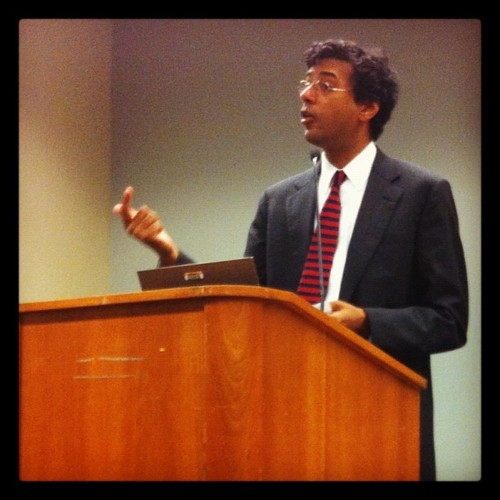
Notes on Dr. Atul Gawande’s talk at the Health Data Palooza [LIVEBLOG]


[Editor’s note: these are live, rough notes from my iPad, and should not in any way represent a 100% accurate transcription. I missed far too much. Caveat lector. My comments are in brackets. You can find Dr. @Atul_Gawande‘s bio & writing at the New Yorker. Update: I’ve posted video of Dr. Gawande below.]

GAWANDE: A fascinating part [of the Health Data Palooza]: the idea that we’re putting together people from government, healthcare systems, people from outside who have knowledge about data and tools. This is quite different from the normal models: regulatory or laissez faire.

We have a healthcare system that’s fundamentally broken. The most common complaints from patients seem to be no one you can count on. If you’re paying, you have no sense that there is anyone who can help it costs be under control.

Where to start to fix that? We have recognized that there is enormous variation in cost, depending on whet you go. There is enormous variation in cost, depending on where you go. The two don’t have anything to do with one another. So there’s hope. [Good news.]

Some of the best places to get care are the least expensive. [In healthcare,] positive deviants are the ones that look the most like systems.

Examples from war and lessons within lethality

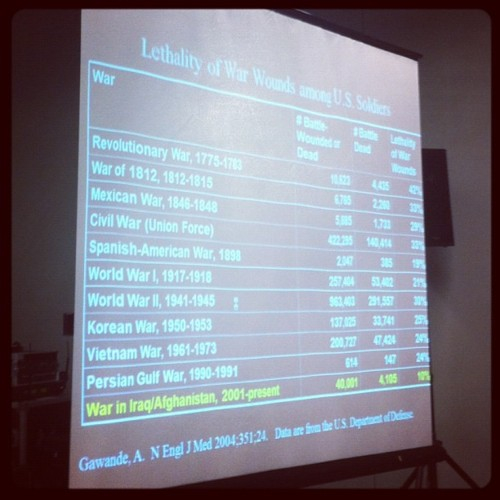
GAWANDE: Start by looking at performance of doctors in war and their teams. In the war in Iraq/Afghanistan, lethality below 10%. That doesn’t reflect intensity of conflict but improvement in care.

How did we do it? It was the not discovery of new tech that transformed survival but ability to use existing tech far better, in a system that works.

1) Kevlar. Got soldiers to wear it, operationally.
2) Speed to operating table. Improved forward mobile operating theaters.

We achieved the best survival rates in history. How? They changed the way they did surgery. Looked at data, realized needed to stop bleeding, stop contamination, under resource restrictive conditions. No X-rays, needed to learn 19th century techniques for finding fractures by feel.

They adopted “damage control surgery”: Do what you could during 2 hours. Ship and add a note: here’s what I’d did, what’s needed. That helped stimulate development of simple EHR. Average time from wounded on the battlefield, to getting care in the field, Baghdad, in Germany, in us, is less than 3 days. Less than 36 hours for some.

Soldiers can find better care for some conditions in Iraq than in a US city, with fewer resources. How? Alignment of finances, incentives. They weren’t “fee for service soldiers.” Everyone is on the same team: focused on saving life, maintaining health.

Within 48 hours of the wounding or death of soldier, posted on the DoD website. [DCAS: Defense Casualty Analysis System] The public accesses that data, but doctors & nurses access it the most.

One more example: soldiers not wearing protective eyewear. They called them ‘Granny goggles.’ The DoD contracted with a designer, made cool ones. Now wearing. Needed data and research to understand. [Stories matter.]

Affordable Care Organizations (ACOs) have done financial alignment. They’re committing to doing more project at a time. They’re committed to better health within an environment.

To get there, folks in war needed data useful to frontline decision makers. [The same is true at home.]

3 Comments

Filed under government 2.0, research, technology

A few thoughts on the use of Twitter by federal officials

“Yes, saw news @acarvin retweeted from Tunisia. On it. Please @reply from @StateDept. – Hillz”

Last month, Federal Computer Week reporter Alice Lipowicz interviewed me about how federal officials and Congressmen in the United States government were using Twitter. She ended up using just one quote in her article on Feds using Twitter, regarding the reality that the division between “personal” and “professional” accounts has become quite blurred in the public eye, regardless of disclaimers made.

Look no further than the Congressional staffers who were connected to tweets about drinking during the workday and subsequently fired. With millions of people on the service and the DC media listening closely, there’s simply a higher likelihood that a bad error will be noticed and spread — and corrections never travel as far as the original error. An offhand comment, even if meant to be funny, can be taken out of context.

If a government executive or editor shared pictures of cute puppies and dogs on an official Twitter feed, they do run the risk that some people may not take their professional leadership as seriously. Then again, citizens and colleagues might connect with them as a fellow ‘dog person,’ like me. I set up a Twitter account for my greyhound some time ago. (He doesn’t tweet much.)

Alice and I talked about much more than risk, though, and since I have notes from the conversation, here are a few other observations I made. (The caption above, for Secretary of State Hillary Clinton, is 100% fiction.)

First, we talked about Senator Chuck Grassley (R-Iowa), who writes cryptic tweets but appears to be doing something some of his colleagues may not: listen. He told the National Law Journal that he pays attention to reactions to his tweets.

“Twitter’s a new way to communicate with constituents,” said Senator Grassley. “The real-time feedback and contact with the grassroots that Twitter offers is a real value.”

Even though some of his more partisan tweets have drawn controversy at times, he is a notable example of a lawmaker in the Senate demonstrating personal use of social media, including typos, text speak and messages that his staff might prefer he hadn’t sent, like his recent comments concerning the President.

In general, if Congress is going to draft legislation that leads to rulemaking about social media, it makes sense that Senators and Representatives should have some basic familiarity with these tools and what’s being said on them or down with them, given the role that they’re now playing in the new public square.

Their staffers certainly realize that by now, tethered by BlackBerrys and iPhone and Android devices to a 24/7 newscycle that has compressed to 24 minutes — or even 24 seconds — from 24 hours. The modern workplace may reward working long hours outside of the office, or at least the appearance of it. Late night and early morning emails are part of Washington working culture. It takes a specific attitude, boundaries and discipline to find a healthy work-life balance in the context of pressure.

That’s certainly true of officials as well, like federal CIO Steven VanRoekel, who is a father to several young children. He is an unapologetically geeky guy who has been learning to use Twitter better, as Alice described, to go “direct” in answered questions from the government IT media.

He and his colleague, US CTO Todd Park, are actually both more advanced in their use of Twitter at this point in their tenures than Vivek Kundra and or Aneesh Chopra, their respective predecessors, neither of whom were tweeting when they began work. (Both men continue to tweet now, after they’ve left government, with Chopra much more active.)

VanRoekel tweeted infrequently as the managing director of the FCC, although he demonstrated that he both knew the basics. Using hashtags for comedic effect in his tweets now strongly suggests he’s learned something about the culture of Twitter since then. Yes, it was a bit of inside baseball, since you’d need to understand the context of Molly’s column to understand his comment, but the tweet was a reply to a specific column.

I thought that he was trying to be funny, with respect to confirming that APIs would be part of the federal government’s digital strategy using a “#specialsauce” hashtag and “#thereIsaidit.” At least for my (admittedly) geeky sense of humor, I think he succeeded.

I still see a perception in some quarters that Twitter is a fad and a waste of time — and currently, given the political context around taxes, the federal budget and spending, conversations about government wasting anything trend pretty negatively. Even with 100% of federal agencies on the service, I find that it still takes a demonstration of how Twitter is useful to accomplishing a mission before an uninitiated person’s eyes open to its value. Searching for topics, events or the name of an employer or agency is often effective.

That’s true for every other social network or tool, too. In 2012, I’m still enjoying exploring and experimenting with what the right approach to each platform, from blogging to Twitter to having family, friends and subscribers on Facebook and Google+ to tumbling or staying LinkedIn to my professional network or sharing video on YouTube. The same is true of federal officials.

We’re all “stumbling” along together.

Leave a comment

Filed under article, social media, technology, Twitter, video

In the Capital, influence on social media in DC is more than Twitter followers

It’s hard to believe that it’s been over a year since I implored the DC tech community and media scene at large to stop holding influence contests. Deja vu, all over again.

It was brilliant of In The Capital to hire a smart journalist to cover notable events in the political and tech scene. That coverage put them on the District’s radar during Social Media Week.

It was not brilliant of them to put together this week’s smudged sterling example of linkbait, which stands to damage their credibility with new readers who are not friends of those selected.

Look: I’ve met 80% of the people on this list of the “DC’s Top 10 Social Media Influencers” and follow many of them. I have much respect for their smarts, digital savvy and professionalism.

But if this is the” top 10,” what, exactly, does being an DC “influencer in social media” mean here? Online influence is not just about having a lot of Twitter followers.

For instance, I’m ahead of @LukeRussert by more than 33,000+ and have a higher Klout score, due in part to a large following on Google+ and Facebook. Does that mean that I’m more influential? Maybe on social media and certainly with respect to technology, but certainly not on broadcast news, which still retains enormous influence in our country. It also wasn’t hard to think of another person in DC who’s more influential with respect to social media than either one of us:

What about more “influential in the startup and DC tech scene, which “In the Capital” says it covers? Are all ten of these people more influential than Peter Corbett, Frank Gruber or Jen Consalvo, the co-founders or DC Week and organizers of the huge DC Tech Meetup? I’d don’t think so. And neither does Russert:

In a larger sense, does anyone believe that Russert is more of an “influencer” on social media in Washington than President Obama, between @WhiteHouse and @BarackObama? (I certainly don’t kid myself about my “clout” relative to POTUS.) What about @SpeakerBoehner or House Majority Leader @EricCantor or @SenJohnMcCain? Is the rest of the list is more “influential” than @MarkKnoller or @MarcAmbinder or @MikeAllen? A recent study of Twitter use in Congress, in fact, found that SenatorSanders was the most “influential” member of Congress on social media. (Or at least on Twitter.) one could go deeper on the list of people in media and government but the point is clear enough.

Mark Drapeau, director of innovative engagement in Microsoft’s office of civic engagement — and a member of the list — offered a dissenting perspective:

all these lists are kinda different or the same based on peoples’ biases and what they hope to accomplish and the audience they hope to reach. The Washington Post turns it into a ridiculous game. In the Capital picked… people they think are cool. Politico made the same exact list [of top DC Twitterers] and it’s all – gasp – politicos! The LA Times made the same list [DC twitterers], and they simply ranked people by followers – lazy! I made the same list based on how people interact with their communities – lots of people I know from… my community! All the lists are right, all the lists are wrong, there is nothing to debate, complain about, or mock.

In DC social media, there’s lots of actual social data to crunch to enable some measure influence and connected, not just from PeerIndex or Klout but from Google back links or Twitter/Facebook engagement numbers. Or they could have run their own data on how much engagement or amplification people get on Twitter, Facebook, Tumblr, Google+, etc. That’s just not what happened today.

This feels straightforward, at least from where I sit tonight: If editors make lists, they need to be able to back them up with criteria and methodology. That’s why people read Consumer Reports, for instance, when they buy things. Lists and ratings from credible publications influence the buying and hiring decisions of consumers. That’s why there’s a market for them and why people and brands get excited about being selected.

If “In The Capital” really wanted to measure “influence” and do a Top 10 List, “In the Capital” could have cited Klout or PeerIndex, flawed as those services may yet be. Gadi-Ben Yehuda, social media strategist for IBM’s Center on the Business of Government, made this comment:

The easiest way to have voided any controversy would have been not to use the title “DC’s Top Ten Influencers in Social Media,” which is confusing in any case. Honestly, when I saw who was on the list (the majority was women), I thought “OK, this must be people who do primarily social media activities, i.e. they don’t publish substantive articles on important government events (like Alex), they don’t run tech/innovation companies (like Peter Corbett), they don’t work in the innovation office of cabinet-level agencies (like @AlecJRoss). These are people who’s skill is in the medium that others of us use as a tool to accomplish other things.”

That seemed to answer the question of what the article was about, but only if one focused on the words “in social media.” But what about this words “top” and “influencer” what do those words even mean? Klout defines influence as the ability to spur others to take action. If that’s what an influencer is, then I don’t think there can be a top ten list without Obama, or at least Macon Phillips. Again, Peter Corbett (he got more than 10K people here for DCWeek, after all). Alan Rosenblatt should also likely be on that list.

Based upon Byrne’s comments and some background gathered at last night’s DC Social Media Happy Hour, the list was originally pitched to be about 10 awesome women who consult and teach others in the DC community about how to use social media. Shireen Michell, for instance, is influential with segments of the District’s community who are not in the government or media space.

Then In The Capital appears to have dropped two of them, added Russert and Drapeau, and changed the title and premise, which was not and is not supportable based upon qualititative or quantitative grounds. When asked about the substance behind the list, the author of the post offered this response:

Lisa Byrne, a social strategist at the Pappas Group who was put on the list, offered some insight into what seems to have happened:

“I actually gave a lot of input (originally it was all female so I never spoke of any guys who should be noted),” she commented. “I was not advised it would be titled Influencers. I listed people who were community leaders in the social space – online and specifically offline.”

1 Comment

Filed under blogging, government 2.0, journalism, social media, technology, Twitter