Category Archives: social media

Privacy Camp DC 2010: 3 words [#privacy2010]

Today I’m at the 2010 Privacy Camp unconference in Washington, D.C.

As with every unconference, it kicked off with each participant introducing him or herself with three words that offer insight into their work, identity, passion or wit. Combining them all created the “word cloud” above.

You can follow DC Privacy Camp 2010 in real-time on Twazzup on Twitter.

Leave a comment

Filed under poll, social media, technology

Is it ethical for journalists to “friend” sources on Facebook or LinkedIn?

In this video, Sree Sreenivasan, dean of student affairs & professor at the Columbia Journalism School, answers my question about whether it’s ethical for journalists to friend sources on social networks like Facebook or LinkedIn. Sreenivasan was speaking at a workshop on social media tools and tips hosted by the Online News Association in Arlington, Virginia.

Sreenivasan has posted many useful social media resources.

5 Comments

Filed under journalism, social media, technology, Twitter, video

Tech Term of the Week: Location-based service (LBS) bacn

Over the past year, I’ve grown increasingly frustrated by the prevalence of notifications about mayorships and badges on Foursquare or finds on Gowalla.

During the SXSW festival, it grew monumentally worse.

As location-based services (LBS) like Foursquare and Gowalla have picked up users over the past year, many of them have chosen to share their activity on Twitter.

I have a term for that sort of notification, pushed towards followers: “LBS bacn.

I define LBS bacn as default notifications from location-based services that are autoposted to social networks.

In my view,  LBS bacn adds bits and bytes of “datafat” to otherwise useful lifestreams. For those who aren’t familiar with this porktacular digital slang, Wikipedia defines bacn as:

email which has been subscribed to and is therefore not unsolicited, but is often unread by the recipient for a long period of time, if at all. Bacn has been described as ’email you want but not right now.'”

According to WhatIs.com’s definition for bacn,

“The term was coined in August 2007 at Podcamp Pittsburgh, a social media “unconference” attended by bloggers and podcasters. The term “bacn” was chosen because of its similarity to spam. Both are popular pork products and both can fill up your inbox pretty quickly. The term “ham,” by way of contrast, is sometimes used to refer to email that a user wants to both receive and read right away.”

Some of Foursquare, Gowalla, BrightKite or other location-based service post can be useful or entertaining. After all, a location is a relevant response to Twitter’s original question: “What are you doing?” After all, it’s not so far off as an answer to the new question, “What’s happening?” either.

Annotated locations are even interesting, in most cases. One of the best check-ins of that sort pushed to Twitter came from Amy Senger, who tweeted:

“Skilling v the U.S. (@ Supreme Court of the United States) http://4sq.com/6HSdgV

But LBS bacn, at least to me on Twitter, is not. As ever, with Twitter everyone’s approach will be different. And if LBS bacn gets too much from a given source, it’s much easier to stop reading it then to give up bacon in the real world: you can just unfollow the bacnator. I don’t hate the idea of a location-based services, or the people that use them,  although location-based services do raise online privacy concerns. Everyone will can — and will — use Twitter differently, so don’t please take this as me telling anyone what to do.

I’m just as tired of reading LBS bacn as I am of notifications from Facebook or updates that I have new friends on Friendster. No, Seriously.

/rant

Leave a comment

Filed under application, social media, technology, Twitter

On @OKGo, viral video and going independent: What is Band 2.0?

Mental Health Break: the wonderfully creative video for “This Too Shall Pass,” from the OK Go album, “Of the Blue Colour of the Sky.”

According to the shownotes on YouTube, the video was directed by James Frost, OK Go and Syyn Labs and produced by Shirley Moyers.

The video was filmed in a two story warehouse, in the Echo Park neighborhood of Los Angeles, CA. The “machine” was designed and built by the band, along with members of Syyn Labs ( http://syynlabs.com/ ) over the course of several months. OK Go thanks State Farm for making this video possible.

I was the 7,869,145th person to discover it. [HT Mark Drapeau] I’m ok with that. The success of this video built further on “Here It Goes Again,” one of the most popular viral videos ever:

This past week, OK Go took one step further along their transition to “Band 2.0” — they left EMI Records to form Paracadute Recordings. (Paracadute is parachute in Italian, for those wondering, along with being really fun to say.) Fittingly, the move was a;so announced on YouTube:

As Kulash indicated in a New York Times op-ed, “WhoseTube” earlier this year, however, there’s more of a backstory here. As Kulash observed, EMI prevented users from embedding the label’s videos on other websites, a move which likely targeted at increasing the label’s streaming royalties from YouTube. Kulash argued that the policy hamstrung the “viralability” of the video:

When EMI disabled the embedding feature, views of our treadmill video dropped 90 percent, from about 10,000 per day to just over 1,000. Our last royalty statement from the label, which covered six months of streams, shows a whopping $27.77 credit to our account.

Clearly the embedding restriction is bad news for our band, but is it worth it for EMI? The terms of YouTube’s deals with record companies aren’t public, but news reports say that the labels receive $.004 to $.008 per stream, so the most EMI could have grossed for the streams in question is a little over $5,400.

With that move, the “most-downloaded band ever” followed Radiohead and NIN into independent distribution and promotion. Given a press release that credits OK Go with 180 million video streams and counting, perhaps Damian Kulash, Tim Nordwind, Dan Konopka and Andy Ross figure they can make it without a label’s backing.

Given the challenges of selling music online, this hybrid model of sponsored viral media, touring and merchandise sales might allow OK Go to make enough to support families. Not every artist is going to be able to pull this off. As Jonathan Coulton showed in 2007, however, for some savvy musicians, the Web offers a new media model. Code Monkey went viral – and fans got involved:

Both Coulton and OK Go have embraced video, blogging, Twitter, Facebook and other online networks to distribute their work, promote their appearances and — crucially — engage their fans. Making money from that investment of time is the secret sauce, of course, but for some, “band 2.0” will pay off. Not every band will be able to make more than $2 million dollars from digital downloads, as Radiohead managed to do through inrainbows.com, but OK Go’s success does show how creativity can be rewarded.

In the meantime, enjoy that Rube Goldbergian video.

UPDATE: NPR’s On the Media ran a terrific show on the the music business this weekend. Highly recommended listening. Direct MP3 download: Facing the (Free) Music

Leave a comment

Filed under blogging, music, social media, technology, video

Anil Dash on Expert Labs, useful online communities and “.com as the new .gov”

“Politicians know they can use social media to talk to people. What they don’t know yet is how to listen.”

That was Anil Dash’s summary of a basicchallenges that lie ahead for many world’s representatives as they explore Twitter, Facebook, YouTube, blogs and other online platforms that allow reciprocal communication. Last year, he wrote that “the most Interesting new tech startup of 2009” was government.

Dash knows a thing or two about tech startups as the first employee of Six Apart LLC, one of the world’s leading blogging companies. He understands online engagement too, after blogging at Dashes.com since 1999. Now, however, he’s set his sights on an even bigger goal: transforming the ways citizens relate to their government through social media using a startup mindset.

2010-03-11-anildashdebbieweil.jpg

Speaking to a group of “digerati” at Baked and Wired, a chic purveyor of cupcakes and Internet in Washington’s tony Georgetown neighborhood, Dash laid out his vision for Expert Labs, “a new independent initiative to help policy makers in our government take advantage of the expertise of their fellow citizens.”

The first project at Expert Labs will be a “ThinkTank App,” an open source web application that aggregates and organizes replies to status updates on Twitter. ThinkTank App was developed by Lifehacker founder Gina Trapani, who has signed on with Expert Labs to develop the platform.

The event was the fourth “Sweets and Tweets” event produced by corporate social media consultant Debbie Weil.

The first client for Expert Labs is one that would make most startup founders swoon, too: the White House will be using the ThinkTank app to get better answers from citizens.

As Dash wrote in describing “Expert Labs, Gina Trapani, ThinkTank App and our Grand Challenges,” he’ll be collaborating with the White House in support of the Grand Challenges initiative.

“We want to create a different space for participation that rewards good answers, said Dash. He cited several online websites with communities that allow meaningful exchange of information without the ugliness that pervades many comment boards, including stackoverflow.com, ask.metafilter.com and the site his wife manages, SeriousEats.com.

“We need to establish our priorities as a nation, with citizens as the think tank,” said Dash.” If we can go from six people in closed door room to sixty thousand addressing a problem, that will be a small win.” Dash asserted that the disruptive influence of online collaborative tools will cause “entire federal agencies will be transformed, just as newspapers have been.”

Given the immense economic, social and technological challenges that lie ahead for the United States and the world in this young 21st Century, that’s a vision worth keeping an eye on.

Dash’s talk was livestreamed on uStream and may be viewed there. Debbie Weil has also blogged about Anil Dash and Expert Labs, along with DC cultural maven @KStreetKate‘s write-up on NBCWashington.com@ClearedJobsNet has also posted photos from the event.

As Weil shared on her blog, there’s no shortage of other places to learn more about Dash’s progress or last night’s event:

Leave a comment

Filed under application, article, blogging, social media, technology, Twitter

Tech delegation explores Siberia, looks for connection through digital diplomacy [#RusTechDel]

Delegations from the State Department to Russia haven’t generally been accompanied by  great fanfare. In an information age where a growing social layer for the Internet provides unprecedented means for people to share their experiences online, the progress of the “innovation delegation” through Moscow and Siberia has been marked by a steady progression of tweets, online video and photos.

This is, after all,  a group of “geek luminaries” that has considerable reach online and into popular culture. Unsurprisingly, the member of the tech delegation that’s attracted both the attention of mainstream media in the US and fans abroad is Hollywood actor Ashton Kutcher. Kutcher brought with him more than 4.5 million followers as Twitter’s most-followed user (@aplusk) and, perhaps even more crucially, an iPhone equipped with a video camera and a uStream account.

The delegation is led by Jared Cohen of the State Department’s Office of Policy Planning and Howard Solomon of the National Security Council. US Chief Technology Officer Aneesh Chopra joined them in Moscow. They  are also traveling with:

“We’re trying to look at how Russia can utilize its population as a health resource, as an education resource, as an anti-corruption resource, as an anti-trafficking resource,” said Cohen, as quoted at Wired’s Epicenter blog.

According to Wired:

“the group hopes to emerge with clear deliverables. Women in remote areas could receive information — either online or using the SMS feature on their cellphones — on how to have healthy pregnancies. And in order to prevent Russian cellphone companies from being pressured into divulging the names and locations of those who report human-trafficking violations by SMS, the complaints could be cleaned and anonymized outside of the country, according to Cohen.

“The State Department is not bringing these people over as CEOs,” Cohen added. “John Donahoe is the CEO of eBay, but he’s also an expert on e-commerce and building platforms that move large sums of money in ways that aren’t corrupt, so he’s an expert on ‘e-anti-corruption.’”

The success of the mission hit at least one roadblock: Moscow traffic.

Despite tweeting about people, the ballet, the Kremlin, food and one another, the tech delegation was quiet about missing a meeting with Russia’s communications minister — and six Russian tech companies.

Other visits, at least viewed from through Kutcher’s livestream and Cohen’s able narration, have been more productive. Twitter gained another high profile user, after Jack helped Donahoe sign up on Twitter.

[http://www.flickr.com/photos/edyson/ / CC BY-NC 2.0]

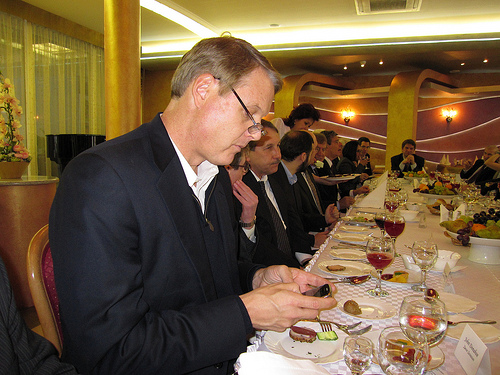
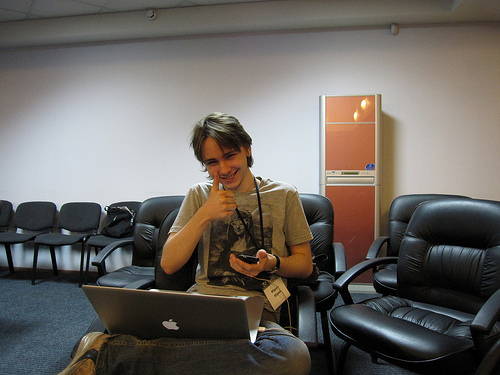
Sometimes the best record of an event is in pictures of the delegation’s progress. Three of the pictures in this post  are from Esther Dyson’s Flickr photostream. While the tweets of delegation tell a tale, as do reactions from Russian students and the rest of the online audience, her pictures and captions is the most eloquent storytelling I’ve encountered to date.

Search engines and science

What’s the fastest growing search engine in the world? Apparently  Yandex.ru, as the delegates learned when they visited Yandex.ru headquarters. The Russian search engine has the fastest rate of growth in the world, according to Comscore. After we met on Twitter, Nick Wilsdon also shared statistics on Russia’s top social networksVKontakte.ru & Odnoklassniki.ru.

Students and social media

As with students elsewhere,  Russian students are using phones and social networking to exchange information. Warrior shared a picture of the students gathered at Novosibirsk on Twitter, tweeting about an “energizing chat w/ univ students, topics ranged from talent, innov., corruptin, beer pong.”

Given the return of state control of domestic television networks in Russia, the Internet’s role as a vital means of communication and global news has perhaps never been as acute.


What else will come of the “innovation delegation?”

Veterans of the Cold War might wonder why the U.S. or its entrepreneurs are offering advice or a forum to a former opponent. Even if the “missile gap” is a remnant of the past, Russian and U.S. relations haven’t been exactly sunny over the decades.

It may be that this delegation is a physical expression of the hopes that Hillary Clinton expressed in her speech on Internet freedom. And, in fact,  Jared Cohen tweeted the State Department’s  innovation delegation is  “an example of 21st century statecraft driven by Hillary Clinton.”

But putting concerns about aiding Russian industry aside, creating the conditions that make Silicon Valley or NYC fertile grounds for tech entrepreneurship won’t be easy. “We’re developing joint projects w/Russia on education, anti-trafficking, health, e-gov, anti-corruption using tech,” Cohen tweeted earlier today.

“Novosibirsk is Russia’s 4th largest city,” tweeted Cohen, “less than 100yrs old, Russia’s hub of innovation, & just northeast of India in middle of Siberia. [The] challenge in Siberia is not lack of innovation, but rather avenues for entrepreneurs to attract start-up capital.”

Giving young Russian entrepreneurs confidence about both patents and ownership of intellectual property would help, as would mentors. “I’ve been interested in Russia, working in computer science, engineering, mathematics for a long time,” said Dorsey in Novosibirsk. “Russia has been a major part of the story. I’ve found that there’s a real desire to create projects and an entrepreneurial spirit but not enough face to face discussion.”

Dorsey pointed out that the U.S. tech community regularly has meetups in Silicon Valley and New York City where the largest companies constantly invite people to come in. “When you have that supportive culture, it’s very easy to take risks,” he said. In Russia, Dorsey observed, “There’s not this desire, or a structure, or momentum, to get together and talk about what we want to create together. If you bring people who can fund this from the beginning, you start building angel networks, which are the basis for all innovation in the US these days.”

Desire, control of intellectual property and a tech community would be an incremental change on a larger continuum. As Fraser Cameron wrote in a recent op-ed in the New York Times, Russian President Dmitri Medvedev has called for a number of reforms, including a return to elections and freedom.

Cameron points out that Putin “failed to encourage investment in new industries, technologies or infrastructure.” In that context, will access to Western angel investors or social media matter?

Or, to reiterate the questions I asked to the delegation last night:

What uses of tech do Russians admire in the US? Where could new ICT help there now? How important is free, open speech to stimulating a culture of innovation? What about the use of open source tech? (Listen in for answers in Kutcher’s archived streams.)

Kutcher (above, in his own Twitpic) evidently has gained some perspective, at least on the impact of state involvement. “My perception of Russia and Russian technologists was always based on Russia’s ability and interest in scientific achievement,” he said. “The one thing I’ve found since we’ve been here, without Russian government controlling the room, is that it becomes a much more vibrant, expressive room. My perception of control levels and the reality were two different things.”

Donahoe, former head of Bain & Company, had different considerations. He said that while he saw potential to expand eBay into Russia, it would be on the condition: that law enforcement and the Russian government cooperate on anti-cybercrime.

Donahoe was impressed by a number of experiences, particularly in a new view of Siberia. “There’s a wealth of talent, real opportunity to build on a tech center,” he said. “I’m truck by the talent of Russian engineers. They should continue to play a leadership role in the World Wide Web, as they have continued to do with Google, Paypal and  Skype.”

On techno-utopianism and digital diplomacy


[Photo Credit: Jarod Liebman]

The ability of social media platforms to provide a platform for conversations was repeatedly shown in 2009, particularly in Iran’s elections. As Jack said to ABC News, “when you can see more of what’s happening you can really see more of the opposition is arguing about and take those arguments head on and have a conversation about them.”

The same communication tools can and have, however, been used in “digital dictatorships,” as Evgeny Morosov wrote in the Wall Street Journal on Saturday. Rita J. King’s considered rebuttal in the “The Evolution of Revolution,” pointing out where digital diplomacy has had effect.

Cohen’s own involvement in the Alliance of Youth Movements (AYM) conferences would seem to extend from a similar belief in the potential for 21st Century statecraft.

Some of the most important interactions, after all, are likely to always be in person. As Jack tweeted, “having lunch together is so much more important to creating something than a business meeting -@edyson.”

The role of ICT


[Yuri Marin of Samizdal.ru, a self-publishing/printing site in Novosibirsk. Credit: http://www.flickr.com/photos/edyson/ / CC BY-NC 2.0]

As I listened to the discussions with Russian technologists about what could be done to improve innovation, particularly for civic gain, I thought of a long post that MIT Professor Andrew McAfee posted earlier this month on information and communication technologies (ICT).

As he wrote in “The Oxygen of Bandwidth, or How I Spent My Winter Vacation,” “researchers report that people in the developing world are willing to skip meals in order to buy more bandwidth.”

McAfee’s advice for helping the people of the developing world is simple: “Help them acquire technology that lets them help themselves, and that lets others help them. To paraphrase Winston Churchill: give them the ICT tools, and they will finish the job.”

Mitigating the dangers of journalism in Russia isn’t likely any time soon., but given Russia’s technological base, many of its engineers, students and scientists are equipped with the ability to create such tools already.

Whether this trip will create avenues for better communication, investment in startups or anti-corruption is an open question. It’s one of many that the delegates themselves will no doubt continue to answer in the days ahead.

Leave a comment

Filed under article, photography, research, social bookmarking, social media, technology, Twitter

The world “diggs” virtual farming for social gaming online [#RusTechDel]

Russians and Americans both love virtual farming?

The popularity of  Zynga’s “Farmville” for among Facebook’s 400 million users is well known. Given 69 million active monthly players, Farmville is bigger than Twitter.

A less publicized statistic is that users of Russia’s top social network, VKontakte.ru, also have a farming application the top social game.

Earler today, I met Nick Wilsdon, a Russian online marketer, by following the #RusTechDel hashtag on Twitter.  (In doing so, I was reminded again that #hashtags on Twitter are like channels on cable TV.) I asked Wilsdon if he knew how many unique visitors vKontackte & others receive monthly.

Wilsdon answered with a quick report on vKontackte and Odnoklassniki.ru. According to the statistics he cites, “Happy Farmer” has more than 6 million users and revenues estimated at $200 million dollars per month.

Judging from the gallery of Happy Farmer fans at English Russia, the social game has inspired a passionate following.

And, as a post at The Next Web points out, a farming game is atop the list of most popular social games in China.

Whether or not gaming addiction is an issue, China’s burgeoning social gaming market shows how popular – and profitable – this phenomenon has become.

As VentureBeat’s reporting on online faming games suggests, there’s a “new agrarian revolution” in China. It’s tempting to summarize a global interest in social gaming on the farm as a common virtue, as millions tend virtual gardens for a few minutes every day across different cultures.  It would be lovely if it spoke to yuor shared interest in growing things.

Unfortunately, there’s a dark side to virtual farming parallel to perils of factory farming in the real world: the profit motive.

As Elliott Ng writes:

Some fear that this new social farming revolution may not contribute to the positive development of society. A central feature of social farm games in China is stealing vegetables. Official state media People’s Daily reports that 70 percent of users on Kaixin001 cite it as their favorite feature, and it has even spawned the popular phrase “How many vegetables have you stolen today?”

This key addictive feature has created news stories of business executives “obsessed” with stealing vegetables and broken relationships over vegetables stolen on the night shift. The game is so addictive — with players setting alarm clocks at all hours of the night to check crops — that it 
“destroys jobs and relationships.”

“Simplicity and stickiness are behind the global epidemic of farm games. Anyone can learn to grow crops within minutes and reap a reward for getting friends — or the entire office — addicted too,” said BloggerInsight Co-Founder Lucas Englehardt.

There’s a business in serving that intense interest, along with providing others a means to slay monsters in World of Warcraft. There’s no small amount of psychology at work behind the incentive structures of these games, as designer look for ways to induce users to spend money on virtual good or services. And, as Michael Arrington pointed out in “Scamville” in TechCrunch last year, the “social gaming ecosystem” can lead to bad behavior.

For good or ill, however, more of us are planting virtual seeds each day.

Leave a comment

Filed under blogging, research, social media, technology, Twitter

What can news organizations learn from the DC media market?

It’s no secret that the media industry has been massively disrupted by the Internet and mobile communications technology. Newspapers no longer have monopolies on the market for local advertising. And news breaks in real-time across social networks like Twitter, splashing on the the 24 hour news networks minutes later.

The media market in Washington, D.C. has been similarly affected by technological change, particularly as new, nimble online players have moved into the nation’s capitol. Last night, I visited FedNet’s officers in D.C. for the Online News Association‘s February meetup. The night featured a panel moderated by Keith Carney, President of FedNet and featured Mike Mills (@Mike_Mills), Editorial Director of the Congressional Quarterly/Roll Call Group; Howard Kamen (@hkamen) Partnership Editor for USA Today, and Karl Eisenhower, Editor, New Media Strategy for NationalJournal.com. Fednet will be posting video soon; in the meantime, the livestream I recorded is below:
Vodpod videos no longer available.

more about “#ONADC on USTREAM: The Online News As…“, posted with vodpod

The panel primarily focused on the business of online news as practiced by these different organizations. Congressional Quarterly (CQ) and Roll Call have a combination of a subscription model focused on high-value, scarce information gleaned from dedicated reporting on the minutiae of legislation, lobbying and political news. The combination of access, high value eyeballs and profit didn’t escape another provider of high value information: As Mills observed, the Economist Group owns both Roll Call and CQ now. The same media group also runs Congress.org, which Mills says is for “citizens to learn about Congress engage in grassroots activity.” He’s not worried about losing content to search engines, either, given a closed subscription model. “We’re not on the Internet, we’re on the intranet,” said Mills.

USA Today, by contrast, is a national newspaper with a generalist focus. According to Kamen, partnerships with other organization are providing USAToday.com with data for interactive graphics. Those interactive features in turn provide sustained traffic over time to support an advertising revenue model. When asked by Carney if a paywall might show up at USA Today to match the reported metered model at the New York Times, Kamen responded that “I don’t think that’s going to happen any time soon.” USA Today has moved into mobile news, recording over 2.5 million downloads of its free iPhone app. “We made it free to get eyeballs first,” said Kamen.

Even though the paper’s leadership has focused on retaining its position as the most widely circulated paper in the US, Kamen’s comments made it clear that USAToday.com is an important part of its future. “I truly think we do have an ‘online first’ model now,” said Kamen, although there coordinating print and online remains a “work in progress.”

The bridge between writers and coders has been bridged at National Journal, where Eisenhower said every newsroom has dedicated IT resources. The need to connect developers with reporters is felt across town, too: “The real merger that needs to happen is between editorial and IT,” said Mills.

National Journal is also shifting with the times, looking carefully at where and when readers are consuming their content. “Knowing our audience means knowing their work habits,” said -Eisenhower. “Mobile is very important.” Like other glossy weekly magazines, National Journal is experimenting with new advertising models as print circulation wanes.

Each publication also fits into a hypercompetitive emerging media landscape in DC. Whether it’s Politico, the DailyCaller.com, the Fiscal Times or Bloomberg’s coming “BGov” http://bit.ly/cTD1m8, there’s a host of new players that are competing for eyeballs and ad dollars with the Washington Post, Washington Times, the Hill, the Washington City Paper, the Metro Weekly. And that doesn’t even factor in local blogs like the DCist, KStreetKate and We Love DC, or the influence of NPR/WAMU and local TV stations.

What will 2010 bring? Innovation and disruption, without question. Certain takeaways from last night, however, should be of use to every media organization, even those without immense national circulations or access to information of interest to readers with attractive demographics for advertisers.

First, go where the readers are. Mills observed that failures in business models were often rooted in not following the audience to where they’re getting information.

Second, go mobile. Create applications, stripped down websites and email alerts that allow the audience to get news on the go.

Third, use data to create evergreen content. Organizations like Gallup or even governments themselves are providing data feeds or sets that can be used for interactive graphics.

Finally, get social. Facebook recently passed Yahoo as the second-most visited site in the world. Many news organizations are finding that social networks are a significant source of traffic, as the audience shares what it’s reading.

All in all, a great night. I enjoyed talking with the always-entertaining Tiffany Shackleford about celebrity culture online and Lee from NPR’s “Tell Me More” about digital distribution and syndication. Even as old models crumble, there’s no shortage of innovation in how we share the news in 2010.

Leave a comment

Filed under blogging, journalism, social media, technology, video

Voices from the #Gov20LA Unconference: On Innovation and #Gov20

Earlier this month, I stopped in Los Angeles to see what was happening at Goverment 2.0 LA, a hybrid of the unconference/camp and conference model organized by Alan W. Silberberg and Lovisa Williams. I’ve already shared some thoughts on what I learned about language of government 2.0, the history of disruptive innovation and the ways government adapts to technological change.

While I’m proud of those posts, one of the themes that emerged from the weekend was the importance of video for communication. I’m not at all on “video as the new text,” especially for countries with low Internet penetration or bandwidth, but there’s no denying that online video has extraordinary power in conveying messages. Just look at video of Iranian protesters on the streets of Tehran, reports from the earthquake in Haiti or the President of the United States on YouTube. Tune in to CitizenTube any minute of the day to witness that power in action.

Following are short videos from Gov2.0 LA organizers and attendees that share their takeways from the event.

Lovisa Williams

@lovisatalk talks about the goals of the Gov2.0 LA Camp.

Ben Berkowitz

@BenBerkowitz is the CEO of SeeClickFix.

Lewis Shepherd

@LewisShepherd discusses collaborative technology and government.

Wayne Burke

@wmburke talks about Govluv.org, on online platform for connecting to government representatives using Twitter.

Antonio Oftelie

@AntonioOftelie conducted a Government 2.0 Survey for Harvard’s Kennedy School.

Alan Webber

@AlanWebber talks about the international flavor of the Gov2.0 LA Camp.

Laurel Ruma

@LaurelRuma on her impressions from Day 1.

Lisa Borodkin

@LisaBorodkin on the language of Government 2.0.

Christina Gagnier

Christina @Gagnier on communicating about Government 2.0.

Justin Herman

@JustinHerman goes West Coast.

Adriel Hampton

@AdrielHampton on his impressions from Day 1.

Finally, here’s GovFresh.tv‘s video that features interviews with some of the people above and more:

2 Comments

Filed under application, blogging, friends, journalism, microsharing, research, social bookmarking, social media, technology, Twitter, video

Google Buzz: adding algorithmic authority and relevance to social media

A few minutes ago, Google Buzz went live at http://buzz.google.com. Google posted a video introducing the Buzz, which ties together Google contacts into a distributed social network accessed through a new tab in Gmail.

In a live webcast on YouTube, Bradley Horowitz (@elatable) explained what Google was after with Buzz: a way to add relevance to the information firehose represented by social messaging and activity. The Web application will act as a user interface to for social data.

Based upon the demo, it will be a snappy app for processing, sharing and annotating images, video and conversations. “Organizing the world’s social information has been a large problem, the kind @Google likes to solve,” said Buzz product manager Todd Jackson, explaining at least some of the why behind the application of algorithmic authority to social media. Jackson writes more in his introduction to Google Buzz at Google’s official blog.

Content shared on Buzz can be posted publicly to a Google Profile (like the one for, say, Alexander Howard) or sent privately within a network. At first glance, the user interface and contrls looks like a Friendfeed clone, with the additional of familiar keyboard shortcuts from gmail and Google Reader. And, notably, Google has adopted the “@reply” convention from the Twitter community as a means of initiating a conversation with contact.

To get a user started with a network, Buzz will autofollow people you’ve emailed. In other words, as Jeremiah Owyang predicted last summer, Google made email into a social network.

Buzz is also mobile.

The mobile Web application, which works on both iPhone and Android, includes geotagging and voice recognition, allowing the user to make spoken updates. While Google profiles will aggregate a user’s Buzz activity, “Places” will aggregate location-based reviews. (In other words, look out Yelp.) A “Nearby” button provides location-based context for Buzz users. Google also launched a new mobile verion of  Google Maps, adding a a social layer to its maps. The new “conversation bubbles” on Google Maps indicate geotagged Buzz updates and look like a lightweight, useful version of Twittervision.

Coming soon to the enterprise

Google Buzz will be launched as an enterprise product, says Horowitz. Buzz would likely serve as microblogging layer for Google Apps, providing helpful filtering for the noise of the social Web, unlike Wave, which added it. “A lot of the functionality is inspired by Wave,” said Horowitz, a likely nod to a decision to adopt the best features of the often maligned social messaging platform.

Google co-founder Sergey Brin was on hand to share his personal experience with Buzz, offering a preview of how it might be pitched to other business executives or CIOs. “I found a huge amount of productivity from using Google Buzz internally,” said Brin. “I posted [an] OpEd to Buzz. I looked at the broad categories and did a general edit based on that feedback. It was far more efficient.”

Open APIs?

Public feeds are supported as an XML feed and are fully supported by PubSubHub as of today, said another Google exec. By going open API and openly courting developers to join them on Google Code, Google may be after the same fertile ecosystem that surround Twitter.

What does Google Buzz mean?

All of the above gives an idea of what Google’s newest Web application can do and how it might work. Altimeter Group’s Jeremiah Owyang has already posted a quick take on what Google Buzz will mean. Key insights:

  • At the high level, this is a strong move for Google, they continue to aggregate other people’s social content, and become the intermediatry. This helps them to suck in Twitter, Flickr, and any-other-data type as the APIs open up, giving them more to ‘organize’. This is Google acting on its mission to the world.
  • For consumers, the risk of privacy will continue to be at top of mind. Although the features allow for sharing only with friends or in public. expect more consumer groups to express concern. Overtime, this will become moot as the next generation of consumers continues to share in public.
  • For consumers, this could potentially have more adoption than Twitter as Gmail has a large footprint Google told me it’s tens of millions (active monthly unique). Of course, most Gmail users likely aren’t Twitter users, but there could be a large platform to draw from.
  • For Facebook, this is a direct threat, these features emulate Friendfeed and the recently designed Facebook newsfeed. Expect Google to incorporporate Facebook connect, commoditizing Facebook data as it gets sucked into Google and displayed on Google SERP.
  • For small busineses and retailers, this will impact their search engine results pages, as a single top ‘buzzer’ could cause their content to be very relevant, if that person was relevant, then their influential content could show at top of SERP pages. Expect Google to continue to offer advertising options now around buzz content –fueling their revenues.
  • Strong, near real-time analysis from Owyang. One area he didn’t dwell as much on is the utility to both businesses and many users of the social Web who want relevance for work or for specific topics, without the noise that often obscures both on Twitter, Facebook or other social networks. Power users have had to evolve many strategies to filter signal from the noise, including shadow accounts, lists, keyword searches or alerts. Google Buzz has the potential to allow over 150 million gmail users to quickly filter the most useful content from the social Web and then selectively share it with either friends, colleagues or the open Web. That action, often termed “curation” in the digital journalism space, is singularly useful.

    If Buzz easily enables that activity for mobile users, it will have the potential to massively disrupt the nascent mobile social networking space that currently includes Yelp, Gowalla, Brightkite, Loopt and Foursquare. If users turn to Buzz for reviews, to find who is nearby or what’s being discussed in the neighborhood, Google will also have made Google Maps much stickier, which could in turn make it a more useful platform for contextual mobile advertising. Given the potential for targeted ads based on location to be more useful, that might in turn be of great utility to both users and the search engine giant, though electronic privacy advocates are likely to look at the move with concern.

    Will people use Buzz? That’s the multi-million dollar question. Facebook and Twitter own the social Web, as it stands. If Buzz offers a UI that adds relevance, it has a shot. If users find utility in the way that Buzz helps them filter social media from other platform, it could stack up well against Brizzly, Seesmic or similar “social dashboards.”

    I’ll keep an eye out for the function to go live in my inbox in the meantime and read TechMeme for other reactions.

    2 Comments

    Filed under application, blogging, microsharing, social bookmarking, social media, technology, Twitter, video