As a huge fan of Matt Groening, a long-time Apple customer and a serious Twitter user, I found a recent episode of Futurama, “Attack of the Killer App,” to be crackling good satire. Excerpt below:
Futurama’s focus on Apple is, of course, nothing new. Series co-founders David X. Cohen and Matt Groening are both big Apple nerds. We previously chronicled Futurama’s subtle and comical use of Apple and Mac references over here.
The viral Twitworm that creates many zombies is one of the best pop references to botnets and IT security I’ve seen recently, too. And there was one more (seriously geeky) detail that Engadget, Edible Apple and Mashable missed:
“When did the Internet become about losing your privacy?” asks Fry.
The WWW project merges the techniques of information retrieval and hypertext to make an easy but powerful global information system.
The project started with the philosophy that much academic information should be freely available to anyone. It aims to allow information sharing within internationally dispersed teams, and the dissemination of information by support groups.
Reader view
The WWW world consists of documents, and links. Indexes are special documents which, rather than being read, may be searched. The result of such a search is another (“virtual”) document containing links to the documents found. A simple protocol (“HTTP”) is used to allow a browser program to request a keyword search by a remote information server.
The web contains documents in many formats. Those documents which are hypertext, (real or virtual) contain links to other documents, or places within documents. All documents, whether real, virtual or indexes, look similar to the reader and are contained within the same addressing scheme. To follow a link, a reader clicks with a mouse (or types in a number if he or she has no mouse). To search and index, a reader gives keywords (or other search criteria). These are the only operations necessary to access the entire world of data.
The "Women of ENIAC." For their history, read "Programming the ENIAC."
Some issues trigger a deeper response than others within communities. In the technology world, the education, opportunities and inclusion of women holds unusual resonance.
In the U.S., as Nick Kristof wrote, “schoolgirls are leaving boys behind in the dust.” After graduation, the narrative evolves further. As Claire Cain Miller wrote in the New York Times on Friday, “women now outnumber men at elite colleges, law schools, medical schools and in the overall work force. Yet a stark imbalance of the sexes persists in the high-tech world, where change typically happens at breakneck speed.”
Just 1 percent of girls taking the SAT in 2009 said they wanted to major in computer or information sciences, compared with 5 percent of boys, according to the College Board.
Only 18 percent of college students graduating with computer science degrees in 2008 were women, down from 37 percent in 1985, according to the National Center for Women and Information Technology.
As computer scientist Hillary Masontweeted tonight, “We don’t need affirmative action. We need meaningful culture change and support.”
Based upon the research a colleague gathered tonight, some actions could make an important difference in three ways:
(1) It’s good for men. Inclusion of women and minorities reduce stereotypes, and promotes second-order reflection on latent stereotypes, by providing real, first-hand experience. (Mahzarin R. Banaji and Curtis D. Hardin, Automatic Stereotyping, 7(3) Psychol. Sci. 136-41 (May 1996).)
This leads to better, more accurate evaluation of people’s work – because when people unconsciously use stereotypes, they mis-evaluate work. For example women’s presence in high-level orchestras basically doubled once auditions started to be done gender-blind, focusing only on the music.
(Claudia Goldin and Cecilia Rouse, Orchestrating Impartiality: The Impact of “Blind” Auditions on Female Musicians, 90(4) American Econ. Rev. 715-41 (2000).)
(2) It’s good for women. The absence of women (or very low numbers of women) signals to women that they aren’t welcome or don’t belong, which can in turn cause them to leave the field or choose not to enter it in the first place. (William T. Bielby, Minimizing Workplace Gender and Racial Bias, 29(1) Contemporary Soc. 120-29 (2000))
Research also suggests that when women are invited to the table, they have more energy free to do good work, instead of using half their energy just breaking down the door. Reducing cognitive load on subjects who have to work to overcome stereotypes is not a minor factor.
(3) It’s good for business & technology. Whatever the vertical, the entire industry benefits when the best work is being created and presented. As Miller writes:
Analysts say it makes a difference when women are in the garages where tech start-ups are founded or the boardrooms where they are funded. Studies have found that teams with both women and men are more profitable and innovative. Mixed-gender teams have produced information technology patents that are cited 26 percent to 42 percent more often than the norm, according to the National Center for Women and Information Technology.
In a study analyzing the relationship between the composition of corporate boards and financial performance, Catalyst, a research organization on women and business, found a greater return on investment, equity and sales in I.T. companies that have directors who are women.
The number of senior women doing major research and running labs in traditionally male-dominated fields like physics also offers insight into how efforts to include women can lead to merit-based selection across the broadest set of the best candidates. For instance, consider Lisa Randall, one of the most cited theoretical physicists of the last half-decade. Or Marissa Mayer, a senior Google exec who, as Miller wrote, many women she interviewed cited as “someone who gives them hope.”
Where to learn more
I don’t believe that most people are consciously biased, nor that they intend to be biased. Research into implicit bias suggests, however, that the most pervasive forms of bias are unconscious. Those biases can have tremendous effects on how we evaluate others, mostly to our own detriment – but also to our communities and industries.
Does the issue of women in tech matter to the bottom line? Miller’s reporting suggests that’s so:
In a study analyzing the relationship between the composition of corporate boards and financial performance, Catalyst, a research organization on women and business, found a greater return on investment, equity and sales in I.T. companies that have directors who are women.
Fortunately, there are a growing number of conferences, groups and networks that celebrate and honor women in technology, including:
O’Reilly Community also features an excellent series of essays on women in tech. For the fascinating story of how women were involved in “hacking” the world’s first programmable computer, pictured at the top of this post), read ENIACprogrammers.org. And the recent Ada Lovelace Day listed dozens of inspirational women who are innovators, inventors and educators.
Finally, Nick Kristof has done the world a mitzvah by writing eloquently about womens’ rights in his most recent book, “Half the Sky.” Learn more at HalfTheSkyMovement.org.
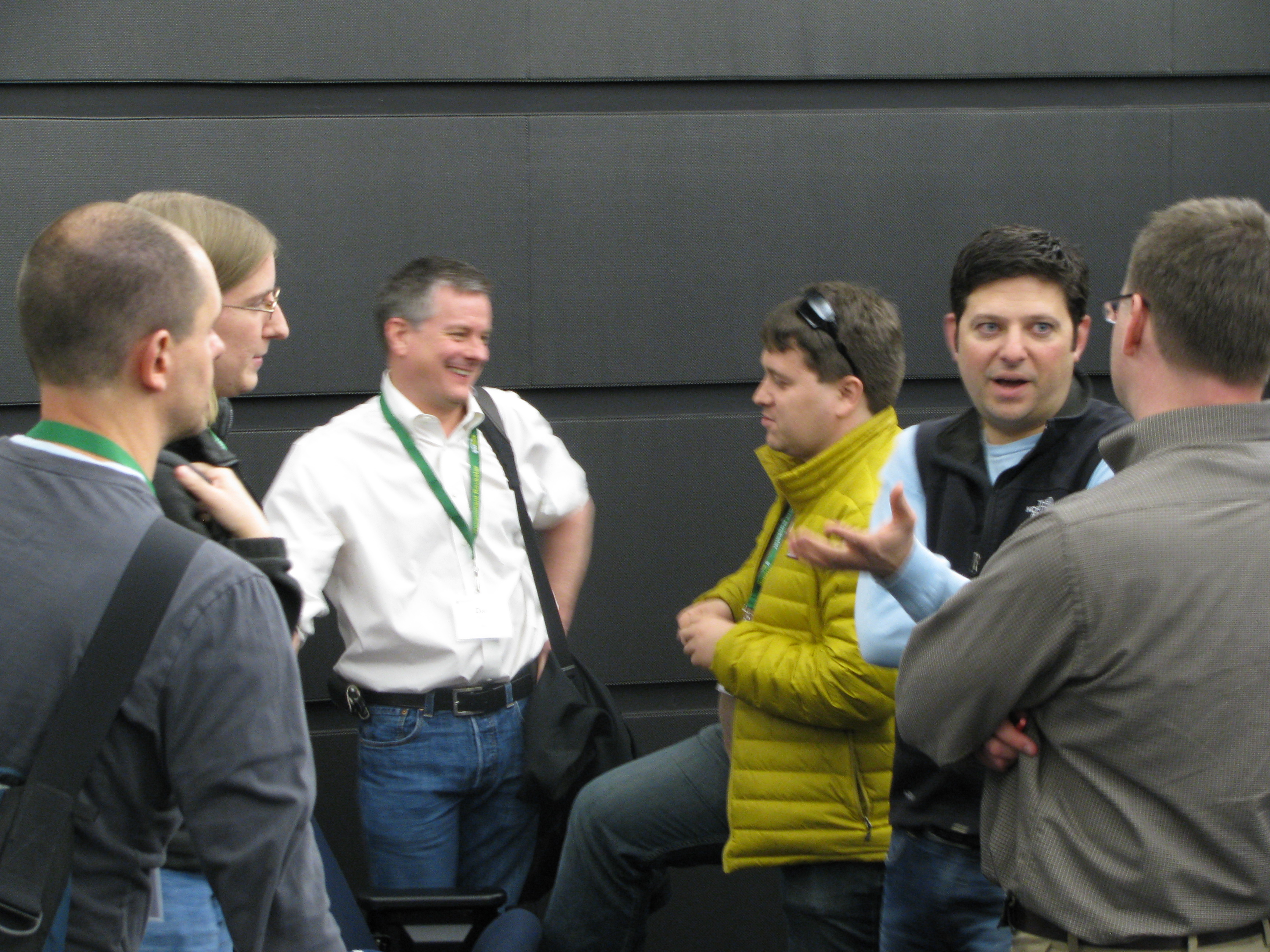
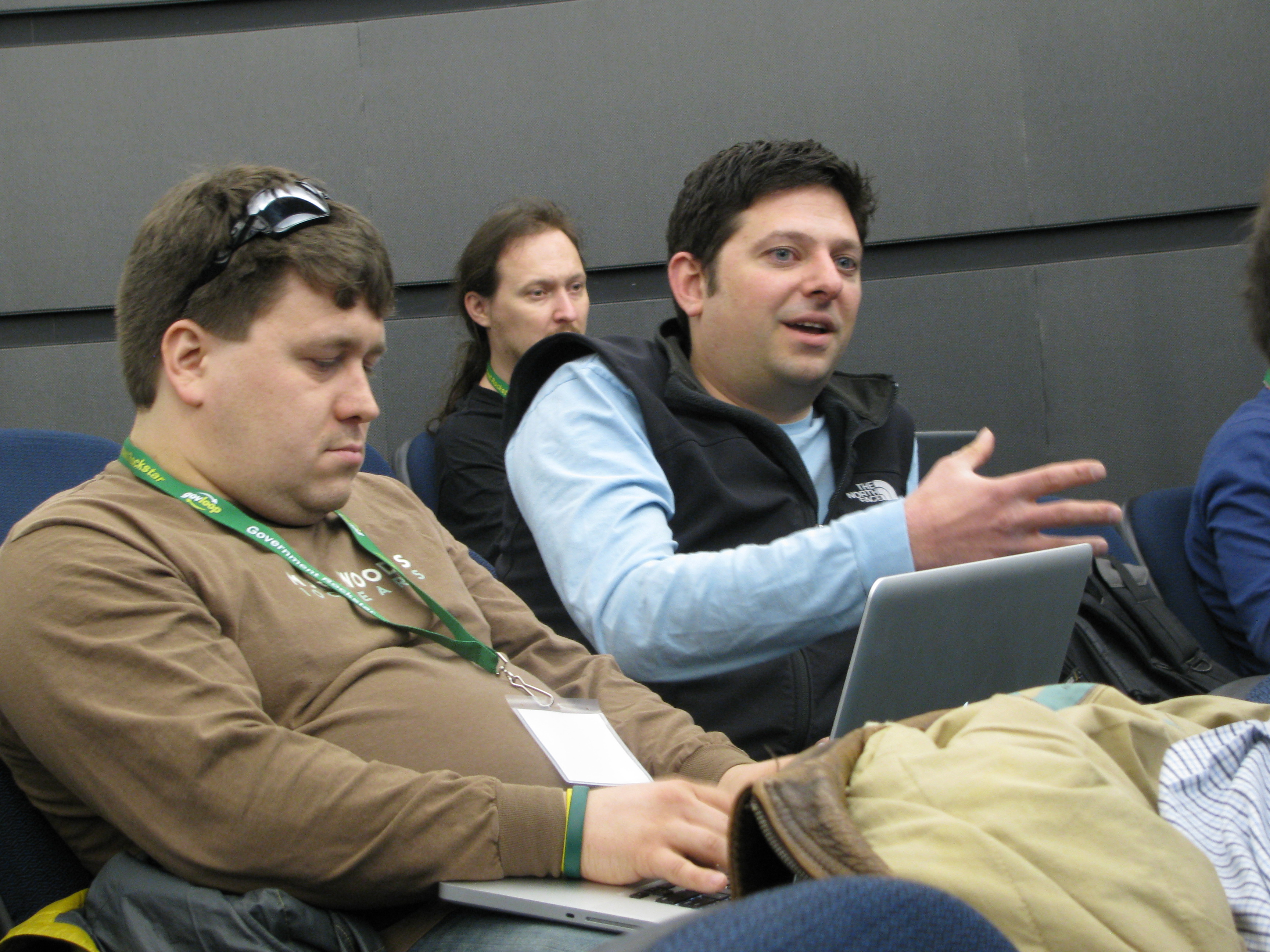
This weekend’s Transparency Camp in Washington, D.C. brought together technologists, journalists, developers, advocates for open data, open government and open data for discussions, case studies, workshops and even, as Micah Sifry put it, some secular colloquy.
Transparency Camp came at a time of immense foment in Washington and the country beyond. A historic healthcare reform had just been signed into law, including an overhaul of student loans. Midterm elections in Congress loom at the end of the year. And the nation’s economy continues towards an uncertain future, perhaps of jobless recovery, after the Great Recession.
The Sunlight Foundation’s engagement director, Jake Brewer, kicked off the morning by asking how much had changed around government transparency since the last Transparency Camp. Make sure to read David “Oso” Sasaki’s notes from Transparency Camp for a superb narrative of his Saturday. (Sasaki is the Director of Rising Voices, a global citizen media outreach initiative of Global Voices Online.)
In 2010, there are more reasons to believe government transparency and open government will see more rapid advancement. As the co-founder of the Sunlight Foundation, Ellen Miller, pointed out in her introduction, there are more significant legislative efforts underway around transparency. The The Public Online Information Act (POIA), HR 4858, introduced by Rep. Steve Israel, would embraces a new formula for transparency: “public equals online.” And an omnibus ethics bill, HR 4983, would “amend the Ethics in Government Act of 1978, the Rules of the House of Representatives, the Lobbying Disclosure Act of 1995, and the Federal Funding Accountability and Transparency Act of 2006 to improve access to information in the legislative and executive branches.”
An Open Data Playbook. Clay described that as “an instruction manual for people inside government to teach them how to open their data
A list of all jurisdictions and elected officials around the country
A data exchange format for data catalogs, in a model like Google did with GTFS.
The success or failure of Transparency Camp can’t be measured by those metrics alone, however, although whether Johnson’s challenges are met by the community are absolutely part of the story of this weekend.
A key element of OIX, as Hamlin pointed out, was the standardization of online privacy principles promulgated though IDManagement.gov. Another important part of the identity picture is Microsoft’s release of part of the intellectual property for its U-Prove ID tokens under Open Specifcation, as detailed at credentica.com.
The Open Government Directive, Datasets and Data.gov
When the “three words” from the unconference were synthesized into a “Wordle” for Transparency Camp, four words emerged as the most powerful themes:
Open, government, transparency and, most of all, data.
The Open Government Directive (OGI) was a significant moment in American history, in terms of putting the data of operations into a format and venue where developers could access and parse it: data.gov.
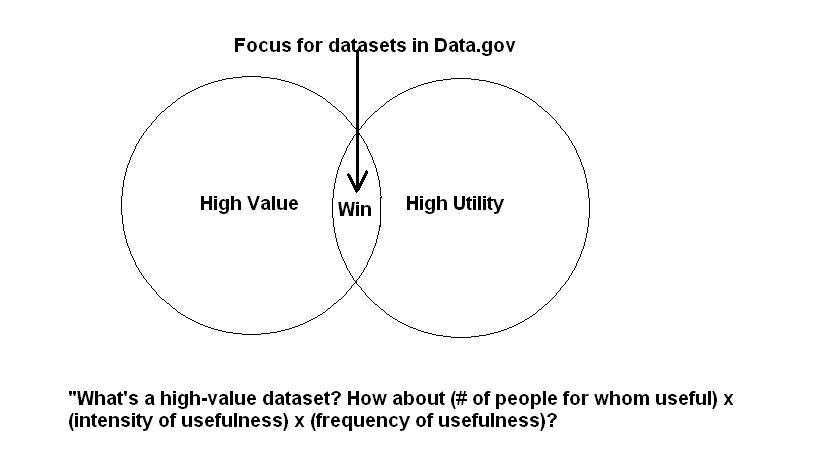
Now that the resource is up, however, there are outstanding concerns about data quality, frequency and, most pertinently, utility. Andrew McLaughlin, the “Deputy Chief Nerd @ the White House” (aka deputy US chief technology officer), suggested that “to get reluctant agencies to embrace data sharing, focus on “high-reward”, not “high-value”, datasets.”
When asked if new guidance was needed, since “high-value datasets” for Data.gov are written into the OGI, McLaughlin responded that “some agencies will use a citizen-utility metric for prioritizing scarce resources. Others will focus on datasets that will are rapidly doable, to help overcome resistance and ease culture change. Both ways of defining “high-value” make sense.” The Venn diagram above illustrates how that might look.
McLaughlin also acknowledged a feature request for data.gov and apps.gov from the Transparency Camp community: more and better metadata, like data quality qualifiers or FISMA compliance status.
At the In Code We Trust: Open Government in New York
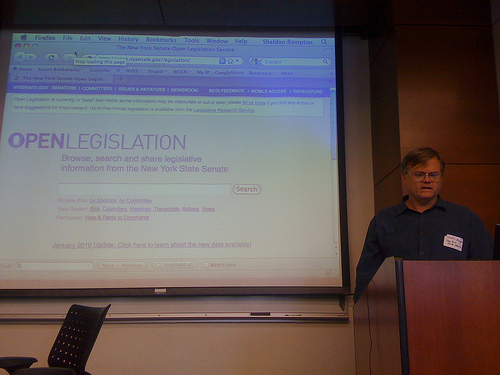
My favorite session for the day was a case study of open government featuring the New York Senate. With a nod to Lawrence Lessig, Noel Hidalgo, Sheldon Rampton and Mark Head showed precisely how law could be turned to code. I livestreamed “In Code We Trust” on uStream. After poor transparency ratings, a broad swath of changes to the New York state senate websites was implemented over the past year. New York was the first state senate to adopt Creative Commons for its intellectual property.
One of the basic principles of an unconference is the “law of two feet.” If you don’t like a session, you move. You own your own experience. Given that livestreamed parts of Transperency Camp, I also “voted with my feed,” moving my window to the Internet along with my body. After a session on the relationship of open government descended into somewhat unproductive discussion about open policy, I moved over to the healthcare information technology (HIT) session, which I recorded in part. Given the billions of dollars that will be flowing into healthcare IT over the next few years, as provisions of the Recovery Act are implemented, this was an important discussion.
Brian Behlendorf, a notable open source technologist, led the session. There’s now an Office of the National Coordinator for Health IT to direct action, available on the Web at HealthIT.gov or on Twitter at @ONC_HealthIT. As Andrew McLaughlin noted, Brian Ahier maintains a great blog on health IT, including details on how the healthcare reform bill affects HIT.
Local Government and the Digital Divide
Another excellent session featured discussions about how transparency is coming to people closer to home.
Literally.
OpenMuni.org provides some perspective on that effort. The Ideascale model of crowdsourced recommendations for better efficiency and governance has been applied to local government, at least in beta, at Localocracy. The first pilot has been put into action at Amherst, Massachusetts.
The local government session at Transparency Camp was also fortunate to have the D.C. CTO, Bryan Sivek, and staff from @octolabs present.
Sivek defined his role as integral to both enabling better services online, like the city resource request center at 311.dc.gov, finding efficiencies for government through IT, and in bringing more citizens the benefit of connectivity. He illuminated a yawning gap in Internet use, observing that “DC has a huge issue with the digital divide. In Wards 5, 7 and 8, 36% of the people are connected.”
Bryan Sivek is now looking for feedback on how to use technology better in the District, elements of which are evidenced at track.dc.gov.
Odds, Ends, Resources and Takeaways
I was reminded of a great travel resource, FlyOnTime.us, and learned about a new one for Washington, ParkItDC.com.
I wish the former existed for Amtrak.
I learned about data and visualizations of local campaign spending at FollowTheMoney.org and government transparency at OpenSecrets.org.
Most of all, I was reminded by how many brilliant, passionate and engaged people are working to improve government transparency and efficiency through technology, collaboration and advocacy.
Delegations from the State Department to Russia haven’t generally been accompanied by great fanfare. In an information age where a growing social layer for the Internet provides unprecedented means for people to share their experiences online, the progress of the “innovation delegation” through Moscow and Siberia has been marked by a steady progression of tweets, online video and photos.
This is, after all, a group of “geek luminaries” that has considerable reach online and into popular culture. Unsurprisingly, the member of the tech delegation that’s attracted both the attention of mainstream media in the US and fans abroad is Hollywood actor Ashton Kutcher. Kutcher brought with him more than 4.5 million followers as Twitter’s most-followed user (@aplusk) and, perhaps even more crucially, an iPhone equipped with a video camera and a uStream account.
The delegation is led by Jared Cohen of the State Department’s Office of Policy Planning and Howard Solomon of the National Security Council. US Chief Technology Officer Aneesh Chopra joined them in Moscow. They are also traveling with:
Jack Dorsey, creator, co-founder andcChairman of Twitter
Ellis Rubinstein, president and CEO of New York Academy of Sciences.
“We’re trying to look at how Russia can utilize its population as a health resource, as an education resource, as an anti-corruption resource, as an anti-trafficking resource,” said Cohen, as quoted at Wired’s Epicenter blog.
According to Wired:
“the group hopes to emerge with clear deliverables. Women in remote areas could receive information — either online or using the SMS feature on their cellphones — on how to have healthy pregnancies. And in order to prevent Russian cellphone companies from being pressured into divulging the names and locations of those who report human-trafficking violations by SMS, the complaints could be cleaned and anonymized outside of the country, according to Cohen.
“The State Department is not bringing these people over as CEOs,” Cohen added. “John Donahoe is the CEO of eBay, but he’s also an expert on e-commerce and building platforms that move large sums of money in ways that aren’t corrupt, so he’s an expert on ‘e-anti-corruption.’”
The success of the mission hit at least one roadblock: Moscow traffic.
Despite tweeting about people, the ballet, the Kremlin, food and one another, the tech delegation was quiet about missing a meeting with Russia’s communications minister — and six Russian tech companies.
Other visits, at least viewed from through Kutcher’s livestream and Cohen’s able narration, have been more productive. Twitter gained another high profile user, after Jack helped Donahoe sign up on Twitter.
Sometimes the best record of an event is in pictures of the delegation’s progress. Three of the pictures in this post are from Esther Dyson’s Flickr photostream. While the tweets of delegation tell a tale, as do reactions from Russian students and the rest of the online audience, her pictures and captions is the most eloquent storytelling I’ve encountered to date.
As with students elsewhere, Russian students are using phones and social networking to exchange information. Warrior shared a picture of the students gathered at Novosibirsk on Twitter, tweeting about an “energizing chat w/ univ students, topics ranged from talent, innov., corruptin, beer pong.”
Given the return of state control of domestic television networks in Russia, the Internet’s role as a vital means of communication and global news has perhaps never been as acute.
What else will come of the “innovation delegation?”
Veterans of the Cold War might wonder why the U.S. or its entrepreneurs are offering advice or a forum to a former opponent. Even if the “missile gap” is a remnant of the past, Russian and U.S. relations haven’t been exactly sunny over the decades.
It may be that this delegation is a physical expression of the hopes that Hillary Clinton expressed in her speech on Internet freedom. And, in fact, Jared Cohen tweeted the State Department’s innovation delegation is “an example of 21st century statecraft driven by Hillary Clinton.”
But putting concerns about aiding Russian industry aside, creating the conditions that make Silicon Valley or NYC fertile grounds for tech entrepreneurship won’t be easy. “We’re developing joint projects w/Russia on education, anti-trafficking, health, e-gov, anti-corruption using tech,” Cohen tweeted earlier today.
“Novosibirsk is Russia’s 4th largest city,” tweeted Cohen, “less than 100yrs old, Russia’s hub of innovation, & just northeast of India in middle of Siberia. [The] challenge in Siberia is not lack of innovation, but rather avenues for entrepreneurs to attract start-up capital.”
Giving young Russian entrepreneurs confidence about both patents and ownership of intellectual property would help, as would mentors. “I’ve been interested in Russia, working in computer science, engineering, mathematics for a long time,” said Dorsey in Novosibirsk. “Russia has been a major part of the story. I’ve found that there’s a real desire to create projects and an entrepreneurial spirit but not enough face to face discussion.”
Dorsey pointed out that the U.S. tech community regularly has meetups in Silicon Valley and New York City where the largest companies constantly invite people to come in. “When you have that supportive culture, it’s very easy to take risks,” he said. In Russia, Dorsey observed, “There’s not this desire, or a structure, or momentum, to get together and talk about what we want to create together. If you bring people who can fund this from the beginning, you start building angel networks, which are the basis for all innovation in the US these days.”
Desire, control of intellectual property and a tech community would be an incremental change on a larger continuum. As Fraser Cameron wrote in a recent op-ed in the New York Times, Russian President Dmitri Medvedev has called for a number of reforms, including a return to elections and freedom.
Cameron points out that Putin “failed to encourage investment in new industries, technologies or infrastructure.” In that context, will access to Western angel investors or social media matter?
Or, to reiterate the questions I asked to the delegation last night:
What uses of tech do Russians admire in the US? Where could new ICT help there now? How important is free, open speech to stimulating a culture of innovation? What about the use of open source tech? (Listen in for answers in Kutcher’s archived streams.)
Kutcher (above, in his own Twitpic) evidently has gained some perspective, at least on the impact of state involvement. “My perception of Russia and Russian technologists was always based on Russia’s ability and interest in scientific achievement,” he said. “The one thing I’ve found since we’ve been here, without Russian government controlling the room, is that it becomes a much more vibrant, expressive room. My perception of control levels and the reality were two different things.”
Donahoe, former head of Bain & Company, had different considerations. He said that while he saw potential to expand eBay into Russia, it would be on the condition: that law enforcement and the Russian government cooperate on anti-cybercrime.
Donahoe was impressed by a number of experiences, particularly in a new view of Siberia. “There’s a wealth of talent, real opportunity to build on a tech center,” he said. “I’m truck by the talent of Russian engineers. They should continue to play a leadership role in the World Wide Web, as they have continued to do with Google, Paypal and Skype.”
The ability of social media platforms to provide a platform for conversations was repeatedly shown in 2009, particularly in Iran’s elections. As Jack said to ABC News, “when you can see more of what’s happening you can really see more of the opposition is arguing about and take those arguments head on and have a conversation about them.”
The same communication tools can and have, however, been used in “digital dictatorships,” as Evgeny Morosov wrote in the Wall Street Journal on Saturday. Rita J. King’s considered rebuttal in the “The Evolution of Revolution,” pointing out where digital diplomacy has had effect.
Cohen’s own involvement in the Alliance of Youth Movements (AYM) conferences would seem to extend from a similar belief in the potential for 21st Century statecraft.
Some of the most important interactions, after all, are likely to always be in person. As Jack tweeted, “having lunch together is so much more important to creating something than a business meeting -@edyson.”
As I listened to the discussions with Russian technologists about what could be done to improve innovation, particularly for civic gain, I thought of a long post that MIT Professor Andrew McAfee posted earlier this month on information and communication technologies (ICT).
McAfee’s advice for helping the people of the developing world is simple: “Help them acquire technology that lets them help themselves, and that lets others help them. To paraphrase Winston Churchill: give them the ICT tools, and they will finish the job.”
Mitigating the dangers of journalism in Russia isn’t likely any time soon., but given Russia’s technological base, many of its engineers, students and scientists are equipped with the ability to create such tools already.
Whether this trip will create avenues for better communication, investment in startups or anti-corruption is an open question. It’s one of many that the delegates themselves will no doubt continue to answer in the days ahead.
The popularity of Zynga’s “Farmville” for among Facebook’s 400 million users is well known. Given 69 million active monthly players, Farmville is bigger than Twitter.
A less publicized statistic is that users of Russia’s top social network, VKontakte.ru, also have a farming application the top social game.
Earler today, I met Nick Wilsdon, a Russian online marketer, by following the #RusTechDel hashtag on Twitter. (In doing so, I was reminded again that #hashtags on Twitter are like channels on cable TV.) I asked Wilsdon if he knew how many unique visitors vKontackte & others receive monthly.
Wilsdon answered with a quick report on vKontackte and Odnoklassniki.ru. According to the statistics he cites, “Happy Farmer” has more than 6 million users and revenues estimated at $200 million dollars per month.
Whether or not gaming addiction is an issue, China’s burgeoning social gaming market shows how popular – and profitable – this phenomenon has become.
As VentureBeat’s reporting on online faming games suggests, there’s a “new agrarian revolution” in China. It’s tempting to summarize a global interest in social gaming on the farm as a common virtue, as millions tend virtual gardens for a few minutes every day across different cultures. It would be lovely if it spoke to yuor shared interest in growing things.
Unfortunately, there’s a dark side to virtual farming parallel to perils of factory farming in the real world: the profit motive.
Some fear that this new social farming revolution may not contribute to the positive development of society. A central feature of social farm games in China is stealing vegetables. Official state media People’s Daily reports that 70 percent of users on Kaixin001 cite it as their favorite feature, and it has even spawned the popular phrase “How many vegetables have you stolen today?”
This key addictive feature has created news stories of business executives “obsessed” with stealing vegetables and broken relationships over vegetables stolen on the night shift. The game is so addictive — with players setting alarm clocks at all hours of the night to check crops — that it “destroys jobs and relationships.”
“Simplicity and stickiness are behind the global epidemic of farm games. Anyone can learn to grow crops within minutes and reap a reward for getting friends — or the entire office — addicted too,” said BloggerInsight Co-Founder Lucas Englehardt.
There’s a business in serving that intense interest, along with providing others a means to slay monsters in World of Warcraft. There’s no small amount of psychology at work behind the incentive structures of these games, as designer look for ways to induce users to spend money on virtual good or services. And, as Michael Arrington pointed out in “Scamville” in TechCrunch last year, the “social gaming ecosystem” can lead to bad behavior.
For good or ill, however, more of us are planting virtual seeds each day.
While I’m proud of those posts, one of the themes that emerged from the weekend was the importance of video for communication. I’m not at all on “video as the new text,” especially for countries with low Internet penetration or bandwidth, but there’s no denying that online video has extraordinary power in conveying messages. Just look at video of Iranian protesters on the streets of Tehran, reports from the earthquake in Haiti or the President of the United States on YouTube. Tune in to CitizenTube any minute of the day to witness that power in action.
Following are short videos from Gov2.0 LA organizers and attendees that share their takeways from the event.
Lovisa Williams
@lovisatalk talks about the goals of the Gov2.0 LA Camp.
When people talk about “government 2.o,” it’s often couched in terms of a new, shiny idea. Using a version number imbues the category with heady techno-futurism and taints discussions with the hype that surrounds social media and “Web 2.0” technologies.
The morning of the first day of the Government 2.0 unconference in LA featured sessions and speakers devoted to something else entirely: history. Practical applications and an open forum on how to make the language used more approachable to citizens followed Cory Andrejka’s talk on how government can adapt to exponential technological change. As he pointed out, however, analyzing open data sets to in ways that help citizens and commerce isn’t novel.
Driving Adoption of Disruptive Innovation
According to Andrejka, one area to improve lies in identifying technological innovation within the private sector and adopting it where it makes sense. In the present day, that may be digital tools and online platforms where citizens gather.
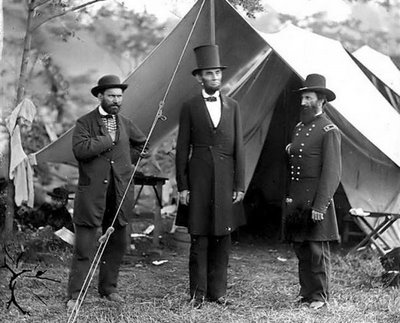
To put the challenge in content, for good or ill, adoption has often driven by crises or societal disruption. In the 1800s, the Civil War in the United States drove the development of new military technologies, often with far-reaching effect.
That weapon could take seven shots for every one from traditional rifles. Unfortunately, the generals of the day within a conservative Department of War resisted its adoption for any number of logistical and tactical rationales. Spencer took the gun West, and, famously, to a shooting match with the President himself. Lincoln, a fine shot, put 7 bullets into a board, which Spencer saved. Subsequently, Lincoln put the gun into production.
Gaining access to critical “influencers” or IT buyers is no less important today. The use of Facebook, Twitter or Drupal by the White House has given each additional legitimacy as a means to engage citizens, amplify a message or collect information.
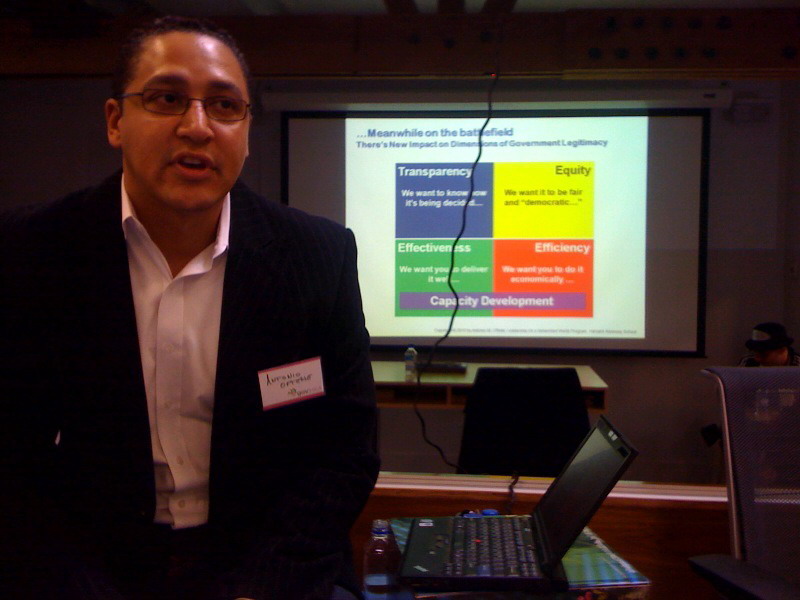
According to a Gov 2.0 survey conducted by Oftelie, however, the most valuable use of technology in government is for “enterprise-wide, net-enabled guidance and collaboration.”
Oftelie outlined four broad areas where collaborative technology platforms can be useful and are being employed now:
Policy
Productivity
Equity
Legitimacy
“We want to know how things are being decided,” he said. “There’s unprecedented interest in transparency into policy, fairness.”
Oftelie observed that while the potential for collaboration technologies to create transformational change is substantial, the transition for most government agencies or other organization can be rocky.
Hierarchies of authority are disrupted, even while new models for remote, asynchronous service with fewer interruptions emerge. Citizens are increasingly expecting (and finding) self-service options on government websites.
“All of the challenges that government faces cut across organizational boundaries,” said Oftelie. “Most technologies aren’t easy to learn, and they’re even tough to implement.”
Note: Security concerns about social media are also relevant. (See the Federal CIO Council’s Guidelines for Social Media [PDF], embedded below, for some best practices for agencies).
As Dybwad writes, this video shows the potential for Wave as a “video production medium,” like the “Pulp Wave Fiction” movie that Mashable shared elsewhere. And as Adam Ostrow tweeted, the folks over at Whirled Interactive are “super talented.”
As funny as these videos may be, I’m still looking for a personal use case for Google Wave. I’ve been dipping in and out of Wave for months as new people log on and explore. I expected the network effect of having more contacts there to result in some pick up. Enterprise 2.0 is not THAT big of a deal,as Andy McAfee says: what about Google Wave?
Creation and Management of “Living” Group Projects
Drag-and-Drop Photo Sharing
Creation of “Living” meeting notes
Interactive Gaming
The best way to learn about the software, however, is to read Gina Trapani and Adam Pash’s Complete Guide to Google Wave and to watch this (long) intro video from Google itself:
Lorraine Lawson wrote about Google Wave’s potential for enterprise integration over at IT Business Edge back in June and offered any number of potential use cases. (I have yet to hear about their transition into case studies.) Dion Hinchcliffe was bullish on the potential of the tool when he wrote about the enterprise implications of Google Wave at the end of May. He offered an excellent “first look” review there, for readers who want a more detailed breakdown of what Wave it and how it works.
More recently, Lifehacker included Google Wave on its 5 best collaboration tools, and collected an impressive breadth and variety of Google Wave use cases that range from family life to wedding planning, disaster relief to translation for research.
The bad
For me, combining a heterogenous suite of wikis, microblogging, email, IM and Skype has continued to be more useful than Wave. As a working environment, I’ve found it to be both noisy, as I watch other contribute, and often unstable. (I even gave it a try on my iPhone over wifi, an experience akin to pouring molasses down a snowdrift).
My colleague, Rachel Lebeaux, expressed much the same reaction when she wrote about Google Wave as an enterprise collaboration tool. (She found a CIO who is installing a Wave server in her comments; I hope to hear more on that.)
Since then, however, the reaction online has often been withering, due in part to the learning curve required of new users that don’t have the attention span to watch that video or read the manual. For good or ill, people expect to be able to figure out collaborative software without that time investment. The editor-in-chief of TechRepublic, Jason Hiner, put the software at the top of his “worst tech products of the year.” Tough year in review to make:
“After trying Google Wave when the product was released into the wild, my opinion hasn’t changed (and others such as Robert Scoble have come to the same conclusion). Google Wave is basically a super-chatty IM client, and a badly overhyped one at that. The only use I can see for this product is for geographically dispersed project teams collaborating and brainstorming on documents and product development ideas in real time.”
And as Shaun Dakin @replied tonight, “@RWW named it as one of the top 10 products failures of the year, I agree. Solution in search of problem.” To say that Jolie O’Dell was rough on Wave is an understatement:
“We have to hand it to Google’s publicity team; we don’t know one geek who wasn’t positively salivating for a Wave invite. The ReadWriteWeb back channel was a complete melee when the first invites were rolled out to team members. But once we got there and saw the new tech tricks, like watching one another type, we started thinking about use cases. And the more we struggled to understand and use this product, the more frustrated and bored we became. Blame it on the steep learning curve. Blame it on our misunderstanding the product. Mount whatever feeble defense you like, but techies know Wave was a flop.
The trouble-y
Even with all of that negativity, I still have trouble with dismissing Google Wave as a victim of hype. I’ve already read about some innovative use cases for those who can get through the UI challenges. And I’ve met CIOs and CTOs who are interested in what happens next, when Google’s engineers iterate to address user feedback.
Many media organizations are trying out Google Wave for news, as Leah Betancourt shared on Mashable and Lifehacker wrote about above. As she writes:
“Robert Quigley, social media editor at the Austin American-Statesman, has started two public waves so far” and
“Andrew Nystrom, senior producer of social media and emerging platforms at the Los Angeles Times, collaborated with social media reporter Mark Milian on the blog post “How Google Wave Could Transform Journalism” that ran on the newspaper’s web site a couple of months ago.”
Additionally, as Revolution Magazine reported, Welt Kompakt, a spinoff of the German daily Die Welt, is among the first newspapers around the world to integrate Google Wave into its coverage.
When I asked if any of my followers had found a use for Google Wave, Wayne Kurtzman @replied that “Google Wave is amazing if people use it as a collaboration tool; not just e-mail. Google does not make it easy to learn how & holds it back. I used Wave to collaborate on a voice over script for a video; elements SoundFX, vid, script, etc. Goog has no resources to teach others. Security, cultural (collab) and our size are challenges. Wave can be a game-changer.”
As quoted in Forbes, Tom Mornini, CTO and founder of Engine Yard, “pointed out recently (see: “The Real Meaning of Google Wave”), the major impact of Google Wave will ultimately come from its power as a development platform for serious, distributed applications.” If you’re wondering at how far Google Wave will get, consider whether enterprise software makers like SAP are taking it seriously as a platform. As Forbes described, SAP Research used of it in its Gravity demonstration prototype, combining SAP’s business process modeling (BPM) technology with Google Wave.
My colleague Kristen Caretta was balanced in assessing what Google Wave may mean for IT, offering that Gravity use case. Kristin also wrote that “Salesforce.com is working on a prototype extension to Google Wave that could help its customers provide customized, documented support in their own businesses.”
Attendees at the Enterprise 2.0 Conference in San Francisco this fall were presented with other Google Wave use cases by Google Wave product manager Gregory D’Alesandre, including Novell Pulse and ThoughtWorks. The collaboration tool is certainly part of Google’s plans for its enterprise customers. “Wave will be available as part of the Google Apps suite if you have Google Apps for your domain,” said D’Alesandre.
That might all imply that at least some techies do not, in fact, regard Wave as a flop. Google continues to add more to its development team with the recent acquisition of Etherpad, a Web-based collaboration app that may well be a boost to Google Wave.
As for this geek, caught somewhere in the intertices between journalism and techiedom, I’ll be on the lookout for more enterprise and media use cases. If you have one at hand, please share it in the comments.
Welt Kompakt, a spinoff of the German daily Die Welt, is among the first newspapers around the world to integrate Google Wave into its coverage, Revolution Magazine reported yesterday.
Early on Tuesday morning, I walked up Massachusetts Avenue to attend the FTC workshop on the future of journalism. Ten hours later, I emerged overstimulated by the volume of ideas presented, saddened again by the tens of thousands of journalists who have lost employment and energized by the quality of the conversations I’d had.
The event began with a video about the changing media world from Minnesota Public Media, embedded below. More about the “Future of News Summit, where it premiered, can be found at thefutureofnews.ning.com.
The FTC established a Twitter account for the conference, @FTCnews. You can see all of the participants’ tweets aggregated at #ftcnews.
Why convene the conference?
The very existence of the forum raised some eyebrows. How does the Federal Trade Commission factor into regulating journalism, after all? FTC Chairman Jon Leibowitz observed that:
..the ongoing revolution in the markets for news, then, warrants serious study for at least two reasons. First, markets for public goods such as news may work imperfectly. Competition policy is well-suited to evaluate these market imperfections.
Consumer protection policy is well-suited to help us understand the privacy and data security implications of the behavioral marketing used by media companies to increase ad revenues online. Second, and far more important, this is not just any market. The changes we are seeing in journalism will affect how we govern ourselves, not just the profits and losses of various news organizations.
The full remarks of FTC Chairman Jon Leibowitz on creative destruction and journalism in the Internet Age are available as a PDF. He was forthright in assessing that there was no reversing the Internet revolution. As he put it, “when Gutenberg printed the Bible, that was bad for those who illustrate by hand.” (Note: Jessica Clark argued that the FTC Should Consider Policy Reform to Support Public Media 2.0” over at PBS’s MediaShift blog.)
Leibowitz was followed by Paul Steiger of Propublica, an “independent, non-profit newsroom that produces investigative journalism in the public interest. “The answer is not to save newspapers,” said Steiger. “The goal should be to assure the continuation of journalism.” He called Amanda R. Michel an “Internet genius” for her coverage of the 2008 campaign at the Huffington Post. Steiger also cited Propublica’s investigative journalism on “hydraulic fracturing” in gas drilling as an example of the work the organization is doing.
Rick Edmondsof thePoynter Institute, author of the BizBlog there, presented results of 2009 State of the media study he co-authored. One of his final assessments was sobering: “Most surviving newspapers will be smaller, more expensive & targeted to older consumers.” As I replied to Andy Carvin , who wondered about the statement, given the debt loads that Edmonds cited, waiting for hyperwired Echo Boom to “age into” newspapers might be a tough strategy.
The News from News Corporation
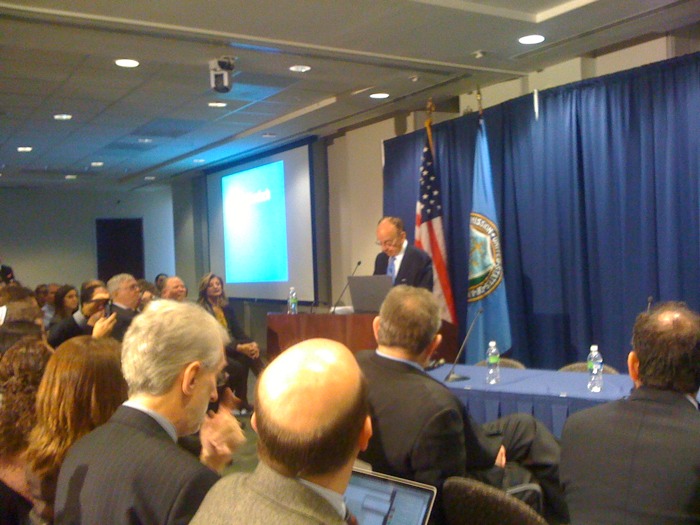
It’s a fair bet that the packed room in the morning was there in anticipation of remarks from Rupert Murdoch, founder, chairman and managing director of News Corporation, especially given that many of the media in attendance left to file stories once he was through.
Why? Murdoch may have held that “a diversity of views is essential to debate” but he was crystal clear: news organizations that don’t adapt should fail, “just like a restaurant that makes meals that no one wants to eat.”
Further, even as he argued that the feds should keep the U.S. press the most free in the world, the government should also “use its power to make sure the most innovative companies can reach customers,” a view that sounded to this writer’s ears rather like net neutrality.
He was also crystal clear in a conviction: “online ads can’t sustain good journalism.” Murdoch intends to extend the pay model of the WSJ and @BarronsOnline to the Times UK, perhaps as early as next January.
Murdoch also suggested that the FCC‘s cross-ownership rule that prevents single ownership of both TV and newspaper in local markets was “out-dated” in the Internet age, effectively suggesting that regulators both stay out of the news business and change the market conditions. He also observed that “for newspapers, spectrum could well prove an economic vehicle,” pointing to online convergence and the move to a readership increasingly consuming news through mobile computing devices.
What is the state of journalism?
Following Murdoch’s remarks, a state of journalism panel began with a focus on the financial health and accomplishments of newspapers and magazines. Martin Kaiser, senior vice president of the Milwaukee Journal Sentinel, spoke to journalism’s essential role: enforcing goverment accountability.
Bryan Monroe, a visiting professor at the Medill School of Journalism, brought attention to issues of diversity. His remarks were published at the Huffington Post as “Why New Media Looks A Whole Lot Like Old Media.”
This panel also raised the first – and as it turned out, only – question to the audience, in the form of a poll: How many of you know someone under 30 who reads a newspaper in print? To my eye, about 40% of those present raised their hands. It’s perhaps worth observing that very few people present were in that demographic.
One hopeful model for reporting by assignment that was cited by David Westphal, Executive in Residence, Annenberg School for Communication & Journalism, University of Southern California, hailed from my former neck of the woods at the New England Center for Investigative Reporting.
Mark Contreras, chairman of the Executive Committee of the Newspaper Association of America & senior VP, newspapers at the E.W. Scripps Co., ended the panel with an analogy to the music industry, suggesting that there are “poignant similarities” to news business. He favors ASCAP/BMI models for content protection and a B2B model for revenue generation. Given the music industry’s struggle to adapt to the Internet, that approach might merit more consideration.
Defending the aggregators
After the representatives of legacy media shared their perspectives, Arianna Huffington came to the defense of aggregators and new media, like her own enterprise, the Huffington Post.
As she dryly observed, citing a post by Mike Masnick at TechDirt, there’s some news aggregation by News Corp/IGN out there. All Things Digital, for instance, links and aggregates content, as does Rotten Tomatoes.
Huffington didn’t mince words in her denunciation, either:
It’s time for traditional media companies to stop whining and face the fact that far too many of them, lulled by a lack of competition and years of pretax profits of 20 percent or more, put cash flow above journalism and badly misread the web when it arrived on the scene. The focus was on consolidation, cost-cutting, and pleasing Wall Street — not modernization and pleasing their readers.
They were asleep at the wheel, missed the writing on the wall, let the train leave the station, let the ship sail — pick your metaphor — and quickly found themselves on the wrong side of the disruptive innovation the Internet and new media represent. And now they want to call timeout, ask for a do-over, start changing the rules, lobby the government to bail them out, and attack the new media for being… well, new. And different. And transformational. Suddenly it’s all about thievery and parasites and intestines.
Get real, you guys. The world has changed. Here are some facts culled from one of the most popular anthems to the impact of technology on our world:
(I talked with Huffington afterwards about her comments and the transition the industry is going through. She asked if I’d like to write about it – so I did, in “Is journalism going through a Reformation?“)
Where are the readers? Whither remedies? A Yahoo! News consortium? And how does Google News work?
After lunch, media analyst Ken Doctor shared his thoughts about “where the readers are.” You can read more from him at Contentbridges.com.
Leonard Downie presented findings on the reconstruction of journalism from the Columbia journalism report: Columbiajournalismreport.org
Lem Lloyd, vice president of channel sales at Yahoo!, shared details of the media company’s growing newspaper consortium. Lloyd said they’ve have sold 18,000 campaigns on Yahoo!, amounting to more than six billion impressions. Behavioral targeting sales represent some ninety percent of that total.
And Josh Cohen explaining how GoogleNews works with publishers. Cohen wrote about the FTC and the future of news at Google’s Public Policy blog. A extensive interview of Cohen on paywalls, publishers and partnerships by Danny Sullivan is also available at Search Engine Land.
Emerging models for journalism
The most dynamic panel of the day featured technologists, entrepreneurs and an bonafide bloggers like Josh Micah Marsall of Talkingpointsmemo.com and Danny Sullivan, who took a break from liveblogging to participate.
Sullivan, at that point, was frustrated with offline metaphors applied online. And Jeff Jarvis, media pundit and CUNY professor, asked the FTC to “stay off the lawn,” suggesting that premise of the event was about the survival of legacy players, not journalism itself.
In considering the prospect of not finding a viable models, Robert Thomson, managing editor of the Wall Street Journal, observed that “the cost to society of not being able to afford specialist journalism is going to be profound.”
Chris Ahern, of Reuters, and Danny Sullivan replied to Thomson that it’s not “an either/or proposition.” Hybrid models for news are worth trying.
And in a memorable exchange, Marshall observed that “there is more of an ethic online of linking to the story that got the reporter on the track and then adding commentary” than is practiced by traditional media, alluding to stories that the AP and others have run with without linking.
Media consumption trends, the economics of news and online advertising models
Ball State professor Mike Bloxham presented on media consumption based upon data that can be found at ResearchExcellence.com. He described a need for publisher to look cross-platform for media consumption in order to meaninfully gauge a “news footprint” that included print, TV, online and radio.
Susan Athey, a professor of economics at Harvard, presented on the economics of news, particular the trend toward “multi-homing” in consumption and the growth of online advertising. Her presentation addressed the salience of potential FTC regulation more directly than any other, aside from the chairman himself, predicting competition in online ad networks and between aggregators that would require oversight.
Law professor David Evans, following Athey, said that “the one thing I do worry about is mixing up market failure with nostalgia.” His paper on economics of the online advertising industry is available online.
The final panel of the day, addressed the important of behavioral advertising to future business models. Jeff Chester of Democraticmedia.org asserted that “the news media industry should embrace fair information principles.”
Conclusions?
As I look back over the day, it’s not clear to me yet what the FTC intends to do, other than listen. I look forward to returning to the FTC tomorrow to learn more.
Today at Harvard Law Schools’s weekly Berkman Center lunch, Aaron Shaw presented into the potential Amazon‘s Mechanical Turk(AMT) holds for social science and the culture that surrounds it. His talk drew upon research-in-progress from the Berkman Center’s Online Cooperation group, in collaboration with Daniel Chen and John Horton.
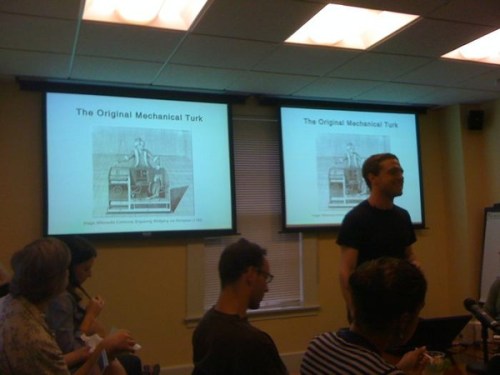
As Shaw noted, the origin of the name for Amazon‘s Mechanical Turk lies in a chess-playing “automaton” that was no mechanical creation at all, but instead a clever contraption that hid a chessmaster inside. Amazon’s version farms out small tasks — or “HITs” — that require a human to accomplish.
As an aside, I have to note that, as Peggy Rouse pointed out in Mechanical Turk, Powerset and enterprise search, there may be considerably more to Amazon’s strategy than the creation of a crowdsourcing market for simple tasks. She thinks Mechanical Turk may play a role in enterprise search down the road. She’s a canny observer, I’d recommend reading her thoughts.
Early in his presentation, Shaw offered up a shoutout to Andy Baio (@waxpancake) who asked two questions late last year in “Faces of Mechanical Turk“: “What do [Amazon Turk users] look like, and how much does it cost for someone to reveal their face?”
Credit: Andy Baio, Faces of Mechanical Turk
The aggregated image is shown on the right. $0.50 was the magic price, apparently.
As Shaw noted, however, when it comes to the Turk, no public, trustworthy, aggregate data is available. What evidence is available derives from self-selecting surveys and experiments. Those samples showed a large number of women, from many countries of residence (although mostly in the US & India). Speculatively, he noted that the age of users appears to be low, while education and income is high.
Shaw posited that the geographically component is likely correlated to Amazon’s requirement that users hold a US banking account. As a result, Shaw’s research relied upon whatever his team could collect on the Turk or through interviews with users and Amazon executives.
So, does the Mechanical Turk work for its users? Sometimes. Shaw noted that once you get a few people performing a given task, the accuracy rate for completion goes up overall, providing the example of machine-learning algorithms.
As he noted wryly, it’s “Not all bots, cheaters and scripts.”
Task selection and design is important to that success rate: skill matters, on both sides. It’s not just the skill of users and their ability to follow instructions – success also relies upon the skill of the creators of the HITs. Social scientists — scientists of any stripe, really — recognize the issue here in experimental design.
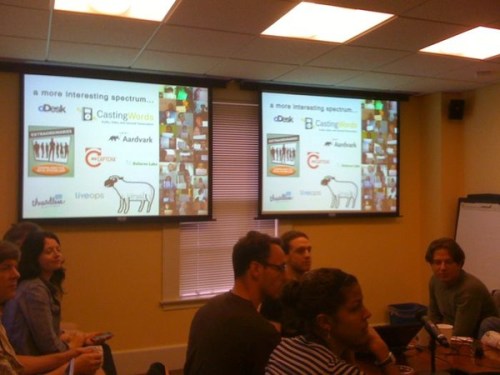
The uses of Turk cover a broad spectrum, though by nature each represents some form of crowdsourcing. Amazon itself used to Turk to generate product descriptions, questions and answers, thereby “spamming itself,” as Shaw put it.
AaronKoblin.com uses Mturk to create art. For .02, he pays users to draw a sheep facing left. He then sells sheets of them for $20, some portion of which is donated to charity.
Also noted: oDesk, reCAPTCHA, Threadless, Aardvark, liveops
Aside from commercial, artistic or volunteer uses, Shaw believes that Mechanical Turk has considerable potential to enhance social science.
Specifically:
As a pool of subjects for randomized experiments
As a pool of inexpert raters for distributed observation, or “coding”
Advantages to labs?
Low cost of use, ease of paying subjects, speeds, diverse subjects (potentially), one HIT = one person, workers do not (usually) interact.
Experiments can consist of contextualized real-effort tasks. As the Turk has created a real labor market, as for text transcription, there’s utility in many areas, like canonical games in economics and paired surveys.
In other words, its neither reducible to a manifestation of the “Internet hivemind” or some sort of “latter day child labor,” at least in Shaw’s view. The online conversation around the presentation, which included Esther Dyston, was more skeptical on the latter point, noting that the potential for skirting labor laws was not inconsiderable. Shaw readily conceded that the issue is salient, although he sees such labor issues as “downstream,” he expects to see more given that the “tension is so clear, so stark.”
Shaw has been advised by Yochai Benkler while at Berkman, who evidently considers the Turk to be of use for content analysis for distributed observations. In this context, the ability for researchers to randomly assign HITs for raters to code objects is helpful. Shaw brought up Klaus Krippendorf, of UPenn, in the context of understanding some of the theory here; I’ll need to go do my due diligence in understanding Krippendorf’s work.
Yochai has noted that specific groups involved in distributing computing types, like SETI, have performed admirably. According to Shaw, in fact,“The Knights who say “Nee” perform quite well when measured against other countries with distributed computing.”
I also heard about the “Turkopticon,” a Firefox extension that allows users to submit feedback about HIT creators. Although Shaw said that it is not widely installed, there’s clearly a step towards community self-policing.
The question itself begged for a follow up, given the release of Chris Andersen’s “Free” this week: How and why are users motivated to provide hits when altruism is involved? Is work of higher quality when there is money involved?
Shaw offered a cautious affirmation, though with reservations: Payment vs free is “such a loaded issue in society. The symbolic value of money or donation is humongous.”
A Berkman Fellow in attendance, Chris Soghoian, noted that his advisor pays 5-10x the market rate and gets email about when the next task is coming, along with decent results.
In Shaw’s view, there needs to be “a more serious examination of the question. Experimental evidence of research suggest sub-populations of people who would respond differently. Some people will be motivated by doing good, others don’t care, want the .05. We need better ways to test. It’s situation-specific.”
As he wryly noted, “We’re not all homo economicus.”
As usual, this was an excellent lunch.You can view the archived video of the presentation as a .mov.
Following the presentation, Aaron wrote me to add the following:
“Daniel and John’s contributions to the field of experimental research on online labor markets include
recognizing that AMT could serve as a venue for experimental studies;
conducting the earliest labor market experiments on AMT;
solving a bunch of difficult problems so that they could make valid causal inference based on the results of these experiments.”
I have to note one other organization I learned about today: “TxtEagle.” TxtEagle is a innovative concept for active “mobile crowdsourcing,” distributing small-scale jobs via SMS and payment the same method.
In other words, microjobs with micropayments. The mobile platform’s founders recognize that there are more than 2 billion mobile phone users in the developing world that could potentially be leveraged to perform tasks. The BBC wrote that “txteagle is changing the dynamics of outsourcing labour.” Hard to disagree with that.
Emerging technology has the power to make democracy stronger or weaker. Understanding where, when, and how is the hard part. Subscribe to Civic Texts to get insights about how technologies are changing our democracy in your inbox.






 , investor and





![Reblog this post [with Zemanta]](https://i0.wp.com/img.zemanta.com/reblog_e.png)

![Faces of Mechanical Turk [Credit: Andy Baio]](https://digiphile.info/wp-content/uploads/2009/07/faces_of_mechanical_turk.jpg?w=121&h=300 "faces_of_mechanical_turk")


 digiphile
