Category Archives: journalism

Does RT = spam? Unlikely. A retweet is social media currency.

Two small cans of Spam. One is closed and the ...
Image via Wikipedia

I’m still working through my notes and interviews from the past week’s Enterprise 2.0 Conference in Boston. Many people, ideas and presentations will stay with me —  I look forward to writing another article and several blog posts today and tomorrow — but I wanted to make sure I captured one particular moment that actually irked me: The statement by a member of a panel in a session on Twitter that a RT is spam.

Apparently, @IsaacGarcia is determined to hold onto that position in the face of substantial counter opinion. I’m left to speculate how much he has used or read about Twitter; I gather from his comments on the panel that he has used the medium to find customers for his company and sell the product. The irony of that use is that by searching for mentions of his brand or looking for potential prospects and replying to them, he is in fact engaging in unsolicited commercial messaging.

I believe there’s a word for that.

Humor aside, I did reflect for a while on Garcia’s contention, which he tweeted during the panel: “How is recvng RTs about a topic/person that I didn’t choose to Follow not spam? Am recvng unsolicited info from the originator.” Isaac isn’t an obtuse man; Central Desktop was used by the Obama campaign to manage field operations in Texas.n, as Josh Catone blogged in ReadWriteWeb.

So where’s the disconnect? I wrote about the retweet last November for WhatIs.com, in “Buzzword Alert: The retweet (RT) is the FWD of 2008.” To retweet is to repost the tweet of another Twitter user using your own account.

It would probably be helpful to review what spam IS again, other than a fatty breakfast meat that’s likely to survive a nuclear winter. Wikipedia (currently) calls “Spam the abuse of electronic messaging systems to send unsolicited bulk messages.” CNET reported that, in 2009, spam makes up 90% of all email. If anything, that’s actually down from the 95% estimate I read a few years ago. That may be a result of shutting down ISPs that allow sending spam; it’s not likely, at least in this pundit’s eyes, to be a result of the CANN-SPAM Act, which created standards for sending commercial email. To be compliant, you must have a way for users to unsubscribe and do so if asked.

Twitter, of course, makes subscribing and unsubscribing from efforts rather easy — follow or unfollow. There are many technical hiccups that sometimes hinder that process, but by and large that’s the way it works. I choose to subscribe to your tweets. If don’t like something about the experience, I stop listening.

Fortunately, I’ve been gifted by thousands of smart, savvy followers, and when I asked them all if a RT is spam, I received 11 immediate @replies, followed by a few more. I’ll share their thoughts, as I believe they speak eloquently in defense of the role of the retweet.

First, my friend and colleague on the Touchbase blog, Leslie Poston, offered her perspective:

Photo_97_normal
geechee_girl: some RT = spam, blogged em on Uptown Uncorked last week

Leslie clearly has had it with some of the hijinks that have been going on Twitter, including a basic lack of netiquette and yes, some genuine spam. In “Retweeting Etiquette, RT Spam, RT Flash Mobs, RT Linkbait,” Leslie points out many of the issues around the convention that have sprung up as Twitter has exploded in popularity and the usual shady netizens have moved in. The post is worth reading, but, in the frame of my question, her concern is around retweeting spam, not that RT itself constitutes it.

Avatar_normal
sleddd: RT not really spam, more sharing information. Like a phone tree or saying hey check this out to the people who do follow you. RTs, DMs, replies, as well as general tweets are what help make social media social.

Stales3_normal
stales: RT=spam? No, not at all. When you “follow”, you’re giving that tweeter the right to pass on ANY info.. regardless of source

New-chris-headshot-forweb_normal
chrisbechtel: a Retweet is not spam – it is a share of something the sharer deems potentially valuable to their community.

Vatar_green_normal
pmhesse: a RT is about sharing information with your friends that you found valuable, informative, or entertaining.

Ericandersen_normal
eric_andersen: I couldn’t possibly follow all of the original sources of info/links I’m interested in; rely on others to RT. IMHO sharing info via retweets is part of the “lifeblood” of Twitter; without sharing much appeal of the medium is lost.

Faseidl-260x260_normal

faseidl: It *may* be spam, but in general I would say false. See my comment on that question on this post: http://bit.ly/Wg7lp

Face1-el-fixed-488x655_iran_normal
craighuff: some of us find RTed information valuable and welcome it.

686124135_cf3e686522_normal
saccades: RT can “reflect the” light of a bright idea

Eric_turquoisefish_normal
turquoisefish
: a RT from me is something I liked, found interesting, or wanted 2 share.

Here’s my version: A retweet is social media currency. It’s a validation of the tweet you are passing on and a stamp that you have not changed it. I use PRT, for partial retweet, if I have to edit for length.

I use via or HT for “hat tip” if I pass along  someone’s link but write my own text, which provides proper attribution. The HT has been a convention of blogging for over a decade; there’s no sense in changing the netiquette simply because the blog is smaller. If Ben Parr is correct in his assessment of the trend, we’ll soon be seeing RS on Facebook, as people reshare information in that real-time environment.
In many ways, reshare is a much better word, as it captures the essence of the action: passing along information that we thought was worthwhile, funny, useful or otherwise worth seeing. It’s precisely the sort of action, in other words, that makes someone want to follow another person on Twitter or not.

As any longtime of Twitter knows, there is in fact plenty of spam on Twitter. There’s even a @spam account to report it to. #hashtags spam has become a problem, given that whenever a topic becomes trending on Twitter, spammer hop on and advertise whatever the scheme of the day might be. Nastier folk lurk there too, twishing for unsuspecting users.

Even reputable companies have engaged in it, as Mashable noted yesterday, when Habitat Used Iran Twitter Spam to Pimp Furniture.‎

(Habitat has since apologised for its Twitter ‘hashtag spam.’)

Patrick LaForge, a long-time user of Twitter and director of the copy desks for the New York Times, had the last word in my @reply stream. I tend to take his view as definitive on the subject. (The emphasis below is mine.)

Photo_266_normal
palafo: If you don’t like my tweets, don’t follow. Only spam is follow-spam and reply-spam. “RT” is ugly/confusing but quick.

In other words, it’s not that there isn’t spam on Twitter — it’s just not the RT.
Reblog this post [with Zemanta]

9 Comments

Filed under blogging, journalism, microsharing, social bookmarking, social media, technology, Twitter

Takeaways from Day 1 of #140Conf: The real-time Web disrupts the media

Newspapers & Twitter panel

Newspapers & Twitter panel

Kudos to Jeff Pulver and his staff for creating what turned out to be an extraordinary day of discussion and learning, not to mention more than a little music and humor.

Following is a digest of some of my favorite moments, as tweeted. I already blogged about the extraordinary discussion that took place between Ann Curry, Robert Scoble and Rick Sanchez: “RickSanchezCNN was listening to #CNNfail: Did Twitter change CNN coverage?

Aaron Strout also liveblogged the 140 Conference and @stevegarfield has added many #140conf pics on Flickr.

I will note, and indeed tweeted, that I was surprised that no one on the Twitter for business panel talked about when NOT to use Twitter, given the legal or compliance issues in regulated industries. I’ll be writing more about that later this trip.

After all, collecting links and ideas from the day from a conference about Twitter from Twitter makes sense, no? I remain sad that I missed the keynotes by @JeffPulver, @Jack, @FredWilson and @TimOReilly that started the day but know that I’ll be able to watch them later and that the hundreds of other attendees here will summarize those words and insights perfectly well for the rest of the Web.

On TV

“Twitter is not cost-prohibitive. @JimmyFallon has 1.3 million followers. He tweeted a Zack Morris pic before the show. That became a trending term before the show aired.”-@GavinPurcell

On Newspapers

Twitter is changing newspapers, both in their relationship to readers and within the newsroom. Editors and writers are collaborating more on news or events, in real-time. As Patrick LaForge (@palafo) said during the panel when he was watching Twitter, he saw a tweet come in that “There’s a plane in the Hudson.” The Village Voice has created a private account to coordinate coverage.

Journalists are receiving tips and sharing news with their followers, engaging in so-called “process journalism.”

On Digital Journalism

JohnAByrne of BusinessWeek shared that perspective, noting that “now journalism” — reporting on news as it breaks and evolves on the real-time Web, is enabled and extended by Twitter. Reporters now use Twitter to report, share & discuss news. The extension of news gathering and sharing into these digital platforms changes it from a product to a process. Indeed, Byrne believes that “Twitter as a collaborative and engagement tool is essential to any kind of forward-thinking journalism.”

A journalist from the Middle East, @moeed, of http://aljazeera.net, stated that “Micro reporting has transformed how we do reporting, particularly in crisis situations, like war.” He shared a number of innovative digital platforms that are enabling Al Jazeera to both disseminate information and to leverage the distributed eyes, ears and phones of people scattered across a region.

On Music

Chris (@1000TimesYes) of http://RollingStone.com and the @VillageVoice) is reviewing 1000 records on Twitter in 2009. Michael brought down the house, too. He was both hilarious & darkly poetic in bemoaning the death of the music critic.Crowdsourcing killed punk rock,” in his view, along with many other alternative or indie genres.

On Love, Microsyntax, @CNNBrk, Kodak & Power

Panels and speeches also included the following, all of which you can find commentary and quotes from or about on #140conf:

  • a love letter to Twitter from @pistachio
  • @stoweboyd on his microsyntax nonproject at Microsyntax.org
  • @imajes on the story behind @CNNBRK (he created a script that posted CNN email alerts into Twitter)
  • @JeffreyHayzlett on Kodak and Twitter, which included a crowdsourced term: “twanker” for a Twitterers that show bad form
  • @ajkeen on Twitter and power (a contrarian’s take to be sure)

Sessions to come include panels on Twitter cewebrity wtih @adventuregirl @ijustine @juliaroy and @chrisbrogan, Twitter for social good, which includes @drew & @twestival.

On the real-time Web

This was aa tremendous day. The conversation that has been unfolding on the tension between information about events coming in over the real-time Web and so-called “old media” organizations that seek to uphold journalistic standards honed over decades is fascinating. It follows on the blog up…er, blow up between TechCrunch and the New York Times regarding process vs product journalism earlier this month. For journalists, getting the story right, with corroboration, attribution and validity is crucial. Finding a way to do that in the context of the torrent of real-time news will be a central challenge of newsrooms in the month to come.

These are tough questions, debated by the world’s best thinkers on digital journalism and technology. My Twitter conversation with Jason Pontin yesterday lingers: what are the opportunities for distributed, “open source” journalism? Twitter and blogs from #IranElection are a novel source. And as Jason pointed out, we know that there’s misinformation and rumors there; how can journalists do real reporting on Twitter?

Journalists are filing links to pictures and video, which helps — harder to fake the latter — but there are real challenges. As Jason tweeted, “reporting requires verification from at least three sources, posted or printed in an authoritative, independent publication. If I were editing #iranelection stories, I’d want: who is the open source? What conflicting interests? Cross-verification? Open source journalism, appropriately handled, could provide verification.”

It’s possible some technologists in today’s audience or  in Silicon Valley, India, Israel or home from MIT for the summer might find a way to provide all of that. For now, I’m looking forward to learning more from the Web luminaries here at the 140 Characters Conference.

Reblog this post [with Zemanta]

2 Comments

Filed under blogging, journalism, microsharing, social media, technology, Twitter

@RichSanchezCNN was listening to #CNNFail: Did Twitter change CNN coverage?

I’m still mulling over an extraordinary discussion around newsgathering held here in New York City this morning. One pane stands out, however, and no doubt will continue to for years to come.

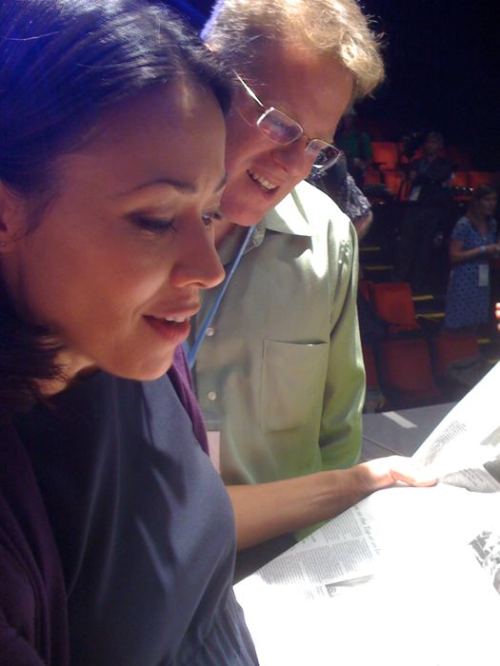
It’s not just that I had the chance to meet Ann Curry, who was passionate, thoughtful and deeply insightful.

'll always remember @AnnCurry reading @zittrain in the @NYTimes on #IranElection to @Scobleizer & me at #140conf

I’ll always remember Ann Curry reading @zittrain’s quote on Twitter’s impact on the election in Iran in the New York Times to Robert Scoble (and me) at the 140 Characters Conference

How can I not admire a television journalist who spoke with such passion and conviction about journalism, facts and getting it right?

She noted with considerable gravitas that she took her responsibility to “never Twitter something that is wrong” seriously.

Curry suggested to citizen journalists covering global stories that “I want you to shoot that story like it’s your sister, brother or mother.”

She also offered a perspective I can appreciate, based upon my own experience:

“My followers are my own newspaper.”

Aside from Curry’s comments, all of which I hope become available online as soon at the conference videographers can manage it, there’s another story to tell.

Last Saturday, CNN anchor Rick Sanchez noticed something happening on Twitter.

That’s nothing new: @RickSanchezCNN has in many ways bet his show, even career, on his integration with social media.

His use has paid off, according to the remarks Sanchez made at JeffPulver’s 140 Characters Conference, and not just in terms of his 95,000 followers: social media, particularly Twitter, has pushed CNN to cover the existence of fraud or overall validity of the elections in Iran.

After his comments on the panel, Sanchez described to me and others how his email about #CNNFail on Twitter went up to the highest levels of the network. And, after the network’s business, PR and marketing staff was pulled in, coverage the next day shifted.

In other words, just as the audience here in New York grew restive after hearing Sanchez and Robert Scoble talk about #CNNfail and asked to hear from Curry, CNN’s online audience on Twitter pushed the network to cover the news differently.

I wasn’t watching CNN on either day — I was focused on tracking Twitter, YouTube and other online sources — but I’m now incredibly curious about how Sunday’s broadcasts on CNN were different.

I do know that Sanchez said to me that CNN stayed with Ahmadinejad’s speech on Sunday much longer than they would have otherwise.

During the panel, Sanchez that “at no time did CNN drop the ball” — based upon his remarks following, however,  I have to wonder whether there was an appreciation in the C-suite at CNN that the online backlash on Twitter was a hint that Amanpour reporting live from Tehran wasn’t capturing the whole scene, and that US citizens were hungry for more information about what was happening on the streets and rooftaps of Iran.

I know now that, on some subtle level, there were changes — and that’s a win for all of those in the US who wanted CNN to cover events in Iran more closely. There’s a long road for newspapers and cable news networks to travel yet as they adjust to the real-time Web and its audience gathering information and publicly critiquing coverage decisions of network.

Even digital natives are still working out the standards for validation, attribution and information sharing. Old school publishers and broadcasters, by and large, are behind. It could be that the events in the Middle East this weekend could change that.

Sanchez was honest about the economic realities there, including the competition with Fox. Unfortunately, given the existence of a profit motive and ratings driven by celebrity stories and natural disasters, there are real barriers to the cable news networks shifting their airtime to just serious news stories.

In a public company, after all, ratings rule when shareholder value must be maximized.

Ann Curry suggested another, more sobering root cause: “It’s hard to get Americans to care about international issues.”

If journalists can frame, analyze and convey the stories of our collective humanity, whether it’s in Darfur, North Korea, Iran, China or some other global spot, perhaps that will change. Nick Kristof won a Pulitzer for his coverage in the New York Times.

Here’s hoping others follow in his footsteps.


Reblog this post [with Zemanta]

6 Comments

Filed under blogging, journalism, social media, technology, Twitter

IT innovation in Massachusetts: MIT-style business plan competition

Another day, another opportunity to meet Deval Patrick and report on innovation and technology in the Commonwealth.

Actually, it wasn’t just another day: I livestreamed the governor’s announcement of the MassChallenge Venture Funds Competition. His twitter account @MassGovernor picked it up and shared it with the rest of the Commonwealth.

That was, as they say, nifty. I embedded his speech below; Patrick begins speaking twenty minutes in.

Vodpod videos no longer available.

If you listen carefully, you’ll even hear me ask a question about how the Commonwealth will use Mass.gov to make the bidding process open and transparent. Patrick noted my “little camera” and asked one of the VCs involved to come speak at the podium — the Governor was online media-savvy today.

I wrote about the details of the MVFC over on the TotalCIO blog at TechTarget’s ITKnowledgeExchange: “Massachusetts launches MassChallenge Venture Funds Competition

The rest of the day? Well, clearly there’s plenty of passion, desire and insight in the local tech community about how innovation can be fostered, nurtured and funded here in Massachusetts.

I heard about the state of the Mass. IT economy, as described by researchers at the UMass Donahue Institute.

Good data points: The composition of Mass. IT industry is shifting. Hardware/networking shrinking, software/IT services growing. There are more than 176,000 IT workers in Massachusetts, making the industry second only to healthcare. The IT execs surveyed put business costs (71%) at the top of their list of challenges, followed by IT infrastructure (57%). Lck of collaboration in R&D was also cited as an issue.

I heard more substantive evidence of IT’s enabling effect on other industries, including mobile, marketing and robotics, not to mention productivity in general.

I heard, from Akamai’s CEO, that that company exists because of “pure, academic research,” funded by DARPA, that an entrepreneur thought could be made profitable. (Current market cap: 3.84 billion [Yahoo Finance])

I saw, yet again, how well thoughtful event planers can prepare for online participation and use free, open tools to engage participants in real life and extend the discussion onto the Web, capturing the insights and resources shared in a persistent way.

The organizers used one of the large screens to pull in the twitterstream, bringing the online conversation back into meatspace.

There was also a useful collaborative discussion tool for the Communications Breakout Session: @Google Moderator: http://bit.ly/wNinM

I learned about STEM, as referenced by @Google‘s @SteveVintner: http://stemedcoalition.org

I discovered http://theventurecafe.com, located at http://cictr.com, and read a Boston Globe story about it: http://bit.ly/BjGwg

I heard about a digital marketing organization in San Francisco that is working towards creating partnerships between schools and corporations: @SFBig & http://sfbig.com/education

I even had the microphone for a minute and advocated that attendees consider working towards more mentorship, co-op programs and show students how technologists and IT execs worked towards a path to success. I noted the course described by David Brooks in a recent NYTimes OpEd piece on “Genius”: http://bit.ly/11bkVM |

And, of course, that aforementioned livestream netcasted the session on scaling large organizations to the online audience.

I’ve embedded “a dialogue about growing Massachusetts enterprises to scale” below.

Vodpod videos no longer available.

You can read much of the discussion on Twitter at the #innovateMAtech hashtag.

Reblog this post [with Zemanta]

Leave a comment

Filed under blogging, journalism, research, social media, technology, Twitter, video

Compliance Week thoughts, takeaways, memories [new articles]

U.S.
Image via Wikipedia

I’m still working though two intense days in Washington, D.C. last week.

I met John Kerry on the way home.

I took thousands of words of notes and tweeted up a storm at @ITCompliance.

I published three articles and have at least as many yet to come. And I ate some of the best crab bisque and fried chicken of my life, as Georgia Brown’s.

I’ll be posting more of my coverage as it comes.

For now, here are the first articles, on increasing regulation, enforcement and Harvey Pitt‘s views on SOX & risk management, respectively.

Reblog this post [with Zemanta]

Leave a comment

Filed under article, journalism, Twitter

Top 5 Twitter tips and the best Twitter tools [podcast]

My colleague, Elaine Hom, was kind enough to invite me to sit in on her website’s monthly podcast, “Reality Check.” In the episode, I offered up my “Top Twitter tips and the best Twitter tools

I was well-caffeinated, as you’ll hear, but I’m generally quite proud of the final product. I hope others will find is useful for navigating Twitter in an efficient way and make some meaning out of that noise.

Listen to: Top Twitter Tools and Tips

Reality Check: Top Twitter tips and the best Twitter tools
29 May 2009 | SearchUnifiedCommunications.com

Reblog this post [with Zemanta]

Leave a comment

Filed under journalism, podcast, social media, Twitter

“Massachusetts Senate seeks to amend, weaken data protection law” [new article]

We had to respond to a bit of a curveball this morning on the Mass. data protection law. A MA Senate Bill significantly alters certain provisions. I reported on it today and will be reviewing it further tomorrow.

Massachusetts Senate seeks to amend, weaken, data protection law
13 May 2009 | SearchCompliance.com

Reblog this post [with Zemanta]

Leave a comment

Filed under article, journalism

Compliance, security and transparency in the cloud [new article]

Torre Mare Nostrum / Torre Gas Natural
Image by jsprhrmsn via Flickr

I’m still working my way through RSA coverage. This article, focused on a panel of cloud providers at RSA,  emerged an editor’s scalpel stripped to its core. Many questions remain — but that’s for later pieces.

Cloud computing providers debate compliance, security and transparency
30 Apr 2009 | SearchCompliance.com

Reblog this post [with Zemanta]

Leave a comment

Filed under article, journalism

Biometrics, privacy and compliance [new article]

biometric birthday
Image by striatic via Flickr

It was deeply satisfying to see the piece on biometrics I’ve been working on go live today. It turned out well, especially with the usual polish that my brilliant copy editor put on the prose, formatting and pull quote.

Biometric security data adds layer of privacy compliance risk
30 Apr 2009 | SearchCompliance.com

Reblog this post [with Zemanta]

Leave a comment

Filed under article, journalism, technology

“The challenges of a state CIO” [New podcast]

I was happy to find the podcast  I recorded with Anne Marguiles at the top of SearchCIO.com tonight. The conversation I had with the Commonwealth’s CIO is captured in two portions at “The challenges of a state CIO.” Marguiles was an engaging interview and offered insight on a wide variety of technological challenges and opportunities that exist in 2009 for government agencies and their leaders.

Reblog this post [with Zemanta]

Leave a comment

Filed under article, journalism, podcast