Much was made of President Obama’s choice on day one of his Presidency to doff his jacket in the Oval Office. When the White House unbuttoned its formal dress code, it was a symbolic move that reflected a larger shift to more casual business attire in culture. While some may feel the President’s showed a lack of respect for the office, for many Americans, doffing the jacket in office and rolling up shirt sleeves to get to work simply reflected their own experience.
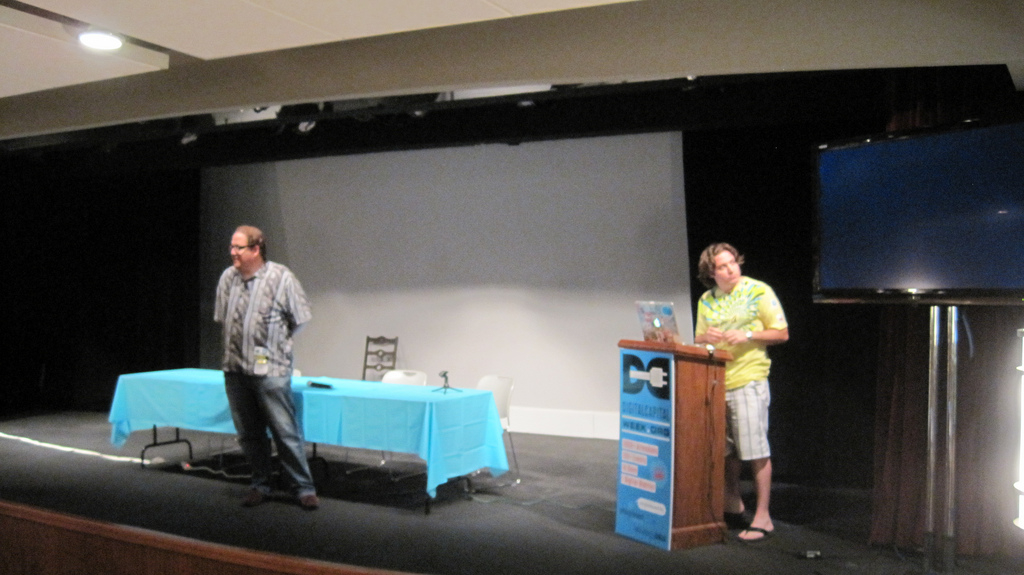
For many people after all, it’s about whether you can get the job done, not what you’re wearing when you do it. That issue came into sharp relief yesterday, when some speakers at the 140 Conference held during Digital Capital Week in the District of Columbia came under criticism for not wearing pants.
I wish I could wear shorts more often around Washington. It’s now officially moved into “absurdly hot season” and wearing a suit is miserable. That said, there’s often no way around it. This week, for instance, I wore a suit to the Center for American Progress for the Law.gov workshop, since I knew I’d be meeting John Podesta and other lawyers who put stock in that kind of professionalism. I’ve pulled my suit on to go to the ballet at the Kennedy Center, to go to Congressional testimony or to attend a landmark event on community health data at the National Academy of Sciences.
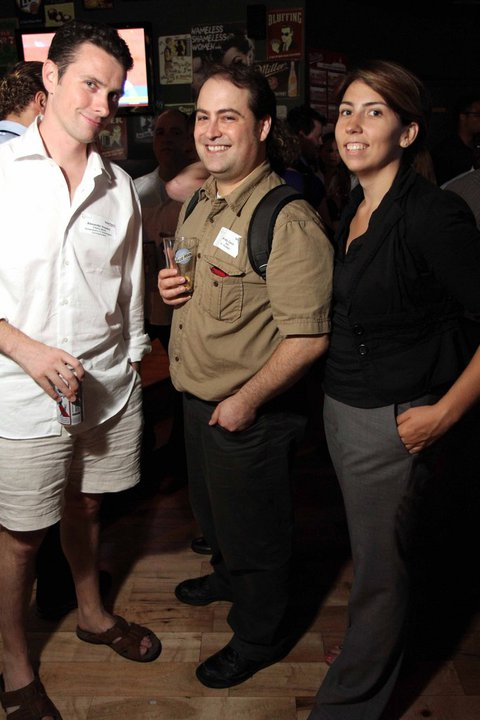
That said, I wore linen shorts, sandals and a collared shirt to the Gov 2.0 day at Digital Capital Week, since it was damn hot, and that fit my vision of summer business casual in the District. And yesterday, at the 140 Conference, I wore jeans and an untucked dress shirt, since that fit the image of the tech journalist I am these days.
Mike Schaffer, a self-described social media strategist here in DC, focused on elevating the style of online communications professionals in public. Respectfully, I think he missed the point. In every situation above, what I wore mattered but, to my audience, was beside the point.
Peter Corbett may have worn shorts and a t-shirt, as seen on the left, but, in his role, it didn’t matter. Since I know him and have respect for the work he’d done for D.C. Week, at iStrategy Labs for Apps for the Army, and other initiatives, I know what he’s done.
I also believe that the informal nature of 140 Conference requires no more of us than that we represent ourselves as ourselves and share what matters, much like, perhaps, we might approach Twitter.
Representative Mike Honda (D-CA) may have come dressed in a suit, as you might expect from a Congressman in D.C., but what he said reflected that sentiment:
“It’s about sharing who you are, rather than trying to sell what you’d like to have people believe about you.”
By focusing on what people wore instead of what they said or have done, I’m not sure Schaffer honored the hard work of the organizers, nor the quality of the experiences that, say, Justin Kownacki shared.
Kownacki, whose cargo shorts drew attention at the D.C. 140 Conference, tweeted afterwards that “I don’t believe in wardrobe labels. I judge words and actions, not packaging. I’m amused by the #140conf attendees who think my wardrobe ‘killed my credibility.’ Who knew packaging dictates truth? Wardrobes provide a shorthand by which we can exclude & ignore. Makes life easier for traditionalists & streamliners, I’m sure.”
I’ve been to dozens of tech conferences, many of which featured people dressed to the nines with little substantive tactical or strategic value.
I can frankly say, as someone who has overdressed on occasion, that sometimes wearing shorts and a hip t-shirt is absolutely the right choice.
Tools and Togs both matter
Schaffer wrote that “a carpenter is known for getting the job done, not which saw he uses.”
That’s both true and untrue. Master builders who can afford to work with Bosch or DeWalt tools do so because of the quality of the tools and the precision product they allow. It’s true that someone with lack of knowledge to use them will fare far worse that a worker without, just as a rube with an expensive composite fly rod might be outfished by a boy with a cheap piece of bamboo and string, if the young man knows where and how to apply his simple rig. What you do with the tools matters more than their quality, but don’t overlook the fact that those tools do matter.
If someone contracts with a professional videographer to create a broadcast-quality ad and she showed up with a disposable camera and a vintage iBook, what would the new client think?
Consider the building example again. Carpenters are known for building things out of wood. Getting the job done is dependent upon the general contractor who employs him or her, or the reputation of the master builder that is hired. I have some familiarity with carpentry, after working as an apprentice for 18 months in Massachusetts. In that role, I wore shorts when it was hot, Carhardt pants when it wasn’t and many layers of fleece and polypro when it was frigid. We dressed as needed to get the job done. If someone showed up on the job site improperly dressed, or without boots, a belt, gloves and a full set of tools, he couldn’t get the job done without a loan of same.
Working in digital media is no different, in the sense that what we wear what we need to to accomplish a goal, in the context of the social mores of the space we move in.
Virtually, that might mean creating a well-designed website that is standards compliant. Or developing a mobile app for a conference or service. In the social media world, it means adding an avatar, bio, link and other elements that fill out a profile before sally forth. Dressing to impress can mean many things, but in the end, it’s what you can do and have done that will matter most to your clients, customers and audience. Did I get the story right? Will the house stay sound for decades? Is this a sustainable business? Does the app work?
Given the monumental challenges that lie ahead for government officials in Washington and around the nation, I suspect many citizens would rather they focus on getting real results, narrowing budgets, passing effective legislation and developing effective regulations that address issues in the financial, technical and environmental space, rather than any wardrobe choice.
As for me, I hope I can wear shorts more often around Washington.
Unlike last year, I haven’t had time to properly write up this year’s 140 Conference in New York City. My takeaways from 2010 were much the same, however: the real-time Web has disrupted the media. This year’s 140conf didn’t have a volcanic panel on #CNNFail or the full attention of the Internet’s digerati, given Facebook’s concurrent f8 developer’s conference, but those in attendance were treated to case studies in how educators, artists, musicians, developers, marketers, fashionistas and journalists were using Twitter.
Given my profession and involvement in the digital response to the earthquake in Haiti, I was particularly interested in the terrific panels on real-time news gathering (watch it) and the evolution of emergency communications in the era of the real-time Internet (watch the panel.) And given my new role for O’Reilly Media and status as a digital resident of Washington, D.C., I was glad to see Peter Corbett speak eloquently about open government and the upcoming Digital Capitol Week (Watch him).
I expected to learn about innovative uses of Twitter, gauge the maturation of the platform and meet many people I’d know virtually for year in the flesh. What I didn’t expect was that I’d be asked to ascend the stage participate in one of the panels! Due to the disruption to air travel caused by the volcano in Iceland, the editors from the Economist that were slated to be on in the couldn’t make it. Jeff Pulver asked me if I’d like to come up.
So I did.
I was honored to join Benjamen Walker (@benjamenwalker), Senior Culture Producer, WNYC, Fred Fishkin (@ffishkin), host of Bootcamp Report and Nick Bilton (@nickbilton), lead technology writer at the New York Times Bits blog, to talk about how Twitter is changing the ways that journalists report, write and share news.
You can watch the media roundtable on-demand. Given that I didn’t prepare at all, I’m happy with the outcome. Social media can allow journalists to pick up on trends, find sources, find audiences and, over time, develop more trust with readers.
I was also happy to learn that NPR’s “On The Media” also stopped by to ask attendees what’s the point of Twitter?. Good question, great answers, particularly from the New York Times David Carr (@carr2n.
I look forward to participating in the upcoming 140conf in DC.
“I used to say “justify every pixel,” said Sree Sreenivasan. “Now I say earn every reader.”
Sreenivasan, a dean of student affairs and professor at the Columbia Journalism School, went beyond “what Jeff Jarvis calls the blog boy dance,” offering up more than an hour of cogent advice, perspective and tips on social media to a packed classroom populated by members of the DC Online News Association at Georgetown’s campus in Virginia.
Where once he used to go around newsrooms to talk about email, then Google and blogs, now he’s moved to new tools of digital journalism grounded in a reciprocal relationship between the audience and the reporter. After all, Sreenivasan had to tailor his talk to the audience, a collection of writers, editors and producers already steeped in the tools of digital journalism, moving quickly beyond listing Twitter, Facebook and LinkedIn to the tools and services that that enable journalists to use those social media platforms improve their reporting, editing and careers.
“The best people find the things that work for them and skip the rest,” said Sreenivasan. Services need to be useful, relevant and extend the journalist’s work. Quoting a student, now at the Wall Street Journal, Sreenivasan observed that you “can have greatest content in world but will die on the vine if we don’t have a way for our readers to find it.” He classified the utility of social media for journalists into four broad categories:
tracking trends on a given beat
connecting with the audience, where ever it is online
putting that audience to work, aka crowdsourcing
building and curating the journalists personal brand
“Tools should fit into workflow and life flow,” he said. “All journalists should be early testers and late adopters.” In that context, he shared three other social media tools he’s tried but does not use: Google Wave, Google Buzz and Foursquare. Sreenivaan also offered Second Life as as an example, quipped that “I have twins; I have no time for first life!”
The new Listener-in-Chief
One group that undoubtedly needs to keep up with new tools and platforms is the burgeoning class of social media editors. Sreenivasan watches the newly-minted “listeners-in-chief” closely, maintaining a list of social media editors on Twitter and analyzing how they’re using the social Web to advance the editorial mission of their mastheads.
He showed the ONA audience a tool new to many in the room, TagHive.com, that showed which tags were trending for a group. What’s trending for social media editors? This morning, it was “news, love, work, today, great, people, awesome and thanks.” A good-natured group, at least as evidenced by language.
The simple answer is yes, in his opinion, but with many a caveat and tweaks to privacy settings. Sreenivasan described the experiences of people in NGOs, activists and other sources whose work has been impaired by associations on social media. To protect yourself and sources, he recommended that Facebook users untag themselves, practicing “security by obscurity,” and use lists. As an example of what can go wrong, he pointed to WhatTheFacebook.com.
Where should journalists turn next for information? Follow @sreenet on Twitter and browse through the resources in his social media guide, which he referenced in the four videos I’ve embedded in this post. He’s a constant source of relevant news, great writing and good tips.
I’m thrilled to announce that I have a new job! Earlier today, I accepted an offer from Tim O’Reilly to be the Washington, D.C. correspondent on Government 2.0 for O’Reilly Media.
I’m hitting the ground running here in the District of Columbia, since O’Reilly’s upcoming 2010 Government 2.0 conference is only a few weeks away — and there’s plenty to do.
Over the following months, I expect to write – a lot – about how technology is being used to help citizens, cities and national governments solve big problems.
There’s no shortage of case studies to highlight, from the local town green right on up to the federal or international level. Just listen to the voices from the Gov2.0 LA unconference for a small sample of the perspectives on the issue.
O’Reilly’s goal in Washington D.C. is to “create a context in which people can think” differently about the role of technology in government, and the role of government in society. I look forward to helping to create that context.
In service of that goal, I’ll be blogging, conducting short interviews with government officials and industry participants, writing features and using the rest of the tools for digital curation I’ve been honing in the past several years.
I’m very excited to get started. I expect my new position to be challenging, engaging, rewarding, occasionally frustrating and never dull.
I also expect the process of writing about government 2.0 case studies to be a reciprocal process, as readers help me to understand more about what stories are important to them and which voices deserve to be heard.
I hope that in the days and months to come that you’ll share your perspectives, ideas and suggestions with me.
The story of government 2.0 is already being written every day by citizens, civic hackers, advocacy groups, government employees, researchers and technologists.
As a digital pilgrim, I look forward to chronicling that progress.
In this video, Sree Sreenivasan, dean of student affairs & professor at the Columbia Journalism School, answers my question about whether it’s ethical for journalists to friend sources on social networks like Facebook or LinkedIn. Sreenivasan was speaking at a workshop on social media tools and tips hosted by the Online News Association in Arlington, Virginia.
“Despite widespread deployment, nearly a third of Americans have not embraced broadband,” said FCC Commissioner Baker this morning at the Newseum in Washington, D.C. Baker spoke at the Digital Inclusion Summit, an event co-hosted by the Federal Communications Commission (FCC) and the Knight Foundation to offer perspective the state of the nation’s connectivity and a preview up the upcoming National Broadband Plan, due to be delivered to Congress on March 17.
FCC Chairman Genachowski said that there has been the unprecedented “open process” for the Plan, including livestreams of 40 public workshops, 70 posts at blog.broadband.gov that generated thousands of comments. That process has brought “vital points into focus,” said Genachowski. Rural, minorities, disabled, senior, tribal communities are all lagging in broadband adoption and access. “The cost of digital exclusion is high and growing every day,” he said. In fact, a recent study from the Digital Impact Group estimated the aggregate economic cost of digital exclusion at $55 billion per year.
While eight days remain until the release of the National Broadband Plan (See Broadband.gov), the FCC has indicated that it will include a “National Digital Literacy Corps,” an update to Lifeline and work on building out public, private and nonprofit partnerships.
The Plan may also include spectrum for free wireless broadband. As reported in Reuters, the FCC may also “dedicate spectrum to free wireless Internet service for some Americans to increase affordable broadband service nationwide. One way of making broadband more affordable is to ‘consider use of spectrum for a free or a very low cost wireless broadband service,” the FCC said in a statement.”
An “Apps for Inclusion” Challenge
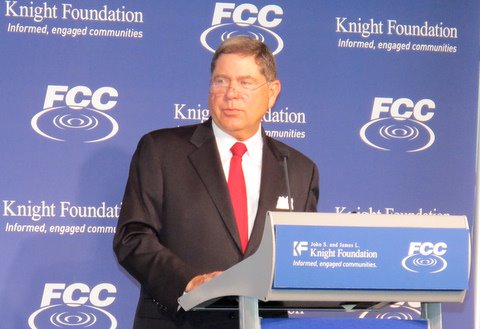
Ibargüen speaks at the Newseum (Courtesy FCC)
Knight Foundation President and CEO Alberto Ibargüen presented a summary of the Commission on the Information Needs of Communities in a Democracy, comparing information to basic commodities to good streets and clean water.
“If information is a core need, and if it is to be delivered digitally, then logically to be a fully participating citizen one must have access,” he said.
Ted Olson, Knight Co-Chair, would echo that sentiment later. “Information is as vital as air and water to democratic communities,” said Olson. “Citizens must have it to thrive.”
In voicing his support for broadband and new media literacy, Ibargüen noted a recent study from Pew Internet that the Internet has surpassed newspapers as a primary means of getting news for Americans, including many “non-traditional” means like personal feeds, social media and mobile applications. Ibargüen compared broadband to the national infrastructure projects of past generation. “I can’t wait to build the equivalent of Eisenhower’s highways — or for that matter the railroads under Lincoln,” he said.
The Knight Foundation and FCC Apps for Inclusion Challenge will award cash prices to developers who can create easier online access to services and information. “This contest reflects on three beliefs that are key to our work at Knight Foundation,” said Ibargüen in a prepared release. “First, our ideal of informed, engaged communities; second, our conviction that universal broadband is key to achieving this ideal; and third, our deep interest in using new approaches to connect with innovators.”
The Inclusion Challenge follows the Knight News Challenge, which distributed $5 million dollars for digital innovation. “Citizens should be able to see voting records or campaign contributions,” said Ibargüen after his speech.
“This is an open-ended contest. Like the News Challenge, we don’t know what will come of it,” he said. “I do know that [the Challenge] has been phenomenally successful in generating ideas that we could not have imagined.”
Support from Congress, officials on broadband initiatives
Other federal officials and members of Congress were also on hand to share their perspectives on the importance of the broadband plan.
HUD Secretary Donovan spoke of creating “a geography of opportunity” through broadband, working through private, public and nonprofit partnerships. “Too often today we can predict the outcome of a kid’s life by their zip code,” he said.
“With broadband, we can use access to drive other outcomes,” said Secretary Donovan. “The ability to learn is not limited by school or resources available. Seniors and the disabled can get control of their healthcare or get better housing. It is not just about the hardware, the wiring, the computers themselves, it’s about the barriers to actualizing using the technology.”
Secretary Donovan suggested three ways to apply technological innovation where it’s needed:
local outreach on the specific ways technology can improve lives
digital literacy training
workforce development and financial literacy training.
Secretary Donovan said they’ll need to work with nonprofit and private sectors to “bring down the cost of computers and monthly service.” He observed that “our most creative housing developers and civic institutions are nonprofit CDCs. If we’re going to be successful, we need to engage private sector and fundamentally engage that third sector.”
Representative Lee Terry (R-NE), following Commissioner Baker, said that “90% of Nebraskans have access to broadband but “puts an asterisk next to that. It’s 200 kbps. That doesn’t work in 21st Century.” Rep. Lee stated his support for reform of the Universal Service Fund to provide rural broadband.
Using a phrase that might raise some libertarian hackles, FCC Commissioner Copps called Internet access a civil right. “Access denied is opportunity denied,” he said. Full text of Copps’ remarks is available as .doc or PDF at FCC.gov.
Rep. Ed Markey, courtesy of the FCC.
Rep. Ed Markey (D-MA) spoke at length about the importance of broadband to civic life and equal access. As the Washington Post’s Cecilia Kang observed, Markey put national broadband charge for FCC in stimulus plan. And, as Kim Hart reported in the Hill, broadband funding from the stimulus has been a contentious topic.
Rep. Markey cited the precedent of E-Rate in improving digital literacy. According to Rep. Markey, 95% of US schools and libraries are now connected to the Internet, up from 14%.
In an alliterative moment, Rep. Markey observed that the “plan is not merely for megabits and megahertz but consumers and community.”
Joey Durel, City-Parish President, spoke about “muni fiber” at Lafayette, Louisiana, where a “citizen-owned utility” company delivers up to 50 Mbps at costs lower to comparable commercial services.
As Durel has said elsewhere, commenting at DSL Reports, Lafayette muni fiber also supports 100Mbps symmetrical P2P.
Rep. Doris Matsui (D-CA) said 75% of U.S. employers require prospective employees to apply online. “Affordability is a necessity, not a luxury,” she said. Rep. Matsui referred to the Broadband Affordability Act, which would amend the Communications Act of 1934 to establish a Lifeline Assistance Program for universal broadband adoption to include low-income citizens. Before she spoke, FCC Chairman Genachowski gave Matsui and other members of credit due credit for the inclusion of the USF in the Broadband Plan. “I want you to hear it from me before the tabloids,” he joked.
Rep. Xavier Becerra (D0CA) described the importance of connecting to a wider world, removing language barriers. He observed that people are ten times more likely to use the Internet if they’ve gone to college. “What we’re doing in connecting all Americans to broadband is helping those families who are too distant from the rest of us,” he said.
Examples of success for technology education, pleas for connectivity
A diverse set of citizens also spoke at the Summit to share how access to broadband or technology changed their lives. Rhonda Locklear, a housing specialist for the Lumbee Tribe in Pembroke, NC, shared her pain in not being able to provide her child with broadband connectivity he needs for homework. “If our children don’t get what they need, they’re going to be left behind,” she said.
Korean War vet and writer Garrison Phillips talked about how the OATS program engaged and trained seniors in the use of technology. Phillips said he began blogging in his 70s, thanks to digital programs aimed at seniors, and that’s he’s grateful for Net access to information, given the challenges posed by living in a 6th floor walkup.
For AmeriCorps volunteer Alex Kurt, the success of a tech skills program in Minnesota “only highlighted how big the problem really is. For each person I help, two to three more come saying ‘I lost my job. I can’t use a computer,'” he said. More information regarding the program Kurt is involved in is available at wip.technologypower.org.
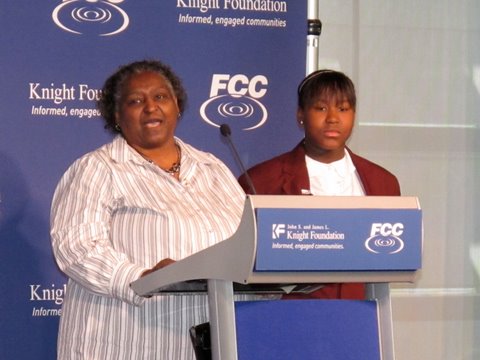
Florence Pearson and her daughter speak at the Newseum. Picture courtesy of FCC.
“I was handicapped. I had to have someone else type my work for me,” said Florence Pearson, Education Director at Head Start in NYC, as quoted on the KnightBlog and pictured on the left with her daughter. “[After training,] all I can see are possibilities for myself and my family. I went in with fear and came out with the motivation to tackle the computer and make my children proud.”
And what does the FCC and broadband mean to Irvin Aviles, a computer technician from Baltimore? “Broad opportunities for a common community,” he said, explaining how training and certification led to employment for the father of four at Time Warner Cable in Baltimore.
Launching a National Digital Literacy Corps
“If today’s disparities are not addressed, our digital divide will soon become a digital canyon,” said FCC Commissioner Clyburn, who said a “National Digital Literacy Corps” will be part of the National Broadband Plan.
“Broadband is one of our generation’s most important challenges, primarily because it presents one of our most monumental opportunities,” said Clyburn. Universal broadband and the skills to use it can lower barriers of means and distance to help achieve a more equal opportunity for all Americans.”
According to Clyburn, next week’s Plan will recommend a three-part National Digital Literacy Program that will consist of
a National Digital Literacy Corps
a one-time investment to bolster the capacity of libraries and community centers
an Online Skills portal for free, basic digital skills training.
Why? “As political dialogue moves to online forums; as the Internet becomes the comprehensive source of real-time news and information; and as the easiest access to our government becomes email or a Web site, then those who are offline become increasingly disenfranchised,” said Clyburn. “Until recently, not having broadband was simply an inconvenience. Now it’s becoming essential to opportunity and even citizenship. As I have said before, if the adoption gap is not addressed soon, today’s digital divide will soon transform into a digital canyon.”
“Altogether, 93 million Americans do not have broadband at home. And adoption rates are much lower among certain populations, including rural Americans [50%], the elderly [65%], persons with disabilities [42%], low-income Americans [40%], African Americans [59%], and Hispanics [49%]. Among the 13 million children between the ages of 5 and 17 who do not have broadband at home, 6 million are either Hispanic or African American. These disparities won’t just disappear over time if we sit back and do nothing.”
“Targeted solutions should aim to direct resources at populations less likely to be online with broadband,” said Clyburn. Collaborative solutions acknowledge the need for government leadership and coordination in this area; but also rely on the private, non-profit and philanthropic sectors. And local solutions understand that, while the decision to adopt is an individual one, the path to adoption is social.”
“The staff has come up with a number of recommendations with these goals in mind,” said Clyburn. “To help with cost, the Plan recommends expanding low income Universal Service support to broadband, and exploring using spectrum for a free or very low cost wireless service. Partnerships between the public, private, non-profit and philanthropic sectors, can help address the relevance barrier by encouraging comprehensive solutions that combine hardware, service, training and content, and by conducting outreach and awareness campaigns that target underserved communities.”
Applying “Gov2.0” in practice
The use of social media and other collaboration technology online has been notable in many branches of government. The FCC launched Reboot.gov earlier this year, following OpenInternet.gov and Broadband.gov.
Even if FCC.gov remains dated, the FCC itself has moved quickly to use crowdsourcing tools for questions, @FCC took questions about the digital inclusion at summit using the event’s #BBplan hashtag or using email sent to newmedia@fcc.gov. (Authors of “questions from Twitter,” however, were not unattributed.) Several of the tweeted questions were answered and webcast at FCC.gov/live. That virtuous feedback loop using a combination of online collaborative tools and a livestream is one of the better examples of so-called “government 2.0” technology I’ve seen in action.
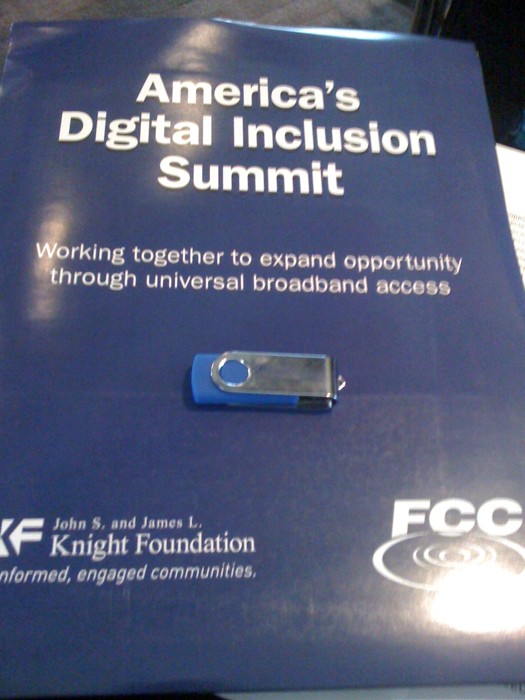
The FCC and Knight Foundation also distributed USB flash drives with PDFs of remarks, reports and relevant links, along with paper versions of the same. That move was both digitally savvy and helpful to members of the media or general audience.
Following the broadband debate ahead
As Amy Gahran pointed out in her post on the National Broadband Plan at the Knight Digital Media Center, this moment presents opportunities for community news and civic engagement.
Given the stakeholders involved in this project, the months ahead will likely be contentious as well. Gahran is spot on in this observation:
“Large, established businesses such as cable companies, broadcasters, and telcos have much at stake and are throwing substantial lobbying muscle toward protecting their interests. Expect that the there will be changes to the plan between the time it goes to committee and the version that eventually makes it to the floor of Congress.
Gahran shared events and resources that will be of use to readers in the D.C. area and beyond in following both the debate around broadband policy and implementation.
The National Broadband Plan will be posted at Broadband.gov next week.
It’s no secret that the media industry has been massively disrupted by the Internet and mobile communications technology. Newspapers no longer have monopolies on the market for local advertising. And news breaks in real-time across social networks like Twitter, splashing on the the 24 hour news networks minutes later.
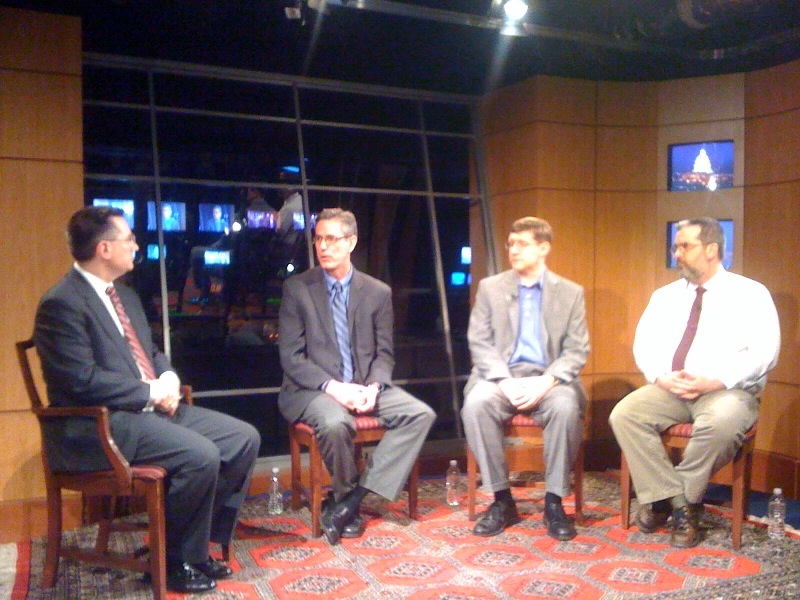
The media market in Washington, D.C. has been similarly affected by technological change, particularly as new, nimble online players have moved into the nation’s capitol. Last night, I visited FedNet’s officers in D.C. for the Online News Association‘s February meetup. The night featured a panel moderated by Keith Carney, President of FedNet and featured Mike Mills (@Mike_Mills), Editorial Director of the Congressional Quarterly/Roll Call Group; Howard Kamen (@hkamen) Partnership Editor for USA Today, and Karl Eisenhower, Editor, New Media Strategy for NationalJournal.com. Fednet will be posting video soon; in the meantime, the livestream I recorded is below:
Vodpod videos no longer available.
The panel primarily focused on the business of online news as practiced by these different organizations. Congressional Quarterly (CQ) and Roll Call have a combination of a subscription model focused on high-value, scarce information gleaned from dedicated reporting on the minutiae of legislation, lobbying and political news. The combination of access, high value eyeballs and profit didn’t escape another provider of high value information: As Mills observed, the Economist Group owns both Roll Call and CQ now. The same media group also runs Congress.org, which Mills says is for “citizens to learn about Congress engage in grassroots activity.” He’s not worried about losing content to search engines, either, given a closed subscription model. “We’re not on the Internet, we’re on the intranet,” said Mills.
USA Today, by contrast, is a national newspaper with a generalist focus. According to Kamen, partnerships with other organization are providing USAToday.com with data for interactive graphics. Those interactive features in turn provide sustained traffic over time to support an advertising revenue model. When asked by Carney if a paywall might show up at USA Today to match the reported metered model at the New York Times, Kamen responded that “I don’t think that’s going to happen any time soon.” USA Today has moved into mobile news, recording over 2.5 million downloads of its free iPhone app. “We made it free to get eyeballs first,” said Kamen.
Even though the paper’s leadership has focused on retaining its position as the most widely circulated paper in the US, Kamen’s comments made it clear that USAToday.com is an important part of its future. “I truly think we do have an ‘online first’ model now,” said Kamen, although there coordinating print and online remains a “work in progress.”
The bridge between writers and coders has been bridged at National Journal, where Eisenhower said every newsroom has dedicated IT resources. The need to connect developers with reporters is felt across town, too: “The real merger that needs to happen is between editorial and IT,” said Mills.
National Journal is also shifting with the times, looking carefully at where and when readers are consuming their content. “Knowing our audience means knowing their work habits,” said -Eisenhower. “Mobile is very important.” Like other glossy weekly magazines, National Journal is experimenting with new advertising models as print circulation wanes.
What will 2010 bring? Innovation and disruption, without question. Certain takeaways from last night, however, should be of use to every media organization, even those without immense national circulations or access to information of interest to readers with attractive demographics for advertisers.
First, go where the readers are. Mills observed that failures in business models were often rooted in not following the audience to where they’re getting information.
Second, go mobile. Create applications, stripped down websites and email alerts that allow the audience to get news on the go.
Third, use data to create evergreen content. Organizations like Gallup or even governments themselves are providing data feeds or sets that can be used for interactive graphics.
Finally, get social. Facebook recently passed Yahoo as the second-most visited site in the world. Many news organizations are finding that social networks are a significant source of traffic, as the audience shares what it’s reading.
All in all, a great night. I enjoyed talking with the always-entertaining Tiffany Shackleford about celebrity culture online and Lee from NPR’s “Tell Me More” about digital distribution and syndication. Even as old models crumble, there’s no shortage of innovation in how we share the news in 2010.
While I’m proud of those posts, one of the themes that emerged from the weekend was the importance of video for communication. I’m not at all on “video as the new text,” especially for countries with low Internet penetration or bandwidth, but there’s no denying that online video has extraordinary power in conveying messages. Just look at video of Iranian protesters on the streets of Tehran, reports from the earthquake in Haiti or the President of the United States on YouTube. Tune in to CitizenTube any minute of the day to witness that power in action.
Following are short videos from Gov2.0 LA organizers and attendees that share their takeways from the event.
Lovisa Williams
@lovisatalk talks about the goals of the Gov2.0 LA Camp.
The wrangling about whether Twitter is revolutionary, useful or mindless twaddle simply will not end. Given the continued interest in the microblogging platform in the media, that is perhaps to be expected.
Last month, David Carr wrote in the Sunday edition of the The New York Times that “Twitter will endure,” exploring how he’d initially dismissed the platform and then found it useful. In late January, The New Yorker‘s George Packer responded to Carr, deriding Twitter as “information hell” and comparing it to an addiction to crack in “Stop the world.” That brought a flood of attention from online media outlets, including Nick Bilton, lead writer for the excellent Bits blog at the Times, who wrote that “The Twitter train has left the station,” defending Twitter from the point of view of a journalist who has found utility amidst the stream. On Thursday, Mr. Packer offered a rebuttal, positioning himself as neither a “Luddite or a Biltonite.” Jeffrey Goldberg has now weighed in at the Atlantic, consigning Bilton and others who might share his conviction to the arena of “info freaks.”
Well and good. (At least Goldberg tweets.) Two disclaimers:
1) I am a long-time reader of George Packer’s excellent work in the New Yorker. I found “The Assassin’s Gate” to be one of the best books written about the early stages of the war in Iraq.
2) I’ve found considerable utility in Twitter since I joined in March of 2007.
I don’t expect either truth to be degraded by the spat between Bilton and Packer.
I was, however, surprised that Packer had chosen to criticize a platform that he hadn’t used. Few serious technology journalists, book reviewers, movie or restaurant critics would consider rendering judgment without personal experience. Such considerations don’t hold back millions of Twitter users, bloggers or, I believe, any number of television pundits, but since I admire Mr. Packer’s professionalism, that approach surprised me.
When he wrote “The Revolution Will Not Be Blogged” six years ago, my sense was that, despite his misgivings and evident frustration with pajama-clad pundits, he’d read some blogs, even if he doubted their utility as serious platforms for commentary or criticism. Given the maturation of blogs in the years since (including, I might note, at New Yorker.com), I wonder if revisiting that analysis might have been more useful, rather than dismissing Twitter without first dipping into the ebb and flow of news there.
In his second pass, Packer wrote that he had, in fact, “sought out a Tweeter,” without linking to or identifying that person. Well and good, but perhaps a weak strawman. As a commenter at Packer’s blog reflected, much of the content produced there is ambient noise, or digital “phatics” as Kevin Marks has rightly described them.
Twitter is profoundly social. That’s is why, despite the mindless hype surrounding the phrase, “social media” has had staying power in describing Twitter, Facebook or other platforms that allow two way conversations.
Twitter, like so many other things, is what you make of it. Some might go to a cocktail party and talk about fashion, who kissed whom, where the next hot bar is or any number of other superficial topics. Others might hone in on politics, news, technology, media, art, philosophy or any of the other subjects that the New Yorker covers. If you search and listen, it’s not hard to find others sharing news and opinion that’s relevant to your own interests.
Using intelligent filters for information, it’s quite easy to subscribe and digest them at leisure. And it’s as easy as unfollowing someone to winnow out “babble” or a steady stream of mundanity. The impression that one is forced to listen to pabulum, as if obligated to sit through a dreary dinner party or interminable plane ride next to a boring boor, is far from the reality of the actual experience of Twitter or elsewhere.
There’s also genuine utility there for the journalists who choose to experiment. When stories break, we can use it for real-time news and information. In the case of Haiti, Twitter was relevant, immediate and helpful, given that phones went down and the Internet stayed up. NPR was able to use Twitter and Skype to find sources on the ground. Disaster relief agencies were able to coordinate with one another. And in one notable instance, Doctors Without Borders was able to call attention using Twitter at @MSF_USA to the fact that its plane was getting turned away. Ann Curry heard them and helped to amplify the issue:
Packer and others are right to caution against hype and techno-worshipers. On balance, however, Packer errs in tarring much of the online community with a broad brush.
One passage in particular stands out: “There’s no way for readers to be online, surfing, e-mailing, posting, tweeting, reading tweets, and soon enough doing the thing that will come after Twitter, without paying a high price in available time, attention span, reading comprehension, and experience of the immediately surrounding world.” As Marc Ambinder tweeted earlier today, “I read many, many books in 2009. Including yours. And I Tweet.”
The same is true for me, and for many others. I read much of the New Yorker, the Economist and the Atlantic each month, along with numerous newspapers and technology blogs or trade publications online. (I write for one of the latter.) I also read on average 2-3 books every month, depending upon the rigor of travel, conferences or other factors. I also dip in and out Twitter throughout the week. That may not be an ideal information diet for everyone but for this tech journalist, it works. Even if I miss a story, it’s extremely rare that my network of friends and sources won’t find it and share it.
That’s why this “social news” phenomenon has become of keen interest to Google, as evidenced by the inclusion of social search into its results.
I share Packer’s concern about how the use of the Internet is changing literacy, critical thinking and creativity. Well and good, if not exactly novel. I look forward to more research on how and where those effects are found. I find hypotheses that place high consumption rates video games, television and movies is at the heart of poor information literacy instead of the wired world more convincing.
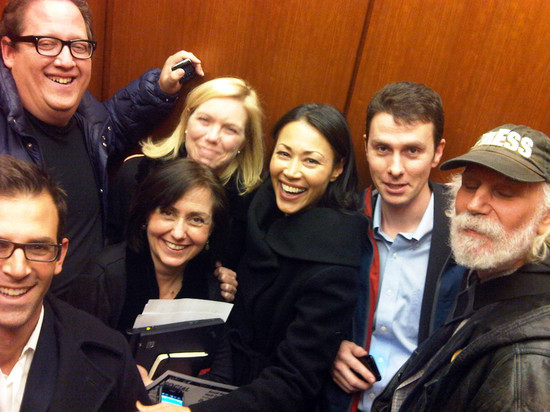
As for another comment regarding the tweets that flew about Ann Curry being stuck in the elevator, I share the amusement from the perspective of the man who sat next to that remarkable woman for ninety minutes. (So did the folks at Gawker, who wrote about the elevator incident at length.) Ann and I talked about Haiti, changes in media, religion, the utility of the iPad and yes, Twitter, all gloriously offline and in depth. I enjoy that memory; there’s a lovely montage of images up at GeoGeller.com, whose camera took the excellent shot below.
The fact that the world knew we were all stuck in that elevator was merely amusing, however, as opposed to a critical message that would best be conveyed to a 911 operator. We all found the intercom more useful than our smartphones, given the awful reception.
Sharing our experience with our networks of friends, however, was a natural extension of life in 2010. It certainly wasn’t breaking news but the act of communicating about it offered me, at least, an opportunity to interact with a broader audience of other humans around globe. That’s an unalloyed good.
I agree that “cheerleading uncritically” is not useful, nor a mentality that any writer should adopt. I do not share Packer’s conviction, however, that the news landscape can’t be occupied by more technological platforms, including reporters tapping away on BlackBerrys. One important example of that is Mark Knoller, the CBS White House correspondent whose tweets read like a they’ve been adapted from a history book already written.
If Mr. Packer would like to meet over coffee in DC to talk further about how life has changed in the age of Twitter, consider this an open invitation. Given my experience with his writing, I am certain that @GeorgePacker would be worth following.
Secretary of State Hillary Clinton speaks on Internet Freedom at the Newseum
“We stand for a single internet where all of humanity has equal access to knowledge and ideas.” – Secretary Clinton.
Today, Secretary of State Hillary Clinton delivered a major speech on Internet Freedom to an audience of diplomats, politicians, journalists, tech executives and online activists in Washington, D.C.
The Wall Street Journal headline was clear this morning: “Internet access is the Clinton Doctrine.” As reported there, the U.S. has made unrestricted access to the Internet a top foreign-policy priority.
“This issue isn’t just about information freedom; it is about what kind of world we want and what kind of world we will inhabit,” said Clinton. “It’s about whether we live on a planet with one internet, one global community, and a common body of knowledge that benefits and unites us all, or a fragmented planet in which access to information and opportunity is dependent on where you live and the whims of censors.”
Secretary Clinton’s speech at the Newseum was streamed live at NetFreedom.state.gov. The discussion on Twitter was aggregated at the #netfreedom hashtag. Notably, many of the tweets showing up there are in Chinese.
“The spread of information networks is forming a new nervous system for our planet,” said Secretary Clinton. “When something happens in Haiti or Hunan, the rest of us learn about it in real time – from real people. And we can respond in real time as well. ”
“Now, in many respects, information has never been so free,” said Clinton. “There are more ways to spread more ideas to more people than at any moment in history. And even in authoritarian countries, information networks are helping people discover new facts and making governments more accountable.”
“On their own, new technologies do not take sides in the struggle for freedom and progress, but the United States does.We stand for a single internet where all of humanity has equal access to knowledge and ideas.And we recognize that the world’s information infrastructure will become what we and others make of it. Now, this challenge may be new, but our responsibility to help ensure the free exchange of ideas goes back to the birth of our republic.”
Where the Berlin Wall Crumbled, an “information wall” has emerged
“The Berlin Wall symbolized a world divided and it defined an entire era,” said Clinton. “Today, remnants of that wall sit inside this museum where they belong, and the new iconic infrastructure of our age is the internet. Instead of division, it stands for connection. But even as networks spread to nations around the globe, virtual walls are cropping up in place of visible walls.”
These walls are made of bits, not bricks.
“Some countries have erected electronic barriers that prevent their people from accessing portions of the world’s networks,” she said. “They’ve expunged words, names, and phrases from search engine results. They have violated the privacy of citizens who engage in non-violent political speech. These actions contravene the Universal Declaration on Human Rights, which tells us that all people have the right “to seek, receive and impart information and ideas through any media and regardless of frontiers.” With the spread of these restrictive practices, a new information curtain is descending across much of the world. And beyond this partition, viral videos and blog posts are becoming the samizdat of our day.”
Engaging in censorship could have new consequences.
“States, terrorists, and those who would act as their proxies must know that the United States will protect our networks,” said Secretary Clinton. “Those who disrupt the free flow of information in our society or any other pose a threat to our economy, our government, and our civil society. Countries or individuals that engage in cyber attacks should face consequences and international condemnation. In an internet-connected world, an attack on one nation’s networks can be an attack on all.”
“The final freedom, one that was probably inherent in what both President and Mrs. Roosevelt thought about and wrote about all those years ago, is one that flows from the four I’ve already mentioned: the freedom to connect – the idea that governments should not prevent people from connecting to the internet, to websites, or to each other. The freedom to connect is like the freedom of assembly, only in cyberspace. It allows individuals to get online, come together, and hopefully cooperate.”
Secretary Clinton also made it clear the the U.S. would support the development and distribution of tools to enable Internet freedom. Such moves might be analogous to distributing radio components and communications gear to partisans in World War II.
“We are also supporting the development of new tools that enable citizens to exercise their rights of free expression by circumventing politically motivated censorship,” she said. “We are providing funds to groups around the world to make sure that those tools get to the people who need them in local languages, and with the training they need to access the internet safely. The United States has been assisting in these efforts for some time, with a focus on implementing these programs as efficiently and effectively as possible. Both the American people and nations that censor the internet should understand that our government is committed to helping promote internet freedom.”
Clinton was clear regarding how access to information can be vital in preventing conflict:
“Information freedom supports the peace and security that provides a foundation for global progress. Historically, asymmetrical access to information is one of the leading causes of interstate conflict. When we face serious disputes or dangerous incidents, it’s critical that people on both sides of the problem have access to the same set of facts and opinions.”
She also referenced the Global Network Initiative, a distributed group of companies, civil society organizations, investors and academics dedicated to “protecting and advancing freedom of expression and privacy in information and communications technologies (ICT).” GNI has posted a reaction to Clinton’s remarks on Internet freedom.
Secretary Clinton took questions from the audience after her speech.
A man from Libya asked wehether help would be available to defend against hackers who silence online media. Secretary Clinton said that tools would be developed collaboratively and deferred specific discussion for the panel.
One attendee wondered how young people, wired in a way they have never been before, can be engaged. Don’t panic over the hyperconnection of young people, said Secretary Clinton.” Find a way to utilize it.”
She closed by focusing again on the response recent disaster in Haiti, where a woman was rescued after the earthquake after sending a text message. “These networks took a voice that was buried & spread it to the world,” said Clinton.
Google, China and beyond
The timing of the speech could not be more apt, given the state of affairs that exists after Google’s announcement regarding ending censorship of its search engine in China, China.cn.
Today’s speech on Internet freedom met with strong support from other federal agencies and electronic freedom advocates.
“Secretary Clinton’s inspiring remarks are a compelling argument for the power of Internet freedom to promote economic opportunity and the rights of all people,” said FCC Chairman Julius Genachowski.
“The FCC has a rich history of promoting open and competitive telecommunications markets at home and abroad. I look forward to working with our government partners and the private sector to advance free communications markets and networks worldwide.”
Chris Messina, open Web advocate (and now Googler) offers his perspective from the stage at the Newseum. Video of the interview is embedded below:
The Center for Democracy & Technology released the following statement in response to Secretary of State Clinton’s major policy address on Internet freedom:
“We applaud Secretary Clinton for placing global Internet freedom at the heart of 21st century diplomacy,” said CDT President Leslie Harris. “This is a critical moment in the evolution of the Internet. Authoritarian regimes are remaking the Internet into a tool of political control; meanwhile, democratic countries are struggling to manage old social ills in the new digital world,” Harris said. “The United States must take bold action to ensure that the global Internet remains a powerful force for democracy and human rights, Secretary Clinton’s speech is an historic first step toward that end.”
CDT Attorney Cynthia Wong added: “The free and open Internet is inexorably linked to the achievement of other major foreign policy goals, from protecting human rights to promoting democracy and economic empowerment. CDT looks forward to working with the State Department as it incorporates this new global Internet freedom objective into the fabric of American diplomacy worldwide.”
“Today’s speech exposes Hilary Clinton as a dyed in the wool cyberutopian… which is a good thing,” said Ethan Zuckerman, co-founder of Global Voices and research fellow at the Berkman Center, as quoted by the Index on Censorship. “Her description of the internet as a “new nervous system for the planet” reflects aspiration as much as reality and points to a thorough embrace of the potentials for this technology, even in the face of dangerous uses of the tools. I was gratified to see her root the idea of ‘freedom to connect,’ not just in American history and tradition, but in the Universal Declaration of Human Rights and to make clear that she saw the responsibility to protect these rights falling on international institutions, like the UN Human Rights Council.”
“I’d been somewhat concerned that her statement might propose a new slate of internet rights, which might have sparked debate about whether the US was trying to impose its norms of speech on a global network – making it clear that internet freedom is rooted in the UDHR as is not a novel set of rights was an excellent move on her part. The policy part of the speech didn’t have many surprises. There’s been support in different branches of the US government for years for censorship circumvention technologies, and the State Department had already announced their interest in online diplomacy. What was interesting was the idea that taking a stand against censorship should become part of the “American brand”. That, combined with the prominent mention of the Global Network Initiative, looked like a hearty endorsement of Google’s recent decision to change its China business practices, and a challenge to other US companies to reconsider how they engage with nations that censor the Internet.”
David Weinberger, Zuckerman’s colleague at the Berkman Center, offered his thoughts and reaction in the video below:
I was taken aback by how much Cold War rhetoric she managed to work into it. Multiple references to 1989, fall of the Berlin Wall, the rise of the Information Iron Curtain (as Fridmanesque a metaphor as it gets). It’s as if the last twenty years and globalization did not happen. The view of authoritarianism that she articulated in the speech smacked of a memo written by a bunch of confused Kremlinologists. I guess no sane American politician would ever acknowledge that information could be the opium of the masses, but acting as if today’s Russians, Iranians or Chinese are totally cut off from information/travel/globalization is kind of silly. The very thought that authoritarianism can survive in the age of information abundance scares the bejesus out of American policy-makers, so they simply prefer to skirt it. I doubt that such self-denial would pay off in the long run.
2. The problem with such an anachronistic view of authoritarianism – which supposedly relies on a very rigorous system of censorship – is that it doesn’t explain countries likes Russia or Egypt, where there is technically very little censorship per se (I bet that Russian has less Internet censorship than Australia or the United Kingdom). Unfortunately, I didn’t hear anything about the evolving nature of Internet control (e.g. that controlling the Internet now includes many other activities – propaganda, DDoS attacks, physical intimidation of selected critics/activists). If we keep framing this discussion only as a censorship issue, we are unlikely to solve it.
3. Clinton was too soft on China, essentially granting them the right to censor whatever they’d like simply because they have “different views”. I doubt that would go well with the Republicans and others who have chided the White House for being too soft on human rights. Her remarks about the need to incorporate Internet freedom into CSR for American companies working in authoritarian countries are valid , but I doubt it would help to solve the problem: local Chinese companies will simply fill in the gaps. Anti-censorship tools are not going to help either, because Chinese Internet companies delete content at its root (a point that Rebecca MacKinnon made during the panel).
4. Clinton’s remarks about the need to go after those who initiative cyber-attacks also puzzled me. She is probably unaware of the numerous campaigns launched by American hacktivists on the web-sites of the Iranian government. Will those be persecuted too? The US government really needs to develop and then adopt a more coherent view on the ethics of cyberwarfare; otherwise, the US State Dept will be accused of duplicity. We can’t be tolerating cyber-attacks in one context and criticizing them in another context (I wrote more about it here) [Read the rest of “cyber Cold War]
Panel parses the meaning of Internet freedom
Following Secretary Clinton’s speech, a panel of long-time analysts, activists and academics convened on stage.
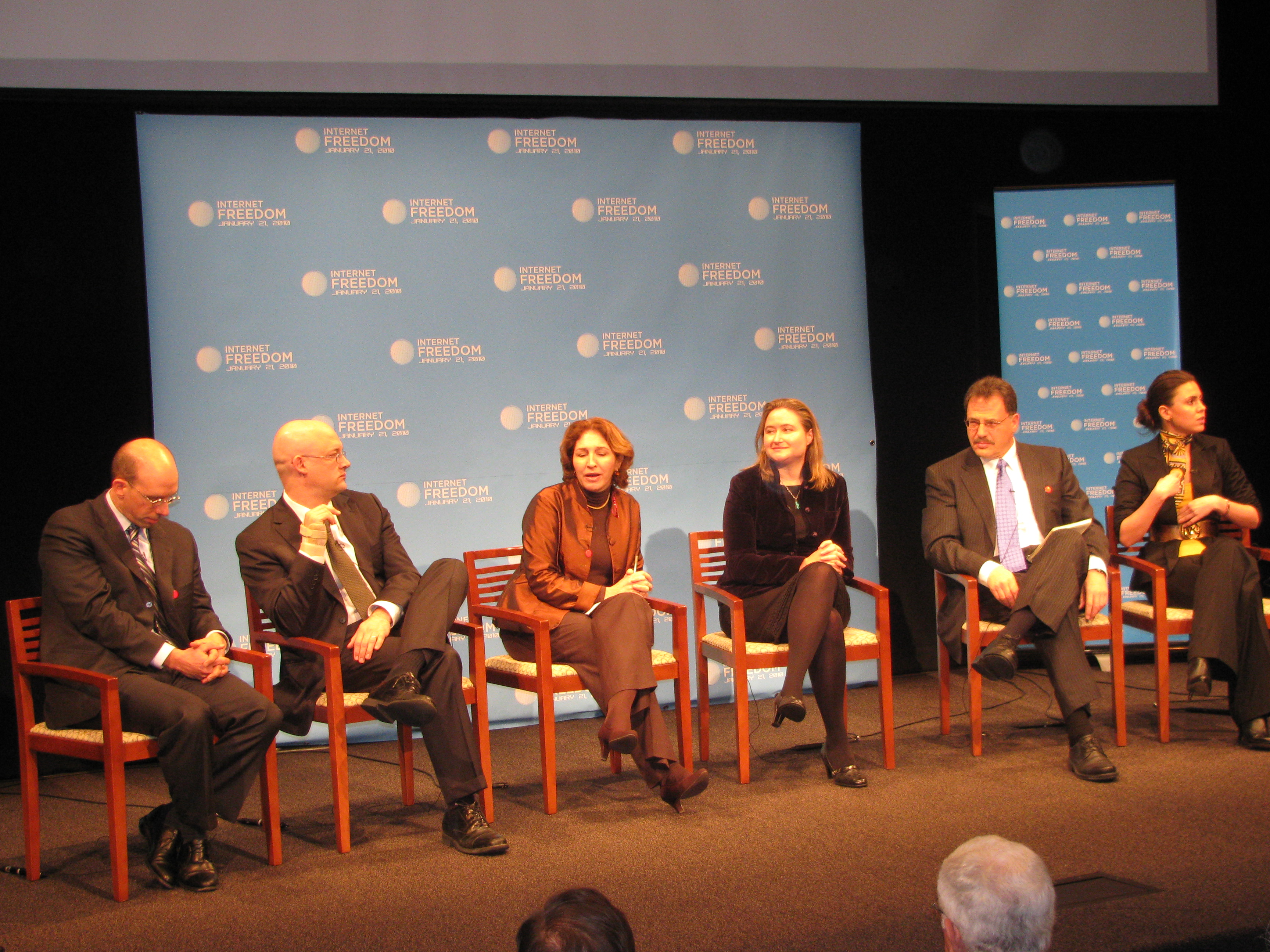
Internet Freedom Panel at the Newseum
“No amount of tools will help people access information when it’s been deleted by the private sector,” said Rebecca MacKinnon, Open Society Fellow, and future Visiting Fellow at Princeton’s Center for Information Technology Policy. “10 years ago, only a small number of countriues censored the Internet. Now it’s more than 40.”
The panel was moderated by , Anne-Marie Slaughter, Director of Policy Planning at the State Department. Panelists included:
Shirky, speaking to the disruptive impact of online networks on societies, said that “We overestimate the value of access to information. We underestimate the value of access to each other.” In describing what happened in Iran and elsehwere, he observed that “it’s been dubbed the Twitter revolution, but it’s plainly the cellphone revolution.” Shirky has written extensively on the potential for online social networks to change authoritarian governments, including a recent essay, “the net advantage.”
“Damaging the open Internet is now starting to be seen like polluting rivers,” said Mackinnon, describing a shift in expectations for corporate responsibility online.
The panel also brought up FreeGate, free anti-censorship software for Internet access in China or beyond.
Mackinnon emphasized that development of tools needn’t be U.S.-centric. “It’s not about Westerners giving tools to the oppressed masses,” she said. “There are great programmers in Africa. They need support.”
There’s a crucial current example of precisely that kind of innovation outside of Western computer science labs: the Ushahidi platform was developed in Kenya & adapted for Haiti: Haiti.ushahidi.com
The final question for the panel came from the Internet: What is the U.S. responsibility regarding freedom of expression in Iran?
“Our responsibility is to stand up, engage governments openly in this discussion,” said Anne-Marie Slaughter.
[When video of the panel is available, look for a link]
Questions remain, with foreign policy, online freedoms and trillions in investments in the balance
Ultimately, it won’t be words alone that changes how Internet freedom is defined, upheld or enforced. It will be governments working in concert with NGOs, private companies and citizens. Doc Searls warned that we must be careful, lest the Internet become a “Cinternet.” MacKinnon looked last week at whether China’s demands for Internet ‘self-discipline’ are spreading to the West, in the form of censorship driven by copyright concerns and regulated through intermediary liability.
Clinton’s speech will matter most if it is translated into policy, just as Google’s bold blog post will be hold water when it stops censoring China.cn.
For now, the U.S. Secretary of State has made a major policy address on Internet freedom that will reverberate throughout the rest of the year. In a world that grows more interconnected by the second, such attention was needed.
Emerging technology has the power to make democracy stronger or weaker. Understanding where, when, and how is the hard part. Subscribe to Civic Texts to get insights about how technologies are changing our democracy in your inbox.

 Much was made of President Obama’s choice on day one of his Presidency to doff his jacket in the Oval Office. When the White House unbuttoned its formal dress code, it was a symbolic move that reflected a larger shift to more casual business attire in culture. While some may feel the President’s showed a lack of respect for the office, for many Americans, doffing the jacket in office and rolling up shirt sleeves to get to work simply reflected their own experience.
 Mike Schaffer, a self-described social media strategist here in DC, focused on elevating the style of online communications professionals in public. Respectfully, I think he missed the point. In every situation above, what I wore mattered but, to my audience, was beside the point.
  Representative Mike Honda (D-CA) may have come dressed in a suit, as you might expect from a Congressman in D.C., but what he said reflected that sentiment:
 As for me, I hope I can wear shorts more often around Washington.





 digiphile