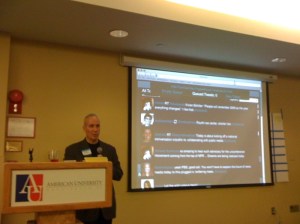
John Boland at Pubcamp
“TV, radio and pro journalism still matter in this new ecosystem”-John Boland, PBS.
This past weekend, I attended Public Media Camp, an unconference at American University in Washington, D.C.
I came away from the two days of sessions, talks, informal discussions, random encounters and rapid-fire information exchange inspired, exhilarated and a bit exhausted. That last is why it took a day to get a post up. By its nature, I couldn’t go to everything. What I did attend, I tried to take notes upon and livestream to Livestream.com and uStream. When it comes to the archiving that video, unfortunately, I endured two crashes and suffered from the lack of a decent mic. Happily, much better video will be coming online from other sources over the next week. What follows are my thoughts, links and video from “Pubcamp.”
Citizen Journalism and public media
The first session of the day remains one of the most memorable. Citizen journalists and local bloggers have much to learn from – and about – one another. “We the media” is a theme I pick up later in this post. Suffice it to say that democratization of the tools for information sharing has taken some producers unaware and left many stations understaffed, at least at the level it takes to effectively engage with those in the community creating the content. That said, many NPR editors and writers are doing quietly effective work in finding, engaging and collaborating with bloggers in the community. I mentioned Universal Hub in Boston, although I’ll leave it to Adam Gaffin, Radio Boston and WBUR to relate exactly how well that relationship works.
@jessieX referenced the tensions in this session in her post on generational differences, “My Takeaway,” where she captures the insight she shared with me in person.
Video of the citizen journalism session is available on-demand.
Tools for curation of audience-generated content
This was one of the best attended sessions of Public Media Camp and, due to any number of reasons, one of the best, at least in my view. The standing room-only group was organized into as a circle and shared dozens of useful tools and services that can aid stations and editors in aggregating, organizing, filtering and curating pictures, video and text generated from listeners.”We all want to open up the floodgates to UGC and crowdsourcing but there’s issues of trust,” said Andrew Kuklewicz.
My favorite metaphor from Public Media came from Andy Carvin here, in the idea of “trust clouds,” or the social network of people around us that represent who we can believe, retweet, link or otherwise invest with our own reputation. A tool for doing just that if at . also came up as “a guide to good .”
Such tools and relationships are critical to both the use of user generated content by stations and the decision of readers and listeners to trust and, in the social media world, pass on information. As I commented during the session, increasingly consumers of media follow bylines, not masthead. To borrow David Weinberger’s phrase, “transparency is the new objectivity.” By showing readers how and where the audience was sourced in real-time, media organizations can make a stronger case for the veracity of such information.
Tools included:
Greg Linch shared the approach to curation that Publish2 takes: “Social Journalism: Curate the Real-Time Web.”
Social Media Success
The most obvious case study in social media success may be Andy Carvin himself. The impact of his efforts have been deep and far-reaching throughout NPR’s shows and staffers. As Amy Woo put it, “I feel the same way about Andy and his tweeting as I do about Diane Rehm.”
Carvin offered compelling examples of success, like an NPR partnership with content discovery service Stumbleupon to create a reciprocal connection w/Twitter. With a little tweaking, a retweet can equal a stumble.
Another site, criticalexposure.org, “teaches kids to take pics as a way to be advocates for social change,” said Carvin.
He also said that NPR’s Facebook fan page generates some 8% of NPR web traffic. Their testing shows 1 post every 60-90 minutes is ideal for audience. That connection came courtesy of a listener, at least at the outset: The NPR fan page on Facebook was created by a fan. That fan then gave it back to the organization, says Jon Foreman. Carvin’s curation of public radio content took it to the next level.
Hurricanewiki is likely to be cited as a classic case in social media success, where more than five hundred people came together, organized through Twitter by @acarvin. You can see the results at Hurricanewiki.org. Carvin also created a hurricane resources community for Gustav on Ning, built in about 48 hours.
One example that came up in multiple sessions is NPR’s Vote Report . Jessica Clark and Nina Keim wrote a report on it: “Building #SocialMedia Infrastructure to Engage Publics.” And while Carvin pointed out where Vote Report fell short, the idea behind enabling listeners to “help NPR identify voting problems” holds some promise. The use of social media for election monitoring is spreading globally now, as can be seen in Votereport.in in India.
The was a different issue with InaugurationReport:- volume. Carvin said that there was simply “too much social media content to effectively curate.” By way of contrast, even a few hundred engaged listeners could effectively use the #factcheck hashtag by http://npr.org/blogs/politics to fact check the U.S. presidential debates in real-time.
Greg Linch shared a collection of social media guidelines curated at Publish2, including NPR’s social media guidelines. There’s a careful eye keeping watch here on the ethics that go with the new territory: the @NPR ombudsman was present (she’s @ombudsman on Twitter) and brought attention to how the public will relate to any perceived bias shown on social media platform.
A standard for conduct matters. It’s not all peaches and cream, after all, given the ugliness that online discourse descend into on many occasions. “Posting on our site is a privilege, not a right,” said Carvin regarding the scrum on comment trolls, online spammers & NPR sites.
Video of the social media success session is available online at uStream.com.
Public Media and Gaming
One of the more entertaining and creative sessions at Public Media Camp was the hour on gaming. Educational gaming can raise literacy rates in children, after all – could NPR deliver further by reaching into this interactive medium? Nina Wall (@) said, in fact, that PBS Kids will soon have available an API similar to NPR’s for educational games.
An excellent summary of this discussion can be found at AmericanObserver.net. Video of the public media and gaming session is available online at uStream.com.
PictureTheImpossible is one intriguing example of the genre. The online, community-based game jointly developed by RIT & the Rochester Democrat & Chronicle.
The discussion also included Kongregate and their “social gaming” model, which provides a platform & revenue share for developers. Could NPR follow suit?
Or what if NPR created a fantasy league for news? Points could be accrued for newsgathering, with players trading shows or writers.
It’s been done for politics – check out the case study of an @NPR fantasy league, from Julia Schrenkler: Minnesota Public Radio’s “fantasy legislature.”
My favorite suggestion, however, came from Andy Carvin: a social “Wait, Wait, don’t tell me!” game where the audience can create news quizzes and then challenge one another on Facebook or the Web.
Social Media FAIL
The first FAIL from Andy Carvin? When the hype around crowdsourcing with Amazon’s Mechanical Turk didn’t deliver. Here’s the Wired story on questions about crowdsourcing.
Video of the social media FAIL session is available on-demand. Amy Woo and other attendees offered many more examples of failures.
Apps for Public Media
The last session of Pubcamp kicked off with a description of @AppsForDemocracy by Peter Corbett. Interesting examples about:
ParkItDC helps people find parking in DC, including which meters are broken.
AreYouSafeDC shows potential threats.
StumbleSafely is a guide to bars & avoiding crime in DC.
FixMyCityDC is a web-based application that allows users to submit service requests by problem type.
And the winner, DC311, enables iPhone access (download from iTunes) to the District’s 311 city service site, coupled with a Facebook App.
There’s more to come: In 2 years, the vision laid out by Corbett includes “muni data standardization, open civic app ecology and the ‘real-time muni web.’ And in 5 years, the vision for includes ideas seemingly lifted out of science fiction: augmented civic reality, AI-driven civic optimization & “virtual flow working.”
What could be created for public media? Apps that enable listeners to create channels from the API for specific topics. Apps that combine real-time data feeds from government sources with local bloggers and radio stations. Apps that allow listeners to help filter the flood of information around events, like the Vote Report project.
Why develop such apps? Andy Carvin believes that “the line between content, services & apps is blurring. To create a more informed public, it now takes more.” To not create such innovation would, in effect, be irresponsible.
More posts, eclectica and public media resources
The PBS News Hour has partnered with the Christian Science Monitor on “Patchwork Nation.”
The work of Doc Searls at the Berkman Center on “vendor relationship management” came up, mentioned by one Keith Hopper. More details at http://projectvrm.org.
FrontlineSMS.com is a free group text messaging tool for nonprofit that is useful in disaster and crisis response.
Swiftapp.org was shared by @kookster: free, #opensource toolset for crowdsourced situational awareness.
Plenty of social media application develop is going on at PBS. Their social media guru, Jonathan Coffman, pointed to the tools at PBS.org/engage.
The Participatory Culture Foundation has launched Videowtf.com.
Economystory.org is a cooperative effort of public media producers to provide financial literacy.
Check out Radio Drupal and Radioengage.com for open source public netcasting information.
Session notes for @PublicMediaCamp are going up at the wiki at PublicMediaCamp.org and are being aggregated under #pubcamp on Delicious.com by Peter Corbett.
My Takeaways
There a lot of smart, savvy, funny geeks in public media, passionate about delivering on the core mission of education, media literacy and good journalism.
This same cadre is pushing innovative boundaries, whether it’s engaging the audience, creating new technology platform or expanding the horizons of computer assisted reporting. Database journalism is alive and well at NPR – just look at this visualization of the U.S. power grid.
Vivian Schiller said during her keynote that “2009 was the year everything changed.” Out of context, that statement drew raised eyebrows online. In person, there was more clarity. The massive disruption to the newspaper and traditional media industry is now resulting in significant layoffs and a seachange in how people experience events, share information and learn about the issues. Despite the issues presented by ingesting a torrent of new sources of information, the concept of “We the media” has deep roots, given that so many more people now have the ability to contribute news and help analyze it now that the tools for communication have been democratized and often made freely available online.
What’s missing in that fluid mix of updates, streams and comments is trust in veracity. As we all move into the next decade of the new millennium, the central challenge of public media may be making sense of the noise, taking much the same approach that it has in the past century: report on what’s happening, where it happened, who did it and why it’s important, with a bit more assistance from the audience. Given the loyalty of tens of millions of listeners, “we the media” might just have some legs.
Oct 18, 2009
Twitter / digiphile
digiphile: #Cloudcomputing, Windows 7 & forecasts for @Microsoft’s future: http://bit.ly/4oh4fo #business #tech
– digiphile: #Cloudcomputing, Windows 7 & forecasts for @Microsoft’s future: http://bit.ly/4oh4fo #business #tech
Oct 18, 2009
Twitter / digiphile
digiphile: “How Private Can Electronic Data Ever Be?” http://j.mp/4kqRye “De-anonymization” is a crucial #privacy issue.
– digiphile: “How Private Can Electronic Data Ever Be?” http://j.mp/4kqRye “De-anonymization” is a crucial #privacy issue.
Oct 18, 2009
Twitter / digiphile
digiphile: “Why have 33% of American households that have access to broadband elected not to subscribe?”-Randall Stross http://j.mp/2s4gp3
– digiphile: “Why have 33% of American households that have access to broadband elected not to subscribe?”-Randall Stross http://j.mp/2s4gp3
Oct 18, 2009
Twitter / digiphile
digiphile: No shock: monitoring live online video is still the Wild West. @BradStone reports on Stickam.com & sex crime: http://j.mp/1FeojO
– digiphile: No shock: monitoring live online video is still the Wild West. @BradStone reports on Stickam.com & sex crime: http://j.mp/1FeojO
Oct 18, 2009
Twitter / digiphile
digiphile: The rain *finally* ceased. Beautiful, cool & calm fall morning for my walk in to Day 2 of @PublicMediaCamp at American University. #pubcamp
Oct 17, 2009
Twitter / digiphile
digiphile: @jayrosen_nyu I wish you could have been at #pubcamp. Open APIs, ethics, citizen journalism, social media, data-driven reporting & insight.
Oct 17, 2009
Twitter / digiphile
digiphile: Given the volume of #socialmedia, @jdevo25, my guess is that COPE will effectively syndicate, not oversaturate: http://bit.ly/XaMin #pubcamp
– digiphile: Given the volume of #socialmedia, @jdevo25, my guess is that COPE will effectively syndicate, not oversaturate: http://bit.ly/XaMin #pubcamp
Oct 17, 2009
Twitter / digiphile
digiphile: Like @stevegarfield, I #blamedrewscancer that every tweet that has #beatcancer in it today raises money for cancer research.
Oct 17, 2009
Twitter / digiphile
digiphile: “So this one time, at #pubcamp…” Enjoying ribald conversations with unconference goers at Cactus Cantina, next to a bachelorette party.
Oct 17, 2009
Twitter / digiphile
digiphile: “Thanks to all that came to my NPR API session. Here’s my @programmableweb post (w/diagram)” – @daniel_jacobson http://bit.ly/XaMin #pubcamp
– digiphile: “Thanks to all that came to my NPR API session. Here’s my @programmableweb post (w/diagram)” – @daniel_jacobson http://bit.ly/XaMin #pubcamp
Oct 17, 2009
Twitter / digiphile
digiphile: Learned about http://economystory.org from @kkemple — cooperative effort of public media producers to provide financial literacy #pubcamp
– digiphile: Learned about http://economystory.org from @kkemple — cooperative effort of public media producers to provide financial literacy #pubcamp
Oct 17, 2009
Twitter / digiphile
digiphile: @jayrosen_nyu @jeffjarvis Archive of my livestream of Vivian Schiller’s talk at #pubcamp: http://livestream.com/digiphile Quote in context.
– digiphile: @jayrosen_nyu @jeffjarvis Archive of my livestream of Vivian Schiller’s talk at #pubcamp: http://livestream.com/digiphile Quote in context.
Oct 17, 2009
Twitter / digiphile
digiphile: @ksablan W/scarce resources, I wonder if news orgs would do better to build evergreen wikis internally, like http://whorunsgov.com at WaPo?
– digiphile: @ksablan W/scarce resources, I wonder if news orgs would do better to build evergreen wikis internally, like http://whorunsgov.com at WaPo?
Oct 17, 2009
Twitter / digiphile
digiphile: OH: “The more we engage with our audience online, the more willing they are to contribute philanthropically” <-Drawing correlations #pubcamp
Oct 17, 2009
Twitter / digiphile
digiphile: Map of @Solar_Decathlon on National Mall on @OpenStreetMap: http://j.mp/18N5HQ “mapping transient features”~ @rekha6 #pubcamp
– digiphile: Map of @Solar_Decathlon on National Mall on @OpenStreetMap: http://j.mp/18N5HQ “mapping transient features”~ @rekha6 #pubcamp
Oct 17, 2009
Twitter / digiphile
digiphile: @IsCool Research suggests educational gaming raises literacy rates. If @NPR games >> interactions w/news, could be potential. #pubcamp
Oct 17, 2009
Twitter / digiphile
digiphile: @USSJoin Bring in the foreign correspondents for ringers for #FantasyNPR: Sylvia Poggioli + Anne Garrels. Unstoppable. #pubcamp
Oct 17, 2009
Twitter / digiphile
digiphile: Broke into a huge grin at #pubcamp: @acarvin suggesting an @NPR fantasy league. Points accrued for newsgathering, can trade shows or writers
Oct 17, 2009
Twitter / digiphile
digiphile: Open question to those listening & following #pubcamp: what kind of game would YOU play if @NPR made one? iPhone app? Flash social game?
Oct 17, 2009
Twitter / digiphile
digiphile: Checking out http://picturetheimpossible.com – an online, community-based game developed by RIT & Rochester Democrat & Chronicle. #pubcamp
– digiphile: Checking out http://picturetheimpossible.com – an online, community-based game developed by RIT & Rochester Democrat & Chronicle. #pubcamp
Oct 17, 2009
Twitter / digiphile
digiphile: YES please. Shared. RT @acarvin I still want a social @waitwait game where people create news quizzes, challenge each other on FB #pubcamp
Oct 17, 2009
Twitter / digiphile
digiphile: Discussion of http://kongregate.com & their “social gaming” model here at #pubcamp. Provides a platform & revenue share for developers.
– digiphile: Discussion of http://kongregate.com & their “social gaming” model here at #pubcamp. Provides a platform & revenue share for developers.
Oct 17, 2009
Twitter / digiphile
digiphile: @markstencel I bet most at #pubcamp are glad Bike DC ended & that streets are open. Can we do something about the rain? Shoes still squelch.
Oct 17, 2009
Twitter / digiphile
digiphile: As referenced by @acarvin at #pubcamp, here are IBM’s Social Computing guidelines: http://j.mp/p0tdH #socialmedia
– digiphile: As referenced by @acarvin at #pubcamp, here are IBM’s Social Computing guidelines: http://j.mp/p0tdH #socialmedia
Oct 17, 2009
Twitter / digiphile
digiphile: “Posting on our site is a right, not a privilege”~@acarvin on the scrum on comment trolls, online spammers & NPR sites #socialmedia #pubcamp
Oct 17, 2009
Twitter / digiphile
digiphile: @juliaschrenkler Yes, I’m streaming (&, in theory, recording) the #socialmedia session at @uStream: http://j.mp/3nvY5N #pubcamp
– digiphile: @juliaschrenkler Yes, I’m streaming (&, in theory, recording) the #socialmedia session at @uStream: http://j.mp/3nvY5N #pubcamp
Oct 17, 2009
Twitter / digiphile
digiphile: Collection of journalism-related #socialmedia policies & guidelines curated using @Publish2, via @GregLinch: http://bit.ly/smlinks #pubcamp
– digiphile: Collection of journalism-related #socialmedia policies & guidelines curated using @Publish2, via @GregLinch: http://bit.ly/smlinks #pubcamp
Oct 17, 2009
Twitter / digiphile
digiphile: The @NPR ombudsman is here (she’s @ombudsman!) & brought attention to how the public will relate to perceived bias on #socialmedia. #pubcamp
Oct 17, 2009
Twitter / digiphile
digiphile: Policy comes up here at the #socialmedia session. @acarvin notes @NPR’s is published online for all to view: http://j.mp/y8Qjv #pubcamp
– digiphile: Policy comes up here at the #socialmedia session. @acarvin notes @NPR’s is published online for all to view: http://j.mp/y8Qjv #pubcamp
Oct 17, 2009
Twitter / digiphile
digiphile: The use of #socialmedia for election monitoring is spreading globally. @acarvin cites http://votereport.in in India. #pubcamp
– digiphile: The use of #socialmedia for election monitoring is spreading globally. @acarvin cites http://votereport.in in India. #pubcamp
Oct 17, 2009
Twitter / digiphile
digiphile: Different issue with http://inaugurationreport.com – volume. @acarvin said “too much #socialmedia content to effectively curate.” #pubcamp
– digiphile: Different issue with http://inaugurationreport.com – volume. @acarvin said “too much #socialmedia content to effectively curate.” #pubcamp
Oct 17, 2009
Twitter / digiphile
digiphile: Next up from @acarvin’s presentation of #socialmedia successes: @VoteReport: “Help NPR Identify Voting Problems” http://j.mp/1fysxf #pubcamp
– digiphile: Next up from @acarvin’s presentation of #socialmedia successes: @VoteReport: “Help NPR Identify Voting Problems” http://j.mp/1fysxf #pubcamp
Oct 17, 2009
digiphile: Next up from @acarvin’s presentation of #socialmedia successes: @VoteReport: “Help NPR Identify Voting Problems” http://j.mp/1fysxf #pubcamp
Add starLikeShareShare with noteEmailKeep unreadAdd tagsSend to
Oct 17, 2009
Twitter / digiphile
digiphile: More #socialmedia success: #factcheck hashtag by http://npr.org/blogs/politics to fact check the presidential debates in real-time. #pubcamp
– digiphile: More #socialmedia success: #factcheck hashtag by http://npr.org/blogs/politics to fact check the presidential debates in real-time. #pubcamp
Oct 17, 2009
Twitter / digiphile
digiphile: Another resource is @hurricanewiki: http://hurricanewiki.org | 500+ people came together, organized through Twitter by @acarvin. #pubcamp
– digiphile: Another resource is @hurricanewiki: http://hurricanewiki.org | 500+ people came together, organized through Twitter by @acarvin. #pubcamp
Oct 17, 2009
Twitter / digiphile
digiphile: “Here’s what happens when you don’t plan” says @acarvin, pulling up http://gustav08.ning.com Built in 48 hours. #socialmedia #pubcamp
– digiphile: “Here’s what happens when you don’t plan” says @acarvin, pulling up http://gustav08.ning.com Built in 48 hours. #socialmedia #pubcamp
Oct 17, 2009
Twitter / digiphile
digiphile: “I feel the same way about @acarvin & his tweeting as I do about Diane Rehm”~@AmyWoo, offering kudos to @NPR’s #socialmedia guru at #pubcamp
Oct 17, 2009
Twitter / digiphile
digiphile: Fascinating. @acarvin talks about how @NPR has partnered with @Stumbleupon. Reciprocal connection w/Twitter. A RT can = a stumble. #pubcamp
Oct 17, 2009
Twitter / digiphile
digiphile: @planetrussell uStream may have less hunger-inducing ads. Picture quality isn’t terrific but at least the stream is staying up.
Oct 17, 2009
Twitter / digiphile
digiphile: RT @lmasri NPR Facebook fan page testing shows 1 post/ hour is ideal [for audience] & generates 8% of NPR web traffic #pubcamp
Oct 17, 2009
Twitter / digiphile
digiphile: Livestream is borked. Switched to @uStream for #socialmedia success stories at #pubcamp: http://j.mp/3nvY5N [Frustrating.]
– digiphile: Livestream is borked. Switched to @uStream for #socialmedia success stories at #pubcamp: http://j.mp/3nvY5N [Frustrating.]
Oct 17, 2009
Twitter / digiphile
digiphile: The @NPR fan page on @Facebook was created by… a fan. He gave it back to the organization, says @jonforeman. #pubcamp
Oct 17, 2009
Twitter / digiphile
digiphile: #socialmedia success: http://criticalexposure.org – “teaches kids to take pics as a way to be advocates for social change”~@acarvin #pubcamp
– digiphile: #socialmedia success: http://criticalexposure.org – “teaches kids to take pics as a way to be advocates for social change”~@acarvin #pubcamp
Oct 17, 2009
Twitter / digiphile
digiphile: “TV, radio & pro journalism still matter in this new ecosystem”-John Boland, PBS #pubcamp [HT @beyondbroadcast] http://yfrog.com/5dokavj
– digiphile: “TV, radio & pro journalism still matter in this new ecosystem”-John Boland, PBS #pubcamp [HT @beyondbroadcast] http://yfrog.com/5dokavj
Oct 17, 2009
Twitter / digiphile
digiphile: We’re live here at #pubcamp! @acarvin is making introductory remarks before the unconference gets rolling: http://livestream.com/digiphile
– digiphile: We’re live here at #pubcamp! @acarvin is making introductory remarks before the unconference gets rolling: http://livestream.com/digiphile
Oct 17, 2009
Twitter / digiphile
digiphile: Arrived at #pubcamp. Bedraggled. Sitting in the front row. I’ll livestream VIvian Schiller’s opening remarks http://livestream.com/digiphile
– digiphile: Arrived at #pubcamp. Bedraggled. Sitting in the front row. I’ll livestream VIvian Schiller’s opening remarks http://livestream.com/digiphile
Oct 17, 2009
Twitter / digiphile
digiphile: Journos should update Wikipedia, @stevebuttry & @ksablan? http://bit.ly/4s9WWU Good idea (w/caution) but how about building wikis in-house?
– digiphile: Journos should update Wikipedia, @stevebuttry & @ksablan? http://bit.ly/4s9WWU Good idea (w/caution) but how about building wikis in-house?
Oct 17, 2009
Twitter / digiphile
digiphile: Headed to @PublicMediaCamp at American U. Busy sched at #pubcamp: http://twurl.nl/ky01h8 Would feel martyred but @acarvin was up at 5:48 AM
– digiphile: Headed to @PublicMediaCamp at American U. Busy sched at #pubcamp: http://twurl.nl/ky01h8 Would feel martyred but @acarvin was up at 5:48 AM
Oct 17, 2009
Twitter / digiphile
digiphile: Business #innovation through IT: “Computers create more productivity” http://j.mp/100cPc
– digiphile: Business #innovation through IT: “Computers create more productivity” http://j.mp/100cPc
Oct 17, 2009
Twitter / digiphile
digiphile: @davewiner Given how early the list beta is, I’d say that’s a lot. And since list counts are rather like the new follower numbers, congrats.
Oct 17, 2009
Twitter / digiphile
digiphile: @eric_andersen The mac n’ cheese at Silvertone is among Boston’s best. The steak tips are great, too, along with an excellent spinach salad.
Oct 17, 2009
Twitter / digiphile
digiphile: “James Bramford, the world’s expert on the NSA, reviews a new history of the e-int agency in @NYBooks” ~@jason_pontin http://bit.ly/3wiwxu
– digiphile: “James Bramford, the world’s expert on the NSA, reviews a new history of the e-int agency in @NYBooks” ~@jason_pontin http://bit.ly/3wiwxu
Oct 17, 2009
Twitter / digiphile
digiphile: Met a former ad exec on the Metro who now works on http://research.gov for the National #Science Foundation. Grant writing galore. #gov20
– digiphile: Met a former ad exec on the Metro who now works on http://research.gov for the National #Science Foundation. Grant writing galore. #gov20
Oct 17, 2009
Twitter / digiphile
digiphile: “For the next hour, using #beatcancer & #genesistoday in ANY tweet will generate $1 to fight cancer”~@cfnoble 10 minutes left.
|
![Reblog this post [with Zemanta]](https://i0.wp.com/img.zemanta.com/reblog_e.png)


 @jayrosen_nyu/best-mindcasters-i-know
 @Scobleizer/my-favstar-fm-list


 digiphile


