I played Chess, browsed news and otherwise enjoyed using Microsoft’s table-sized touchscreen computer at the “NERD” offices in Cambridge last year. Fun, but not quite mind-blowing. Interactive Dungeons and Dragons? THAT I could get into:
You can watch another demonstration by the team from Carnegie Mellon University working on the Surfacescapes project, courtesy of CrunchGear’s hands-on review.
Pretty cool. Geektastic, in fact. Now if Microsoft could just do something about that $21,000 price tag for the hardware.
Hat Tip to @StevenWalling: “I’m trying to Force Orb a Dragon over here.”
A few minutes ago, Google Buzz went live at http://buzz.google.com. Google posted a video introducing the Buzz, which ties together Google contacts into a distributed social network accessed through a new tab in Gmail.
In a live webcast on YouTube, Bradley Horowitz (@elatable) explained what Google was after with Buzz: a way to add relevance to the information firehose represented by social messaging and activity. The Web application will act as a user interface to for social data.
Based upon the demo, it will be a snappy app for processing, sharing and annotating images, video and conversations. “Organizing the world’s social information has been a large problem, the kind @Google likes to solve,” said Buzz product manager Todd Jackson, explaining at least some of the why behind the application of algorithmic authority to social media. Jackson writes more in his introduction to Google Buzz at Google’s official blog.
Content shared on Buzz can be posted publicly to a Google Profile (like the one for, say, Alexander Howard) or sent privately within a network. At first glance, the user interface and contrls looks like a Friendfeed clone, with the additional of familiar keyboard shortcuts from gmail and Google Reader. And, notably, Google has adopted the “@reply” convention from the Twitter community as a means of initiating a conversation with contact.
To get a user started with a network, Buzz will autofollow people you’ve emailed. In other words, as Jeremiah Owyang predicted last summer, Google made email into a social network.
Buzz is also mobile.
The mobile Web application, which works on both iPhone and Android, includes geotagging and voice recognition, allowing the user to make spoken updates. While Google profiles will aggregate a user’s Buzz activity, “Places” will aggregate location-based reviews. (In other words, look out Yelp.) A “Nearby” button provides location-based context for Buzz users. Google also launched a new mobile verion of Google Maps, adding a a social layer to its maps. The new “conversation bubbles” on Google Maps indicate geotagged Buzz updates and look like a lightweight, useful version of Twittervision.
Coming soon to the enterprise
Google Buzz will be launched as an enterprise product, says Horowitz. Buzz would likely serve as microblogging layer for Google Apps, providing helpful filtering for the noise of the social Web, unlike Wave, which added it. “A lot of the functionality is inspired by Wave,” said Horowitz, a likely nod to a decision to adopt the best features of the often maligned social messaging platform.
Google co-founder Sergey Brin was on hand to share his personal experience with Buzz, offering a preview of how it might be pitched to other business executives or CIOs. “I found a huge amount of productivity from using Google Buzz internally,” said Brin. “I posted [an] OpEd to Buzz. I looked at the broad categories and did a general edit based on that feedback. It was far more efficient.”
Open APIs?
Public feeds are supported as an XML feed and are fully supported by PubSubHub as of today, said another Google exec. By going open API and openly courting developers to join them on Google Code, Google may be after the same fertile ecosystem that surround Twitter.
What does Google Buzz mean?
All of the above gives an idea of what Google’s newest Web application can do and how it might work. Altimeter Group’s Jeremiah Owyang has already posted a quick take on what Google Buzz will mean. Key insights:
At the high level, this is a strong move for Google, they continue to aggregate other people’s social content, and become the intermediatry. This helps them to suck in Twitter, Flickr, and any-other-data type as the APIs open up, giving them more to ‘organize’. This is Google acting on its mission to the world.
For consumers, the risk of privacy will continue to be at top of mind. Although the features allow for sharing only with friends or in public. expect more consumer groups to express concern. Overtime, this will become moot as the next generation of consumers continues to share in public.
For consumers, this could potentially have more adoption than Twitter as Gmail has a large footprint Google told me it’s tens of millions (active monthly unique). Of course, most Gmail users likely aren’t Twitter users, but there could be a large platform to draw from.
For Facebook, this is a direct threat, these features emulate Friendfeed and the recently designed Facebook newsfeed. Expect Google to incorporporate Facebook connect, commoditizing Facebook data as it gets sucked into Google and displayed on Google SERP.
For small busineses and retailers, this will impact their search engine results pages, as a single top ‘buzzer’ could cause their content to be very relevant, if that person was relevant, then their influential content could show at top of SERP pages. Expect Google to continue to offer advertising options now around buzz content –fueling their revenues.
Strong, near real-time analysis from Owyang. One area he didn’t dwell as much on is the utility to both businesses and many users of the social Web who want relevance for work or for specific topics, without the noise that often obscures both on Twitter, Facebook or other social networks. Power users have had to evolve many strategies to filter signal from the noise, including shadow accounts, lists, keyword searches or alerts. Google Buzz has the potential to allow over 150 million gmail users to quickly filter the most useful content from the social Web and then selectively share it with either friends, colleagues or the open Web. That action, often termed “curation” in the digital journalism space, is singularly useful.
If Buzz easily enables that activity for mobile users, it will have the potential to massively disrupt the nascent mobile social networking space that currently includes Yelp, Gowalla, Brightkite, Loopt and Foursquare. If users turn to Buzz for reviews, to find who is nearby or what’s being discussed in the neighborhood, Google will also have made Google Maps much stickier, which could in turn make it a more useful platform for contextual mobile advertising. Given the potential for targeted ads based on location to be more useful, that might in turn be of great utility to both users and the search engine giant, though electronic privacy advocates are likely to look at the move with concern.
Will people use Buzz? That’s the multi-million dollar question. Facebook and Twitter own the social Web, as it stands. If Buzz offers a UI that adds relevance, it has a shot. If users find utility in the way that Buzz helps them filter social media from other platform, it could stack up well against Brizzly, Seesmic or similar “social dashboards.”
I’ll keep an eye out for the function to go live in my inbox in the meantime and read TechMeme for other reactions.
Does the public need to know what Government 2.0 is?
One might ask Tim O’Reilly, who has written eloquently about the topic and emceed the Gov2.0 Summit last year. One might also ask Mark Drapeau, who asked the question above earlier tonight on his blog, or Laurel Ruma, his co-chair at the Gov2.0 Expo last year, which showcased software and online platforms that used government data in innovative ways.
Or one might ask the nation’s technology executives, like US CIO Vivek Kundra or CTO Aneesh Chopra, both of whom participated in the Summit in Washington last summer. The attendees of the summit were asked by the organizers to define the term themselves in an online contest, offering up a multitude of interpretations of the nebulous term. Unfortunately, tonight I didn’t seek comment, turning instead to Wikipedia for the crowd’s opinion. As of tonight’s version, Wikipedia’s entry for “Government 2.0” defines it as:
“a neologism for attempts to apply the social networking and integration advantages of Web 2.0 to the practice of government. William (Bill) Eggers claims to have coined the term in his 2005 book, Government 2.0: Using Technology to Improve Education, Cut Red Tape, Reduce Gridlock, and Enhance Democracy.[1] Government 2.0 is an attempt to provide more effective processes for government service delivery to individuals and businesses. Integration of tools such as wikis, development of government-specific social networking sites and the use of blogs, RSS feeds and Google Maps are all helping governments provide information to people in a manner that is more immediately useful to the people concerned.[2]“
Well and good. The line I find most compelling in the above explanation for the term is the “attempt to provide more effective processes for government service delivery to individuals and businesses.” If I had to explain the idea to my technophobic friends, that’s the tack I’d take. O’Reilly defined government 2.0 as a platform, which I also find to be a useful metaphor, if one that demands the explanation that O’Reilly himself provided at TechCrunch.
Getting technical with government
For those more technically inclined, it might be useful to talk about open data, mashups, Data.gov, the Open Government directive, XML, XBRL, virtualization, cloud computing, social media and a host of other terms that have meaning in context but without prior knowledge do little to inform the public about what, precisely, the “2.0” means. Most people have some sense of what “government” is, though there’s no shortage of opinion about how it should be constituted, run, regulated, managed or funded. Those discussions go back to the earliest days of humanity, well before organizing principles or rules emerged from Hammurabi or were enshrined on the Magna Carta or constitutions.
In all of that time, the body politic and its regulatory and enforcement arms have been equipped with increasingly sophisticated tools. In 2010, agencies and public servants have unprecedented abilities because of the rapid growth of online tools to both engage and inform both their constituencies, relevant markets and others within government. The question that confronts both citizens and public servants around the globe is how to turn all of that innovation to useful change. Savvy political campaigns have already found ways to leverage the Internet as a platform for both organizing and fundraising. Few observers failed to see the way that the Obama campaign leveraged email, text messaging, online donations and social networking in 2008.
One area that will be of intense interest to political observers in 2010 will be whether that same online savvy can be harnessed in the Congressional mid-terms. Micah Sifry wrote about an “Obama Disconnect” at length; I leave it to him to explore that question. What I find compelling is whether any of these technologies can be turned to making better policy or delivering improved services. In theory, good data can be aggregated to create information, which can then in turn be used to form knowledge. Whether the Open Government Directive dashboard at White House.gov reveals information or simply adherence to defined policy is on open question.
Where Web 2.0 matters to Government 2.0
Does the public need to know what Government 2.0 is, exactly? One might wonder if the public needed to know about what “Web 2.0” was? Judging by search traffic and years of Web 2.0 Conferences, my perception has been that there’s interest, if only to know what the next version of the World Wide Web might be, exactly. After all, the Web that Tim Berners-Lee’s fecund mind brought into being has been one of the most extraordinary innovations in humanity’s short history: what could be better? The short answer has often reflected the definition of Government 2.0 above: a combination of technologies that allows people to more easily publish information online, often with a social software or computing component that enables community between their online identities.
In 2010, the dominant platforms that represent Web 2.0 are well known: YouTube, Facebook, Twitter, MySpace, Flickr, Delicious, Digg, Ning, StumbleUpon and a host of new mobile communities or platforms. In each case, the company is often defined by what it allows users to do: upload pictures or video, stay connected to friends, track and discover news, save bookmarks or create communities that do all of those things.
When it comes to government 2.0, I believe that’s precisely how any service be defined: by its utility to helping citizens or agencies solve problems, either for individuals or the commons. The 2.0 term provides an umbrellas term for the movement and the technologies.
Why explaining Government 2.0 matters
As a thought experiment, I asked five people in the lobby where I write if they knew what “government 2.0” was. I asked the same question of “Web 2.0.” In every circumstance, no one could explain the term.
And, in every circumstance, people knew what Facebook, Twitter or YouTube was, including the use of those technologies by government officials.
That’s one reason why Bill Grundfest’s talk at a “Government 2.0 Camp in Los Angeles was a useful balance this past weekend, not least because as the creator of “Mad About You” he’s part of the cultural and business fabric of Hollywood.
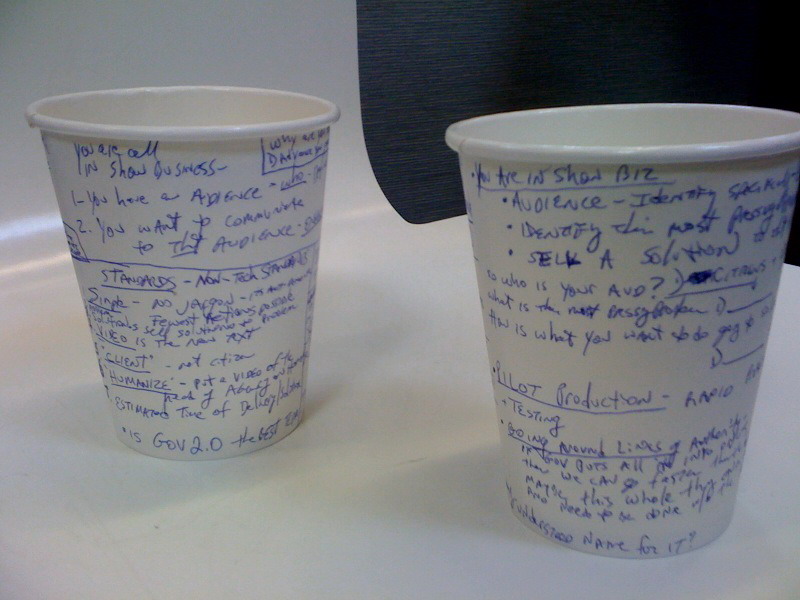
Grundfest sat through the morning’s sessions and took copious notes in a way that was novel, at least to this author, capturing the themes, memes and jargon shared in the talks on coffee cups.
As she captured there, the focus of Grundfest’s frequently entertaining talk was grounded in the entertainment business: communicate clearly, humanize what’s being offered and move away from jargon.
That message was delivered, by and large, to a room that knew and used the jargon. For that audience, getting advice from a true outsider held utility in both its clarity and lack of pretension. Grundfest may not have developed or managed government programs to deliver services but he has certainly learned how to tell stories.
Storytelling, as journalists and teachers know well, is one of the most powerful ways to share information. It’s an art form and human experience that goes back to our earliest days, as hunters and gatherers huddled around fires to share knowledge about the world, passing on the wisdom of generations.
The activity is scarcely limited to our species, as anyone who’s watched a honey bee shimmy and shake to pass on the details of a pollen gathering trip knows, but humanity’s language skills do tend to advance our ability to convey knowledge, along with the technologies we have at our disposal.
Grundfest recommended the use of video, testimonials and other narrative forms to provide an entrance point into the what, how, where and, especially, why of new government technologies or platforms for engagement.
Couched in humor, his audience responded with interest to the simplicity of the message. Embedded below is a video on the Gov2.o LA unconference from Govfresh that reflects that recommendation. (For others, visit YouTube.com/digiphile) By and large, I believe Grundfest’s message was delivered to a crowd of “goverati” for whom the message was valuable.
Instead of dwelling any further on what Government 2.0 might be or couching discussion or branding in jargon, explain what the technology or platform will do — and what problem it will solve. And at the end of the day, remember that on language, usage drives meaning.
What will the rest of 2010 hold for social media? I’m certain will see collaborative technologies be used to cover events and disasters on the real-time Web.
I’m also certain that three issues will dominate the space over the next year:
Identity, Privacy and Security.
Below is an interview where I talk about precisely these issues from Twtrcon:
As you’d imagine, there is no shortage of other opinion on what else the year will hold in social media. For other takes, try:
I suspect the Fortune 500 will go looking for talent to bring in-house, if early adopters aren’t available internally. There’s still a high ceiling — and need — for decent corporate blogs, authentic social media managers and innovative internal implementations of social computing platforms.
Aside from personnel, it’s fun to think about the bigger picture, too. Government is increasingly a big player in this space, as is Google. Social is going to be more mainstream and have more money flow into it than ever before, if marketing investment projections line up.
Here’s hoping that the snake oil is wrung out in the process. I suspect another casualty may be the word “social” itself, as I commented at length on Andy McAfee’s blog. Collaboration and results are in, hype and hysteria are out.
Protecting identity, security and trust will plague adoption of all of these platforms, whether they’re in the public or private space. If we’re giving away our data, social graphs, interactions and transactions, we’ll expect to retain our identities, credentials and privacy. Companies that abuse that relationship will experience viral backlash that beggars the ire we’ve seen to date.
What do you think? What are the trends in collaboration technology that will matter this year?
As Dybwad writes, this video shows the potential for Wave as a “video production medium,” like the “Pulp Wave Fiction” movie that Mashable shared elsewhere. And as Adam Ostrow tweeted, the folks over at Whirled Interactive are “super talented.”
As funny as these videos may be, I’m still looking for a personal use case for Google Wave. I’ve been dipping in and out of Wave for months as new people log on and explore. I expected the network effect of having more contacts there to result in some pick up. Enterprise 2.0 is not THAT big of a deal,as Andy McAfee says: what about Google Wave?
Creation and Management of “Living” Group Projects
Drag-and-Drop Photo Sharing
Creation of “Living” meeting notes
Interactive Gaming
The best way to learn about the software, however, is to read Gina Trapani and Adam Pash’s Complete Guide to Google Wave and to watch this (long) intro video from Google itself:
Lorraine Lawson wrote about Google Wave’s potential for enterprise integration over at IT Business Edge back in June and offered any number of potential use cases. (I have yet to hear about their transition into case studies.) Dion Hinchcliffe was bullish on the potential of the tool when he wrote about the enterprise implications of Google Wave at the end of May. He offered an excellent “first look” review there, for readers who want a more detailed breakdown of what Wave it and how it works.
More recently, Lifehacker included Google Wave on its 5 best collaboration tools, and collected an impressive breadth and variety of Google Wave use cases that range from family life to wedding planning, disaster relief to translation for research.
The bad
For me, combining a heterogenous suite of wikis, microblogging, email, IM and Skype has continued to be more useful than Wave. As a working environment, I’ve found it to be both noisy, as I watch other contribute, and often unstable. (I even gave it a try on my iPhone over wifi, an experience akin to pouring molasses down a snowdrift).
My colleague, Rachel Lebeaux, expressed much the same reaction when she wrote about Google Wave as an enterprise collaboration tool. (She found a CIO who is installing a Wave server in her comments; I hope to hear more on that.)
Since then, however, the reaction online has often been withering, due in part to the learning curve required of new users that don’t have the attention span to watch that video or read the manual. For good or ill, people expect to be able to figure out collaborative software without that time investment. The editor-in-chief of TechRepublic, Jason Hiner, put the software at the top of his “worst tech products of the year.” Tough year in review to make:
“After trying Google Wave when the product was released into the wild, my opinion hasn’t changed (and others such as Robert Scoble have come to the same conclusion). Google Wave is basically a super-chatty IM client, and a badly overhyped one at that. The only use I can see for this product is for geographically dispersed project teams collaborating and brainstorming on documents and product development ideas in real time.”
And as Shaun Dakin @replied tonight, “@RWW named it as one of the top 10 products failures of the year, I agree. Solution in search of problem.” To say that Jolie O’Dell was rough on Wave is an understatement:
“We have to hand it to Google’s publicity team; we don’t know one geek who wasn’t positively salivating for a Wave invite. The ReadWriteWeb back channel was a complete melee when the first invites were rolled out to team members. But once we got there and saw the new tech tricks, like watching one another type, we started thinking about use cases. And the more we struggled to understand and use this product, the more frustrated and bored we became. Blame it on the steep learning curve. Blame it on our misunderstanding the product. Mount whatever feeble defense you like, but techies know Wave was a flop.
The trouble-y
Even with all of that negativity, I still have trouble with dismissing Google Wave as a victim of hype. I’ve already read about some innovative use cases for those who can get through the UI challenges. And I’ve met CIOs and CTOs who are interested in what happens next, when Google’s engineers iterate to address user feedback.
Many media organizations are trying out Google Wave for news, as Leah Betancourt shared on Mashable and Lifehacker wrote about above. As she writes:
“Robert Quigley, social media editor at the Austin American-Statesman, has started two public waves so far” and
“Andrew Nystrom, senior producer of social media and emerging platforms at the Los Angeles Times, collaborated with social media reporter Mark Milian on the blog post “How Google Wave Could Transform Journalism” that ran on the newspaper’s web site a couple of months ago.”
Additionally, as Revolution Magazine reported, Welt Kompakt, a spinoff of the German daily Die Welt, is among the first newspapers around the world to integrate Google Wave into its coverage.
When I asked if any of my followers had found a use for Google Wave, Wayne Kurtzman @replied that “Google Wave is amazing if people use it as a collaboration tool; not just e-mail. Google does not make it easy to learn how & holds it back. I used Wave to collaborate on a voice over script for a video; elements SoundFX, vid, script, etc. Goog has no resources to teach others. Security, cultural (collab) and our size are challenges. Wave can be a game-changer.”
As quoted in Forbes, Tom Mornini, CTO and founder of Engine Yard, “pointed out recently (see: “The Real Meaning of Google Wave”), the major impact of Google Wave will ultimately come from its power as a development platform for serious, distributed applications.” If you’re wondering at how far Google Wave will get, consider whether enterprise software makers like SAP are taking it seriously as a platform. As Forbes described, SAP Research used of it in its Gravity demonstration prototype, combining SAP’s business process modeling (BPM) technology with Google Wave.
My colleague Kristen Caretta was balanced in assessing what Google Wave may mean for IT, offering that Gravity use case. Kristin also wrote that “Salesforce.com is working on a prototype extension to Google Wave that could help its customers provide customized, documented support in their own businesses.”
Attendees at the Enterprise 2.0 Conference in San Francisco this fall were presented with other Google Wave use cases by Google Wave product manager Gregory D’Alesandre, including Novell Pulse and ThoughtWorks. The collaboration tool is certainly part of Google’s plans for its enterprise customers. “Wave will be available as part of the Google Apps suite if you have Google Apps for your domain,” said D’Alesandre.
That might all imply that at least some techies do not, in fact, regard Wave as a flop. Google continues to add more to its development team with the recent acquisition of Etherpad, a Web-based collaboration app that may well be a boost to Google Wave.
As for this geek, caught somewhere in the intertices between journalism and techiedom, I’ll be on the lookout for more enterprise and media use cases. If you have one at hand, please share it in the comments.
Welt Kompakt, a spinoff of the German daily Die Welt, is among the first newspapers around the world to integrate Google Wave into its coverage, Revolution Magazine reported yesterday.
Early on Tuesday morning, I walked up Massachusetts Avenue to attend the FTC workshop on the future of journalism. Ten hours later, I emerged overstimulated by the volume of ideas presented, saddened again by the tens of thousands of journalists who have lost employment and energized by the quality of the conversations I’d had.
The event began with a video about the changing media world from Minnesota Public Media, embedded below. More about the “Future of News Summit, where it premiered, can be found at thefutureofnews.ning.com.
The FTC established a Twitter account for the conference, @FTCnews. You can see all of the participants’ tweets aggregated at #ftcnews.
Why convene the conference?
The very existence of the forum raised some eyebrows. How does the Federal Trade Commission factor into regulating journalism, after all? FTC Chairman Jon Leibowitz observed that:
..the ongoing revolution in the markets for news, then, warrants serious study for at least two reasons. First, markets for public goods such as news may work imperfectly. Competition policy is well-suited to evaluate these market imperfections.
Consumer protection policy is well-suited to help us understand the privacy and data security implications of the behavioral marketing used by media companies to increase ad revenues online. Second, and far more important, this is not just any market. The changes we are seeing in journalism will affect how we govern ourselves, not just the profits and losses of various news organizations.
The full remarks of FTC Chairman Jon Leibowitz on creative destruction and journalism in the Internet Age are available as a PDF. He was forthright in assessing that there was no reversing the Internet revolution. As he put it, “when Gutenberg printed the Bible, that was bad for those who illustrate by hand.” (Note: Jessica Clark argued that the FTC Should Consider Policy Reform to Support Public Media 2.0” over at PBS’s MediaShift blog.)
Leibowitz was followed by Paul Steiger of Propublica, an “independent, non-profit newsroom that produces investigative journalism in the public interest. “The answer is not to save newspapers,” said Steiger. “The goal should be to assure the continuation of journalism.” He called Amanda R. Michel an “Internet genius” for her coverage of the 2008 campaign at the Huffington Post. Steiger also cited Propublica’s investigative journalism on “hydraulic fracturing” in gas drilling as an example of the work the organization is doing.
Rick Edmondsof thePoynter Institute, author of the BizBlog there, presented results of 2009 State of the media study he co-authored. One of his final assessments was sobering: “Most surviving newspapers will be smaller, more expensive & targeted to older consumers.” As I replied to Andy Carvin , who wondered about the statement, given the debt loads that Edmonds cited, waiting for hyperwired Echo Boom to “age into” newspapers might be a tough strategy.
The News from News Corporation
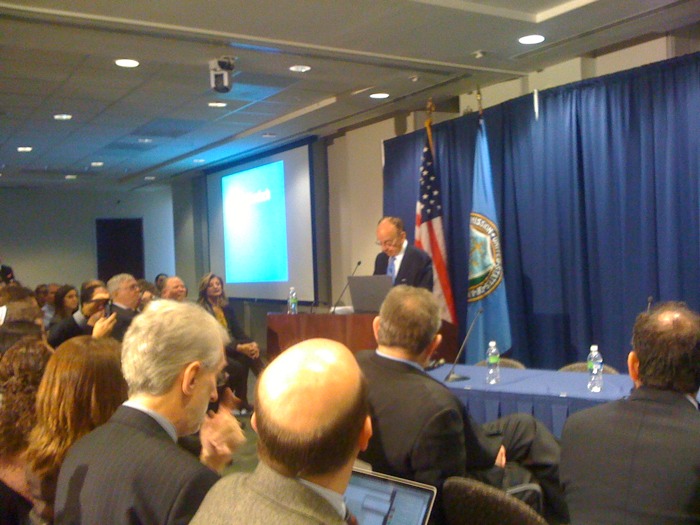
It’s a fair bet that the packed room in the morning was there in anticipation of remarks from Rupert Murdoch, founder, chairman and managing director of News Corporation, especially given that many of the media in attendance left to file stories once he was through.
Why? Murdoch may have held that “a diversity of views is essential to debate” but he was crystal clear: news organizations that don’t adapt should fail, “just like a restaurant that makes meals that no one wants to eat.”
Further, even as he argued that the feds should keep the U.S. press the most free in the world, the government should also “use its power to make sure the most innovative companies can reach customers,” a view that sounded to this writer’s ears rather like net neutrality.
He was also crystal clear in a conviction: “online ads can’t sustain good journalism.” Murdoch intends to extend the pay model of the WSJ and @BarronsOnline to the Times UK, perhaps as early as next January.
Murdoch also suggested that the FCC‘s cross-ownership rule that prevents single ownership of both TV and newspaper in local markets was “out-dated” in the Internet age, effectively suggesting that regulators both stay out of the news business and change the market conditions. He also observed that “for newspapers, spectrum could well prove an economic vehicle,” pointing to online convergence and the move to a readership increasingly consuming news through mobile computing devices.
What is the state of journalism?
Following Murdoch’s remarks, a state of journalism panel began with a focus on the financial health and accomplishments of newspapers and magazines. Martin Kaiser, senior vice president of the Milwaukee Journal Sentinel, spoke to journalism’s essential role: enforcing goverment accountability.
Bryan Monroe, a visiting professor at the Medill School of Journalism, brought attention to issues of diversity. His remarks were published at the Huffington Post as “Why New Media Looks A Whole Lot Like Old Media.”
This panel also raised the first – and as it turned out, only – question to the audience, in the form of a poll: How many of you know someone under 30 who reads a newspaper in print? To my eye, about 40% of those present raised their hands. It’s perhaps worth observing that very few people present were in that demographic.
One hopeful model for reporting by assignment that was cited by David Westphal, Executive in Residence, Annenberg School for Communication & Journalism, University of Southern California, hailed from my former neck of the woods at the New England Center for Investigative Reporting.
Mark Contreras, chairman of the Executive Committee of the Newspaper Association of America & senior VP, newspapers at the E.W. Scripps Co., ended the panel with an analogy to the music industry, suggesting that there are “poignant similarities” to news business. He favors ASCAP/BMI models for content protection and a B2B model for revenue generation. Given the music industry’s struggle to adapt to the Internet, that approach might merit more consideration.
Defending the aggregators
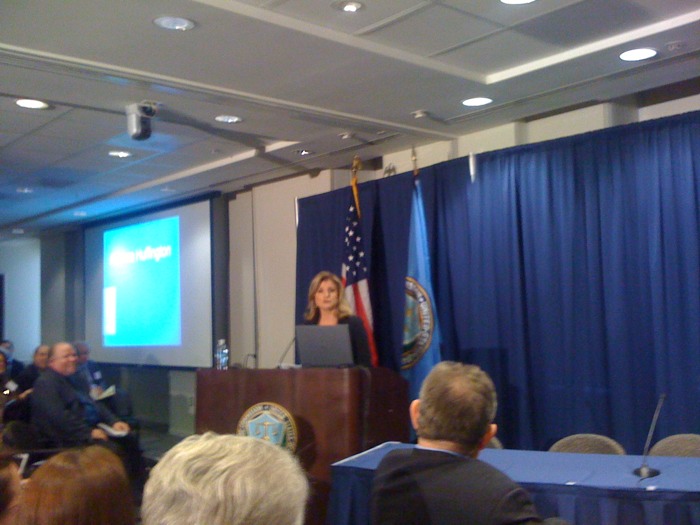
After the representatives of legacy media shared their perspectives, Arianna Huffington came to the defense of aggregators and new media, like her own enterprise, the Huffington Post.
As she dryly observed, citing a post by Mike Masnick at TechDirt, there’s some news aggregation by News Corp/IGN out there. All Things Digital, for instance, links and aggregates content, as does Rotten Tomatoes.
Huffington didn’t mince words in her denunciation, either:
It’s time for traditional media companies to stop whining and face the fact that far too many of them, lulled by a lack of competition and years of pretax profits of 20 percent or more, put cash flow above journalism and badly misread the web when it arrived on the scene. The focus was on consolidation, cost-cutting, and pleasing Wall Street — not modernization and pleasing their readers.
They were asleep at the wheel, missed the writing on the wall, let the train leave the station, let the ship sail — pick your metaphor — and quickly found themselves on the wrong side of the disruptive innovation the Internet and new media represent. And now they want to call timeout, ask for a do-over, start changing the rules, lobby the government to bail them out, and attack the new media for being… well, new. And different. And transformational. Suddenly it’s all about thievery and parasites and intestines.
Get real, you guys. The world has changed. Here are some facts culled from one of the most popular anthems to the impact of technology on our world:
(I talked with Huffington afterwards about her comments and the transition the industry is going through. She asked if I’d like to write about it – so I did, in “Is journalism going through a Reformation?“)
Where are the readers? Whither remedies? A Yahoo! News consortium? And how does Google News work?
After lunch, media analyst Ken Doctor shared his thoughts about “where the readers are.” You can read more from him at Contentbridges.com.
Leonard Downie presented findings on the reconstruction of journalism from the Columbia journalism report: Columbiajournalismreport.org
Lem Lloyd, vice president of channel sales at Yahoo!, shared details of the media company’s growing newspaper consortium. Lloyd said they’ve have sold 18,000 campaigns on Yahoo!, amounting to more than six billion impressions. Behavioral targeting sales represent some ninety percent of that total.
And Josh Cohen explaining how GoogleNews works with publishers. Cohen wrote about the FTC and the future of news at Google’s Public Policy blog. A extensive interview of Cohen on paywalls, publishers and partnerships by Danny Sullivan is also available at Search Engine Land.
Emerging models for journalism
The most dynamic panel of the day featured technologists, entrepreneurs and an bonafide bloggers like Josh Micah Marsall of Talkingpointsmemo.com and Danny Sullivan, who took a break from liveblogging to participate.
Sullivan, at that point, was frustrated with offline metaphors applied online. And Jeff Jarvis, media pundit and CUNY professor, asked the FTC to “stay off the lawn,” suggesting that premise of the event was about the survival of legacy players, not journalism itself.
In considering the prospect of not finding a viable models, Robert Thomson, managing editor of the Wall Street Journal, observed that “the cost to society of not being able to afford specialist journalism is going to be profound.”
Chris Ahern, of Reuters, and Danny Sullivan replied to Thomson that it’s not “an either/or proposition.” Hybrid models for news are worth trying.
And in a memorable exchange, Marshall observed that “there is more of an ethic online of linking to the story that got the reporter on the track and then adding commentary” than is practiced by traditional media, alluding to stories that the AP and others have run with without linking.
Media consumption trends, the economics of news and online advertising models
Ball State professor Mike Bloxham presented on media consumption based upon data that can be found at ResearchExcellence.com. He described a need for publisher to look cross-platform for media consumption in order to meaninfully gauge a “news footprint” that included print, TV, online and radio.
Susan Athey, a professor of economics at Harvard, presented on the economics of news, particular the trend toward “multi-homing” in consumption and the growth of online advertising. Her presentation addressed the salience of potential FTC regulation more directly than any other, aside from the chairman himself, predicting competition in online ad networks and between aggregators that would require oversight.
Law professor David Evans, following Athey, said that “the one thing I do worry about is mixing up market failure with nostalgia.” His paper on economics of the online advertising industry is available online.
The final panel of the day, addressed the important of behavioral advertising to future business models. Jeff Chester of Democraticmedia.org asserted that “the news media industry should embrace fair information principles.”
Conclusions?
As I look back over the day, it’s not clear to me yet what the FTC intends to do, other than listen. I look forward to returning to the FTC tomorrow to learn more.
The changes that smartphones with camera and an Internet connection are wreaking in society have been both thoughtfully reported upon, relentlessly evangelized and ruthlessly derided, depending upon the angle or intent of the commentator.
The past days will occupy a few lines in the history books. Last night, the U.S. House of Representatives passed a milestone healthcare bill. And earlier in the week, a soldier killed fellow servicemen and women at Fort Hood.
I agreed with him on a few things. The video from “This American Life” (below) that Carr embedded was deeply affecting on this point, in terms of what becoming an observer can do to our involvement in what we are filming.
Changing an avatar to green or changing a location to Tehran did not, despite good intentions, prove to substantively help students escape repression. I gather from reading accounts from journalists that the solidarity demonstrated by doing so was both noticed and appreciated there. And there was a tipping point in terms of the use of the platform to bring attention to a political cause.
Where I was left frustrated is in Carr’s suggestion that those who are watching should be doing something more, whether in the hospital or, in the case of Neda, on the streets of Tehran, instead of documenting events with the digital tools at hand.
I found the example of Neda to be unworthy of the point I think Carr was trying to make.
It also brushed off two key factors: the effect that the release of that video had in revealing the death of a protester and that of the bullet’s impact itself on her heart.
As Suw Charman-Anderson pointed out in her detailed critique and debunking of Carr’s post, “Killing Strawmen,” (which I won’t repeat here), there was a doctor on-site, who was unable to do anything because of the massive trauma to her chest.
In my limited experience, you provide the standard of care to which you are certified and are able to deliver, ceding primary responsibility to others more able as they arrive on scene. As an EMT couldn’t do much more, for instance, than to gauge consciousness, stanch bleeding, stabilize injuries, provide oxygen and transport people. Your choices must change if someone is in the wilderness but in most scenarios, that’s accurate. Paramedics, nurses, doctors and surgeons each have progressively more expertise and responsibility.
In all of that, communication with the nearest hospital and ER docs available is crucial. Transferring information to both medical professionals and law enforcement is something a bystander can and should do.
And to some extent, communication and documentation is precisely what a member of the public equipped with a cameraphone can contribute, despite the vigor with which Carr has chosen to deride that role.
I don’t doubt that seasoned correspondents, armed with an understanding of the ethics and laws that pertain to reporting, are needed to convey information from the battlefield or to analyze the meaning of the trends that confront us.
In fact, Brock Meeks, one such trusted newsman, made a comment on my post about Twitter lists that emphasized just how important getting the facts right is to both the audience and media.
I was left wondering about other situations where the “citizen journalists” Carr derides are providing an important function in the newsgathering ecosystem, whether in reporting national disasters, disease, voting irregularities or consumer sentiment.
A more calm approach might consider whether models of “hyperlocal” journalism that marry traditional media to online platforms might have a chance of success.
My intention is not to suggest that observers couldn’t play a useful role in a crisis. It was to say that when there are qualified staff on scene, documenting what is happening in the absence of mainstream journalists may be useful for those that follow – including news outlets that may use video or audio gleaned on site.
I agree with Paul that running images shouldn’t occur without a full understanding of the ethics or privacy rights involved.
Unfortunately, many tabloids have shown a poor grasp of either historically.
The fact that technology changes behavior doesn’t make it inherently bad. We’re all struggling to make sense of exactly what living in a modern panopticon created by one another will mean. It changes news, our conception of privacy, and even our perception of self.
The traits for good character and decency that the Greeks described millennia ago remain applicable, however, just as the ethics taught in journalism schools pertain to modern reporters armed with Flip cams, iPhones and a direct line to YouTube.
There will continue to be moments when war correspondents are confronted what choices about how covering conflict, versus participating in it, will mean.
Similarly, people driving by an accident will need to be thoughtful about “playing paparrazzi” as opposed to making sure that those involved are receiving the aid they need. Anyone who has a conflict about whether to “tweet or treat” might to do well to consider what basic human decency means to them, personally.
Does an event need to be documented? Or does calling 911 and then moving to help trump rendering assistance?
Citizens are looking for truth, honesty and facts, where ever we can find them. That need was frequently the subject of discussion during Public Media Camp, after which I wrote that “2009 is the year of We, the Media.”
Perhaps, as news organizations and citizens alike contribute to the body of knowledge online, a new model for collaborative journalism will emerge that serves each better.
I livestreamed the event through the digiphile channel at livestream.com. I couldn’t get the video from livestream to embed below correctly, so you’ll need to watch the session on demand at livestream.com. I wish I’d had a better mic and found a seat in the middle for a closer view. That said, the Social Media Club recorded a high quality version of the panel that will be available soon, so you won’t have to rely on my artifacted stream and low sound levels. Nota Bene: forward ahead to 6:30 or so, when the panel actually begins!
My insights for the night?
Challenges for the @Washingtonian include retaining a traditional editorial “voice” online and yet adding some irreverance and snark on social media platforms. Apparently, the editors want stories to be published in print first and then the Web second. That may be a tough balance to strike.
Social media “enables me to compete with NFL and ESPN,” said @Cindyboren of the @WashingtonPost. Twitter levels the playing field for her.
The toughest challenge for for @RickDunham? Time management, given the need to keep up with updating the Houston Chronicle’ digital outposts and the conversations . Community moderation is unending and necessary.
Rick also made a fascinating point about #journalism ethics and #socialmedia: keeping ideological balance with subscriptions to fan pages for politicians on Facebook is important in the digital age to maintain balance. Reporters need to follow everyone on their beat.
I asked a question about sourcing, as you’ll see if you watch the video. The panel provided good answers. Both @cindyboren and @rickdunham apply classic standards of #journalism to confirm the truth of statements, usually by calling people or “@’ing the source.” Pick up that phone!
Rick also made a fascinating observation: the Chronicle is realizing real adverstising revenue by livestreaming confirmation hearings and Congressional town halls to interested readers. Er, viewers. By carrying such news events on their websites, newspapers have become in effect independent Internet TV stations. Hello, convergence.
It may be an “online classic” (read: from 2006) but as a child of the 80s and a confirmed acappella geek, this live performance of classic Nintendo game themes by the University of Washington’s Redefined was too good not to share.
The Tetris choreography was particularly inspired. And when the bass did the little theme from the dungeon level in Mario Brothers, I instantly thought of Stockwell singing “you are in the dungeon. you are in the dungeon.”
Emerging technology has the power to make democracy stronger or weaker. Understanding where, when, and how is the hard part. Subscribe to Civic Texts to get insights about how technologies are changing our democracy in your inbox.



![Reblog this post [with Zemanta]](https://i0.wp.com/img.zemanta.com/reblog_e.png)


 digiphile
