The wrangling about whether Twitter is revolutionary, useful or mindless twaddle simply will not end. Given the continued interest in the microblogging platform in the media, that is perhaps to be expected.
Last month, David Carr wrote in the Sunday edition of the The New York Times that “Twitter will endure,” exploring how he’d initially dismissed the platform and then found it useful. In late January, The New Yorker‘s George Packer responded to Carr, deriding Twitter as “information hell” and comparing it to an addiction to crack in “Stop the world.” That brought a flood of attention from online media outlets, including Nick Bilton, lead writer for the excellent Bits blog at the Times, who wrote that “The Twitter train has left the station,” defending Twitter from the point of view of a journalist who has found utility amidst the stream. On Thursday, Mr. Packer offered a rebuttal, positioning himself as neither a “Luddite or a Biltonite.” Jeffrey Goldberg has now weighed in at the Atlantic, consigning Bilton and others who might share his conviction to the arena of “info freaks.”
Well and good. (At least Goldberg tweets.) Two disclaimers:
1) I am a long-time reader of George Packer’s excellent work in the New Yorker. I found “The Assassin’s Gate” to be one of the best books written about the early stages of the war in Iraq.
2) I’ve found considerable utility in Twitter since I joined in March of 2007.
I don’t expect either truth to be degraded by the spat between Bilton and Packer.
I was, however, surprised that Packer had chosen to criticize a platform that he hadn’t used. Few serious technology journalists, book reviewers, movie or restaurant critics would consider rendering judgment without personal experience. Such considerations don’t hold back millions of Twitter users, bloggers or, I believe, any number of television pundits, but since I admire Mr. Packer’s professionalism, that approach surprised me.
When he wrote “The Revolution Will Not Be Blogged” six years ago, my sense was that, despite his misgivings and evident frustration with pajama-clad pundits, he’d read some blogs, even if he doubted their utility as serious platforms for commentary or criticism. Given the maturation of blogs in the years since (including, I might note, at New Yorker.com), I wonder if revisiting that analysis might have been more useful, rather than dismissing Twitter without first dipping into the ebb and flow of news there.
In his second pass, Packer wrote that he had, in fact, “sought out a Tweeter,” without linking to or identifying that person. Well and good, but perhaps a weak strawman. As a commenter at Packer’s blog reflected, much of the content produced there is ambient noise, or digital “phatics” as Kevin Marks has rightly described them.
Twitter is profoundly social. That’s is why, despite the mindless hype surrounding the phrase, “social media” has had staying power in describing Twitter, Facebook or other platforms that allow two way conversations.
Twitter, like so many other things, is what you make of it. Some might go to a cocktail party and talk about fashion, who kissed whom, where the next hot bar is or any number of other superficial topics. Others might hone in on politics, news, technology, media, art, philosophy or any of the other subjects that the New Yorker covers. If you search and listen, it’s not hard to find others sharing news and opinion that’s relevant to your own interests.
Using intelligent filters for information, it’s quite easy to subscribe and digest them at leisure. And it’s as easy as unfollowing someone to winnow out “babble” or a steady stream of mundanity. The impression that one is forced to listen to pabulum, as if obligated to sit through a dreary dinner party or interminable plane ride next to a boring boor, is far from the reality of the actual experience of Twitter or elsewhere.
There’s also genuine utility there for the journalists who choose to experiment. When stories break, we can use it for real-time news and information. In the case of Haiti, Twitter was relevant, immediate and helpful, given that phones went down and the Internet stayed up. NPR was able to use Twitter and Skype to find sources on the ground. Disaster relief agencies were able to coordinate with one another. And in one notable instance, Doctors Without Borders was able to call attention using Twitter at @MSF_USA to the fact that its plane was getting turned away. Ann Curry heard them and helped to amplify the issue:
Packer and others are right to caution against hype and techno-worshipers. On balance, however, Packer errs in tarring much of the online community with a broad brush.
One passage in particular stands out: “There’s no way for readers to be online, surfing, e-mailing, posting, tweeting, reading tweets, and soon enough doing the thing that will come after Twitter, without paying a high price in available time, attention span, reading comprehension, and experience of the immediately surrounding world.” As Marc Ambinder tweeted earlier today, “I read many, many books in 2009. Including yours. And I Tweet.”
The same is true for me, and for many others. I read much of the New Yorker, the Economist and the Atlantic each month, along with numerous newspapers and technology blogs or trade publications online. (I write for one of the latter.) I also read on average 2-3 books every month, depending upon the rigor of travel, conferences or other factors. I also dip in and out Twitter throughout the week. That may not be an ideal information diet for everyone but for this tech journalist, it works. Even if I miss a story, it’s extremely rare that my network of friends and sources won’t find it and share it.
That’s why this “social news” phenomenon has become of keen interest to Google, as evidenced by the inclusion of social search into its results.
I share Packer’s concern about how the use of the Internet is changing literacy, critical thinking and creativity. Well and good, if not exactly novel. I look forward to more research on how and where those effects are found. I find hypotheses that place high consumption rates video games, television and movies is at the heart of poor information literacy instead of the wired world more convincing.
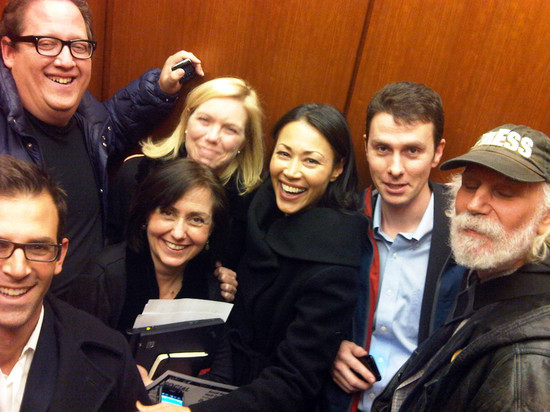
As for another comment regarding the tweets that flew about Ann Curry being stuck in the elevator, I share the amusement from the perspective of the man who sat next to that remarkable woman for ninety minutes. (So did the folks at Gawker, who wrote about the elevator incident at length.) Ann and I talked about Haiti, changes in media, religion, the utility of the iPad and yes, Twitter, all gloriously offline and in depth. I enjoy that memory; there’s a lovely montage of images up at GeoGeller.com, whose camera took the excellent shot below.
The fact that the world knew we were all stuck in that elevator was merely amusing, however, as opposed to a critical message that would best be conveyed to a 911 operator. We all found the intercom more useful than our smartphones, given the awful reception.
Sharing our experience with our networks of friends, however, was a natural extension of life in 2010. It certainly wasn’t breaking news but the act of communicating about it offered me, at least, an opportunity to interact with a broader audience of other humans around globe. That’s an unalloyed good.
I agree that “cheerleading uncritically” is not useful, nor a mentality that any writer should adopt. I do not share Packer’s conviction, however, that the news landscape can’t be occupied by more technological platforms, including reporters tapping away on BlackBerrys. One important example of that is Mark Knoller, the CBS White House correspondent whose tweets read like a they’ve been adapted from a history book already written.
If Mr. Packer would like to meet over coffee in DC to talk further about how life has changed in the age of Twitter, consider this an open invitation. Given my experience with his writing, I am certain that @GeorgePacker would be worth following.
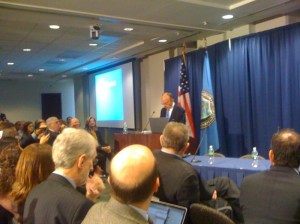
Secretary of State Hillary Clinton speaks on Internet Freedom at the Newseum
“We stand for a single internet where all of humanity has equal access to knowledge and ideas.” – Secretary Clinton.
Today, Secretary of State Hillary Clinton delivered a major speech on Internet Freedom to an audience of diplomats, politicians, journalists, tech executives and online activists in Washington, D.C.
The Wall Street Journal headline was clear this morning: “Internet access is the Clinton Doctrine.” As reported there, the U.S. has made unrestricted access to the Internet a top foreign-policy priority.
“This issue isn’t just about information freedom; it is about what kind of world we want and what kind of world we will inhabit,” said Clinton. “It’s about whether we live on a planet with one internet, one global community, and a common body of knowledge that benefits and unites us all, or a fragmented planet in which access to information and opportunity is dependent on where you live and the whims of censors.”
Secretary Clinton’s speech at the Newseum was streamed live at NetFreedom.state.gov. The discussion on Twitter was aggregated at the #netfreedom hashtag. Notably, many of the tweets showing up there are in Chinese.
“The spread of information networks is forming a new nervous system for our planet,” said Secretary Clinton. “When something happens in Haiti or Hunan, the rest of us learn about it in real time – from real people. And we can respond in real time as well. ”
“Now, in many respects, information has never been so free,” said Clinton. “There are more ways to spread more ideas to more people than at any moment in history. And even in authoritarian countries, information networks are helping people discover new facts and making governments more accountable.”
“On their own, new technologies do not take sides in the struggle for freedom and progress, but the United States does.We stand for a single internet where all of humanity has equal access to knowledge and ideas.And we recognize that the world’s information infrastructure will become what we and others make of it. Now, this challenge may be new, but our responsibility to help ensure the free exchange of ideas goes back to the birth of our republic.”
Where the Berlin Wall Crumbled, an “information wall” has emerged
“The Berlin Wall symbolized a world divided and it defined an entire era,” said Clinton. “Today, remnants of that wall sit inside this museum where they belong, and the new iconic infrastructure of our age is the internet. Instead of division, it stands for connection. But even as networks spread to nations around the globe, virtual walls are cropping up in place of visible walls.”
These walls are made of bits, not bricks.
“Some countries have erected electronic barriers that prevent their people from accessing portions of the world’s networks,” she said. “They’ve expunged words, names, and phrases from search engine results. They have violated the privacy of citizens who engage in non-violent political speech. These actions contravene the Universal Declaration on Human Rights, which tells us that all people have the right “to seek, receive and impart information and ideas through any media and regardless of frontiers.” With the spread of these restrictive practices, a new information curtain is descending across much of the world. And beyond this partition, viral videos and blog posts are becoming the samizdat of our day.”
Engaging in censorship could have new consequences.
“States, terrorists, and those who would act as their proxies must know that the United States will protect our networks,” said Secretary Clinton. “Those who disrupt the free flow of information in our society or any other pose a threat to our economy, our government, and our civil society. Countries or individuals that engage in cyber attacks should face consequences and international condemnation. In an internet-connected world, an attack on one nation’s networks can be an attack on all.”
“The final freedom, one that was probably inherent in what both President and Mrs. Roosevelt thought about and wrote about all those years ago, is one that flows from the four I’ve already mentioned: the freedom to connect – the idea that governments should not prevent people from connecting to the internet, to websites, or to each other. The freedom to connect is like the freedom of assembly, only in cyberspace. It allows individuals to get online, come together, and hopefully cooperate.”
Secretary Clinton also made it clear the the U.S. would support the development and distribution of tools to enable Internet freedom. Such moves might be analogous to distributing radio components and communications gear to partisans in World War II.
“We are also supporting the development of new tools that enable citizens to exercise their rights of free expression by circumventing politically motivated censorship,” she said. “We are providing funds to groups around the world to make sure that those tools get to the people who need them in local languages, and with the training they need to access the internet safely. The United States has been assisting in these efforts for some time, with a focus on implementing these programs as efficiently and effectively as possible. Both the American people and nations that censor the internet should understand that our government is committed to helping promote internet freedom.”
Clinton was clear regarding how access to information can be vital in preventing conflict:
“Information freedom supports the peace and security that provides a foundation for global progress. Historically, asymmetrical access to information is one of the leading causes of interstate conflict. When we face serious disputes or dangerous incidents, it’s critical that people on both sides of the problem have access to the same set of facts and opinions.”
She also referenced the Global Network Initiative, a distributed group of companies, civil society organizations, investors and academics dedicated to “protecting and advancing freedom of expression and privacy in information and communications technologies (ICT).” GNI has posted a reaction to Clinton’s remarks on Internet freedom.
Secretary Clinton took questions from the audience after her speech.
A man from Libya asked wehether help would be available to defend against hackers who silence online media. Secretary Clinton said that tools would be developed collaboratively and deferred specific discussion for the panel.
One attendee wondered how young people, wired in a way they have never been before, can be engaged. Don’t panic over the hyperconnection of young people, said Secretary Clinton.” Find a way to utilize it.”
She closed by focusing again on the response recent disaster in Haiti, where a woman was rescued after the earthquake after sending a text message. “These networks took a voice that was buried & spread it to the world,” said Clinton.
Google, China and beyond
The timing of the speech could not be more apt, given the state of affairs that exists after Google’s announcement regarding ending censorship of its search engine in China, China.cn.
Today’s speech on Internet freedom met with strong support from other federal agencies and electronic freedom advocates.
“Secretary Clinton’s inspiring remarks are a compelling argument for the power of Internet freedom to promote economic opportunity and the rights of all people,” said FCC Chairman Julius Genachowski.
“The FCC has a rich history of promoting open and competitive telecommunications markets at home and abroad. I look forward to working with our government partners and the private sector to advance free communications markets and networks worldwide.”
Chris Messina, open Web advocate (and now Googler) offers his perspective from the stage at the Newseum. Video of the interview is embedded below:
The Center for Democracy & Technology released the following statement in response to Secretary of State Clinton’s major policy address on Internet freedom:
“We applaud Secretary Clinton for placing global Internet freedom at the heart of 21st century diplomacy,” said CDT President Leslie Harris. “This is a critical moment in the evolution of the Internet. Authoritarian regimes are remaking the Internet into a tool of political control; meanwhile, democratic countries are struggling to manage old social ills in the new digital world,” Harris said. “The United States must take bold action to ensure that the global Internet remains a powerful force for democracy and human rights, Secretary Clinton’s speech is an historic first step toward that end.”
CDT Attorney Cynthia Wong added: “The free and open Internet is inexorably linked to the achievement of other major foreign policy goals, from protecting human rights to promoting democracy and economic empowerment. CDT looks forward to working with the State Department as it incorporates this new global Internet freedom objective into the fabric of American diplomacy worldwide.”
“Today’s speech exposes Hilary Clinton as a dyed in the wool cyberutopian… which is a good thing,” said Ethan Zuckerman, co-founder of Global Voices and research fellow at the Berkman Center, as quoted by the Index on Censorship. “Her description of the internet as a “new nervous system for the planet” reflects aspiration as much as reality and points to a thorough embrace of the potentials for this technology, even in the face of dangerous uses of the tools. I was gratified to see her root the idea of ‘freedom to connect,’ not just in American history and tradition, but in the Universal Declaration of Human Rights and to make clear that she saw the responsibility to protect these rights falling on international institutions, like the UN Human Rights Council.”
“I’d been somewhat concerned that her statement might propose a new slate of internet rights, which might have sparked debate about whether the US was trying to impose its norms of speech on a global network – making it clear that internet freedom is rooted in the UDHR as is not a novel set of rights was an excellent move on her part. The policy part of the speech didn’t have many surprises. There’s been support in different branches of the US government for years for censorship circumvention technologies, and the State Department had already announced their interest in online diplomacy. What was interesting was the idea that taking a stand against censorship should become part of the “American brand”. That, combined with the prominent mention of the Global Network Initiative, looked like a hearty endorsement of Google’s recent decision to change its China business practices, and a challenge to other US companies to reconsider how they engage with nations that censor the Internet.”
David Weinberger, Zuckerman’s colleague at the Berkman Center, offered his thoughts and reaction in the video below:
I was taken aback by how much Cold War rhetoric she managed to work into it. Multiple references to 1989, fall of the Berlin Wall, the rise of the Information Iron Curtain (as Fridmanesque a metaphor as it gets). It’s as if the last twenty years and globalization did not happen. The view of authoritarianism that she articulated in the speech smacked of a memo written by a bunch of confused Kremlinologists. I guess no sane American politician would ever acknowledge that information could be the opium of the masses, but acting as if today’s Russians, Iranians or Chinese are totally cut off from information/travel/globalization is kind of silly. The very thought that authoritarianism can survive in the age of information abundance scares the bejesus out of American policy-makers, so they simply prefer to skirt it. I doubt that such self-denial would pay off in the long run.
2. The problem with such an anachronistic view of authoritarianism – which supposedly relies on a very rigorous system of censorship – is that it doesn’t explain countries likes Russia or Egypt, where there is technically very little censorship per se (I bet that Russian has less Internet censorship than Australia or the United Kingdom). Unfortunately, I didn’t hear anything about the evolving nature of Internet control (e.g. that controlling the Internet now includes many other activities – propaganda, DDoS attacks, physical intimidation of selected critics/activists). If we keep framing this discussion only as a censorship issue, we are unlikely to solve it.
3. Clinton was too soft on China, essentially granting them the right to censor whatever they’d like simply because they have “different views”. I doubt that would go well with the Republicans and others who have chided the White House for being too soft on human rights. Her remarks about the need to incorporate Internet freedom into CSR for American companies working in authoritarian countries are valid , but I doubt it would help to solve the problem: local Chinese companies will simply fill in the gaps. Anti-censorship tools are not going to help either, because Chinese Internet companies delete content at its root (a point that Rebecca MacKinnon made during the panel).
4. Clinton’s remarks about the need to go after those who initiative cyber-attacks also puzzled me. She is probably unaware of the numerous campaigns launched by American hacktivists on the web-sites of the Iranian government. Will those be persecuted too? The US government really needs to develop and then adopt a more coherent view on the ethics of cyberwarfare; otherwise, the US State Dept will be accused of duplicity. We can’t be tolerating cyber-attacks in one context and criticizing them in another context (I wrote more about it here) [Read the rest of “cyber Cold War]
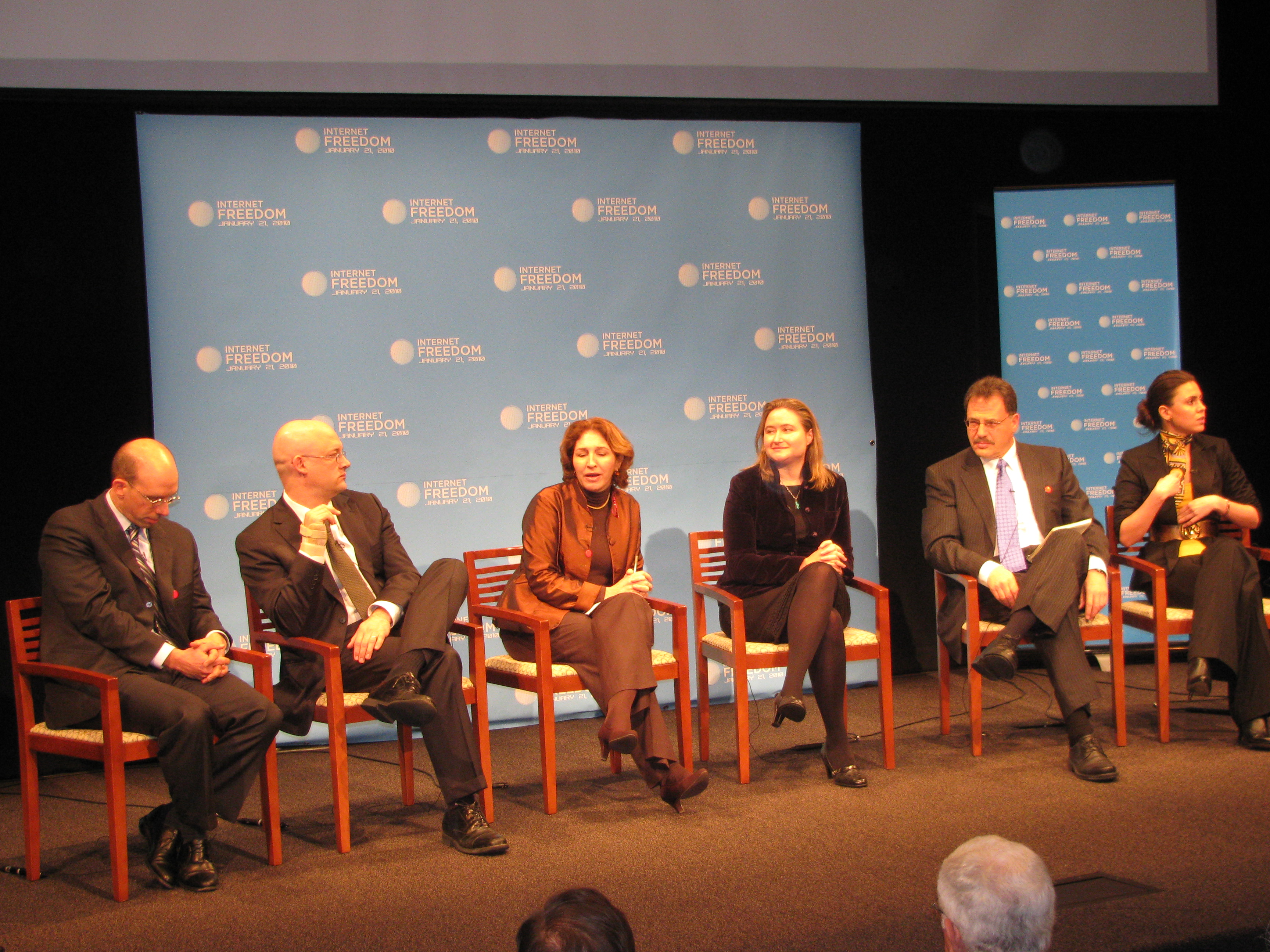
Panel parses the meaning of Internet freedom
Following Secretary Clinton’s speech, a panel of long-time analysts, activists and academics convened on stage.
Internet Freedom Panel at the Newseum
“No amount of tools will help people access information when it’s been deleted by the private sector,” said Rebecca MacKinnon, Open Society Fellow, and future Visiting Fellow at Princeton’s Center for Information Technology Policy. “10 years ago, only a small number of countriues censored the Internet. Now it’s more than 40.”
The panel was moderated by , Anne-Marie Slaughter, Director of Policy Planning at the State Department. Panelists included:
Shirky, speaking to the disruptive impact of online networks on societies, said that “We overestimate the value of access to information. We underestimate the value of access to each other.” In describing what happened in Iran and elsehwere, he observed that “it’s been dubbed the Twitter revolution, but it’s plainly the cellphone revolution.” Shirky has written extensively on the potential for online social networks to change authoritarian governments, including a recent essay, “the net advantage.”
“Damaging the open Internet is now starting to be seen like polluting rivers,” said Mackinnon, describing a shift in expectations for corporate responsibility online.
The panel also brought up FreeGate, free anti-censorship software for Internet access in China or beyond.
Mackinnon emphasized that development of tools needn’t be U.S.-centric. “It’s not about Westerners giving tools to the oppressed masses,” she said. “There are great programmers in Africa. They need support.”
There’s a crucial current example of precisely that kind of innovation outside of Western computer science labs: the Ushahidi platform was developed in Kenya & adapted for Haiti: Haiti.ushahidi.com
The final question for the panel came from the Internet: What is the U.S. responsibility regarding freedom of expression in Iran?
“Our responsibility is to stand up, engage governments openly in this discussion,” said Anne-Marie Slaughter.
[When video of the panel is available, look for a link]
Questions remain, with foreign policy, online freedoms and trillions in investments in the balance
Ultimately, it won’t be words alone that changes how Internet freedom is defined, upheld or enforced. It will be governments working in concert with NGOs, private companies and citizens. Doc Searls warned that we must be careful, lest the Internet become a “Cinternet.” MacKinnon looked last week at whether China’s demands for Internet ‘self-discipline’ are spreading to the West, in the form of censorship driven by copyright concerns and regulated through intermediary liability.
Clinton’s speech will matter most if it is translated into policy, just as Google’s bold blog post will be hold water when it stops censoring China.cn.
For now, the U.S. Secretary of State has made a major policy address on Internet freedom that will reverberate throughout the rest of the year. In a world that grows more interconnected by the second, such attention was needed.
Earlier tonight, there was a major earthquake in Haiti.
Reports of seismic activity trickled online about six hours ago and then grew into a torrent.
Since then, CNN, the New York Times, NPR, WSJ, LA Times and thousands of other outlets have covered the news of the aftermath of a major natural disaster in the poorest nation in Western Hemisphere.
Tragedy unfolding in real-time.
I saw the first report of the earthquake in Haiti on Twitter, through Deb Dobson, when she tweeted a report from @WXII:
“AP: A strong 7.0 earthquake has hit the impoverished country of Haiti where a hospital has collapsed.
When I clicked over, Google real-time search for “Haiti earthquake” had already begin rolling.
No geolocated tweets had begun to show up when I did a geolocated search within 50 miles of Haiti on Twitter
Sharp-eyed picked up on the reports and put it out on the new wire – the real-time Web. After the story broke, the @LATimesreported that there had been multipled aftershock reported for #Haiti, with the initial #earthquake‘s epicenter 10miles inland. Given that location a tsunami was unlikely.
I found that Andy Carvin was following the same electronic channels in real time. He created a NPR’s list of people tweeting from Haiti, adding sources as he discovered them from suggestions from his thousands of followers and his own geolocated searches. A story quickly went up at NPR.org that was updated with details as the story developed.
I heard CNN interview @Wyclef Jean soon afterwards. Wyclef was apparently on the phone with someone in Haiti when quake hit.
Not long after that,@CBSNews tweeted a statement from President Obama: “We are closely monitoring the situation and we stand ready to assist the people of Haiti.”
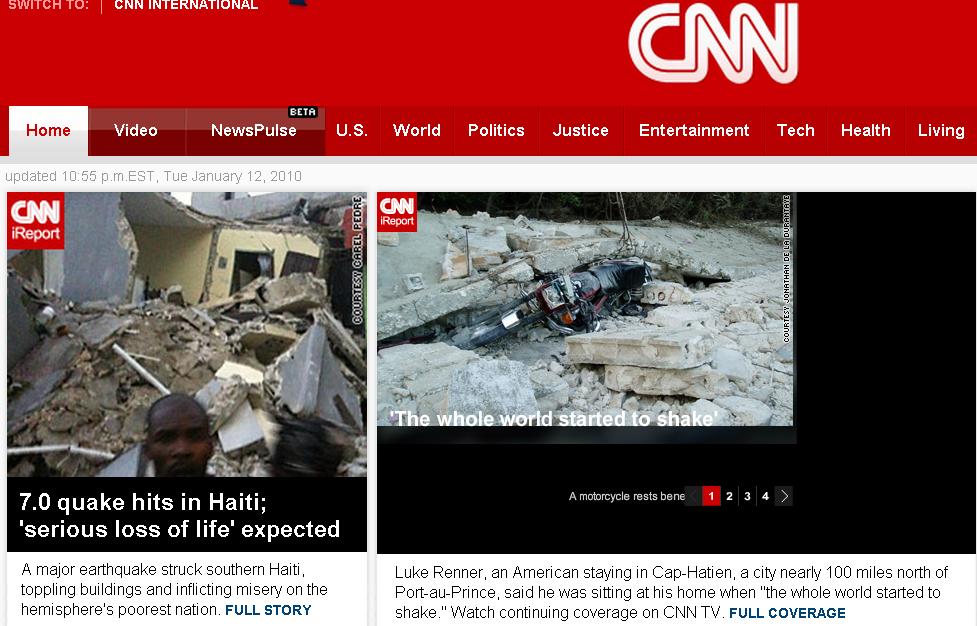
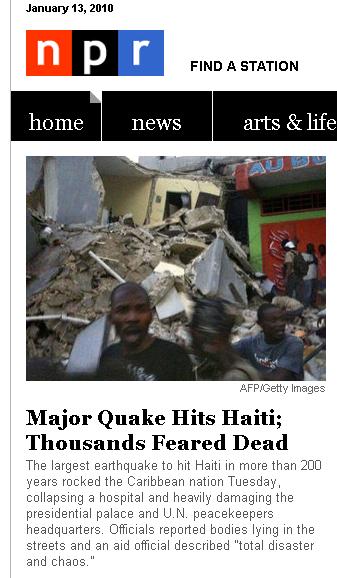
It’s this grainy pic, however, http://twitpic.com/xuthn, that’s on the front page of CNN.com, the LA Times and NPR.org. It’s on the image above.
It wasn’t long before more pictures of the disaster began to stream online. Marshall Kirkpatrick retweeted @RodrigoBNO, who tweeted “the first pictures from Haiti, now via Twitter: http://twitpic.com/photos/marvinady
@TroyLivesay, again geolocated in Haiti, tweeted that “Tipap made it from Carrefour – saw many dead & injured along the way – most buidings w/more than 1 story are down”
By that time, other media organization had made lists sources on Twitter that were near the disaster, including reporters and editors who were curating the stream.
Now, real-time will shift to real work, as disaster relief is surged to Haiti.
The extent of the damage will only become clear as more cameras and connectivity arrive in Haiti.
For now, the world has seen again how information can spread through the virtual reflectors of the online world. In 2010, fiber optic cables link media outlets in much the same way, connecting humans to one another in much the same way as axons connect neurons in a cybernetic brain.
Even in the worst of times, the current ability of humankind to detect harm and direct resources towards healing wounds to populations can be breathtaking. The digital tools available to nimble editors for informing the audience of what’s happening in real-time by curating online media are unprecedented. And the ways that individuals can directly reach out to help those afflicted are powerful.
“Funds are urgently needed to provide safe water, temporary shelter systems, essential medical supplies etc. . . . Haiti is the poorest country in the western hemisphere and has a population of 9.6 million inhabitants, of which more than half are under 21 years old.”
• Mercy Corps is deploying an emergency team, and is asking for donations. You can follow their work on the Mercy Corps blog, and on Twitter at @mercycorps.
• According to their Twitter feed, Oxfam America is already on the ground in Haiti and is asking for donations. You can follow them on the Oxfam America blog and on Twitter at @oxfamamerica
The next twenty four hours will be crucial. As Marc Ambinder tweeted, “from what I can gather, Obama is still up and working on response to the Haiti earthquake.the President was still up at 1 AM. Virtually everything I hear from folks in the know begins with “bad, bad, bad.” A catastrophe upon a catastrophe.”
Here’s hoping the digital tools that communicated the news can be used to help those in dire need.
UPDATE: Chris @Sacca has shared 6 ways that you can help in Haiti. His post and further annotations for each link are worth reading.
1) Text “HAITI” to “90999” to donate $10 to the Red Cross
2) Text “Yele” to 501501 to donate $5 to Yele Haiti
UPDATE II:Brock Meeks posted the following video of the earthquake from YouTube.
UPDATE III Raw footage from after the earthquake ended. Warning: graphic images of death, destruction and grief.
UPDATE IVJournalism professor Dan Kennedy wrote thoughtfully about citizen media and the earthquake in Haiti. As he writes there, Global Voices has a posted “a compilation of tweets and photos and a digest of what bloggers in Haiti and throughout the Caribbean are saying.”
UPDATE V: By the end of Wednesday, the New York Times had also assembled a number of useful list of Twitter accounts related to the earthquake in Haiti:
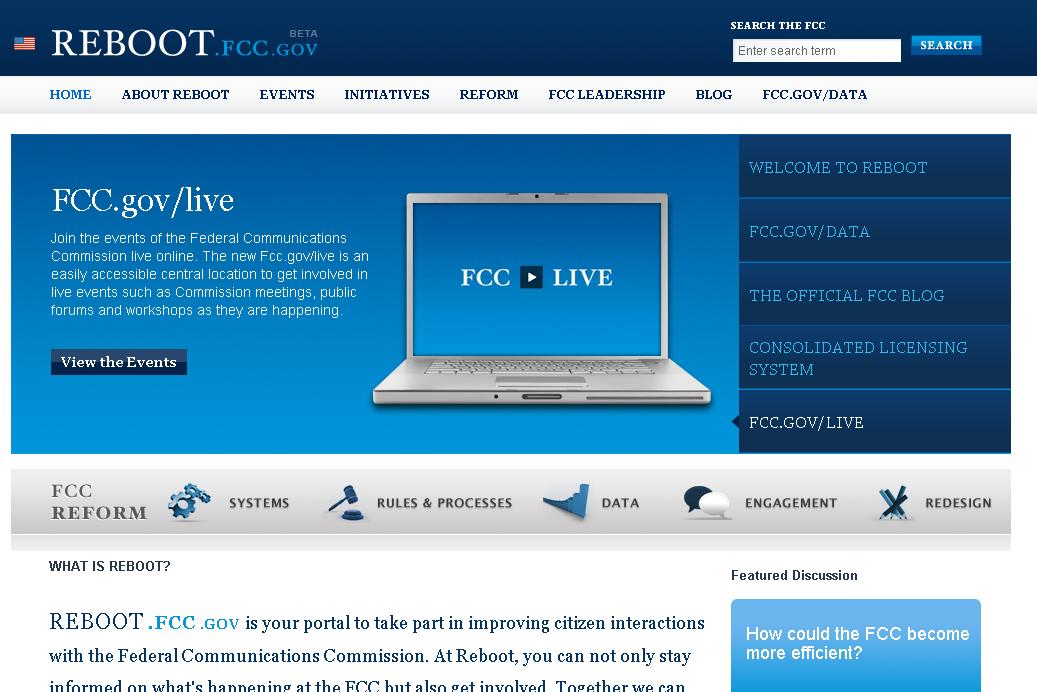
The Federal Communications Commission has announced a new subdomain to FCC.gov today, Reboot.fcc.gov. “Reboot.gov” is being touted by as the first such website to solicit citizen interaction with the FCC, and follows the launch of broadband.gov and openinternet.gov last year. All three websites are notable for their clean design and integration of new media, like blogs, Twitter or videos from YouTube. The chairman’s introduction is embedded below:
One of the stated aims of Reboot.gov is to gather feedback on how FCC.gov itself can be redesigned, a project that’s long overdue. The announcement of the new site, for instance, showed up in email but was not been posted in plaintext on FCC.gov. Like other releases, it showed up as a Word doc and PDF, although today it showed up more quickly than usual, which is to say on the same day the news was announced.
In fact, the FCC has picked up the pace of its communications of late, as anyone who has followed @FCC on Twitter knows, even if it’s not quite up to “Internet speed” just yet.
Design and social media use aside, open government geeks and advocates are likely to be the most excited about the launch of FCC.gov/data, “an online clearinghouse for the Commission’s public data.”
The FCC has already posted search tools for its documents. Users can sort data by type or by bureau. In a move certain to excite Clay Johnson of the Sunlight Foundation and other data geeks, the FCC is posting XML feeds. And, indeed. Clay tweeted the following earlier today: “Well FCC Data Lovers? Get to it: http://rebootfcc.uservoice.com/pages/37109,” linking to a page on Reboot.gov that asks “What data sets would you like to see the FCC publish on FCC.gov/data?”
If the use of open data from the FCC takes off, this could be a significant movement in open government.
Under the Media Bureau, for instance, visitors can explore DTV Station Coverage Maps, a key issue to many given the recent transition to digital TV. The data there is already a bit dated (and released in PDFs) but I can see some potential down the line here. For instance, my parents don’t get good public DTV reception near Baltimore at the moment. If I can get Dad to report that at Reboot.gov, perhaps that might change.
That kind of interaction is precisely where the potential for these sites can be best realized. So-called “Web 1.0” tools like websites, email and SMS used to share information about the quality of services and then “Web 2.0” services like blog comments and social media deployed to gathering feedback from citizens about the delivery of said services.
The press release follows below:
Today, the Federal Communications Commission launched Reboot.FCC.gov, the first-ever Web site dedicated to soliciting public input on ways to improve citizen interaction with the FCC. The launch also includes the first official FCC blog, which will feature posts from FCC employees and each of the five Commission members.
“Transforming the Commission into a model of excellence in government is one of my top priorities,” said Chairman Julius Genachowski. “The success of this transformation depends on strong public participation throughout the process. With the launch of Reboot.FCC.gov, our goal is to get input from all corners of the country on ways to improve usability, accessibility, and transparency across the agency.”
To advance the FCC reform agenda, Chairman Julius Genachowski appointed a team of senior leadership within the agency dedicated to identifying the most needed and important areas for improvement. Reboot.FCC.gov highlights five key elements of FCC reform for public discussion and feedback:
Redesign of FCC.gov: As part of a long-overdue redesign of the FCC.gov Web site, the FCC is asking for ideas on how best to streamline and improve the experience for all site visitors.
Data: Because data underlies all agency proceedings, the FCC is launching FCC.gov/data, an online clearinghouse for the Commission’s public data, and looking for additional ways increase openness, transparency, efficiency and public oversight.
Engagement: The FCC is reevaluating how citizens engage in government and exploring new ways to increase public participation through the use of new media tools, e-rulemaking, and expanding our audiences.
Systems: The FCC is overhauling and reforming the systems available at FCC.gov — from the Electronic Comment Filing System to creating a Consolidated Licensing System — and wants feedback on ways to make them easier to navigate and more useful.
Rules and Processes: The FCC aims to modernize and grow the efficiency of agency proceedings, and seeks input on ways to improve the quality of agency decision-making, reduce backlogs, and enhance the public’s ability to understand and participate in Commission proceedings.
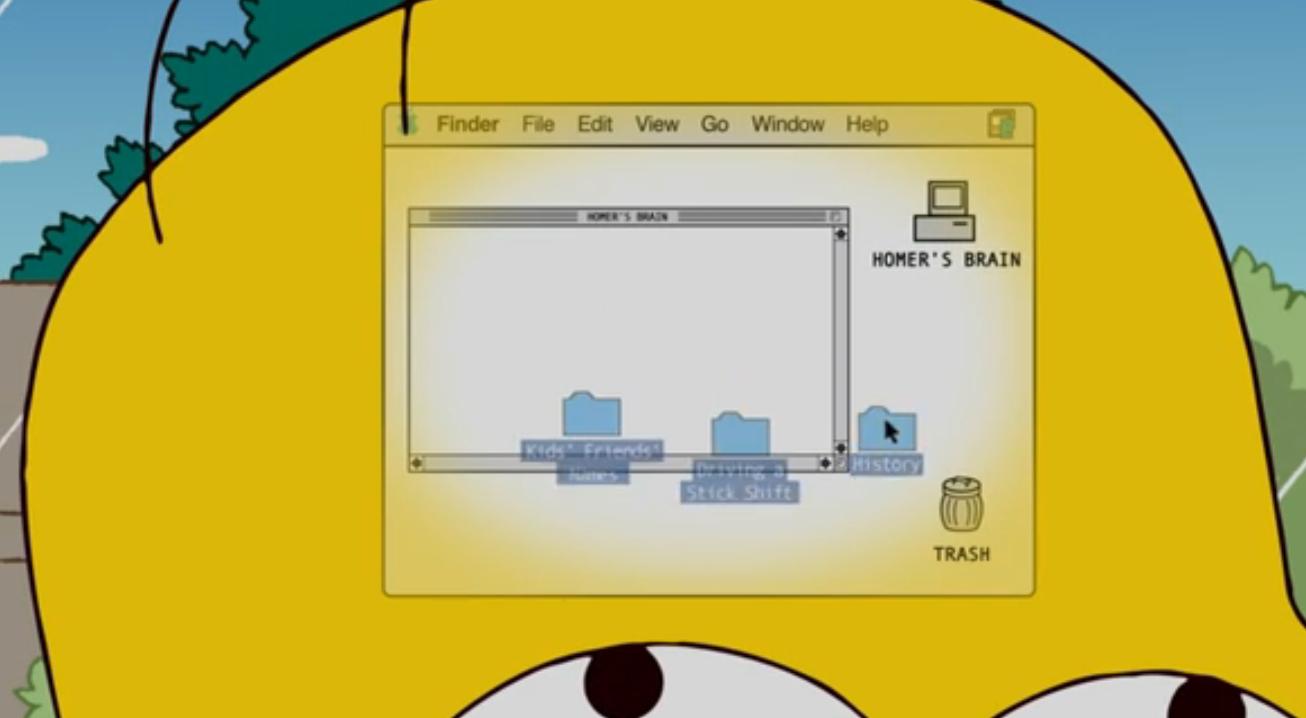
If I’m right, my geeky friends will analyze the screenshot and confirm that my guess that Homer is running Macintosh System 6 is correct.
The writers of the Simpsons may have altered some icons to avoid a notice from the litigious legal department at Apple but to this geek’s eyes, that looks like a Mac, circa late-80s.
If you look at the screen shot of System 6 below, via Wikipedia, you’ll see that there’s no “Finder,” just the Apple symbol on the top left.
The OS above, however, is more similar to System 6 than the more rounded icons in the GUI that Apple introduced in System 7, along with a host of other improvements.
Given that the Simpsons debuted in 1989, System 6 would have been the OS in use at the time.
It wouldn’t surprise me at all, given the glorious geekiness of those writers, if Homer’s brain hadn’t been upgraded since.
“Thursdays With Abe” is free to watch online now, for as long as Hulu makes it available.
As Dybwad writes, this video shows the potential for Wave as a “video production medium,” like the “Pulp Wave Fiction” movie that Mashable shared elsewhere. And as Adam Ostrow tweeted, the folks over at Whirled Interactive are “super talented.”
As funny as these videos may be, I’m still looking for a personal use case for Google Wave. I’ve been dipping in and out of Wave for months as new people log on and explore. I expected the network effect of having more contacts there to result in some pick up. Enterprise 2.0 is not THAT big of a deal,as Andy McAfee says: what about Google Wave?
Creation and Management of “Living” Group Projects
Drag-and-Drop Photo Sharing
Creation of “Living” meeting notes
Interactive Gaming
The best way to learn about the software, however, is to read Gina Trapani and Adam Pash’s Complete Guide to Google Wave and to watch this (long) intro video from Google itself:
Lorraine Lawson wrote about Google Wave’s potential for enterprise integration over at IT Business Edge back in June and offered any number of potential use cases. (I have yet to hear about their transition into case studies.) Dion Hinchcliffe was bullish on the potential of the tool when he wrote about the enterprise implications of Google Wave at the end of May. He offered an excellent “first look” review there, for readers who want a more detailed breakdown of what Wave it and how it works.
More recently, Lifehacker included Google Wave on its 5 best collaboration tools, and collected an impressive breadth and variety of Google Wave use cases that range from family life to wedding planning, disaster relief to translation for research.
The bad
For me, combining a heterogenous suite of wikis, microblogging, email, IM and Skype has continued to be more useful than Wave. As a working environment, I’ve found it to be both noisy, as I watch other contribute, and often unstable. (I even gave it a try on my iPhone over wifi, an experience akin to pouring molasses down a snowdrift).
My colleague, Rachel Lebeaux, expressed much the same reaction when she wrote about Google Wave as an enterprise collaboration tool. (She found a CIO who is installing a Wave server in her comments; I hope to hear more on that.)
Since then, however, the reaction online has often been withering, due in part to the learning curve required of new users that don’t have the attention span to watch that video or read the manual. For good or ill, people expect to be able to figure out collaborative software without that time investment. The editor-in-chief of TechRepublic, Jason Hiner, put the software at the top of his “worst tech products of the year.” Tough year in review to make:
“After trying Google Wave when the product was released into the wild, my opinion hasn’t changed (and others such as Robert Scoble have come to the same conclusion). Google Wave is basically a super-chatty IM client, and a badly overhyped one at that. The only use I can see for this product is for geographically dispersed project teams collaborating and brainstorming on documents and product development ideas in real time.”
And as Shaun Dakin @replied tonight, “@RWW named it as one of the top 10 products failures of the year, I agree. Solution in search of problem.” To say that Jolie O’Dell was rough on Wave is an understatement:
“We have to hand it to Google’s publicity team; we don’t know one geek who wasn’t positively salivating for a Wave invite. The ReadWriteWeb back channel was a complete melee when the first invites were rolled out to team members. But once we got there and saw the new tech tricks, like watching one another type, we started thinking about use cases. And the more we struggled to understand and use this product, the more frustrated and bored we became. Blame it on the steep learning curve. Blame it on our misunderstanding the product. Mount whatever feeble defense you like, but techies know Wave was a flop.
The trouble-y
Even with all of that negativity, I still have trouble with dismissing Google Wave as a victim of hype. I’ve already read about some innovative use cases for those who can get through the UI challenges. And I’ve met CIOs and CTOs who are interested in what happens next, when Google’s engineers iterate to address user feedback.
Many media organizations are trying out Google Wave for news, as Leah Betancourt shared on Mashable and Lifehacker wrote about above. As she writes:
“Robert Quigley, social media editor at the Austin American-Statesman, has started two public waves so far” and
“Andrew Nystrom, senior producer of social media and emerging platforms at the Los Angeles Times, collaborated with social media reporter Mark Milian on the blog post “How Google Wave Could Transform Journalism” that ran on the newspaper’s web site a couple of months ago.”
Additionally, as Revolution Magazine reported, Welt Kompakt, a spinoff of the German daily Die Welt, is among the first newspapers around the world to integrate Google Wave into its coverage.
When I asked if any of my followers had found a use for Google Wave, Wayne Kurtzman @replied that “Google Wave is amazing if people use it as a collaboration tool; not just e-mail. Google does not make it easy to learn how & holds it back. I used Wave to collaborate on a voice over script for a video; elements SoundFX, vid, script, etc. Goog has no resources to teach others. Security, cultural (collab) and our size are challenges. Wave can be a game-changer.”
As quoted in Forbes, Tom Mornini, CTO and founder of Engine Yard, “pointed out recently (see: “The Real Meaning of Google Wave”), the major impact of Google Wave will ultimately come from its power as a development platform for serious, distributed applications.” If you’re wondering at how far Google Wave will get, consider whether enterprise software makers like SAP are taking it seriously as a platform. As Forbes described, SAP Research used of it in its Gravity demonstration prototype, combining SAP’s business process modeling (BPM) technology with Google Wave.
My colleague Kristen Caretta was balanced in assessing what Google Wave may mean for IT, offering that Gravity use case. Kristin also wrote that “Salesforce.com is working on a prototype extension to Google Wave that could help its customers provide customized, documented support in their own businesses.”
Attendees at the Enterprise 2.0 Conference in San Francisco this fall were presented with other Google Wave use cases by Google Wave product manager Gregory D’Alesandre, including Novell Pulse and ThoughtWorks. The collaboration tool is certainly part of Google’s plans for its enterprise customers. “Wave will be available as part of the Google Apps suite if you have Google Apps for your domain,” said D’Alesandre.
That might all imply that at least some techies do not, in fact, regard Wave as a flop. Google continues to add more to its development team with the recent acquisition of Etherpad, a Web-based collaboration app that may well be a boost to Google Wave.
As for this geek, caught somewhere in the intertices between journalism and techiedom, I’ll be on the lookout for more enterprise and media use cases. If you have one at hand, please share it in the comments.
Welt Kompakt, a spinoff of the German daily Die Welt, is among the first newspapers around the world to integrate Google Wave into its coverage, Revolution Magazine reported yesterday.
Early on Tuesday morning, I walked up Massachusetts Avenue to attend the FTC workshop on the future of journalism. Ten hours later, I emerged overstimulated by the volume of ideas presented, saddened again by the tens of thousands of journalists who have lost employment and energized by the quality of the conversations I’d had.
The event began with a video about the changing media world from Minnesota Public Media, embedded below. More about the “Future of News Summit, where it premiered, can be found at thefutureofnews.ning.com.
The FTC established a Twitter account for the conference, @FTCnews. You can see all of the participants’ tweets aggregated at #ftcnews.
Why convene the conference?
The very existence of the forum raised some eyebrows. How does the Federal Trade Commission factor into regulating journalism, after all? FTC Chairman Jon Leibowitz observed that:
..the ongoing revolution in the markets for news, then, warrants serious study for at least two reasons. First, markets for public goods such as news may work imperfectly. Competition policy is well-suited to evaluate these market imperfections.
Consumer protection policy is well-suited to help us understand the privacy and data security implications of the behavioral marketing used by media companies to increase ad revenues online. Second, and far more important, this is not just any market. The changes we are seeing in journalism will affect how we govern ourselves, not just the profits and losses of various news organizations.
The full remarks of FTC Chairman Jon Leibowitz on creative destruction and journalism in the Internet Age are available as a PDF. He was forthright in assessing that there was no reversing the Internet revolution. As he put it, “when Gutenberg printed the Bible, that was bad for those who illustrate by hand.” (Note: Jessica Clark argued that the FTC Should Consider Policy Reform to Support Public Media 2.0” over at PBS’s MediaShift blog.)
Leibowitz was followed by Paul Steiger of Propublica, an “independent, non-profit newsroom that produces investigative journalism in the public interest. “The answer is not to save newspapers,” said Steiger. “The goal should be to assure the continuation of journalism.” He called Amanda R. Michel an “Internet genius” for her coverage of the 2008 campaign at the Huffington Post. Steiger also cited Propublica’s investigative journalism on “hydraulic fracturing” in gas drilling as an example of the work the organization is doing.
Rick Edmondsof thePoynter Institute, author of the BizBlog there, presented results of 2009 State of the media study he co-authored. One of his final assessments was sobering: “Most surviving newspapers will be smaller, more expensive & targeted to older consumers.” As I replied to Andy Carvin , who wondered about the statement, given the debt loads that Edmonds cited, waiting for hyperwired Echo Boom to “age into” newspapers might be a tough strategy.
The News from News Corporation
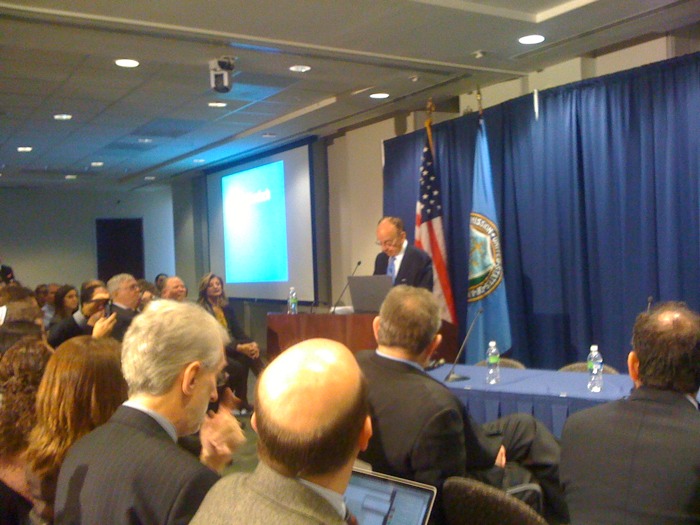
It’s a fair bet that the packed room in the morning was there in anticipation of remarks from Rupert Murdoch, founder, chairman and managing director of News Corporation, especially given that many of the media in attendance left to file stories once he was through.
Why? Murdoch may have held that “a diversity of views is essential to debate” but he was crystal clear: news organizations that don’t adapt should fail, “just like a restaurant that makes meals that no one wants to eat.”
Further, even as he argued that the feds should keep the U.S. press the most free in the world, the government should also “use its power to make sure the most innovative companies can reach customers,” a view that sounded to this writer’s ears rather like net neutrality.
He was also crystal clear in a conviction: “online ads can’t sustain good journalism.” Murdoch intends to extend the pay model of the WSJ and @BarronsOnline to the Times UK, perhaps as early as next January.
Murdoch also suggested that the FCC‘s cross-ownership rule that prevents single ownership of both TV and newspaper in local markets was “out-dated” in the Internet age, effectively suggesting that regulators both stay out of the news business and change the market conditions. He also observed that “for newspapers, spectrum could well prove an economic vehicle,” pointing to online convergence and the move to a readership increasingly consuming news through mobile computing devices.
What is the state of journalism?
Following Murdoch’s remarks, a state of journalism panel began with a focus on the financial health and accomplishments of newspapers and magazines. Martin Kaiser, senior vice president of the Milwaukee Journal Sentinel, spoke to journalism’s essential role: enforcing goverment accountability.
Bryan Monroe, a visiting professor at the Medill School of Journalism, brought attention to issues of diversity. His remarks were published at the Huffington Post as “Why New Media Looks A Whole Lot Like Old Media.”
This panel also raised the first – and as it turned out, only – question to the audience, in the form of a poll: How many of you know someone under 30 who reads a newspaper in print? To my eye, about 40% of those present raised their hands. It’s perhaps worth observing that very few people present were in that demographic.
One hopeful model for reporting by assignment that was cited by David Westphal, Executive in Residence, Annenberg School for Communication & Journalism, University of Southern California, hailed from my former neck of the woods at the New England Center for Investigative Reporting.
Mark Contreras, chairman of the Executive Committee of the Newspaper Association of America & senior VP, newspapers at the E.W. Scripps Co., ended the panel with an analogy to the music industry, suggesting that there are “poignant similarities” to news business. He favors ASCAP/BMI models for content protection and a B2B model for revenue generation. Given the music industry’s struggle to adapt to the Internet, that approach might merit more consideration.
Defending the aggregators
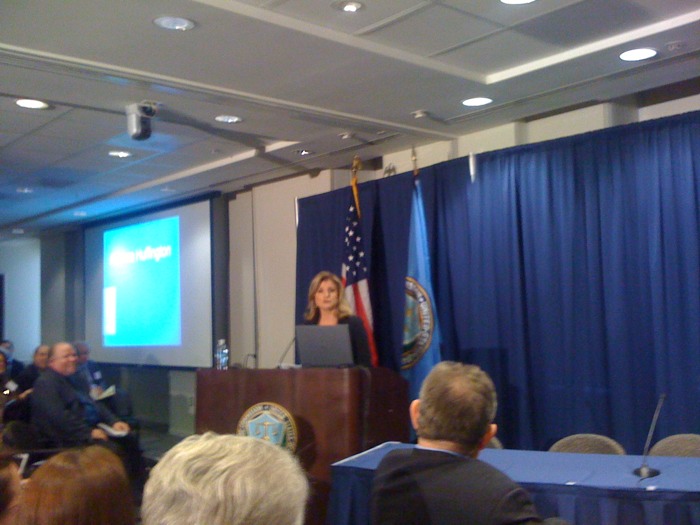
After the representatives of legacy media shared their perspectives, Arianna Huffington came to the defense of aggregators and new media, like her own enterprise, the Huffington Post.
As she dryly observed, citing a post by Mike Masnick at TechDirt, there’s some news aggregation by News Corp/IGN out there. All Things Digital, for instance, links and aggregates content, as does Rotten Tomatoes.
Huffington didn’t mince words in her denunciation, either:
It’s time for traditional media companies to stop whining and face the fact that far too many of them, lulled by a lack of competition and years of pretax profits of 20 percent or more, put cash flow above journalism and badly misread the web when it arrived on the scene. The focus was on consolidation, cost-cutting, and pleasing Wall Street — not modernization and pleasing their readers.
They were asleep at the wheel, missed the writing on the wall, let the train leave the station, let the ship sail — pick your metaphor — and quickly found themselves on the wrong side of the disruptive innovation the Internet and new media represent. And now they want to call timeout, ask for a do-over, start changing the rules, lobby the government to bail them out, and attack the new media for being… well, new. And different. And transformational. Suddenly it’s all about thievery and parasites and intestines.
Get real, you guys. The world has changed. Here are some facts culled from one of the most popular anthems to the impact of technology on our world:
(I talked with Huffington afterwards about her comments and the transition the industry is going through. She asked if I’d like to write about it – so I did, in “Is journalism going through a Reformation?“)
Where are the readers? Whither remedies? A Yahoo! News consortium? And how does Google News work?
After lunch, media analyst Ken Doctor shared his thoughts about “where the readers are.” You can read more from him at Contentbridges.com.
Leonard Downie presented findings on the reconstruction of journalism from the Columbia journalism report: Columbiajournalismreport.org
Lem Lloyd, vice president of channel sales at Yahoo!, shared details of the media company’s growing newspaper consortium. Lloyd said they’ve have sold 18,000 campaigns on Yahoo!, amounting to more than six billion impressions. Behavioral targeting sales represent some ninety percent of that total.
And Josh Cohen explaining how GoogleNews works with publishers. Cohen wrote about the FTC and the future of news at Google’s Public Policy blog. A extensive interview of Cohen on paywalls, publishers and partnerships by Danny Sullivan is also available at Search Engine Land.
Emerging models for journalism
The most dynamic panel of the day featured technologists, entrepreneurs and an bonafide bloggers like Josh Micah Marsall of Talkingpointsmemo.com and Danny Sullivan, who took a break from liveblogging to participate.
Sullivan, at that point, was frustrated with offline metaphors applied online. And Jeff Jarvis, media pundit and CUNY professor, asked the FTC to “stay off the lawn,” suggesting that premise of the event was about the survival of legacy players, not journalism itself.
In considering the prospect of not finding a viable models, Robert Thomson, managing editor of the Wall Street Journal, observed that “the cost to society of not being able to afford specialist journalism is going to be profound.”
Chris Ahern, of Reuters, and Danny Sullivan replied to Thomson that it’s not “an either/or proposition.” Hybrid models for news are worth trying.
And in a memorable exchange, Marshall observed that “there is more of an ethic online of linking to the story that got the reporter on the track and then adding commentary” than is practiced by traditional media, alluding to stories that the AP and others have run with without linking.
Media consumption trends, the economics of news and online advertising models
Ball State professor Mike Bloxham presented on media consumption based upon data that can be found at ResearchExcellence.com. He described a need for publisher to look cross-platform for media consumption in order to meaninfully gauge a “news footprint” that included print, TV, online and radio.
Susan Athey, a professor of economics at Harvard, presented on the economics of news, particular the trend toward “multi-homing” in consumption and the growth of online advertising. Her presentation addressed the salience of potential FTC regulation more directly than any other, aside from the chairman himself, predicting competition in online ad networks and between aggregators that would require oversight.
Law professor David Evans, following Athey, said that “the one thing I do worry about is mixing up market failure with nostalgia.” His paper on economics of the online advertising industry is available online.
The final panel of the day, addressed the important of behavioral advertising to future business models. Jeff Chester of Democraticmedia.org asserted that “the news media industry should embrace fair information principles.”
Conclusions?
As I look back over the day, it’s not clear to me yet what the FTC intends to do, other than listen. I look forward to returning to the FTC tomorrow to learn more.
Is Catholicism to the old media view of journalism as Protestantism is to new media?
To be clear, this isn’t an exact metaphor, nor does it in any way reflect my opinions of any branch of organized religion (or those of my employer). It’s a tricky metaphor, to be sure, and one I’m on dangerous ground to entertain.
The notion was suggested by a conversation I had with Steve Waldman and Arianna Huffington at the FTC’s workshop on the Future of Journalism today in DC, where she gave a fiery (and funny) defense of new media, aggregation, and the shift to a more social news experience online. (Talking with Waldman about the future of journalism had its own resonance, given his new role as a media advisor at the FCC.)
As Huffington put it, “with so many traditional media companies adapting to the new realities, it was ridiculous to engage in an us vs. them, old media vs. new media argument.” Her remarks followed those of Rupert Murdoch, whose speech was ably chronicled by Danny Sullivan in his liveblog of the FTC’s journalism workshop.
Students of history recall that Martin Luther broke away from the Catholic Church after his efforts to reform it were balked. That break resulted in a schism that roiled Europe for centuries. The metaphor may be apt here because of the way that readers are consuming the news has become more social. Protestants, particularly Quakers and Unitarians, embrace a personal relationship with a higher power that is not mediated by a priest. Historically, Catholics have relied upon priests to guide worship and intermediate their relationship with the deity. In medieval times, priests read the Latin in the Bible that illiterate parishioners could not.
The traditional “high priests of journalism” — newspaper and magazine editors — controlled what was covered, which letters to the editor were published, and where and when stories were run.
No more, or at least not in online news. Increasingly, readers have formed a more direct relationships with the sources. Even if the editors at the New York Times or Wall Street Journal choose not to cover a story, if someone uploads video from, say, an ACORN office, a campaign event in Virginia or a street in Tehran, the world can view it, share it and discuss it.
The very existence of this post is evidence of how the tools for production of news have been democratized. I’ve written about the trend before, when I blogged about NPR and PBS’s unconference or asked how, if we are the media, it changes society. And folks like Jeff Jarvis and Dan Gillmor have been writing about the transition to grassroots journalism for years.
Today’s FTC hearings contrasted disparate views from Rupert Murdoch and Arianna Huffington, a contrast in both belief and model, along with a panel of newspaper executives who frequently focused on newspapers’ past, not journalism’s future. “The Reconstruction of American Journalism,” authored by Len Downie and Michael Schudson, points to business models and challenges alike.
…the future of journalism will be a hybrid future where traditional media players embrace the ways of new media (including transparency, interactivity, and immediacy) and new media companies adopt the best practices of old media (including fairness, accuracy, and high-impact investigative journalism).
Perhaps 2010 will be the year that a reformation of journalism will find a workable medium between leaner, traditional news media, the growing flock of distributed contributors, and the higher power – civic good – that its audience expects and needs.
The changes that smartphones with camera and an Internet connection are wreaking in society have been both thoughtfully reported upon, relentlessly evangelized and ruthlessly derided, depending upon the angle or intent of the commentator.
The past days will occupy a few lines in the history books. Last night, the U.S. House of Representatives passed a milestone healthcare bill. And earlier in the week, a soldier killed fellow servicemen and women at Fort Hood.
I agreed with him on a few things. The video from “This American Life” (below) that Carr embedded was deeply affecting on this point, in terms of what becoming an observer can do to our involvement in what we are filming.
Changing an avatar to green or changing a location to Tehran did not, despite good intentions, prove to substantively help students escape repression. I gather from reading accounts from journalists that the solidarity demonstrated by doing so was both noticed and appreciated there. And there was a tipping point in terms of the use of the platform to bring attention to a political cause.
Where I was left frustrated is in Carr’s suggestion that those who are watching should be doing something more, whether in the hospital or, in the case of Neda, on the streets of Tehran, instead of documenting events with the digital tools at hand.
I found the example of Neda to be unworthy of the point I think Carr was trying to make.
It also brushed off two key factors: the effect that the release of that video had in revealing the death of a protester and that of the bullet’s impact itself on her heart.
As Suw Charman-Anderson pointed out in her detailed critique and debunking of Carr’s post, “Killing Strawmen,” (which I won’t repeat here), there was a doctor on-site, who was unable to do anything because of the massive trauma to her chest.
In my limited experience, you provide the standard of care to which you are certified and are able to deliver, ceding primary responsibility to others more able as they arrive on scene. As an EMT couldn’t do much more, for instance, than to gauge consciousness, stanch bleeding, stabilize injuries, provide oxygen and transport people. Your choices must change if someone is in the wilderness but in most scenarios, that’s accurate. Paramedics, nurses, doctors and surgeons each have progressively more expertise and responsibility.
In all of that, communication with the nearest hospital and ER docs available is crucial. Transferring information to both medical professionals and law enforcement is something a bystander can and should do.
And to some extent, communication and documentation is precisely what a member of the public equipped with a cameraphone can contribute, despite the vigor with which Carr has chosen to deride that role.
I don’t doubt that seasoned correspondents, armed with an understanding of the ethics and laws that pertain to reporting, are needed to convey information from the battlefield or to analyze the meaning of the trends that confront us.
In fact, Brock Meeks, one such trusted newsman, made a comment on my post about Twitter lists that emphasized just how important getting the facts right is to both the audience and media.
I was left wondering about other situations where the “citizen journalists” Carr derides are providing an important function in the newsgathering ecosystem, whether in reporting national disasters, disease, voting irregularities or consumer sentiment.
A more calm approach might consider whether models of “hyperlocal” journalism that marry traditional media to online platforms might have a chance of success.
My intention is not to suggest that observers couldn’t play a useful role in a crisis. It was to say that when there are qualified staff on scene, documenting what is happening in the absence of mainstream journalists may be useful for those that follow – including news outlets that may use video or audio gleaned on site.
I agree with Paul that running images shouldn’t occur without a full understanding of the ethics or privacy rights involved.
Unfortunately, many tabloids have shown a poor grasp of either historically.
The fact that technology changes behavior doesn’t make it inherently bad. We’re all struggling to make sense of exactly what living in a modern panopticon created by one another will mean. It changes news, our conception of privacy, and even our perception of self.
The traits for good character and decency that the Greeks described millennia ago remain applicable, however, just as the ethics taught in journalism schools pertain to modern reporters armed with Flip cams, iPhones and a direct line to YouTube.
There will continue to be moments when war correspondents are confronted what choices about how covering conflict, versus participating in it, will mean.
Similarly, people driving by an accident will need to be thoughtful about “playing paparrazzi” as opposed to making sure that those involved are receiving the aid they need. Anyone who has a conflict about whether to “tweet or treat” might to do well to consider what basic human decency means to them, personally.
Does an event need to be documented? Or does calling 911 and then moving to help trump rendering assistance?
Citizens are looking for truth, honesty and facts, where ever we can find them. That need was frequently the subject of discussion during Public Media Camp, after which I wrote that “2009 is the year of We, the Media.”
Perhaps, as news organizations and citizens alike contribute to the body of knowledge online, a new model for collaborative journalism will emerge that serves each better.
“The power of Twitter is in the people you follow.”-@nytimes
You’ll find that quote at NYTimes.com/Twitter, where the New York Times has built a page of Twitter lists curated by its editors, its writers and, presumably, the help of its considerable audience.
As this feature has rolled out, I’ve read knee jerk criticism, thoughtful analysis, wild evangelizing and observed “lists of lists” be collected as sites like Listorious and Listatlas.com spring up to rank them.
Tech pundits and, rapidly, news organizations have all created lists that offer apply new taxonomies, imposed human-defined categories onto the roiling real-time tweetstream.
Readers are defined and informed by the diversity of the information sources that they consume. In a user-created Web, we are defined by those who choose to follow us, including any lists or tags that they associate with our names.
It’s been exciting to watch. And if you’re a reader of David Weinberger, author of “Everything is Miscellaneous,” you might recognize this emergent behavior as a familiar phenomenon. Twitter users are using lists to organize one another into understandable taxonomies. Folksonomies, to use the term coined by Thomas Vander Wal.
Users have some control over which Twitter lists they appear upon. If you block a user, for instance, you can remove yourself from that user’s lists, if for some reason you don’t want to appear on it.
What we can’t control, once we make ourselves public there or elsewhere on the Web, is how others tag or list us.
This goes back to what Weinberger (along with Doc Searls, Rick Levine and Christopher Locke) wrote about in “The Cluetrain Manifesto” ten years ago. “Markets are conversations.”
I suspect that in the weeks ahead, both companies and individuals may find themselves on lists that they perhaps would not wish to define as part of their brand identities.
“I would not join any club that would have someone like me for a member”
As I quote Groucho Marx, today, I feel fortunate, for two different reasons.
First, to date, I’ve been included on 176 lists, none of which I’m embarrassed or insulted to be on. You can see all of them at “memberships,” which is a friendly way of describing inclusion.
Thank you. I’m humbled.
Second, most of the lists are being used by an individual user to categorize others for providing particular sort of information.
Overall, I’m most closely associated with technology, journalism, security and media. That’s a good sign, given my profession! I was glad to see that the account I maintain at work (@ITcompliance) has been added to 33 lists, primarily compliance, information security, cybersecurity and GRC.
I’m talking about the right things in the right places.
Certain lists, however, have meant that many more people reading me than would have otherwise because of the hundreds or thousands of people that have chosen to follow them, due to the influence of their creators. I’m thinking about lists like these, some of which have gone on to become popular at Listorious.com.
Like any other tools, lists will no doubt be used for good and ill. An outstanding article by Megan Garber, “Fort Hood: A First Test for Twitter Lists” in the Columbia Journalism Review, shows how news organizations can leverage the feature to curate the real-time Web for the online audience.
The lists—which offer a running stream of information, updates, and commentary from the aggregated feeds—represent a vast improvement over the previous means of following breaking news in real time. In place of free-for-all Twitter hashtags—which, valuable as they are in creating an unfiltered channel for communication, are often cluttered with ephemera, re-tweets, and other noise—they give us editorial order. And in place of dubious sources—users who may or may not be who they say they are, and who may or may not be worthy of our trust—the lists instead return to one of the foundational aspects of traditional newsgathering: reliable sources. Lists locate authority in a Twitter feed’s identity—in, as it were, its brand: while authority in hashtagged coverage derives, largely but not entirely, from the twin factors of volume and noise—who tweets the most, who tweets the loudest—authority in list-ed coverage derives from a tweeter’s prior record. Making lists trustworthy in a way that hashtagged coverage simply is not.
Garber goes further in exploring what role lists may play in journalism’s future, as organizations collaborate with both their audience and one another in curating user-generated content. It’s a great piece. Pete Cashmore, of @mashable, has written more about this at CNN in “Twitter lists and real-time journalism.”
Individuals and news organizations alike can create lists as needed. For instance, as the House debates a historic health care bill here in Washington, you can follow the discussion at @Mlsif/healthdebatelive
As Cashmore points out, in the social, “people-centric Web,” we use our friends as a filter. As Paul Gillin observed, everything that you’ve learned about SEO may be useless in a more social Web. Google’s new Social Search shows how, if we choose, our search results can be populated with content from our circle of friends.
On Twitter, we can now use the lists from trusted friends and news organizations to curate the real-time Web. That makes them useful, immediately.
And after a week full of public grief here in the U.S., that’s good news.
Emerging technology has the power to make democracy stronger or weaker. Understanding where, when, and how is the hard part. Subscribe to Civic Texts to get insights about how technologies are changing our democracy in your inbox.



![Reblog this post [with Zemanta]](https://i0.wp.com/img.zemanta.com/reblog_e.png)



 digiphile